The Index / Paranormal
Sleep Paralysis Demon Explained: Why People See the Night Hag, Intruders, and Shadow Figures
Sleep paralysis happens when REM muscle paralysis persists into waking consciousness. Here's the science behind the sensed presence, chest pressure, and threatening figures people report.
Topics: Sleep Paralysis, Night Hag, REM Sleep, Hypnagogic Hallucination, Paranormal
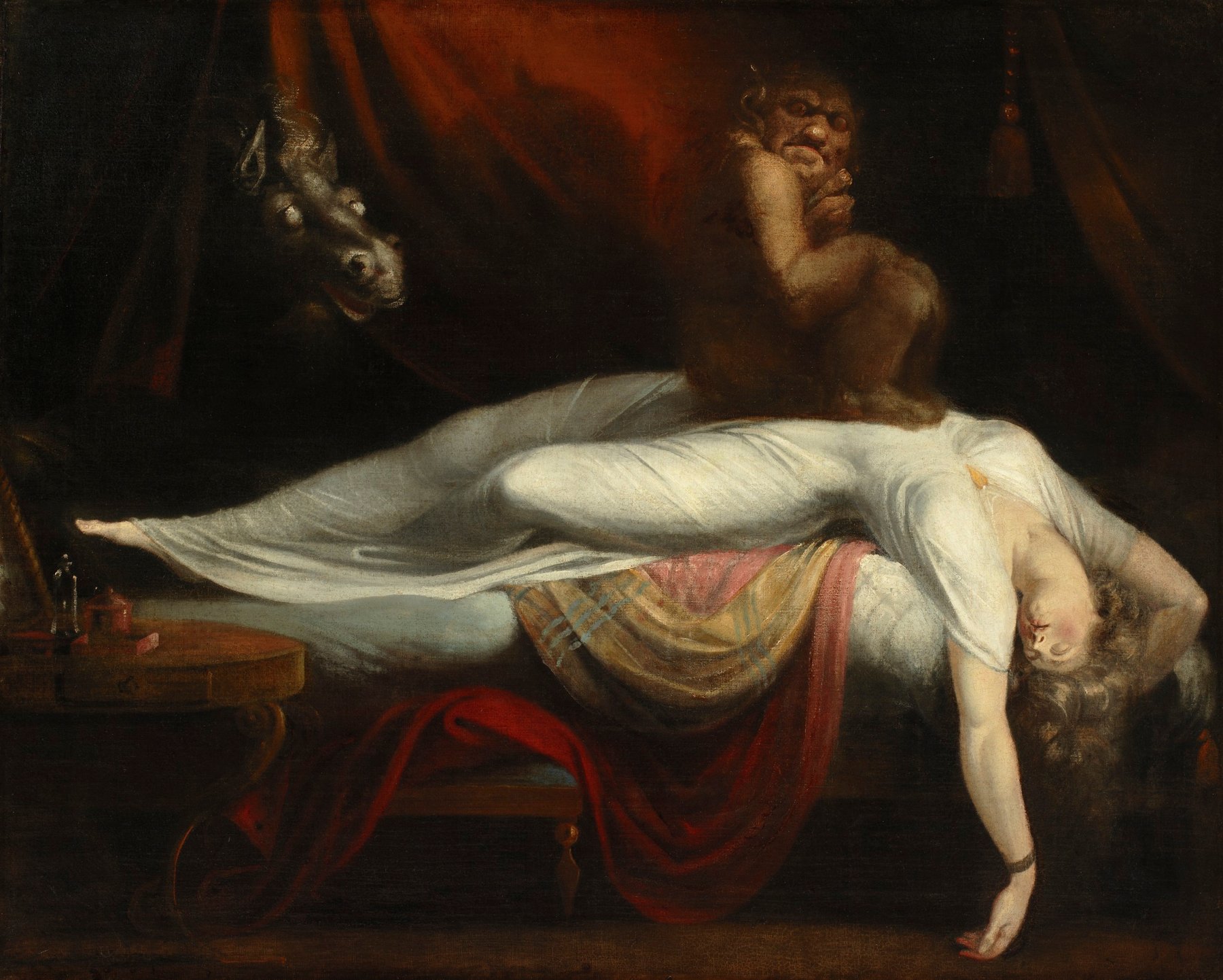
Henry Fuseli, 1781 (Public Domain artwork); photograph via Wikimedia Commons, CC BY 2.5
Roughly one in ten people will experience sleep paralysis at least once — a brief period, usually seconds to a couple of minutes, of being conscious but completely unable to move, often accompanied by a sense that something is in the room. It’s a well-documented neurological event with a specific, understood mechanism. It’s also one of the most consistent sources of “something was in my room” reports across completely unrelated cultures, over centuries, long before anyone had the vocabulary of REM sleep to explain it.
What’s Actually Happening in the Body
During REM (rapid eye movement) sleep, the stage most associated with vivid dreaming, the brain deliberately paralyzes most of the body’s voluntary muscles — a state called REM atonia. It’s a protective mechanism: without it, people would physically act out their dreams. Sleep paralysis occurs when a person’s consciousness resurfaces to waking awareness before that muscle paralysis has fully lifted. The result is a person who is genuinely awake, aware of their surroundings, and unable to move or speak for a period that typically resolves on its own within a minute or two, though it can feel much longer while it’s happening.
This isn’t a rare or exotic disorder. Meta-analysis research puts the prevalence of recurrent isolated sleep paralysis at roughly 8% in the general population, rising to around 28% among students and higher still — around 35% — in psychiatric populations with various diagnoses, likely reflecting the role sleep disruption and irregular sleep schedules play in triggering episodes. It’s also strongly associated with sleep deprivation, irregular sleep-wake schedules, sleeping on one’s back, and stress, and it appears at elevated rates in people with narcolepsy, where it’s one of several characteristic symptoms alongside cataplexy and excessive daytime sleepiness.
Why People See Something, Not Nothing
The paralysis itself doesn’t necessarily terrify people. What tends to do that is the second, closely related phenomenon that frequently accompanies it: vivid, often threatening hallucinations, which research estimates occur in about 75% of sleep paralysis episodes. These aren’t random. Sleep researchers generally sort them into three recurring categories:
Intruder hallucinations — the sense, often visual, of a menacing presence or figure in the room, sometimes standing at the foot of the bed or in a doorway, sometimes felt rather than clearly seen.
Incubus hallucinations — a feeling of heavy pressure on the chest, sometimes accompanied by a sensation of being pinned down or suffocated, historically the basis for the term “incubus” itself.
Vestibular-motor hallucinations — sensations of floating, flying, spinning, or falling, or the feeling of leaving one’s own body, distinct from the other two categories but reported in the same episodes.
The intruder and incubus categories frequently occur together and are what generate most of the folklore-adjacent reports: a sensed presence combined with physical pressure produces an experience that reads, in the moment, exactly like being deliberately held down by something in the room. Researchers studying the neurology behind this have proposed that the “sensed presence” specifically may relate to disrupted activity in brain regions — including structures involved in mirror-neuron function and body-position awareness — that normally help distinguish self from other; when that system misfires during a state of paralysis and heightened threat-vigilance, the brain appears to generate the unmistakable impression of another agent in the space, even though no one else is there.
Why the Figure Feels Threatening, Not Neutral
One of the more consistent findings across sleep paralysis research is that the hallucinated presence is almost never perceived as friendly or neutral. Researchers point to the state’s underlying neurochemistry: sleep paralysis occurs during a moment of genuine physical helplessness combined with heightened amygdala activity, the brain region central to fear response, which is already unusually active during REM sleep. A brain that is simultaneously immobilized, threat-primed, and trying to make sense of an ambiguous sensation of “something else is here” defaults toward interpreting that presence as dangerous rather than benign — consistent with how fear and threat-detection systems generally work when the brain lacks clear sensory information and needs to fill the gap quickly.
Cultural expectation almost certainly shapes the specific content of what people report seeing, without being the underlying cause of the paralysis or the hallucination itself. Someone who has grown up hearing about a specific supernatural intruder is more likely to interpret an ambiguous sensed presence in those particular terms than someone with no such frame of reference — the same way expectation can shape the details people report in other modern folklore contexts, even when the underlying perceptual experience is the same across observers.
The Old Hag, the Mare, and Kanashibari
What makes sleep paralysis unusual as a phenomenon is how independently and consistently different cultures developed remarkably similar explanations for it, long before anyone understood REM sleep.
In Newfoundland, the experience became specifically associated with “the Old Hag” — a malevolent presence said to sit on a sleeper’s chest, and the folk term “hag-ridden” for the experience became widespread enough in the region that researchers studying the phenomenon in the 1980s adopted “Old Hag syndrome” as a working descriptive label in some of the early medical literature on the subject, connecting a regional folk term directly to a clinical phenomenon.
In medieval and early modern Europe, a similar experience was attributed to the “mare,” a spirit believed to sit on or “ride” a sleeping victim — the etymological source of the English word “nightmare,” which originally referred specifically to this kind of chest-pressure night visitation rather than to bad dreams generally. Variations of the mare figure recur across Germanic, Scandinavian, and Slavic folklore under related names.
In Japan, the experience is called kanashibari, meaning roughly “bound” or “tied up,” a term that describes the paralysis itself directly rather than naming a specific attacking figure, though it’s sometimes folded into broader yūrei (vengeful spirit) tradition in popular retellings.
These are worth treating as genuinely separate folk traditions that independently converged on similar explanations for the same underlying neurological experience — not proof of one continuous ancient tradition passed between cultures, and not proof that the traditions are simply “the same story” wearing different names. The consistency is in the biology and the resulting experience, not in a shared cultural lineage.
The Historical Incubus and Succubus Connection
Henry Fuseli’s 1781 painting The Nightmare*, one of the best-known artistic depictions of the incubus and “mare” folklore later connected to sleep paralysis. Source. Public domain artwork; photograph via Wikimedia Commons, CC BY 2.5.*
Medieval and early modern European accounts of incubi and succubi — demons said to assault sleepers, sometimes with explicitly sexual content — plausibly describe sleep paralysis episodes involving incubus-type hallucinations, interpreted through a specific theological framework that already had a ready explanation for unexplained nighttime assault by a malevolent entity. This connection should be stated carefully rather than as settled fact: it’s a reasonable, widely proposed explanation for at least some historical incubus/succubus testimony, not a retroactive diagnosis of every such account across centuries of religious and legal history, some of which involved other social, psychological, and coercive dynamics that a purely medical explanation doesn’t fully account for.
Distinguishing This From “Shadow People” as a Broader Phenomenon
Sleep paralysis with intruder or incubus hallucinations is a specific, well-defined medical phenomenon tied to a particular sleep state. It’s worth keeping separate from the broader modern “shadow people” phenomenon, which describes peripheral, often fleeting figure sightings reported during ordinary waking states as well as during sleep-related events, and which draws on a wider, more recently assembled set of internet-era folklore and reporting conventions. The two overlap — sleep paralysis is one plausible explanation for some shadow-figure reports — but they’re not simply the same thing under two names, and treating every dark-figure sighting as sleep paralysis would be its own kind of oversimplification.
When Recurrent Sleep Paralysis Is Worth a Medical Conversation
Occasional sleep paralysis, especially tied to an identifiable trigger like sleep deprivation, jet lag, or an irregular schedule, generally isn’t considered a medical emergency and often resolves with better sleep hygiene. It’s reasonable to bring it up with a doctor when episodes are frequent, significantly distressing, interfering with willingness to sleep at all, or occurring alongside other symptoms — particularly excessive daytime sleepiness, sudden muscle weakness triggered by strong emotion (cataplexy), or vivid hallucinations at sleep onset — since that combination can point toward narcolepsy, a distinct and treatable sleep disorder rather than isolated sleep paralysis on its own. This is a description of when evaluation is reasonable, not a diagnostic checklist; a sleep specialist, not an article, is the right source for an actual assessment.
Frequently Asked Questions
What causes sleep paralysis? It occurs when a person regains conscious awareness while the muscle paralysis (atonia) that normally accompanies REM sleep hasn’t fully lifted yet, leaving them awake but temporarily unable to move.
Why do people see a demon or intruder during sleep paralysis? Vivid, often threatening hallucinations accompany roughly three-quarters of episodes. Researchers link the “sensed presence” and menacing quality to heightened amygdala activity and disrupted self/other perception during a state of physical helplessness, which the brain tends to interpret as dangerous rather than neutral.
Is sleep paralysis dangerous? No. It’s frightening but not physically harmful, and episodes typically resolve on their own within seconds to a couple of minutes.
What is Old Hag syndrome? A folk term from Newfoundland for the sleep paralysis experience, later adopted informally in some sleep-research literature to describe the chest-pressure, sensed-presence variant of the phenomenon.
Is sleep paralysis linked to narcolepsy? It can be. Recurrent sleep paralysis alongside excessive daytime sleepiness, cataplexy, or vivid hallucinations at sleep onset is a pattern worth discussing with a doctor, since it may indicate narcolepsy.
Are the Old Hag, the mare, and kanashibari the same legend? They describe the same underlying neurological experience but developed as separate folk traditions in different cultures, rather than one legend that spread between them.
Is sleep paralysis the same as seeing shadow people? Not exactly. Sleep paralysis is a specific, medically defined event tied to REM sleep. “Shadow people” is a broader, more recent umbrella term for peripheral figure sightings that can occur in a wider range of circumstances, sleep paralysis being one plausible explanation among several.
Can medication or lifestyle changes help? Improving sleep regularity, reducing sleep deprivation, and addressing underlying stress are commonly recommended first steps. Frequent or severe cases warrant evaluation by a sleep specialist rather than self-treatment.


,_The_Nightmare,_1781.jpg)