The Index / Paranormal
Black-Eyed Children Explained: How a 1990s Encounter Became an Internet Urban Legend
Brian Bethel's 1996 Abilene encounter became the template for the Black-Eyed Children legend. Here's what the earliest record says and what later retellings added.
Topics: Black Eyed Children, Brian Bethel, Urban Legend, Internet Folklore, Paranormal
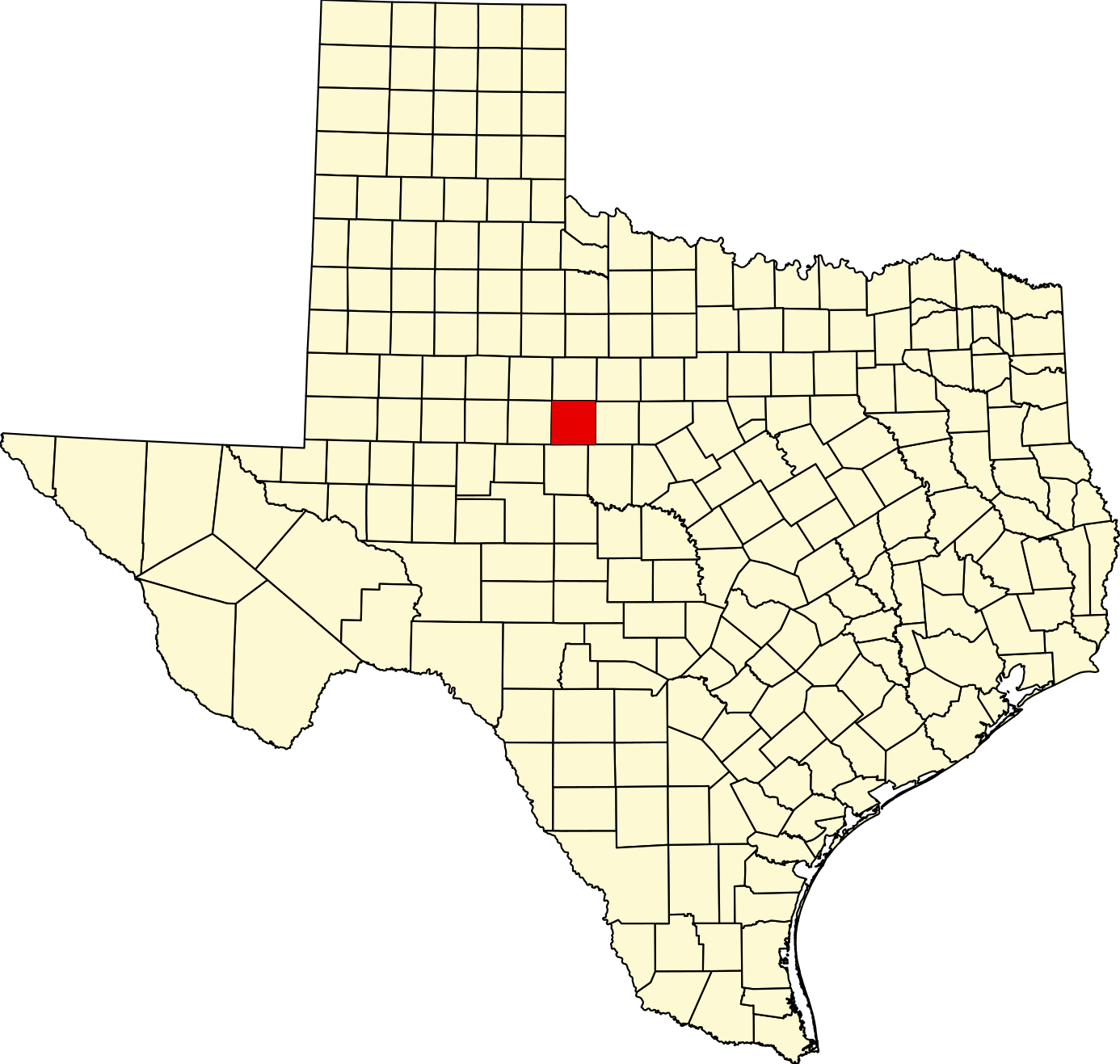
David Benbennick, Wikimedia Commons (Public Domain)
The Black-Eyed Children are a modern legend with an unusually traceable paper trail.
The best-documented starting point is not an old folktale or a nineteenth-century newspaper. It is Brian Bethel’s account of an encounter he said happened in Abilene, Texas, in 1996, circulated on an internet ghost-discussion list in January 1998.
That distinction matters. Bethel’s story is a first-person claim, not a verified paranormal case. But because the surviving text is early, specific and dateable, we can compare what he actually wrote with the much larger mythology that developed afterward.
What Brian Bethel actually wrote
A later Google Groups archive preserves a repost of Bethel’s early messages. The first carries the subject line “Those Darned Black-Eyed Kids” and a header dated January 16, 1998.
In that account, Bethel said the encounter itself had happened roughly two years earlier. He described sitting in his car near a movie theater in Abilene while writing a check for his internet provider. Two boys approached the driver’s-side window and asked for a ride so they could get money for a movie.
Bethel wrote that the conversation felt wrong before he noticed anything unusual about their eyes. He described the older boy as unusually composed and insistent. When he finally looked closely, he said both boys’ eyes appeared completely black.
The story becomes more important for folklore history at the point where the boys press him to open the car.
Bethel’s surviving text already contains the demand “You have to LET US IN.” That means the later invitation motif did not appear from nowhere. It is present in the early account.
What the original message does not establish is the stronger supernatural rule common in later retellings: that Black-Eyed Children are literally incapable of crossing a threshold unless somebody grants permission. The early story describes insistence on being let into a car. Later versions turn that detail into something closer to a fixed vampire-like rule.
The original was a mailing-list story, not a police case
The surviving header is useful because it corrects a detail that is often blurred in summaries.
Bethel’s January 1998 message was addressed to a ghost-discussion email list. Copies and later reposts circulated through early internet paranormal spaces, including Usenet archives, which is one reason the mailing-list and newsgroup histories are often collapsed together.
That internet trail should not be confused with independent corroboration of the 1996 encounter.
There is no contemporaneous police report, photograph, medical record or physical evidence attached to Bethel’s claim. The earliest traceable evidence is the story itself.
Bethel continued to stand by the account in later years, including in a retrospective for the Abilene Reporter-News. Consistency is relevant when documenting what a witness claims, but it does not convert a personal account into proof of a supernatural event.
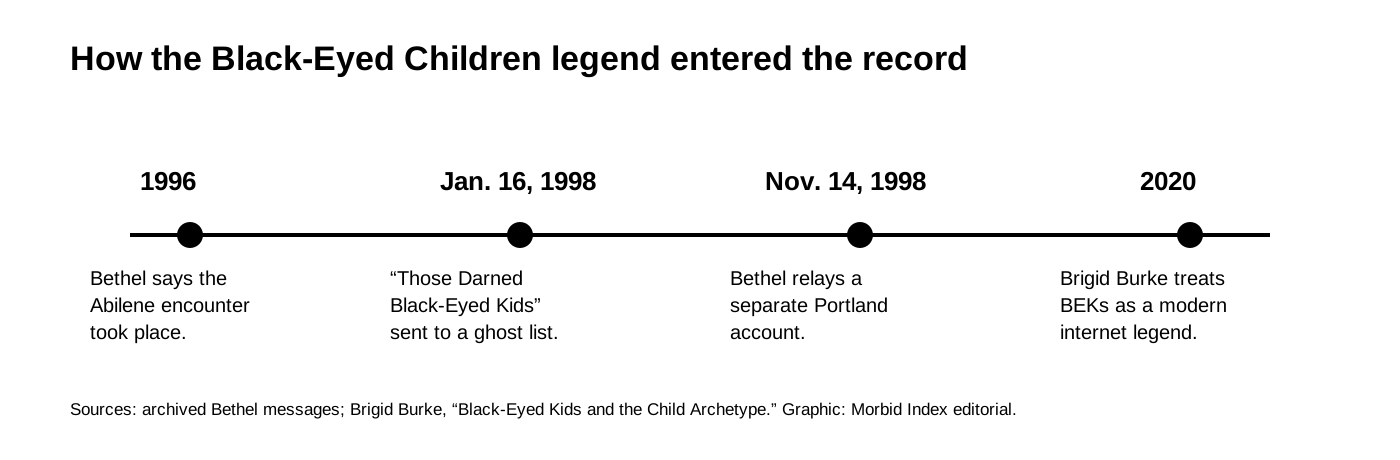
The traceable record separates the claimed 1996 encounter from the dates when the story actually entered circulation. Graphic: Morbid Index editorial.
The Portland story came later in the same 1998 trail
The same archive preserves another Bethel message dated November 14, 1998.
In it, he told readers that a trusted acquaintance had described a separate encounter in Portland, Oregon, and he reposted his own earlier story for context.
That distinction is important. The Portland episode is not independent evidence collected by an outside investigator. It reaches the surviving record through Bethel, months after his own story had already circulated.
It is still part of the legend’s early history, but it should be described as a second account relayed by Bethel, not as confirmation that an unknown class of beings had been independently documented in two cities.
From one story to an internet legend
Folklore researcher Brigid Burke treats Black-Eyed Kids as a modern legendary figure that emerged online. In her chapter on the subject in The Cultural Construction of Monstrous Children, she notes that detailed, consistent accounts are difficult to establish before the late 1990s and that Bethel’s story is commonly acknowledged as the first BEK story to appear on the internet.
That makes the Black-Eyed Children different from a legend whose origin has disappeared into centuries of oral tradition.
Here we can watch features accumulate.
The early story already gives us several elements that became central:
- children or young teenagers at night;
- an ordinary request for help;
- insistence on entering a private space;
- intense fear reported by the witness;
- eyes described as completely black.
Later stories standardized additional details: children at front doors, repeated requests to use a phone or bathroom, old-fashioned clothing, physical sickness after encounters, pets reacting badly, and increasingly elaborate ideas about what happens if somebody lets them inside.
Those later motifs are part of the folklore. They are not automatically evidence about what happened in Abilene.
Did Black-Eyed Children exist before Bethel’s story?
Claims of older encounters circulate online, sometimes pushing the phenomenon back into the 1980s, the 1970s or even earlier.
The problem is documentation.
Burke notes that there are claims of older stories but few consistent, detailed accounts before the late 1990s. That is a more careful conclusion than saying nobody anywhere ever told a remotely similar story before 1998.
Children who behave strangely, uncanny visitors, dangerous strangers at the door and supernatural beings who need permission to enter are all older motifs.
What is difficult to document before Bethel is the specific modern package now called Black-Eyed Children: childlike visitors, completely dark eyes, an ordinary request for access, escalating unease and the late-1990s internet circulation that gave the phenomenon its name and recognizable form.
The invitation rule was simplified in later retellings
One of the most repeated claims says Black-Eyed Children cannot enter unless they are invited.
The earliest surviving Bethel text is subtler.
His speaker insists that Bethel must let them into the car. That is already a threshold-and-permission scene. But the story never demonstrates a supernatural barrier preventing them from entering without consent.
Later storytellers turned an unsettling request into a rule.
That process is common in living folklore. Ambiguous narrative details become memorable rules because rules are easy to repeat: don’t answer, don’t invite them in, don’t look into their eyes.
The comparison to vampire fiction is obvious, but resemblance is not proof of direct descent from historical vampire belief.
Could ordinary eyes look completely black?
There is no medical evidence in the case because nobody examined the children Bethel described.
It is also important not to overstate what mydriasis, or pupil dilation, can explain.
Medical sources such as Cleveland Clinic note that pupils naturally enlarge in dim light, and can also dilate because of drugs, medications, stress and medical conditions. A large pupil can make the dark center of the eye look much more prominent.
But pupil dilation does not turn the white sclera black.
So “their pupils were simply dilated” is not a complete scientific explanation for Bethel’s description of eyes with no visible white or iris. At most, darkness, viewing angle, distance, fear and memory could have affected what he thought he saw. The event cannot now be tested.
That leaves several ordinary possibilities — misperception, memory distortion, deliberate performance, unusual contact lenses or an invented story — but the surviving evidence is not strong enough to select one confidently.
The responsible conclusion is narrower: the record does not establish a supernatural being.
Why the story works so well
Black-Eyed Children combine two kinds of fear that are usually kept apart.
Children are expected to signal vulnerability. A stranger at a car window or front door signals uncertainty. Put the two together and the witness faces a social trap: somebody who appears to need help also feels threatening.
The black eyes then provide a visual confirmation that something is “wrong.”
Burke’s academic treatment places BEKs within the larger cultural tradition of monstrous children — figures that turn ideas about innocence, danger and trust against the audience.
The internet amplified that structure perfectly. A first-person story could be copied without losing its confessional tone, then surrounded by new first-person stories written in the same pattern.
Black-Eyed Children are not an ancient vampire species
Modern retellings sometimes fold BEKs into vampires, demons, aliens, changelings or Men in Black.
Those comparisons can be useful when discussing motifs. They are not genealogies.
There is no documented historical chain showing that Black-Eyed Children are an old vampire tradition under a new name, nor evidence that the legend descends directly from changeling belief or UFO-era Men in Black reports.
A better comparison is Slender Man: both show how a modern figure can acquire variants, rules and supposed eyewitness accounts after its public origin is already visible.
The difference is that Slender Man began as deliberate fiction. Bethel has consistently presented his story as an experience he believed happened.
Folklore can grow from either kind of starting point.
Frequently Asked Questions
Are Black-Eyed Children real?
There is no verified physical evidence establishing supernatural Black-Eyed Children. The modern legend is built from first-person claims and later retellings.
Who first reported Black-Eyed Children?
Brian Bethel’s account is the earliest well-documented version of the modern internet legend. He said the encounter happened in Abilene in 1996 and circulated the story on a ghost-discussion list in January 1998.
Was the original story posted in 1996 or 1998?
The claimed encounter was in 1996. The surviving message carrying Bethel’s story is dated January 16, 1998. Confusing the event date with the publication date is one reason online timelines disagree.
Did the original children ask to be invited in?
Yes, in a limited sense. Bethel’s 1998 text says the boys insisted he had to let them into the car. What came later was the stronger folklore rule that they are supernaturally unable to enter any home or vehicle without permission.
Was there a second early encounter in Portland?
Bethel circulated a November 1998 message describing an account from a trusted acquaintance in Portland. It is part of the early tradition, but it entered the record through Bethel rather than through an independent investigation.
Can dilated pupils make someone’s whole eyes black?
Dilated pupils can make the dark center of the eye much larger, especially in dim light. They do not make the white sclera black. No medical examination exists for Bethel’s claimed encounter, so the appearance he described cannot be reconstructed.
Did Black-Eyed Children exist before the 1990s?
Older uncanny-child and dangerous-visitor motifs certainly exist. But academic discussion finds few consistent, detailed Black-Eyed Children accounts before the late 1990s, and Bethel’s story is commonly treated as the first internet version of the modern legend.
Are Black-Eyed Children vampires?
There is no documented historical lineage connecting BEKs to vampire tradition. The invitation motif resembles vampire fiction, but similarity is not evidence that the legends are the same tradition.
Sources & further reading
- Google Groups archive: 2001 repost containing Brian Bethel's January 16 and November 14, 1998 Black-Eyed Kids messages
- Brigid Burke, 'Black-Eyed Kids and the Child Archetype,' in The Cultural Construction of Monstrous Children (Anthem Press, 2020)
- Brian Bethel retrospective, Abilene Reporter-News (archived copy)
- Atlas Obscura: Black-Eyed Children — The 1990s Texas Urban Legend
- Cleveland Clinic: Dilated Pupils (Mydriasis)
- Cleveland Clinic: Pupillary Light Reflex
- Wikimedia Commons: Map of Texas highlighting Taylor County.svg (Public Domain)