Lore & Explained
Tanuki Explained: The Raccoon Dog, the Magic Tea Kettle and Japan's Shigaraki Statues
Is a tanuki a raccoon? Separate the real Japanese raccoon dog from the shape-shifting yōkai, the Bunbuku Chagama tea kettle tale and the Shigaraki statues.
Topics: Tanuki, Bake-danuki, Bunbuku Chagama, Shigaraki Ware, Yokai, Japanese Folklore
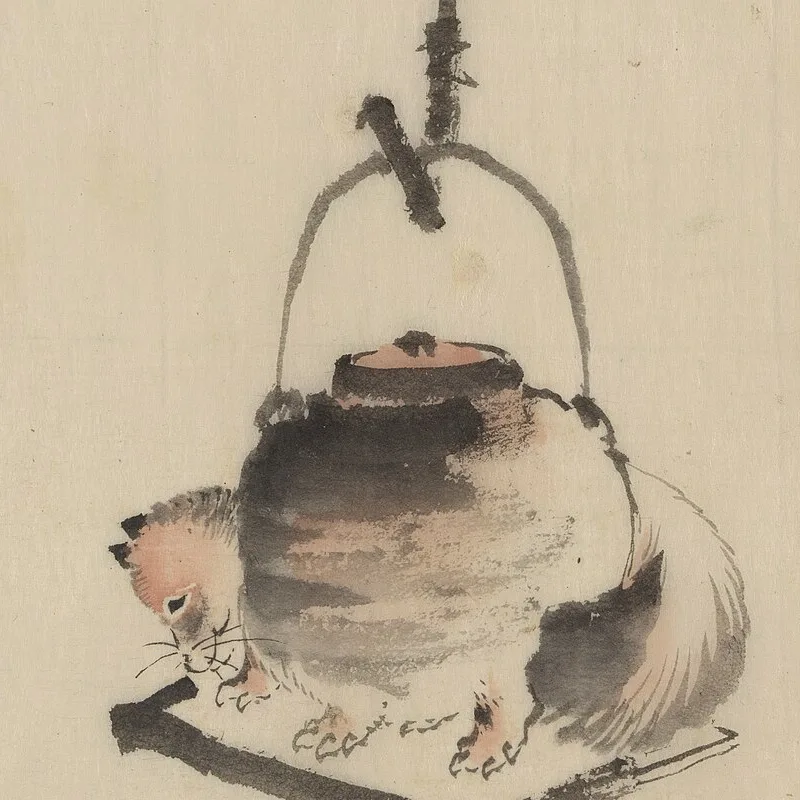
The tanuki is a real animal, the Japanese raccoon dog, and also a shape-shifting trickster of Japanese folklore. The animal is a canid that only looks like a raccoon. The folklore figure, often called a bake-danuki (“transforming tanuki”), turns into other beings and objects, most famously a tea kettle. Today you are most likely to meet it as a glazed ceramic statue with a straw hat and a sake bottle outside a restaurant. This guide separates the animal, the stories and the statues, and says what each source does and does not show.
Is a tanuki a raccoon?
No. The American Society of Mammalogists’ Mammal Diversity Database lists the Japanese raccoon dog as Nyctereutes viverrinus (described by Coenraad Temminck in 1839), also known as the tanuki, and places it in the dog family, Canidae, in the tribe that includes the foxes. It records Japan as the animal’s distribution and notes that the species was formerly classified as Nyctereutes procyonoides, the common raccoon dog. The database lists its IUCN Red List status as “Not Evaluated” under this species name. It only looks like a raccoon: as a canid it belongs to a different family.
Keeping the animal and the yōkai apart helps. Nothing about the real tanuki’s biology explains the folklore, and nothing in the folklore describes the animal’s biology.
What do the oldest texts say about shape-shifting?
The best-known early entry is in the Nihongi. In W. G. Aston’s English translation, the entry for A.D. 627, the thirty-fifth year of Empress Suiko, spring, second month, reads: “In the province of Michinoku there was a mujina which changed into a man and sang.” Aston’s footnote glosses mujina as “a kind of badger.”
That footnote matters. The passage is often cited as the earliest shape-shifting tanuki story, but the animal word in the text is mujina, and Aston reads it as a badger. It is better described as an early written example of the belief that a wild animal can take human form. For the better-documented fox tradition, see our guide to kitsune.
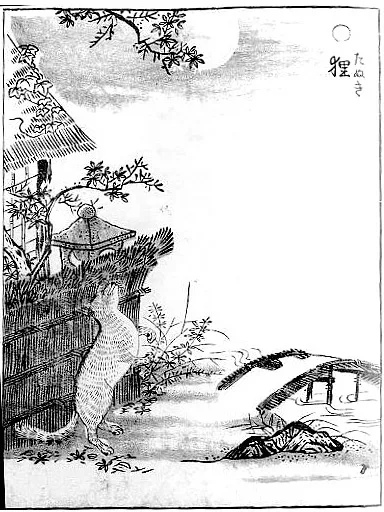
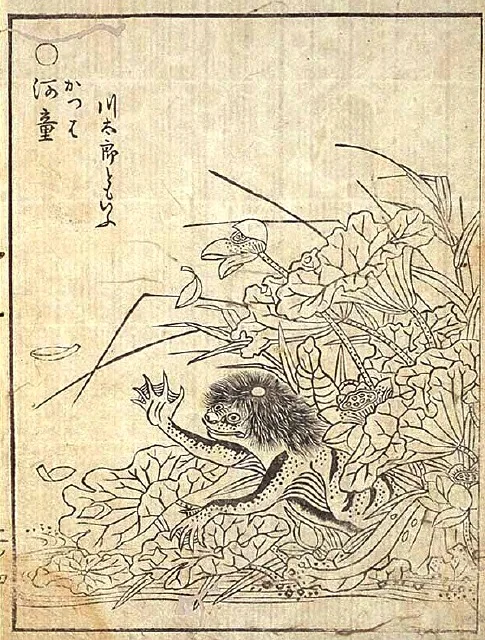
A tanuki by Toriyama Sekien (1712–1788), who gave many yōkai their standard pictures. Source. Public domain. Converted to WebP.
What happens in Bunbuku Chagama?
The folktale is known in Japan as Bunbuku Chagama, “the magic tea kettle.” The Government of Japan’s Public Relations Office retells it like this. A poor man who runs an antique store finds a tanuki caught in a trap and frees it. That night the tanuki visits to thank him and offers to turn itself into a tea kettle that the man can sell to the temple priest. The priest buys it, but when a novice scrubs the kettle in the river it cries out, “You’re hurting my bottom!” When the priest puts it on the fire, the tanuki shrieks that it is hot, half transforms and runs home.
The tanuki then proposes a show: a tea kettle that walks a tightrope, drums its belly and sings. The act draws crowds and makes the man wealthy. The tanuki, however, stays in kettle form and eventually loses its ability to move. It is returned to the priest and kept as a temple treasure.
Folktales have many versions, so treat this as one authoritative telling and not the only one.
What is the connection to Morinji temple?
Morinji, a Sōtō Zen temple in Tatebayashi, Gunma Prefecture, is closely associated with the story. A tourism guide to Gunma Prefecture says the temple is traditionally dated to 1426 and that its own legend differs from the folktale. According to that temple tradition, a monk named Shukaku lived at Morinji in the Ōei era (the fifteenth century) and served tea from a kettle that never ran out of hot water. Other monks one day saw Shukaku asleep and noticed a tanuki’s tail. He was said to be a very old tanuki who had heard the Buddha’s teachings in India and traveled through China before reaching Japan. When he left, he is said to have conjured visions of famous scenes from the past.
The same guide describes the kettle kept at the temple as made of a purple-gold copper alloy, about 21 liters in capacity and about 11 kilograms in weight, and says that twenty-one Shigaraki-ware tanuki statues line the path from the gate. Sekien drew the temple’s kettle in the eighteenth century.
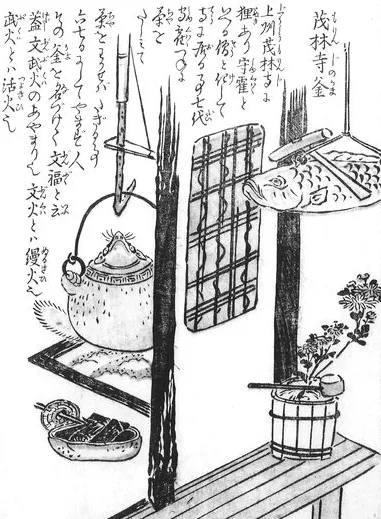
Toriyama Sekien’s “Morinji no kama,” the temple’s tanuki kettle, from the Konjaku Hyakki Shūi. Source. Public domain. Converted to WebP.
Why are there so many ceramic tanuki?
Most of them are Shigaraki-yaki, pottery from Shigaraki in Shiga Prefecture, one of Japan’s Six Ancient Kilns. The Government of Japan’s Highlighting Japan magazine reports the account of the managing director of Shigaraki Touen Tanuki Village that the statues began to be made in Shigaraki around 1900, when the town’s pottery was mostly practical wares such as teapots, storage pots and flowerpots, and that the first ones were said to be made for fun by one of the town’s potters.
The same article gives several reasons they spread. The fine, sticky Shigaraki clay is suited to modeling faces. The word tanuki can be read as a pun on ta o nuku, “to pull ahead of others,” which made the animal a charm for competition and business. And in 1951, when Emperor Hirohito (posthumously Emperor Shōwa) visited Shigaraki, he was reported to have composed a poem about the statues lined up along the road, after which they became widely known as auspicious objects. They now stand at the doors of restaurants, inns and shops.
The magazine lists eight auspicious features, the hasso engi, that a Shigaraki tanuki is believed to carry:
| Feature | Meaning given |
|---|---|
| Bamboo hat (kasa) | Protection from misfortune |
| Smile | Comforting behavior |
| Large eyes | Keen observation of one’s surroundings |
| Belly | Calmness and strong decisiveness |
| Sake bottle (tokkuri) | Acquiring virtue and never lacking food or drink |
| Bankbook | Trustworthiness |
| Tail | Valuing the end of things; all’s well that ends well |
| Money pouch | Financial good fortune |
The article also notes that Shigaraki tiles were used for part of the Black Sun on the Tower of the Sun at the 1970 Osaka Expo.
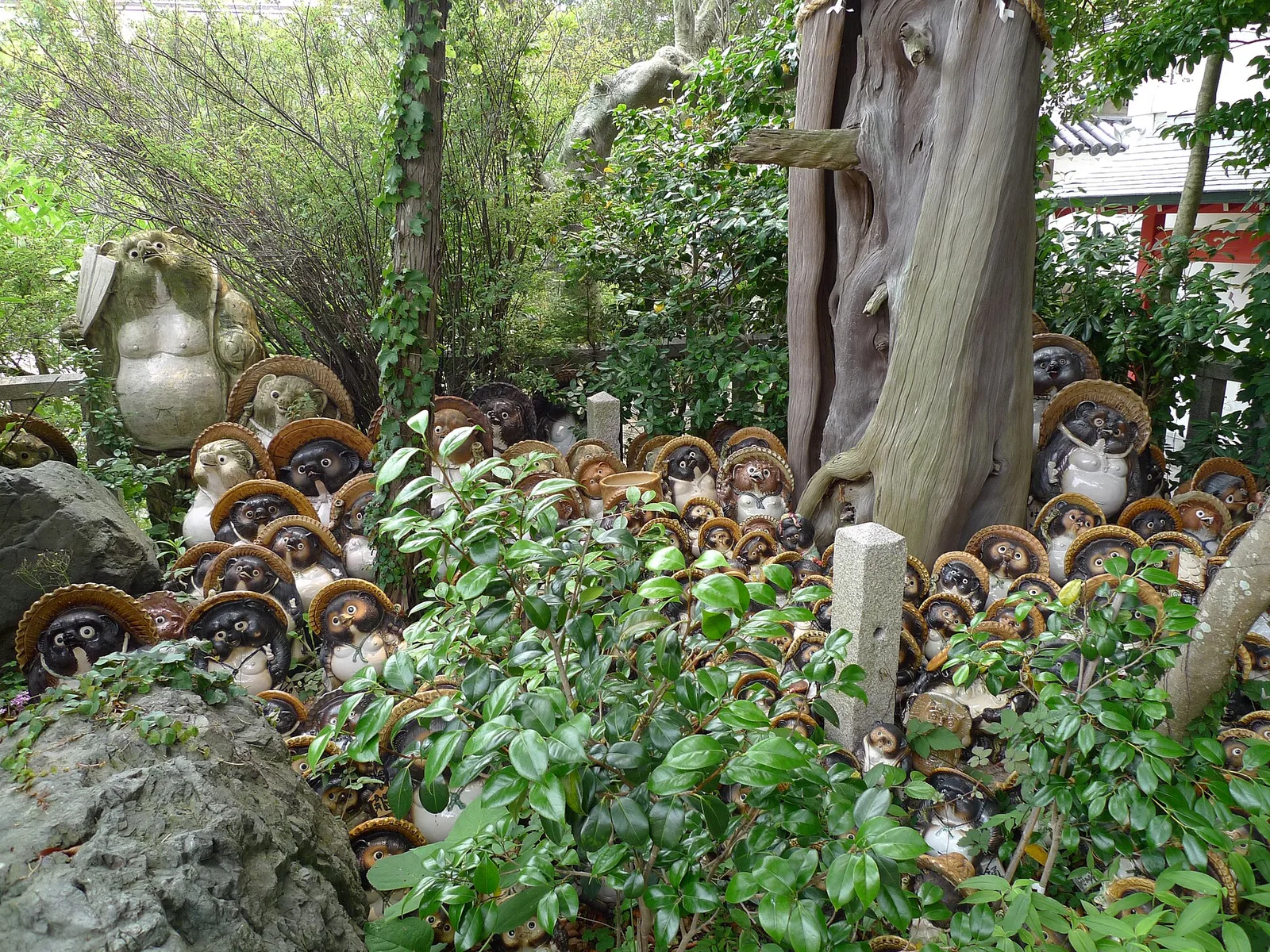
Shigaraki-ware tanuki statues at Awashima Shrine. Photograph by Motokoka, 2009. Source. CC BY-SA 4.0. Resized and converted to WebP.
How should you read tanuki stories?
- Keep three things apart: the animal, the folktales and the good-luck statues. Each has its own history.
- Be careful with “oldest.” The Nihongi entry uses mujina, which Aston translates as badger, so it is evidence for a belief in animal transformation and not a verdict on tanuki specifically.
- Expect variants. The folktale and the Morinji temple legend are related but different stories.
- Prefer sources that say where a claim comes from. The Shigaraki account above is attributed to the kiln complex’s managing director, and the 1951 poem is described as “reported.”
For the wider world of Japanese monsters, see our field guide to yōkai. The tanuki also appears among the many creatures in the night parade tradition, and we cover its water-dwelling neighbor, the kappa, separately.
Frequently asked questions
Is a tanuki a raccoon? No. It is a Japanese raccoon dog, a canid in the dog family. The American Society of Mammalogists’ Mammal Diversity Database lists it as Nyctereutes viverrinus, found in Japan.
What does bake-danuki mean? It means a transforming tanuki, the shape-shifting figure of Japanese folklore.
What is Bunbuku Chagama? A folktale about a tanuki that turns into a tea kettle to repay a man who freed it. The Morinji temple in Gunma Prefecture has its own related legend and keeps a kettle associated with it.
Why are tanuki statues placed outside shops and restaurants? They are good-luck charms. According to the managing director of Shigaraki Touen Tanuki Village, tanuki have been regarded as auspicious for a long time, the name can be read as a pun meaning “pulling ahead of others,” and the statues became widely known after Emperor Hirohito’s 1951 visit to Shigaraki.
Is the Nihongi’s shape-shifting animal a tanuki? It is often cited that way, but W. G. Aston’s translation reads the word mujina as “a kind of badger,” so the identification is an interpretation.
Sources & further reading
- American Society of Mammalogists, Mammal Diversity Database: Nyctereutes viverrinus, Japanese Raccoon Dog
- Nihongi: Chronicles of Japan, Book XXII (Empress Suiko), translated by W. G. Aston, on Wikisource
- Public Relations Office, Cabinet Office, Government of Japan, Highlighting Japan: The Magic Tea Kettle (January 2015)
- Public Relations Office, Cabinet Office, Government of Japan, Highlighting Japan: Japanese Good Luck Charm Culture, Shigaraki-yaki Tanuki (March 2026)
- Gunma tourism guide (mytabi.net): Morinji Temple
- International Research Center for Japanese Studies (Nichibunken): The Database of Folktales of Mysterious Phenomena and Yōkai, English overview and glossary
- Michael Dylan Foster, The Book of Yokai: Mysterious Creatures of Japanese Folklore (University of California Press, 2015)