Lore & Explained
Tengu Explained: Japan's Bird Spirits and Long-Nosed Mountain Guardians
Why do tengu have bird faces or long noses? Explore their changing mountain roles, historical masks and the warrior imagery in Japanese prints.
Topics: Tengu, Japanese Folklore, Yokai, Japanese Art
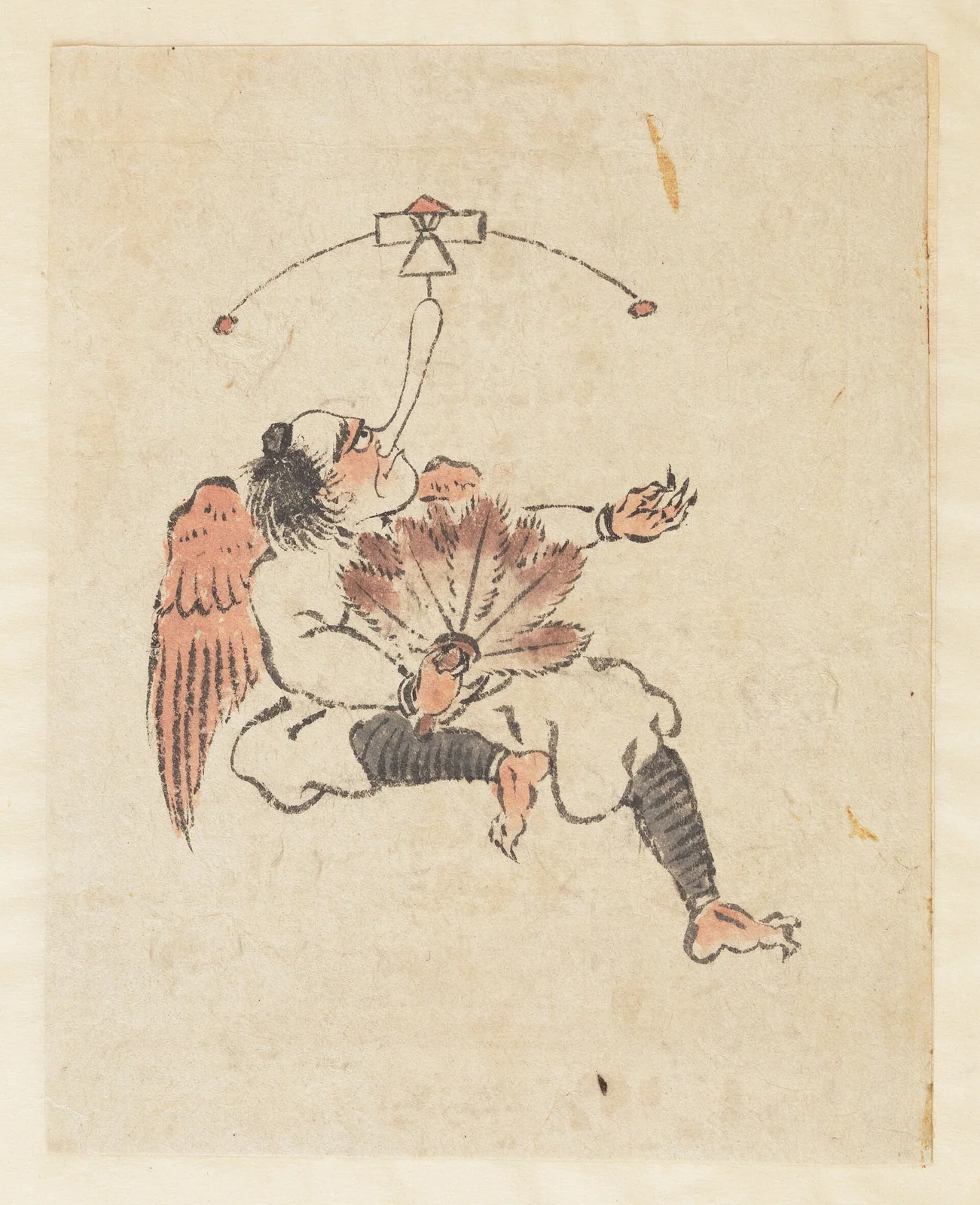
Tengu are supernatural figures associated with Japan’s mountains and woodlands. They appear in both bird-like and long-nosed human forms, and their roles range from dangerous opponents to protective figures. The red face and extraordinary nose are recognizable, but they are only part of the visual history.
To understand a particular tengu, ask what the object or story is doing with it. A mask, a comic drawing and a warrior legend need not present the same personality.
Why do tengu have two different faces?
The Metropolitan Museum of Art’s record for a pair of tengu masks distinguishes the crow-like karasu tengu from the long-nosed konoha tengu. One emphasizes a beak; the other gives a human-looking face an exaggerated projection.
The pair is particularly helpful because the two designs survive together as actual objects. A viewer does not have to imagine a neat sequence in which one form disappeared and another replaced it. Artists could draw on more than one recognizable appearance.
The museum connects tengu with mountain ascetics, martial skills and supernatural abilities. It also notes a shift from disruptive associations with Buddhism toward roles that could be benevolent. That is a history of changing portrayals, not proof that all communities held one belief at the same time.
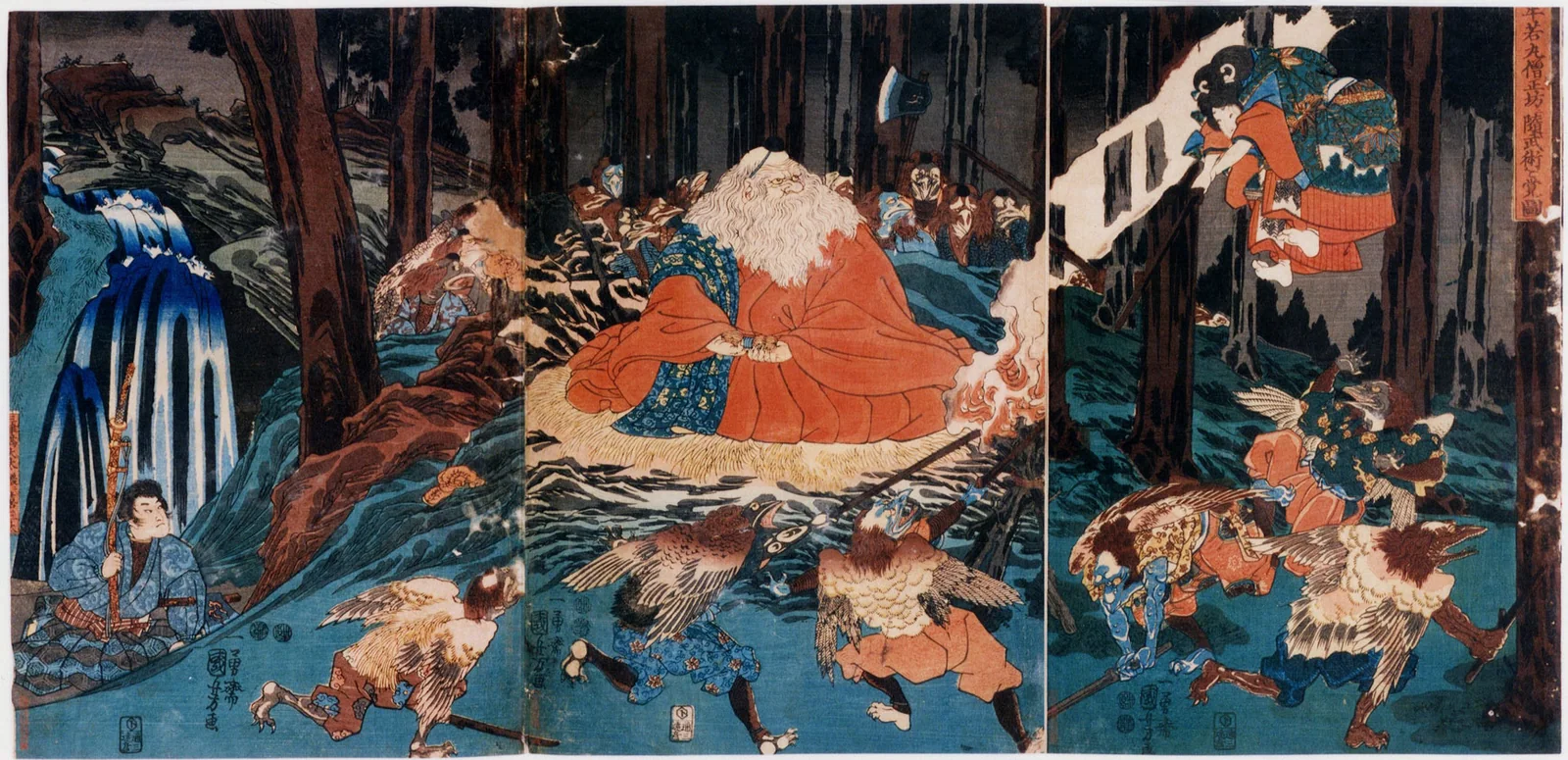
Kuniyoshi’s legendary warrior scene: Ushiwaka among tengu, not a documentary image of Yoshitsune’s life. Source. Utagawa Kuniyoshi. Public domain. Resized and converted to WebP.
What does the Yoshitsune picture show?
Utagawa Kuniyoshi’s print places the young warrior Ushiwaka, the childhood identity of Minamoto no Yoshitsune, among tengu. The scene belongs to the legendary warrior’s supernatural education. Its flying and bird-like figures turn training into something beyond an ordinary lesson.
Read the image as a representation of a legend. It is evidence that the episode was pictured and circulated, not a contemporary record of a historical warrior learning from mountain spirits. That distinction is especially important when a real person’s name sits inside a supernatural story.
The composition also explains the appeal of tengu to artists. Wings, weapons, robes and faces let movement carry the story. They can look formidable while remaining sharply individual. A group of tengu need not resemble a row of interchangeable monsters.
Are tengu demons, gods or yōkai?
No single English label covers every context comfortably. Yōkai is a useful broad term for discussing their place in Japanese supernatural imagery. Demon can describe a hostile role, but it can also import assumptions about Satan, Hell or an entirely evil nature that the particular source does not support.
Compare that problem with oni and Japanese ghosts such as yūrei and onryō. Those names do not designate the same kind of being merely because all appear in horror.
It is more informative to say that a given tengu is an adversary, teacher or guardian in a specific work than to assign the entire tradition one fixed place on a good-versus-evil chart.
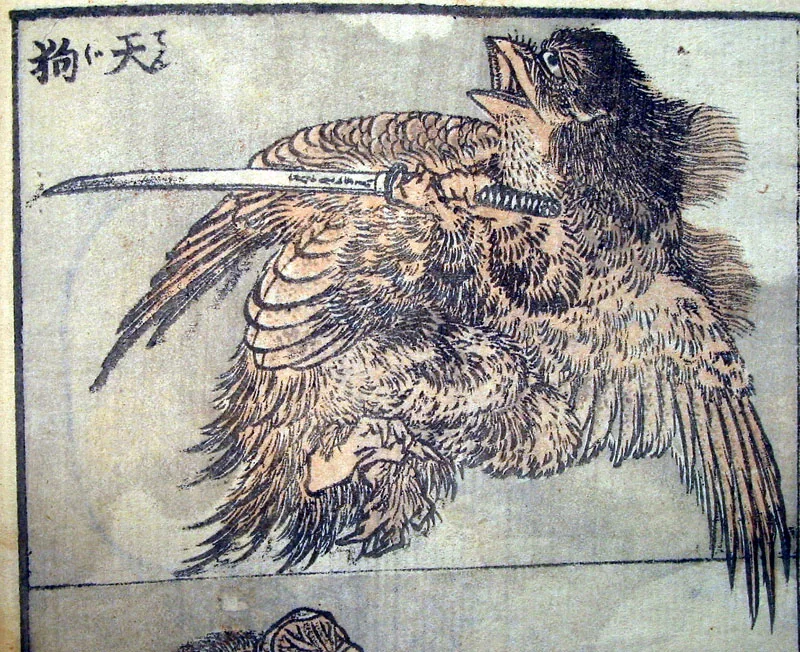
Another Hokusai tengu image demonstrates the range of bird and human features. Source. Katsushika Hokusai. Public domain. Resized and converted to WebP.
Why do some tengu images look funny?
An exaggerated nose or an improbable bird-human body can support humor as readily as fear. The Hokusai pictures reproduced here invite attention to posture and expression, not just to a list of supernatural powers.
That visual range is worth preserving. Modern viewers sometimes expect folklore to supply a definitive monster design. Historical art instead shows people repeatedly interpreting a figure for different purposes and audiences. An amusing drawing is part of that record, even when another work makes the same creature threatening.
How should you compare tengu in modern fiction?
Start with what the adaptation actually borrows: the face, wings, mountain setting, ascetic clothing or martial association. Then identify what the new story adds. A game hierarchy, named faction or precise power system belongs to that game’s world unless a historical source independently supports it.
The same method works for kappa: recognize the traditional motifs, then allow the new work to be a new work. Tengu become more interesting when their variety remains visible.