The Index / Dark History
Winchester Mystery House: The Real Story Behind Sarah Winchester's Endless Mansion
Sarah Winchester spent 36 years renovating her San Jose mansion. The story that she did it on a medium's orders to appease rifle victims has no contemporary evidence behind it.
Topics: Winchester Mystery House, Sarah Winchester, Haunted House, Spiritualism, Dark History
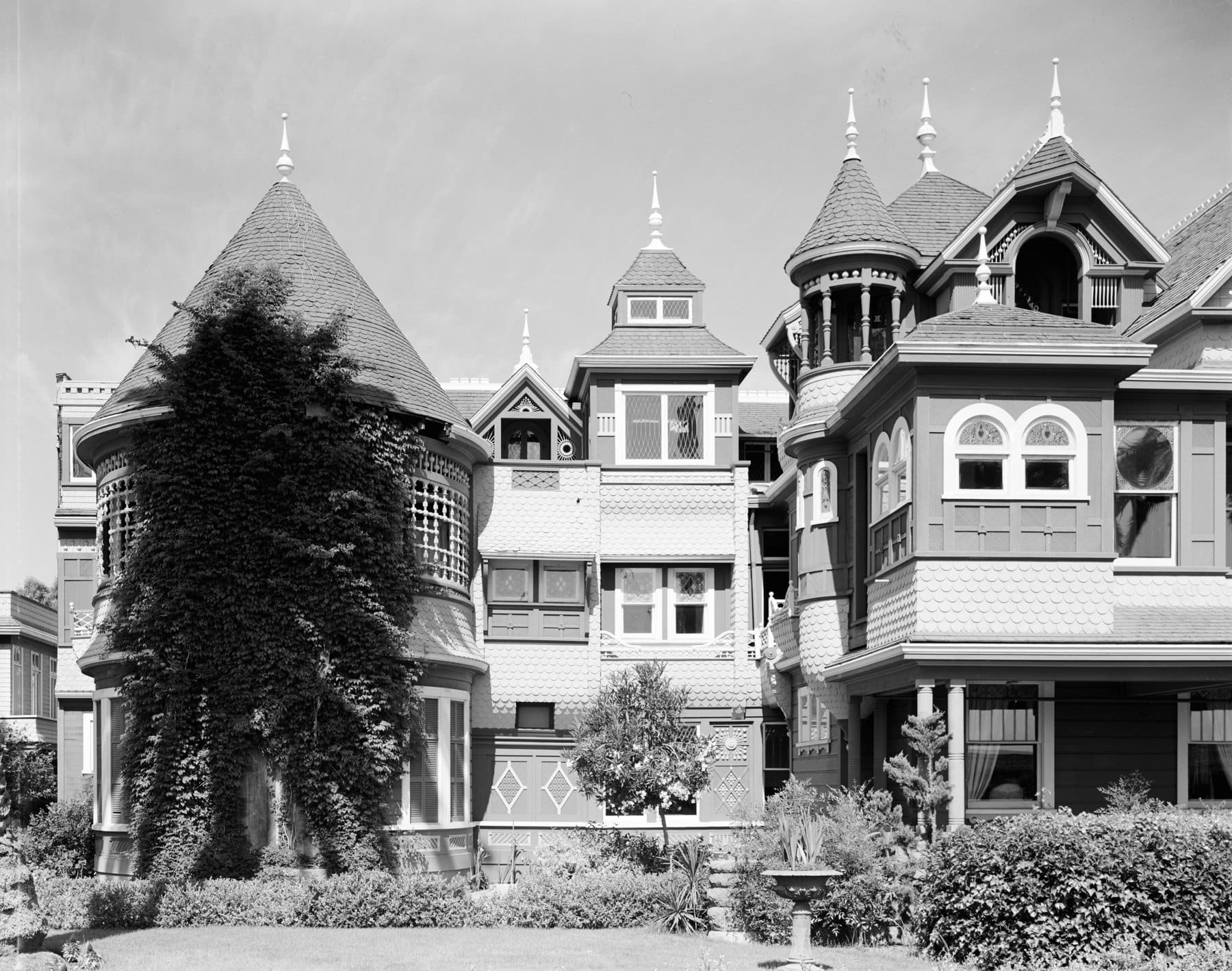
Library of Congress, Historic American Buildings Survey (Public Domain)
Sarah Winchester spent roughly 36 years, from 1886 until her death in 1922, continuously renovating a farmhouse in San Jose, California, into a sprawling Victorian mansion. That part is documented and undisputed. The part usually told alongside it — that a Boston medium instructed her to keep building forever, without pause, to appease the spirits of everyone killed by Winchester rifles, or the house would kill her — has no contemporary source connecting Sarah Winchester to any medium, séance, or spirit-driven construction plan at all. It’s a story that was built, appropriately enough, after she was no longer around to correct it.
Who Sarah Winchester Was
Sarah Lockwood Pardee was born in 1839 in New Haven, Connecticut, and married William Wirt Winchester in 1862. William was the son of Oliver Winchester, founder of the Winchester Repeating Arms Company, maker of the lever-action rifles — including the Model 1873, often marketed as “the gun that won the West” — that built the family’s fortune. The couple’s only child, a daughter named Annie, died in infancy in 1866. William himself died of tuberculosis in March 1881, leaving Sarah roughly half the Winchester family fortune, an inheritance historians have estimated at around $20 million at the time.
Not long after William’s death, Sarah left New Haven and relocated to California. Biographer Mary Jo Ignoffo, whose research is among the more thorough independent treatments of Winchester’s life, points to a combination of ordinary, well-documented factors behind the move: medical advice related to her declining health, fond memories of an earlier trip to San Francisco with her husband, and the broader promotional appeal California held for wealthy Easterners in that era. None of the documented reasoning behind her relocation involves spirits or a medium’s instructions.
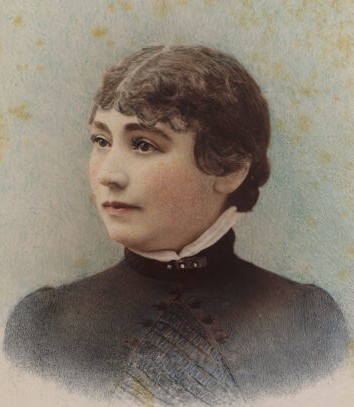
The only known portrait of Sarah Winchester, a hand-tinted ambrotype taken by San Francisco’s Taber Photographic Company in 1865, well before her husband’s death and the house’s construction. Source. Public Domain.
Buying the House and Building for Decades
In 1886, Winchester purchased a 40-acre property in San Jose that included an existing eight-room farmhouse. Renovation and expansion continued without a fixed plan or blueprint for the rest of her life — carpenters reportedly worked in shifts, and additions were made and sometimes altered or removed as her preferences changed. At its largest point, before the 1906 San Francisco earthquake, the house is estimated to have reached roughly 500 rooms. By the time of her death in 1922, after earthquake damage and her own later modifications, the house stood at approximately 160 rooms, along with figures often cited for its doors, windows, staircases, and fireplaces that vary somewhat between sources depending on what’s being counted and when.
What the 1906 Earthquake Actually Did
The San Francisco earthquake of April 1906 caused serious, well-documented structural damage to the house: a seven-story tower collapsed, along with most of the chimneys, and an entire wing including third- and fourth-floor additions was destroyed. Winchester had the wreckage cleared but chose not to rebuild significant portions of what was lost, reportedly relocating her bedroom to a section of the house farther from the damaged area afterward. This earthquake damage, not deliberate design, accounts for a meaningful share of the house’s famous architectural oddities: staircases and doors that open onto blank walls or empty space are, in a number of documented cases, the leftover connection points for sections of the house that the earthquake destroyed and that were never rebuilt.
The Stairs, Doors, and “To Nowhere” Claims
Some of the house’s strange features have straightforward, unmysterious explanations once you look at the documented record rather than the tour-guide version. A staircase with unusually short risers — 44 steps rising only about ten feet in total — is generally explained by Winchester’s declining health and her small stature; shallow steps would have been easier on someone dealing with arthritis and general frailty in her later years, not a design meant to confuse spirits. Some barred or blocked windows were originally exterior windows that became interior features as later additions were built around them, absorbing what used to be an outer wall into the middle of the expanding house. Not every “nowhere” door or window in the house has a fully documented individual explanation, and tourism narratives have unquestionably exaggerated and dramatized some features over the decades — but the earthquake damage and decades of unplanned, piecemeal construction account for the overwhelming majority of what visitors are shown today.
Where the Medium Story Actually Comes From
This is the part worth being precise about, because it’s routinely repeated as settled history. There is no contemporary documentation — no letter, diary entry, newspaper account from Winchester’s lifetime, staff testimony, or estate record — establishing that Sarah Winchester consulted a medium, held séances in the house, or believed she was under any spiritual obligation tied to her family’s firearms business. The specific, detailed version of the story most people know — a Boston medium named Adam Coons instructing her that the spirits of those killed by Winchester rifles required a house built endlessly to house or appease them — traces to Susy Smith’s 1967 book Prominent American Ghosts, published 45 years after Winchester’s death, with no primary sourcing offered for the claim.
Newspapers during Winchester’s own lifetime, beginning around the mid-1890s, had already begun speculating publicly about why a wealthy, reclusive widow was building continuously without an apparent plan — reclusiveness and unexplained behavior from a wealthy woman was, unsurprisingly for the period, more than enough to generate rumor on its own. But the organized, specific “spirits told her to build forever” narrative that visitors hear today took its now-familiar shape well after her death, developed further through decades of tourism marketing. The house became a paid attraction just nine months after Winchester died in 1922, and later management — notably promotional efforts credited to Keith Kittle in the 1970s and 1980s — leaned further into the haunted framing as a business strategy, including billboard advertising that implied visitors might personally encounter a ghost.
Victorian Spiritualism, in Context
It’s worth noting that the historical backdrop makes the myth’s staying power understandable even without evidence: Spiritualism, the religious and cultural movement centered on the belief that the living could communicate with the dead through mediums, was genuinely widespread and socially respectable among wealthy Americans in the decades Winchester lived through, practiced openly by public figures across the country. A wealthy widow building an idiosyncratic house was an easy target for that particular cultural narrative regardless of whether she herself had any documented involvement in Spiritualist practice — the belief system was culturally available, which made it a convenient explanation for behavior nobody had bothered to ask her about directly.
What Sarah Winchester Was Actually Known For
Beyond construction, the documented record of Winchester’s life shows a woman engaged with fairly ordinary upper-class interests and concerns for the period: she was known for philanthropic giving, including support for a local tuberculosis hospital — a disease that had killed her own husband — and she reportedly had a serious personal interest in architecture and horticulture, both of which are far more directly supported by the physical evidence of the house itself (its greenhouses, gardens, and idiosyncratic but genuinely skilled architectural details) than any spiritual motive is.
Frequently Asked Questions
Why was the Winchester Mystery House built? The documented reasons involve Sarah Winchester’s wealth, her interest in architecture and continuous renovation, and practical accommodations for her declining health — not a documented spiritual mandate.
Is the Winchester Mystery House haunted? That’s a claim, not a documented fact. No contemporary evidence supports the séance/medium story that underlies most modern haunting claims about the house.
Did a medium really tell Sarah Winchester to keep building? There’s no contemporary source for this. The specific version most people know traces to a 1967 book published 45 years after Winchester’s death, without primary sourcing.
How many rooms does the Winchester Mystery House have? Estimates vary by source and by which point in the house’s history is being counted — as many as roughly 500 rooms at its pre-earthquake peak, and around 160 rooms by the time of Winchester’s death in 1922.
Why does the house have stairs and doors that lead nowhere? Largely due to 1906 earthquake damage that destroyed sections of the house Winchester chose not to rebuild, along with decades of unplanned, incremental construction — not a deliberate design to confuse spirits.
When did the “haunted house” story develop? Newspaper speculation began during Winchester’s lifetime in the 1890s, but the specific medium/séance narrative took shape decades after her 1922 death and was substantially developed through later tourism marketing.
Was Sarah Winchester actually interested in Spiritualism? No direct evidence documents her personal involvement, though Spiritualism was a widespread and socially accepted movement among wealthy Americans during her lifetime, which likely made the later rumors feel plausible to contemporaries.