News / Games
The Conjuring: Unspoken’s Red Lion Inn, Florrie and Vinea — What the Real Folklore Says
The Conjuring: Unspoken pairs Red Lion Inn’s Florrie legend with Vinea. Explore the real Avebury pub, old grimoire name and limits of the haunting claims.
Topics: The Conjuring: Unspoken, The Conjuring, Red Lion Inn, Avebury, Florrie, Vinea, Ars Goetia, Netflix Games, English ghost stories
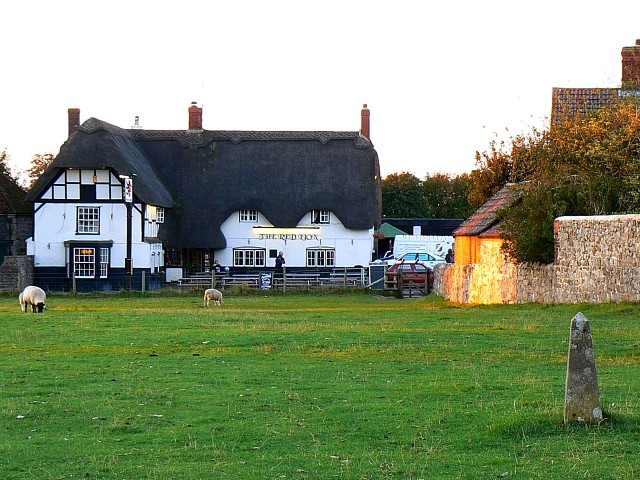
Hero: The real Red Lion in Avebury, photographed on September 26, 2007, not a Netflix game image. Brian Robert Marshall / Geograph, via Wikimedia Commons, CC BY-SA 2.0. JPEG recompressed at its original dimensions; distributed under the same license.
The haunted inn in The Conjuring: Unspoken is not just an anonymous video-game location. Netflix describes a Red Lion Inn in England, a ghost named Florrie and a well. A real Red Lion pub in Avebury, Wiltshire, has a long-circulating story about a ghost called Florrie and a well inside the building.
That is an unusually specific cluster of details. But there is a distinction worth preserving before calling the game a true-story adaptation: Netflix has not named Avebury in the material reviewed for this article or said that its on-screen building is a faithful recreation of that pub.
The match is compelling; a documented statement about the game’s exact real-world model would be stronger.
The game’s other named antagonist, Vinea, has a different sort of historical counterpart. The Goetia, a demon catalogue preserved in early modern occult literature, describes a spirit called Viné or Vinea. The old text does not describe the grief-feeding demon in the game’s story.
Here is what we can actually separate: a protected historic building, a local ghost legend, a name preserved in a grimoire, and a new fictional horror experience.
What Netflix has announced about The Conjuring: Unspoken
Netflix’s announcement dated October 7 dates The Conjuring: Unspoken for October 13, 2026. It is a narrative paranormal-investigation game played on a television with a phone acting as controller and ghost-hunting toolkit. Netflix explicitly includes Sweden among the release territories.
Players control demonologist Francesca Noakes at a supposedly haunted English inn. A family named Cooper arrives after a bereavement. Strange incidents involve missing dolls, a music box and a voice resembling a dead loved one. A séance goes wrong, and Francesca must deal with two named entities: Florrie and Vinea.
The phone interface simulates instruments such as an EMF reader, infrared camera and spirit box. Those devices are part of the game’s ghost-hunting fiction and interactive design. Their appearance in a game is not scientific confirmation that they detect spirits in the real world.
Netflix says players do not need to have watched The Conjuring films to understand the story, although some familiar faces appear.
The real Red Lion stands inside Avebury’s prehistoric landscape
There are many establishments called Red Lion in Britain. One particularly notable example is the Red Lion Public House in Avebury, Wiltshire.
This is a documented building, not merely a location in a ghost story. Historic England’s official listing identifies the Red Lion on High Street in Avebury as a Grade II listed former farmhouse. Its surviving fabric includes work dated to the late sixteenth or early seventeenth century, along with later alterations. The building was listed in 1966.
The National Geographic interview with manager Huw Thomas describes the pub as standing within Avebury’s prehistoric stone-circle landscape. It also describes a well inside the pub, now incorporated into a table.
The pub exists. The well exists. The building’s age and architectural history are recorded in its heritage listing; photographs document the well’s presence. None of those facts, by itself, confirms a haunting.
Florrie is part of the pub’s local ghost story
When National Geographic asked manager Huw Thomas about the Red Lion’s haunting reputation, he identified Florrie as the best-known ghost said to inhabit the building. In the story he told, her husband returns from the English Civil War, discovers she has taken a lover and kills her. Florrie is then associated with the well and with objects reportedly moving in the bar.
Other retellings disagree about some of the details, including William Hughes’s 2018 version for Bath Spa University and Richard Jones’s Haunted Britain account. Versions of the legend describe the attack differently, and the person Florrie is said to be searching for changes between narrators. Some versions include the death of her lover; others focus almost entirely on her alleged murder.
These are features of a local haunting tradition, not details recovered from a verified seventeenth-century case file.
There is a substantial difference between saying that a pub has a Florrie legend and saying that a named woman was demonstrably murdered there during the Civil War. The sources reviewed here establish the former. They do not independently establish the latter.
The surviving pub and well make the story vivid. They do not prove what happened to any particular person centuries ago.
The well is real — but it is not evidence of a murder
A photograph taken by andy dolman in 2008 shows the well through a transparent tabletop inside the Red Lion. The image is independently catalogued on Wikimedia Commons from the Geograph collection.
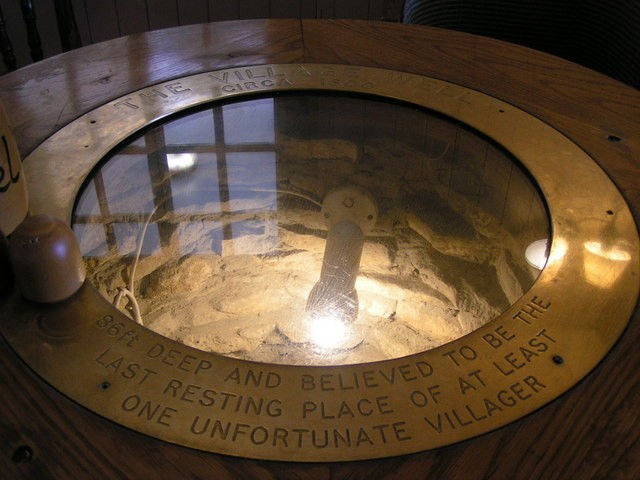
The Red Lion’s real indoor well, photographed in 2008. The feature is part of the site’s physical setting, not proof of the Florrie murder legend or evidence of anything supernatural. Photograph by andy dolman / Geograph, via Wikimedia Commons, CC BY-SA 2.0. JPEG recompressed at its original dimensions; distributed under the same license.
This is the kind of detail that makes the game’s setting unusually interesting. Netflix also mentions a creepy well at its fictional Red Lion Inn. Combined with the name Florrie, the similarity to the Avebury haunting tradition is much more precise than a generic haunted-pub premise.
The careful statement remains: the game appears to draw on the Avebury Red Lion story, but Netflix has not explicitly confirmed the geographical identification in its published announcement.
Does Florrie come from ancient English folklore?
Netflix calls Florrie a ghost from English folklore. That should not automatically be read as a claim that she belongs to an ancient nationwide myth or a centuries-old written text.
A story can be genuinely part of local folklore even when its earliest securely dated written version is comparatively recent or difficult to trace.
The established point is that Florrie circulates in modern accounts of the Avebury pub, including the manager’s own published interview. The sources reviewed for this article do not provide a verified seventeenth-century testimony naming Florrie or documenting her alleged murder.
It would therefore be misleading to claim that a contemporary account proves she haunted the well in the 1640s. It would be equally misleading to claim definitively that the tale was invented recently simply because an early document has not been located.
Recorded local legend and documented historical event are not the same category.
Vinea is an older occult name, but Netflix gives it a new role
The second entity is where the game’s horror-fiction lineage meets written demonology.
Netflix describes Vinea as a demon that feeds on grief. That is the characterization attached to the game’s story about the Cooper family.
A spirit called Viné or Vinea is also listed as number 45 in the Ars Goetia portion of The Lesser Key of Solomon. The widely available 1904 edition edited by S. L. MacGregor Mathers and Aleister Crowley describes Vinea as a king and earl, traditionally pictured as a lion riding a black horse while carrying a viper.
The text attributes to this spirit the discovery of hidden things and knowledge of times past and to come. It also claims the spirit can build towers, break down walls and disturb waters with storms.
It does not describe Vinea as consuming grief in an English pub.
Those are claims made within an occult text, not independently established supernatural abilities. The historical fact is that the name and description occur in a book.
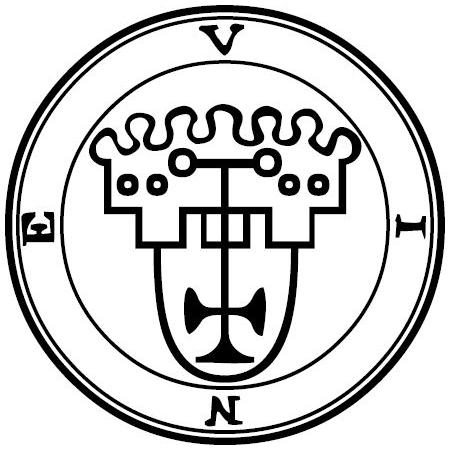
The seal associated with Viné/Vinea in the 1904 Goetia edition. This documents the printed occult tradition; it is not a verified design source for Netflix’s game and not proof that the spirit exists. Historical image via Wikimedia Commons, Public Domain. PNG optimized losslessly; original dimensions retained.
Did the game’s creators deliberately adapt the Goetia’s Vinea?
The identical name is worth identifying, especially because The Conjuring franchise has previously borrowed names from old demon catalogues.
But matching names do not, on their own, document a creative decision.
Netflix’s announcement does not say that its Vinea was adapted directly from the forty-fifth Goetic spirit. It does not assign the game demon the grimoire’s lion, horse, viper or traditional offices. Without a developer statement or unambiguous in-game documentation, the right distinction is:
- Historical text: Vinea is a named spirit in the Goetia.
- Game story: Vinea is a fictional antagonist associated with grief.
- Unconfirmed connection: whether the writers deliberately borrowed the historical name and which source they consulted.
That is the same caution Morbid Index applies to Valac/Valak and The Nun: the documented history of a name is different from a modern film or game’s fictional mythology.
Is this a real Warren investigation?
Netflix identifies the game as part of The Conjuring universe, which was built around fictionalized versions of the paranormal investigators Ed and Lorraine Warren.
That does not establish that the Warrens personally investigated the Red Lion in Avebury, met Florrie or encountered a demon called Vinea there.
No such specific Warren case is verified by the sources reviewed for this article. The Cooper family and Francesca Noakes belong to Netflix’s announced narrative unless independent evidence establishes otherwise.
For comparison, Morbid Index’s Annabelle investigation separates a real object, later paranormal claims and the franchise’s fictional demonology. The same editorial separation is useful here.
Why the combination matters
The Conjuring: Unspoken brings together three different sources of horror:
A real setting: a historic English pub, or at least a setting strongly resembling the documented Avebury Red Lion tradition.
A local haunting narrative: Florrie, the woman said to haunt a well after a Civil War-era domestic tragedy.
A historical occult name: Vinea, attested in the Goetia, given a different role in Netflix’s game.
The game then adds its own people, plot, tools and supernatural rules.
That combination is more interesting than calling the whole thing either “based on a true story” or “completely invented.” Parts of the cultural and physical background are documented. The haunting and demon claims remain claims or fiction.
Frequently Asked Questions
When does The Conjuring: Unspoken release?
Netflix lists October 13, 2026, including availability for members in Sweden. The announced format is an interactive TV experience with a smartphone controller.
Is the Red Lion Inn a real place?
There is a real, Grade II listed Red Lion Public House in Avebury, Wiltshire. Its historic building and indoor well are documented. Netflix names a Red Lion Inn and ghost Florrie, closely matching that local tradition, but has not explicitly named Avebury as the game’s exact model.
Who is Florrie?
Florrie is the name given to a ghost in stories about the Avebury Red Lion. A commonly told version alleges that her husband killed her during the English Civil War and disposed of her body in the well. That is a legend, not a murder proven by a contemporary historical record reviewed here.
Is the well real?
Yes. Photographs and descriptions of the real Red Lion show the well incorporated into an indoor table. The well’s existence does not verify the supernatural or murder claims attached to it.
Is Vinea a real demon?
Vinea is a name found in historical demonological literature. That documents an occult tradition, not the objective existence of a supernatural being.
Is Netflix’s Vinea the same as the Goetia’s Vine?
The name matches a Goetic variant, but Netflix has not explicitly confirmed a direct adaptation. The game’s grief-feeding characterization is not part of the 1904 entry.
Did Ed and Lorraine Warren investigate the Red Lion?
The sources reviewed here do not establish that they did. Being set in The Conjuring franchise does not turn the game’s story into a documented Warren case.
Is this a review of the game?
No. This is a source-based explanation of the published premise, historic building, local legend and occult-text parallel. No Morbid Index author is claiming to have played the unreleased game.
Sources & further reading
- Netflix Tudum: The Conjuring: Unspoken — Everything to Know (October 7, 2026)
- Historic England: Red Lion Public House, Avebury (National Heritage List 1192990)
- National Geographic: Interview with Red Lion manager Huw Thomas
- Bath Spa University: William Hughes’s Florrie legend retelling (October 31, 2018)
- Richard Jones, Haunted Britain: Red Lion legend variants (undated retelling)
- The Lesser Key of Solomon, Mathers and Crowley edition (1904), Goetia no. 45
- Wikimedia Commons: Red Lion pub, Avebury, 2007 photograph
- Wikimedia Commons: Red Lion pub well, 2008 photograph
- Wikimedia Commons: Vine seal from the 1904 Goetia edition
- Morbid Index: Valac, Valak and The Nun — Grimoire Versus Fiction
- Morbid Index: Annabelle — The Real Doll and the Conjuring Films