The Index
Eastern State Penitentiary: Prison History and Haunted Claims
Behind Eastern State's haunted reputation is a real experiment in isolation. Explore its prison design, Dickens's visit and the staged scares.
Topics: Eastern State Penitentiary, Haunted Places, Prison History, Philadelphia
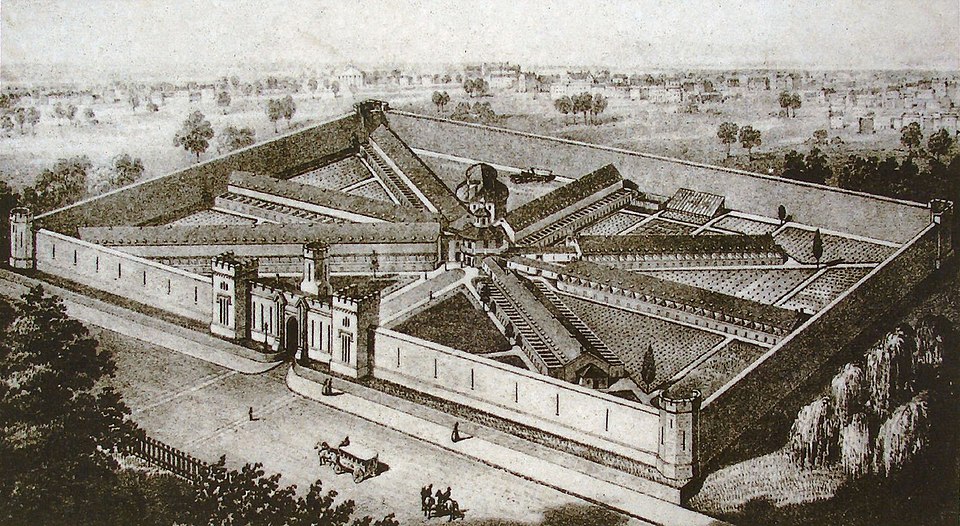
19th-century engraving (Public Domain)
Eastern State Penitentiary in Philadelphia is a former prison whose empty cellblocks have become part of a haunted reputation. Its documented history is disturbing without a supernatural explanation: the institution was designed around the belief that enforced separation and labor could reform the people held inside it.
Ghost stories, the prison’s historical record and its theatrical Halloween attractions are three different things. A frightening experience in the building may be sincere, staged or misunderstood; the setting alone does not establish that it was paranormal.
What was Eastern State built to do?
Eastern State opened in 1829. Its original approach, commonly called the Pennsylvania System, separated incarcerated people from one another while requiring work. The historic site’s fact sheet identifies architect John Haviland and the original seven cellblocks radiating from a central point.
The arrangement made an idea about confinement visible in the building itself. A plan showing those radiating blocks can explain something that an isolated photograph of a ruined doorway cannot: the individual cells belonged to a deliberately organized system.
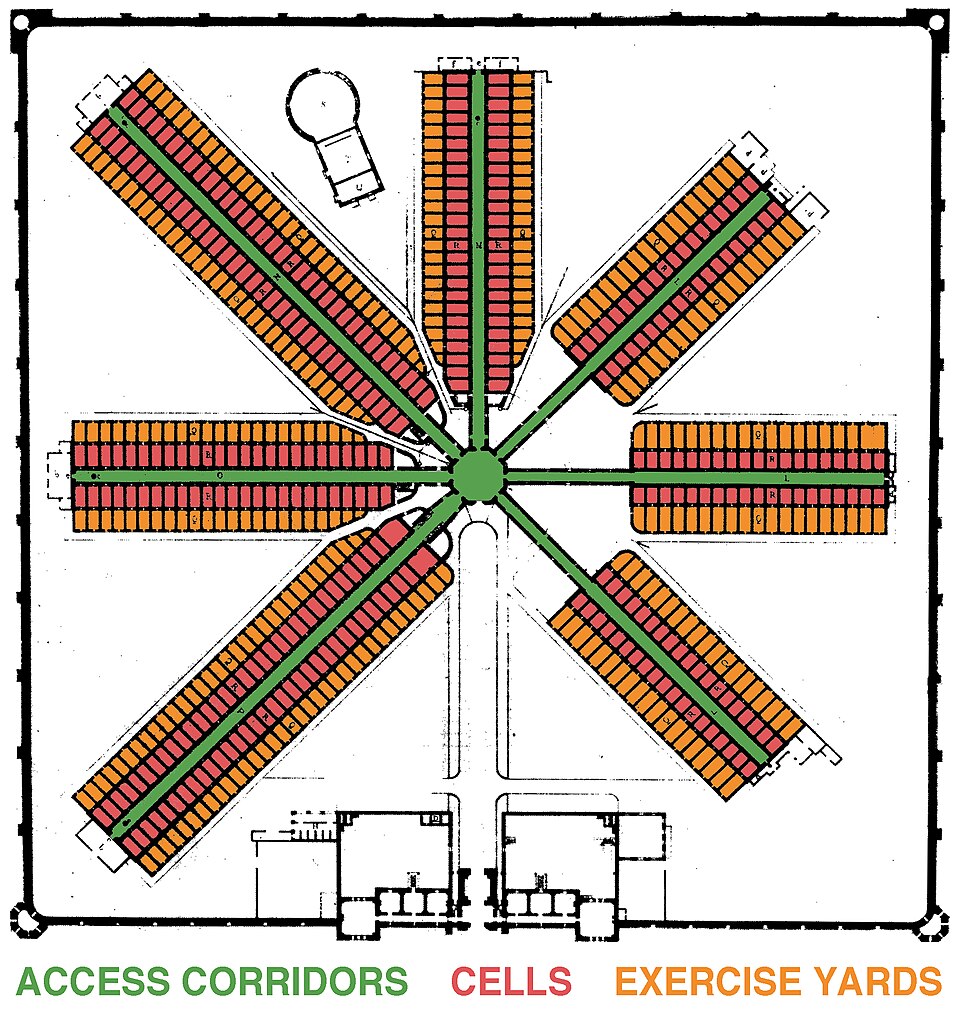
An annotated floor plan showing Eastern State’s radiating cellblock design, with access corridors, individual cells and exercise yards marked separately. Source. Licensed CC BY-SA 4.0.
The exterior and interior also create different impressions. Defensive-looking walls establish a boundary with the city; repeated doors and passages organize the lives within that boundary. Looking at the prison only as a picturesque ruin can hide how purposeful those spaces originally were.
The approach changed over time. Eastern State’s own historical material dates the official abandonment of its separate system to 1913. It would be inaccurate to describe the entire operational history as one unchanging experiment in isolation.
What Charles Dickens saw
Charles Dickens visited in 1842 and described the prison in American Notes. His account is valuable because it records a named visitor’s observations and reaction while the early system was operating.
He described a central space opening onto long passages, numbered cell doors, work carried out in confinement and the oppressive quiet of the building. He also recorded conversations with incarcerated people. His objection centered on the suffering he believed prolonged separation caused.
That is Dickens’s assessment, not a modern clinical study. His writing includes assumptions and prejudices of its period, and a single day’s visit could not represent every person’s experience. Those limitations do not erase the account; they tell us how to use it.
One of its most unsettling qualities is the contrast between order and distress. An institution could appear carefully managed to a visitor while still producing experiences that visitor found intolerable. The neatness of a building is not, by itself, a description of life inside it.
Why 1970 and 1971 both appear in closure accounts
The historic site’s current history distinguishes the end of state-prison operations in 1970 from a brief period of use as a city jail in 1971. A shorter account may therefore give 1971 as the final closure year without describing the preceding administrative change.
The distinction is small but useful. It prevents two dates from being treated as a dramatic mystery when they describe different stages of the same transition.
The site subsequently faced uncertainty over its future. Its preservation history led to the opening of the historic site for public tours in 1994. The building’s later life as a place of interpretation is another chapter, not a continuation of its original penal purpose.
A ruined cellblock can appear timeless in a photograph. The actual building has passed through construction, adaptation, use, abandonment and preservation. Each phase leaves something different for a visitor to see.
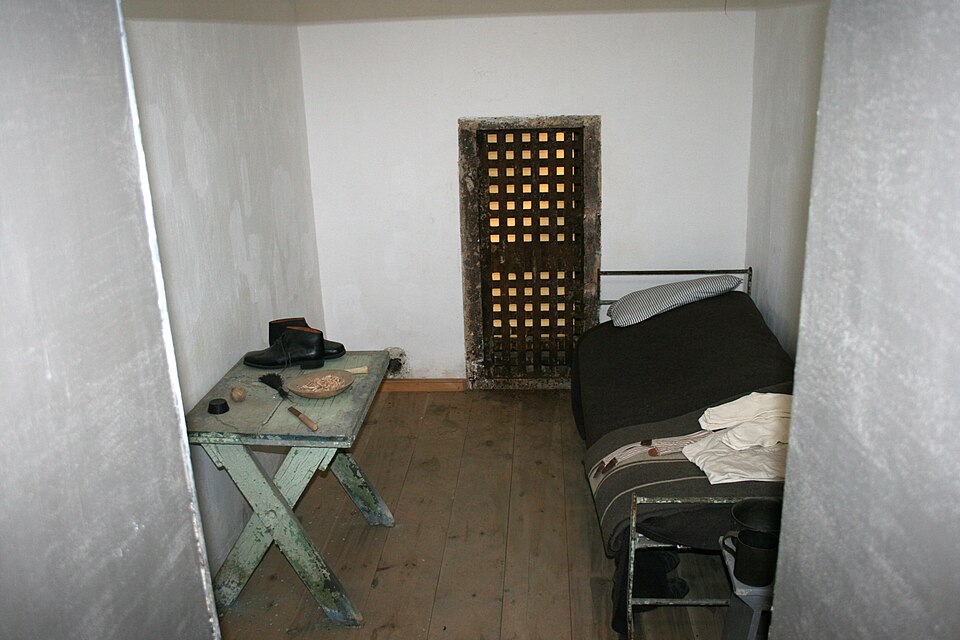
A restored cell interior at Eastern State, furnished to show how the space was used rather than left as an unexplained ruin. Source. Licensed CC BY-SA 4.0.
Does a haunted reputation establish a haunting?
No. A former prison is an effective setting for ghost stories because the visitor knows that people lived there under confinement, often in distress. That knowledge can make an empty room feel populated by a history that is no longer visible.
It does not identify a supernatural occupant. To claim that a particular person’s ghost appears in a particular cell requires more than a matching name in a prison register or a story repeated on a tour.
The same distinction applies to unexplained sounds and photographs. An account can be documented as something a visitor reported while its cause remains uncertain. “Reported” and “verified as paranormal” are not equivalent descriptions.
This article does not attach invented hauntings to named incarcerated people, or turn a famous former prisoner’s notoriety into proof of a ghost. The historical people deserve more than a convenient role in a scare story.
Halloween entertainment is a separate layer
Eastern State’s Halloween Nights material describes an organized entertainment production. Sets, performers and designed scares belong to that experience. They should not be presented as archival prison scenes or footage of genuine supernatural activity.
There is nothing contradictory about a historic site also hosting theatrical entertainment. The editorial responsibility is to label the two clearly. A visitor booking a scare attraction is encountering a production; a reader researching the prison’s past is asking a different question.
A photograph from an event can be especially misleading when removed from its caption. A costume, prop or dramatic lighting effect may look like evidence of a much older scene once its context disappears.
Looking beyond the empty-cell photograph
A useful set of images shows different scales: the exterior boundary, a historical plan and a cell or corridor. Together they explain how the institution organized space. Three nearly identical dark corridors only repeat an atmosphere.
The plan is particularly important. It shifts attention from a supposedly haunted corner to the system of rooms and routes around it. The question becomes what the architecture required people to do, rather than merely what a visitor might imagine seeing there after dark.
The same historical-first approach helps with other locations associated with ghost tourism, including the Edinburgh vaults and the Myrtles Plantation. In each case, the original purpose of the structure is more specific than the haunted reputation that later surrounds it.
Eastern State’s strongest documented story is not that the building contains ghosts. It is that a carefully designed institution embodied an idea about human behavior, and that people who encountered its reality did not agree about what that idea had achieved.