The Index
Edinburgh Vaults: The History Behind the Underground Hauntings
Edinburgh's South Bridge vaults were built as working spaces, not a hidden medieval city. Explore the history beneath the ghost-tour reputation.
Topics: Edinburgh Vaults, Haunted Places, Scotland, Dark History
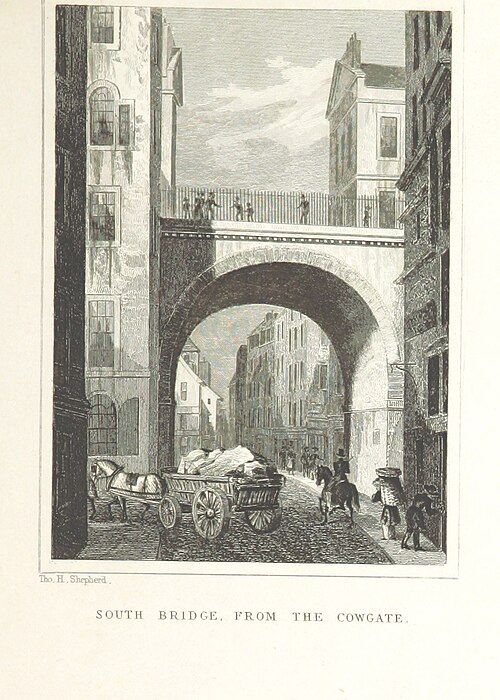
Thomas Hosmer Shepherd, 1829 (Public Domain)
The Edinburgh vaults are man-made chambers associated with South Bridge, not the remains of a whole medieval city swallowed by the ground. They began as useful spaces beneath a late-eighteenth-century structure. Their later reputation combines difficult urban history, fragmentary evidence and ghost storytelling.
The rooms are real. A claim that a named spirit occupies one of them is a different kind of statement, requiring evidence that architecture alone cannot supply.
What are the South Bridge vaults?
South Bridge carries a street across the Cowgate valley. The Historic Environment Scotland architectural record preserves plans and drawings associated with its eighteenth-century development. The vaults occupy spaces formed within and around the bridge structure rather than natural caves discovered beneath the city.
The bridge was completed in 1788. Rooms underneath it could serve the businesses operating above and nearby, turning otherwise enclosed space into workshops and storage. Atlas Obscura’s account describes that commercial use and the problems caused by damp.
Seen from the street, the engineering can be easy to miss. Buildings and changing levels make a space feel underground even when it belongs to a structure carrying another part of the city overhead. The 1829 engraving above shows exactly that construction: an arched bridge spanning a street below, with the vaulted space beneath it built into the design.
That is a more precise explanation than “Edinburgh was built on top of another city.” The vaults were part of the same city’s attempt to use a difficult landscape efficiently.
Why does damp matter to the history?
Storage is useful only if the stored material survives. A room can look secure and conveniently placed while still being poorly suited to goods, work or extended occupation because of water and limited ventilation.
The tour operator Mercat’s account of the Blair Street vaults identifies persistent damp as a reason commercial users left. It also describes evidence associated with a tavern and an illicit still.
Those activities belong to the history of particular spaces, not proof that every chamber had the same use. A complex can change unevenly. One room may continue to serve a purpose after another has become unusable.
That is why a single exact date when “everyone abandoned the vaults” should be treated cautiously. Popular summaries offer neat transitions from commerce to poverty to total disappearance, but the surviving record does not necessarily support that clean sequence for every room.
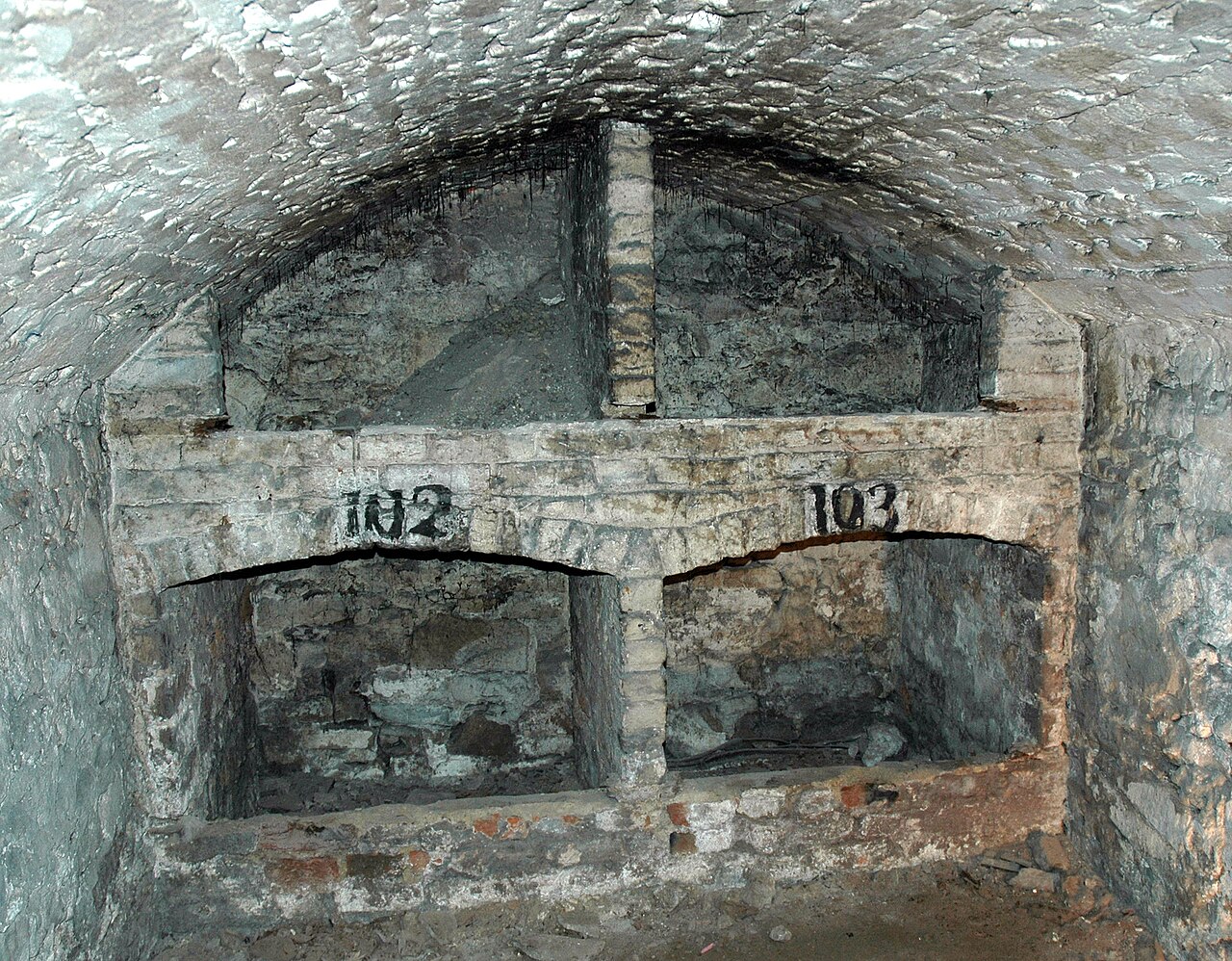
Inside one of the South Bridge vault chambers, with stone archways dividing numbered storage bays. Source. Licensed CC BY-SA 3.0.
Did people live in the vaults?
Mercat presents the Blair Street chambers as spaces occupied by some of Edinburgh’s poorest residents and points to finds including animal bones and children’s toys. That is the operator’s interpretation of the site’s history and material evidence; it should be attributed rather than converted into a complete census.
Such finds raise useful questions without answering all of them. A domestic object can indicate human activity, but it does not automatically establish how many people slept in a room, how long they stayed or what happened to a named family.
The distinction is especially important when poverty becomes part of a ghost-tour narrative. People who lacked secure housing should not be reduced to a faceless population waiting to become ghosts. Their circumstances matter even where individual biographies cannot be recovered.
A dark chamber can make hardship imaginable. It cannot tell us every detail of the lives lived there. The missing information should remain missing rather than being filled with a dramatic scene written as fact.
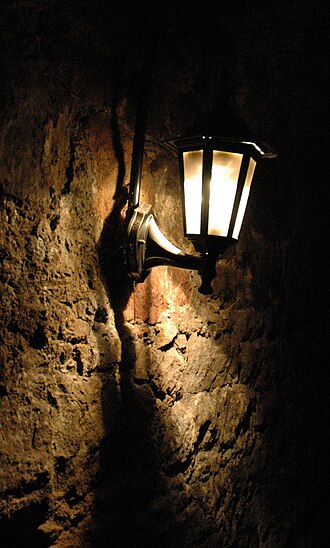
A lantern lighting a narrow stone passage within the vaults — the kind of atmospheric detail that belongs to a visitor’s tour experience, distinct from the documented commercial and residential history above. Source. Licensed CC BY-SA 3.0.
Were the vaults built as catacombs?
No. Their identified original uses were commercial, not funerary. Calling them catacombs confuses an atmospheric resemblance with a historical function.
The distinction is clear when they are compared with the Paris Catacombs. Paris adapted quarry spaces into a municipal ossuary. Edinburgh’s South Bridge chambers belong to a different building project and a different history.
A cellar, a quarry and an ossuary can all be dark enclosed spaces. That does not make them interchangeable. Knowing what a space was built to do is the first step toward understanding what later happened inside it.
Where do the ghost stories enter?
Mercat’s Haunted Underground tour description explicitly presents the Blair Street vaults through ghost storytelling and an atmospheric visitor experience. That establishes how the operator markets and interprets the place. It does not independently verify the supernatural claims involved.
An old room, a guide’s narrative and a visitor’s reported sensation can combine into a compelling experience. The strength of that experience is not a substitute for knowing where a particular story came from.
Before treating an alleged ghost as a historical person, we would need to separate several questions. Is the person’s identity documented? Is their connection to that exact space documented? Who first reported the haunting? How was the apparition connected to the name?
A convincing answer to the first question would not automatically answer the others. An authentic name in an old record can acquire an unsupported ghost biography much later.
Why the boundaries of the site matter
“Edinburgh underground” is a broad phrase, while the Blair Street vaults are a particular part of the South Bridge complex. Stories and photographs attached to other cellars, closes or attractions should not be moved into these rooms simply because the city name matches.
The same applies to claims about notorious criminals. A crime committed in Edinburgh does not establish that the perpetrators used every dark space associated with the city’s haunted reputation. Without evidence tying a claim to these vaults, the connection should not be presented as fact.
This is not a demand that a ghost story stop being a ghost story. It is a distinction between recounting a legend and writing a historical account. A reader should be able to tell which activity is taking place.
The haunting that history can support
There is a nonliteral sense in which the vaults are haunted by their past: the spaces outlast the work, businesses and lives once associated with them. That is an interpretation of the visitor’s encounter with a historic place, not a claim about spirits.
A photograph of South Bridge helps explain the engineering. A view of the actual chambers shows the enclosed space. A historical street scene supplies the city around it. Together, those images make a more useful account than three dark corridors labeled “paranormal.”
The unsettling part is not that a hidden medieval city has been discovered. It is that ordinary urban spaces can become difficult to use, fall out of view and return to public attention with a new set of stories attached. The history is still there, but it takes more than darkness to read it.
_p.195_-_South_Bridge,_from_the_Cowgate_-_Thomas_Hosmer_Shepherd.jpg)

