The Index / Dark History
Anneliese Michel: The True Story Behind The Exorcism of Emily Rose
Anneliese Michel died in 1976 after 67 Catholic exorcism sessions, weighing 68 pounds. Her parents and two priests were later convicted of negligent homicide.
Topics: Anneliese Michel, Exorcism, The Exorcism of Emily Rose, Catholic Church, Dark History
José Luiz Bernardes Ribeiro / Wikimedia Commons (CC BY-SA 4.0)
Anneliese Michel died on July 1, 1976, weighing about 68 pounds, after nearly a year of Catholic exorcism rites that her family and two priests continued even as her body was visibly failing. A German court later convicted all four of negligent homicide. She was 23 years old, a university student who had spent most of a decade cycling through psychiatric diagnoses, anticonvulsant medication, and religious treatment that ultimately replaced medical care entirely rather than supplementing it.
This is a real death, not a horror premise. The 2005 film it inspired, The Exorcism of Emily Rose, kept the outline and changed almost everything else, including the ending.
Who Was Anneliese Michel?
Born September 21, 1952, in Leiblfing, Bavaria, Anneliese Michel grew up in Klingenberg am Main in a devoutly Catholic household. At sixteen, in 1968, she suffered a severe seizure and was diagnosed with temporal lobe epilepsy, a condition that can produce not just convulsions but sensory disturbances, altered consciousness, and, in some documented cases, intense religious or mystical experiences during seizure activity.
Anticonvulsant medication, including Dilantin, failed to control her symptoms adequately. Over the following years doctors also treated her for what case records describe as depression and psychotic features, at one point prescribing Aolept, an antipsychotic used for conditions including schizophrenia, and later switching to Tegretol, an anticonvulsant that also functions as a mood stabilizer. None of it resolved her condition. By the early 1970s she was reporting hallucinations, including hearing voices that told her she was damned.
When the Family Turned to Religious Explanations
Five years of pharmacological treatment with no meaningful improvement pushed the Michel family toward a different framework. A family friend who had visited an unauthorized shrine in Piacenza, Italy, interpreted Anneliese’s aversion to crucifixes and holy water as signs of possession rather than symptoms of a neurological or psychiatric condition. Her mother reported observing what she believed were stigmata.
Father Ernst Alt, initially consulted in September 1974, first concluded she “didn’t look like an epileptic” after observing her without witnessing a seizure himself — a judgment made without the medical training to actually rule epilepsy in or out. By the following summer he had reversed course entirely and became one of the case’s strongest advocates for a possession diagnosis, urging Bishop Josef Stangl of Würzburg to authorize a formal exorcism. Father Adolf Rodewyk, a Jesuit with specific experience in exorcism cases, visited alongside Alt in September 1975 and submitted a report to Stangl supporting that interpretation.
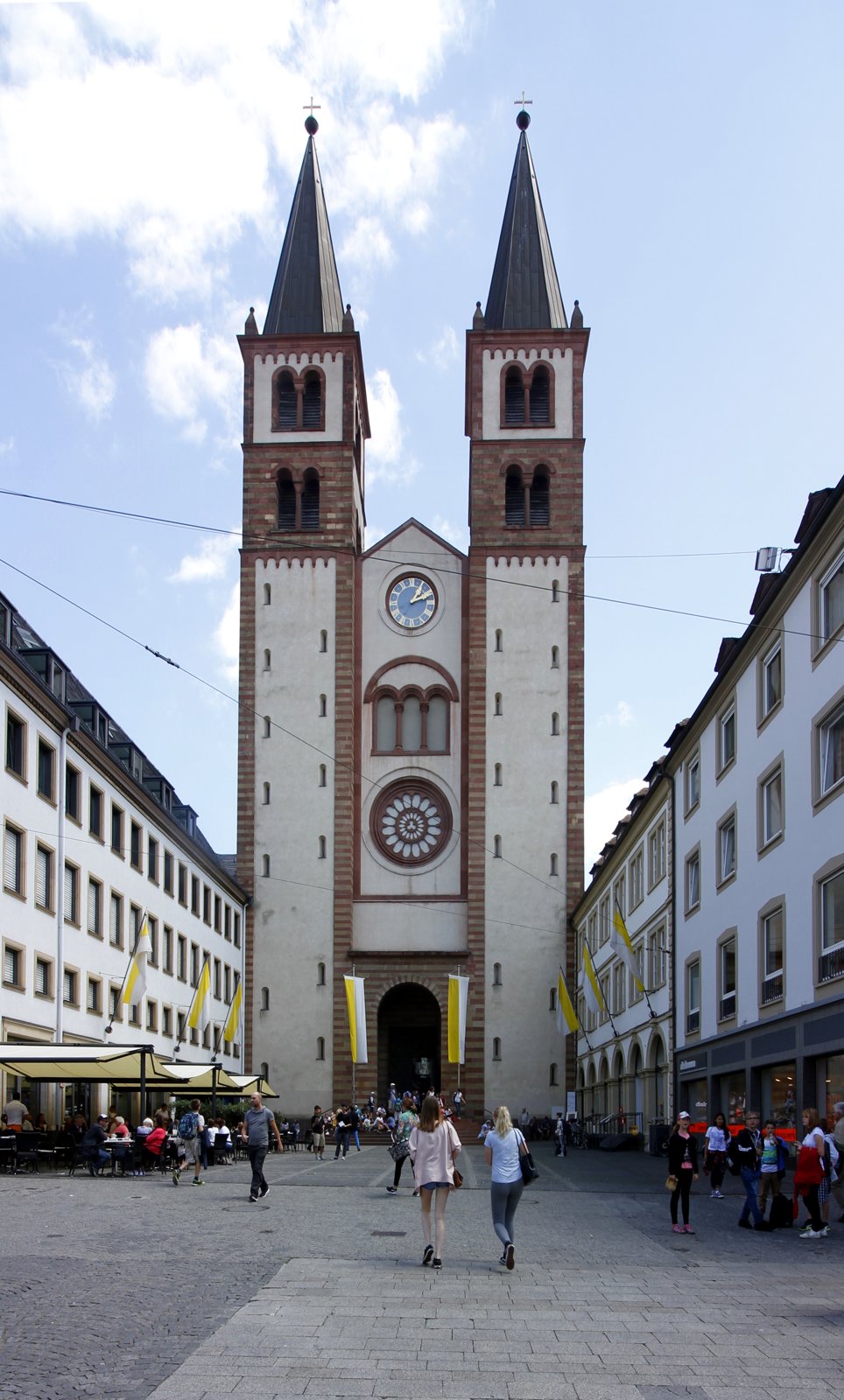
St. Kilian’s Cathedral in Würzburg, seat of the Bishop of Würzburg — the diocese whose bishop, Josef Stangl, authorized the exorcism carried out under his authority. Source. José Luiz Bernardes Ribeiro / Wikimedia Commons, CC BY-SA 4.0.
The Exorcism Sessions
Stangl authorized a minor exorcism rite in August 1975, then in September authorized Father Arnold Renz to carry out the full Roman Ritual under conditions the family and clergy kept deliberately secret. Renz performed the first formal session on September 24, 1975, with Alt assisting. The rite most commonly cited puts the total number of sessions at 67, held roughly once or twice a week over about ten months, each lasting up to four hours — though the figure appears in some sources as 65, a small discrepancy worth noting rather than resolving with false precision.
During the sessions, the priests reported that Anneliese spoke in the voices of what they described as six distinct entities, including figures they identified as Lucifer, Cain, Judas Iscariot, Nero, an unnamed corrupt priest, and Adolf Hitler. That’s a claim made during a religious ritual, recorded by participants who already believed possession was occurring — not an independently verified account of who or what was actually speaking. Portions of the sessions were recorded on audio tape, and excerpts were later used as evidence at trial, presented by the defense as documentation of genuine spiritual affliction rather than a young woman in psychiatric crisis.
Physical Decline and Death
As the rite continued through the winter and spring of 1975–76, Anneliese’s physical condition deteriorated sharply. She refused food for extended periods, reportedly at her own insistence framed as religious penance, and her parents — acting on her wishes and their own conviction that medical intervention would interfere with the exorcism — stopped taking her to see doctors. By the time of her death on July 1, 1976, she weighed roughly 68 pounds, had broken both knees from repeated prolonged kneeling and genuflection, and had contracted pneumonia. The official autopsy attributed death to malnutrition and dehydration consistent with almost a year of near-starvation. State prosecutors later argued that her life could plausibly have been saved by ordinary medical intervention as late as one week before she died.
The Trial
West German prosecutors charged Anneliese’s parents, Josef and Anna Michel, along with Fathers Alt and Renz, with negligent homicide. The trial opened March 30, 1978. The parents’ defense was led by Erich Schmidt-Leichner, a prominent attorney; the priests’ legal costs were covered by the Catholic Church. The defense argued, among other things, that the exorcism was a legitimate act of religious practice protected under West Germany’s constitutional guarantees.
Medical experts who testified for the prosecution rejected the possession framework outright, attributing Anneliese’s symptoms to her documented epilepsy and psychiatric conditions compounded by an intensely strict religious upbringing. In April 1978 the court convicted all four defendants of negligent homicide. The sentences were notably lenient by the standard the crime might suggest: suspended prison terms functioning as roughly three years of probation, along with an order to help cover court costs. The parents received no additional punishment beyond that, on the reasoning, accepted under German sentencing practice at the time, that they had “suffered enough” through their daughter’s death.
What the Catholic Church Said Afterward
The Church did not pursue any process toward canonizing Anneliese, and the case is widely understood to have contributed to a sharp decline in the number of officially sanctioned exorcisms performed in Germany in the years that followed. That doesn’t amount to an institutional statement that possession was disproven — the Church’s position on individual cases like this one has generally stayed quiet rather than issuing a formal verdict either way — but the practical effect was a much more cautious approach to authorizing the rite going forward.
Her grave in Klingenberg became, and to some extent remains, an unofficial pilgrimage site for people who believe she suffered on behalf of others, including for what they see as the sins of the modern clergy. Claims occasionally circulate online about an exhumation revealing an intact or uncorrupted body — a detail sometimes used to suggest sainthood-adjacent significance. The documented exhumation, requested by the family in February 1978 to move her remains to a better coffin, produced an official report describing decomposition consistent with a body of that age and time in the ground. That’s the opposite of the “miraculously preserved” claim that sometimes attaches to the case online, and it’s worth stating plainly rather than repeating the more dramatic, unsupported version.
What The Exorcism of Emily Rose Changed
The 2005 film starring Laura Linney and Tom Wilkinson keeps the broad shape of the case — a devout young woman, a diagnosis of epilepsy, a priest who authorizes an exorcism, a death, and a trial — but restructures almost everything else. The setting moves from Bavaria to the United States. The film centers heavily on a courtroom drama built around a defense attorney arguing for the plausibility of possession, a framing device that doesn’t reflect how the real trial was actually argued or decided; the real case ended in conviction on the strength of medical testimony rejecting the possession explanation, not with the kind of open theological question the film leaves the audience to sit with. The film’s ending deliberately preserves ambiguity about whether Emily Rose was genuinely possessed. The real trial did not end ambiguously — a court found actual human negligence, by identifiable people, directly responsible for a preventable death.
Requiem, a 2006 German film released the same year, takes a considerably more restrained, realist approach to the same source material, following the woman’s psychiatric decline without supernatural framing, and is generally regarded as sitting much closer to the documented medical record than the American film.
How This Compares to Other Documented Exorcism Cases
Anneliese Michel’s case is sometimes mentioned alongside the 1949 case that inspired The Exorcist, and the comparison is instructive mainly for how differently the two ended. The 1949 case involved a period of religious ritual followed by the family’s return to ordinary life, with the boy at its center going on to a long, private adult career. Anneliese Michel’s case ended in her death and a criminal conviction — a difference that traces directly to the escalating withdrawal of medical care in her case, not to any meaningful difference in the underlying psychiatric or neurological presentation.
Frequently Asked Questions
Was Emily Rose a real person? Not exactly — Emily Rose is a fictionalized version of Anneliese Michel, a real German woman whose 1976 death from malnutrition after an extended exorcism directly inspired the film.
Who was Anneliese Michel? A Bavarian university student diagnosed with temporal lobe epilepsy and later treated for psychiatric symptoms including depression and psychosis, who died in 1976 after undergoing roughly 67 Catholic exorcism sessions over ten months.
What illness did Anneliese Michel have? Temporal lobe epilepsy, first diagnosed in 1968, along with psychiatric symptoms treated over the following years with antipsychotic and mood-stabilizing medication that did not resolve her condition.
How many exorcisms did she undergo? Most sources cite 67 sessions, held once or twice weekly for about ten months, though a small number of sources give the figure as 65.
How did Anneliese Michel die? From malnutrition and dehydration after refusing food for an extended period during the exorcism rites, with her parents ceasing medical care at her request. She weighed approximately 68 pounds at death.
Were the priests convicted? Yes. Both priests and both parents were convicted of negligent homicide in April 1978 and received suspended sentences rather than active prison time.
Are the famous tapes real? Audio recordings from some sessions do exist and were used as evidence at trial. They document what participants who already believed in the possession framework recorded and interpreted during the rite — not independent proof of what was actually happening to her medically.
What did The Exorcism of Emily Rose change? It relocated the story to the United States, built the narrative around a courtroom debate over whether possession was genuine, and left that question deliberately unresolved. The real case ended in a conviction based on medical testimony that rejected the possession explanation.
Did the Catholic Church confirm she was possessed? No. The Church has not issued a formal statement confirming possession, and no canonization process was opened. The case is widely credited with making German dioceses far more cautious about authorizing exorcisms afterward.