The Index / Paranormal Cases
The Cock Lane Ghost: What 'Scratching Fanny' Proved in 1762, and What It Didn't
London's 1762 ghost accused a man of murder and sent its promoters to the pillory. Yet the period's own summary admits the noises were never explained.
Topics: Cock Lane, Scratching Fanny, Samuel Johnson, Georgian London, Séances, Hoaxes, 18th century
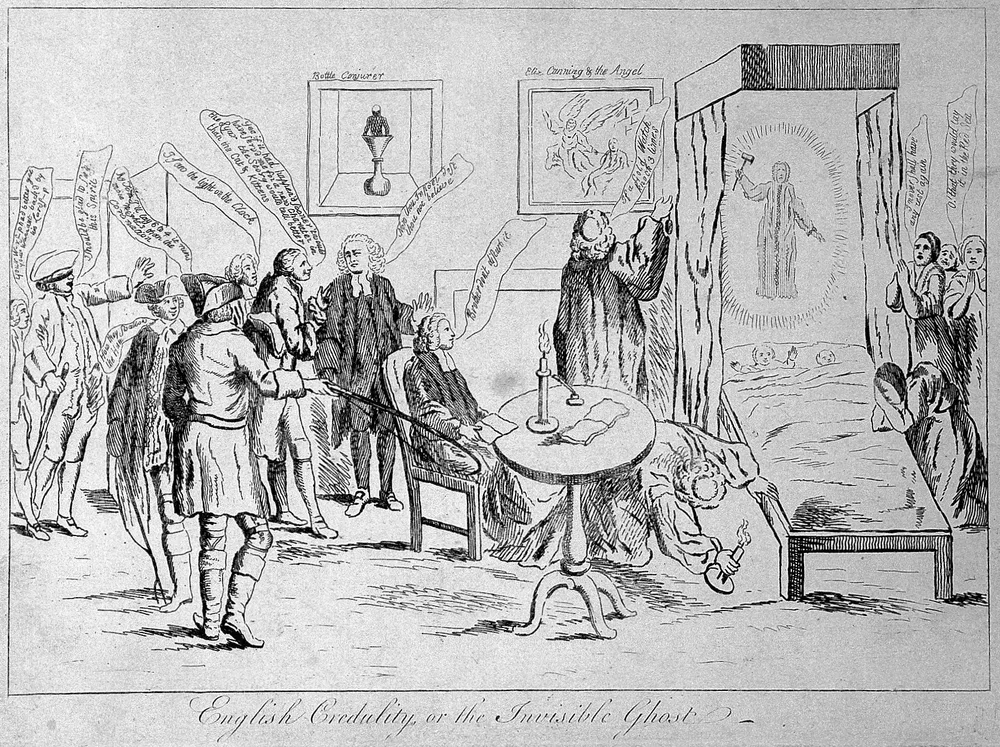
The Cock Lane ghost was a public sensation in London in early 1762, and a court treated it as a criminal conspiracy, not a haunting. Knocks and scratches around the bed of a parish clerk’s young daughter were read as the voice of a dead woman, Fanny Lynes, accusing her partner William Kent of poisoning her. An investigating group that included Samuel Johnson found no sign of a spirit, and five people were convicted that July. But the case is usually told as more settled than it was. The Annual Register’s summary for 1762 opens by admitting that the manner of making the noises had “not as yet been sufficiently ascertained”.
So there are two separate questions here. Was there a ghost? No evidence ever supported that. How exactly was it done? Nobody demonstrated that in 1762, and the piece of wood usually offered as the answer does not settle it.
The short version
| Date | Event | Status |
|---|---|---|
| c. 1759 | William Kent and Fanny, sister of his late wife, lodge with Richard Parsons in Cock Lane | Documented |
| During their stay | Fanny and young Elizabeth Parsons report noises in the bed they share | Reported by witnesses |
| 2 February 1760 | Fanny dies in Clerkenwell. Her physician and apothecary attribute it to smallpox | Documented |
| Around January 1762 | Noises resume after a gap of over a year and a half | Reported |
| January 1762 | Knock code “reveals” poison: arsenic in purl, a spiced beer drink | Claim made through the knocks |
| 1 February 1762 | Test at Rev. Stephen Aldrich’s house and in the vault of St John’s, Clerkenwell | Documented, with a date conflict |
| About 21 February 1762 | Elizabeth is caught with a small board in bed | Reported |
| 25 February 1762 | Kent has the coffin opened to answer a rumour that it had been moved | Documented |
| 10 July 1762 | Five defendants convicted of conspiracy at Guildhall before Lord Mansfield | Documented |
| Early 1763 | Sentences, and Parsons in the pillory | Documented |
How the accusation started
The background is a private grief that became public property. Kent’s wife died in childbirth, and her sister Fanny came to keep house for him. The two became a couple, but canon law stood in the way of marriage, so they lived as husband and wife without being married. Richard Parsons, the officiating clerk at St Sepulchre’s, offered them rooms and later borrowed money from Kent.
According to the Annual Register, Elizabeth Parsons shared Fanny’s bed while Kent was away, and Fanny complained of violent noises. The family first blamed a hardworking shoemaker nearby, until the noises came on a Sunday night too. The couple moved to Clerkenwell, and Fanny soon died. The noises in Cock Lane stopped for “above a year and a half”.
When they returned around the start of 1762, Kent was suing Parsons over the debt. Now the sounds gathered around Elizabeth’s bed, and questions were put to them: one knock for yes, two for no. Wikipedia credits the code to Parsons and the clergyman John Moore, while Andrew Lang’s account suggests it came from Mary Frazer, who attended the child. Through it, “Fanny” said that Kent had poisoned her.
Nothing but the knocks ever supported that charge. Kent was not arrested. Wikipedia says the Lord Mayor, Sir Samuel Fludyer, refused to arrest either man and ordered a test instead. Fanny’s maid, known as Carrots, told one séance that her mistress had been speechless at the end and could not have said what the ghost claimed. The physician and apothecary supported the smallpox diagnosis.
London goes to Cock Lane
Reporters and sightseers soon filled the lane. Charles Mackay, writing 80 years later, says it became impassable and that Parsons began charging for entry, a detail that Dr Johnson’s House also repeats. The best surviving eyewitness comes from Horace Walpole, who squeezed in with the Duke of York and Lady Northumberland. He wrote to George Montagu on 2 February that “it is not an apparition, but an audition”.
His letter is worth reading for what it shows of the room: fifty people, one tallow candle, and a child “whom they are murdering by inches in such insufferable heat and stench”. They heard nothing that night, and were told the ghost would come at seven in the morning. Walpole had already reached his verdict, that “a drunken parish clerk set it on foot out of revenge”. He also said the Methodists had adopted the ghost. Both remarks are his opinion rather than evidence, though the religious quarrel was real. Moore leaned Methodist, and Sean Gaston’s 2015 study treats the ghost as a mirror of the religious and political tensions of the day.
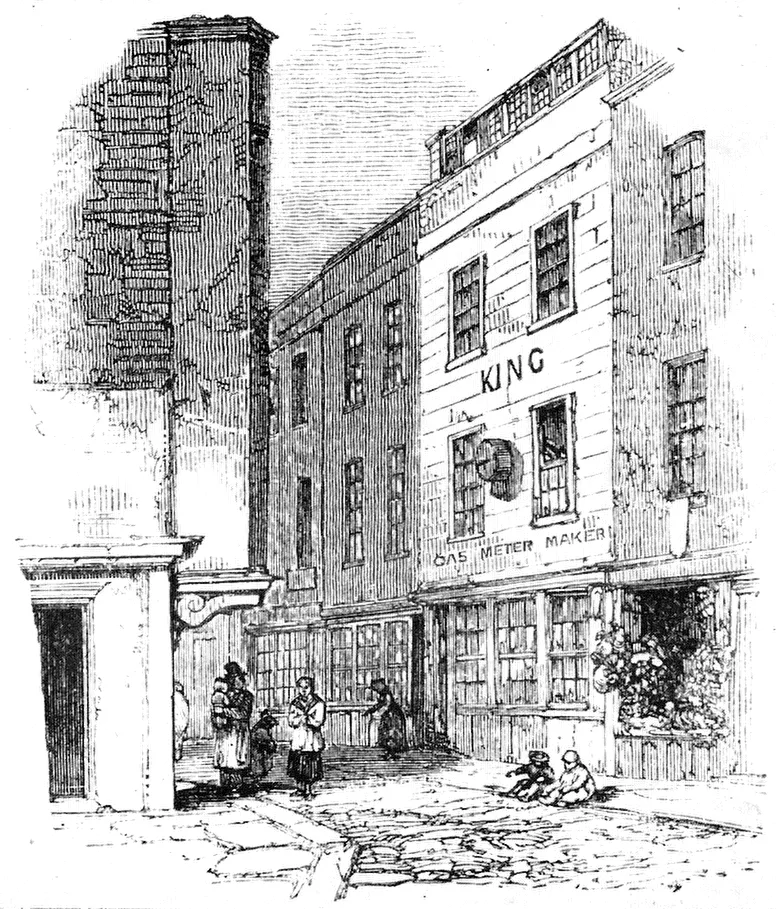
The house said to be the haunted one, as drawn for Mackay’s 1852 edition, by then occupied by a gas meter maker. Its identification rests on house tradition recorded by J. W. Archer. Public domain (PD-1923, PD-UK-unknown) via Wikimedia Commons; converted to WebP.
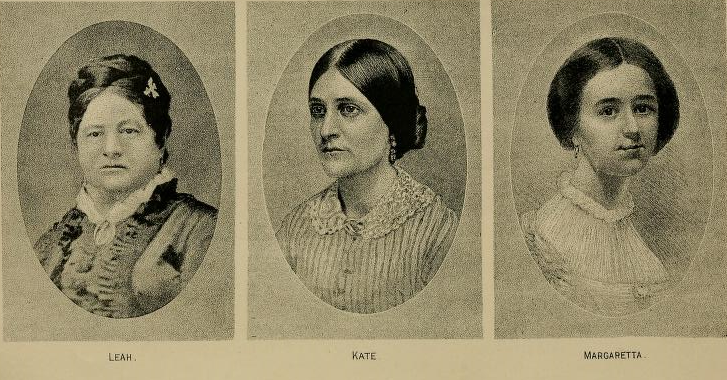
The questioning itself explains part of the appeal. In Mackay’s transcript the knocks correctly gave the number of clergymen present and the colour of a watch case. Every person in the room knew those answers. When the questions touched something only the dead woman could confirm, they failed: Carrots flatly contradicted one reply, and Lang reports that the ghost gave the wrong name for Fanny’s father. A yes-or-no code rewards whoever controls the pace and the phrasing, a pattern that returned in 1848 with the Fox sisters and their alphabet of raps.
What Samuel Johnson’s group actually found
Rev. Stephen Aldrich of St John’s, Clerkenwell, and James Penn set out strict terms in a public notice. The child would come without any of her usual companions, her father would wait in another room, and she would lie on a bare bed in the middle of the room, examined and put to bed by a lady. Parsons stalled, then agreed.
Johnson wrote the report, as Boswell later confirmed on the authority of John Douglas, who took part. It is a sober document. The men sat for over an hour and heard nothing. Then some ladies by the bed called them back, saying they had heard knocks and scratches, and Elizabeth said she felt the spirit “like a mouse upon her back”. She was told to hold her hands outside the bedclothes. From that moment nothing happened.
This is the strongest single observation in the case, though it is rarely singled out. Sound while the hands are hidden, and silence when they can be seen, points firmly towards the child.
The group then went to the church at about one o’clock, because the ghost had promised to knock on its own coffin. Nothing followed in the vault, either for the first two men who went down or for Kent and others after them. Elizabeth confessed to nothing. The conclusion is often paraphrased as an exposure, but the actual words are more careful:
It is therefore the opinion of the whole assembly, that the child has some art of making, or counterfeiting, particular noises, and that there is no agency of any higher cause.
That is an inference. Gaston puts it plainly: Johnson had not discovered the device. Lang adds that a sitting of little more than an hour was thin grounds. Even so, it did the job that mattered, which was to remove any reason to believe the accusation against Kent.
It did not save Johnson’s reputation. Charles Churchill mocked him as the credulous “Pomposo” in his poem The Ghost, and Boswell complained that many readers still believed he had been fooled. Johnson, by Boswell’s account, took pride in having helped detect the cheat and grew irritated when pressed on the subject.
The board does not solve the mystery
Most retellings end with Elizabeth caught red-handed with a piece of wood. The Annual Register’s fuller account is a good deal less tidy.
- Her bed was slung like a hammock, with her hands and feet spread and tied, and for two nights there was no noise at all.
- She was then told that if the noises did not come back, she and her parents would be sent to Newgate.
- On the last permitted night she hid a board, “about four inches broad, and six long”, which was normally used to stand a kettle on. The maids saw her do it.
- In the morning she knocked and scratched on it, with only two men and the maids present, and was searched.
- Both of those men declared that the sounds “had not the least likeness to the former noises”.
- The witnesses’ own conclusion was that she had been “frightened into this attempt” by the threats.
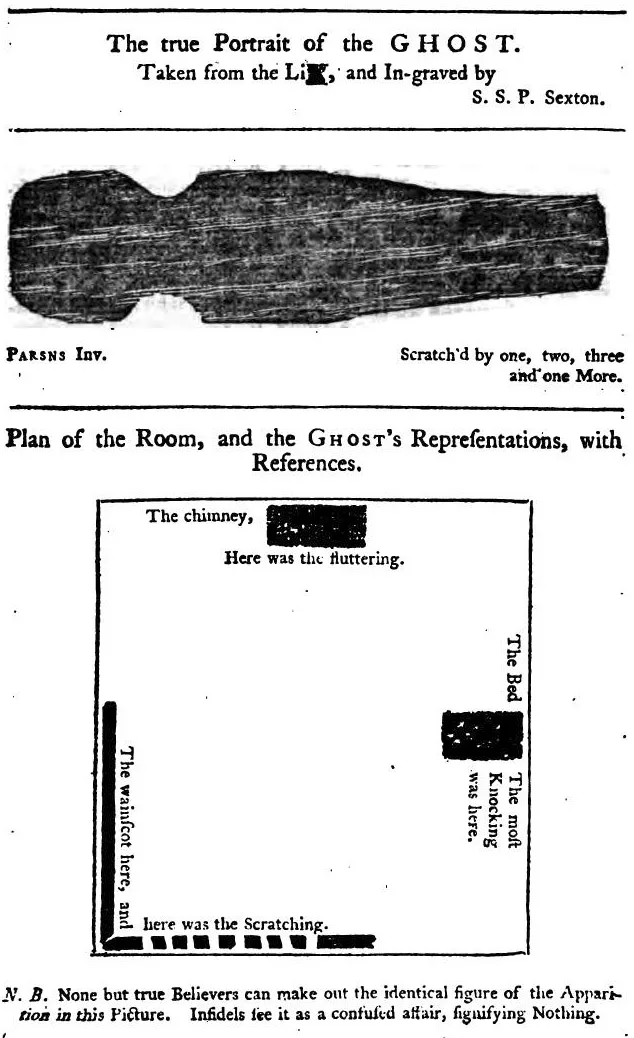
A mocking “portrait of the ghost” and a plan of the room, printed in The Beauties of All Magazines Selected for 1762. The board is satire rather than a measured drawing. Public domain (PD-old) via Wikimedia Commons; converted to WebP.
Read carefully, the board shows that a frightened child, under a threat to her whole family, tried to produce the noises when she had been stopped from making them her usual way. It shows that she was capable of deception at that point. It does not show how the earlier sounds were produced. The people who caught her said as much, and the Annual Register itself guessed at ventriloquism, a theory Lang says was dropped after a surgeon held a hand on her chest and stomach during the noises.
The two silent nights in the hammock are better evidence than the board, because they again tie the noises to her free movement. But they come alongside reports, in the same source, of noises while she was “bound and muffled” and of sounds in distant rooms. These reports were less controlled and are phrased as hearsay (“was said”). We give them less weight, but they are part of the record.
Mackay’s assertion that the mother knocked while the daughter scratched is a guess. He offers no source for it, and says in the same passage that the method “has never been explained”.
The trial and the punishment
Kent, who needed a public verdict to clear his name, brought the case himself. The defendants were Parsons, his wife, Mary Frazer (the ghost’s “interpreter”), a clergyman and a tradesman. Wikipedia identifies the last two as John Moore and Richard James. They were tried at Guildhall before Lord Mansfield and a special jury on 10 July 1762, and convicted of a conspiracy against Kent’s life and character. The jury is reported to have taken only 15 minutes, again according to Wikipedia.
Sentencing was deliberately delayed so that compensation could be arranged. Moore and James paid Kent “between 5 and 600 l.”, which Wikipedia gives as £588, and were dismissed with a reprimand. Parsons was to stand in the pillory three times and serve two years. His wife got one year, and Mary Frazer six months of hard labour in Bridewell.
There is a telling footnote. Parsons appeared “out of his mind” when first brought to the pillory, and instead of attacking him, the crowd took up a collection for him. Elizabeth, the child at the centre of everything, was not among those tried, according to the Annual Register’s list.
The conviction is firm history. It is good evidence that the court believed the accused had knowingly maintained a false charge of murder. It did not establish the technique, and no surviving confession that we could find explains it.
Was it revenge, a child’s trick, or something else?
These are the competing explanations, none of which can be proved.
- Parsons staged it for revenge. This was the verdict of Walpole and much of the town, and it fits the timing of the debt suit. But Lang points out a real weakness: the first noises came while Parsons and his lodgers were on good terms. Much of the revenge story also traces to The Mystery Revealed, the 1762 pamphlet attributed to Oliver Goldsmith, which Lang describes as written in Kent’s defence. We have read it only through such descriptions.
- Elizabeth began it, and adults built on it. This is our reading of the evidence. It accounts for the tie between noises and her movement, and for why adults with a grudge or a religious interest could take over something already under way. It remains an inference.
- A troubled child acting without full awareness. H. Addington Bruce argued in 1908 for what he called “dissociation”. He thought a conspiracy over a debt of about £12 preposterous. This is a retrospective diagnosis of a child nobody could examine, and we treat it as theory only.
- A genuine poltergeist. Lang declined to accept Johnson’s conclusion as final and compared the case with centuries of similar reports. The writer Colin Wilson went further, calling it plainly a poltergeist, as quoted in the Psi Encyclopedia. Yet comparing similar stories shows only that the pattern recurs, not its cause. The better-controlled tests here went against it.
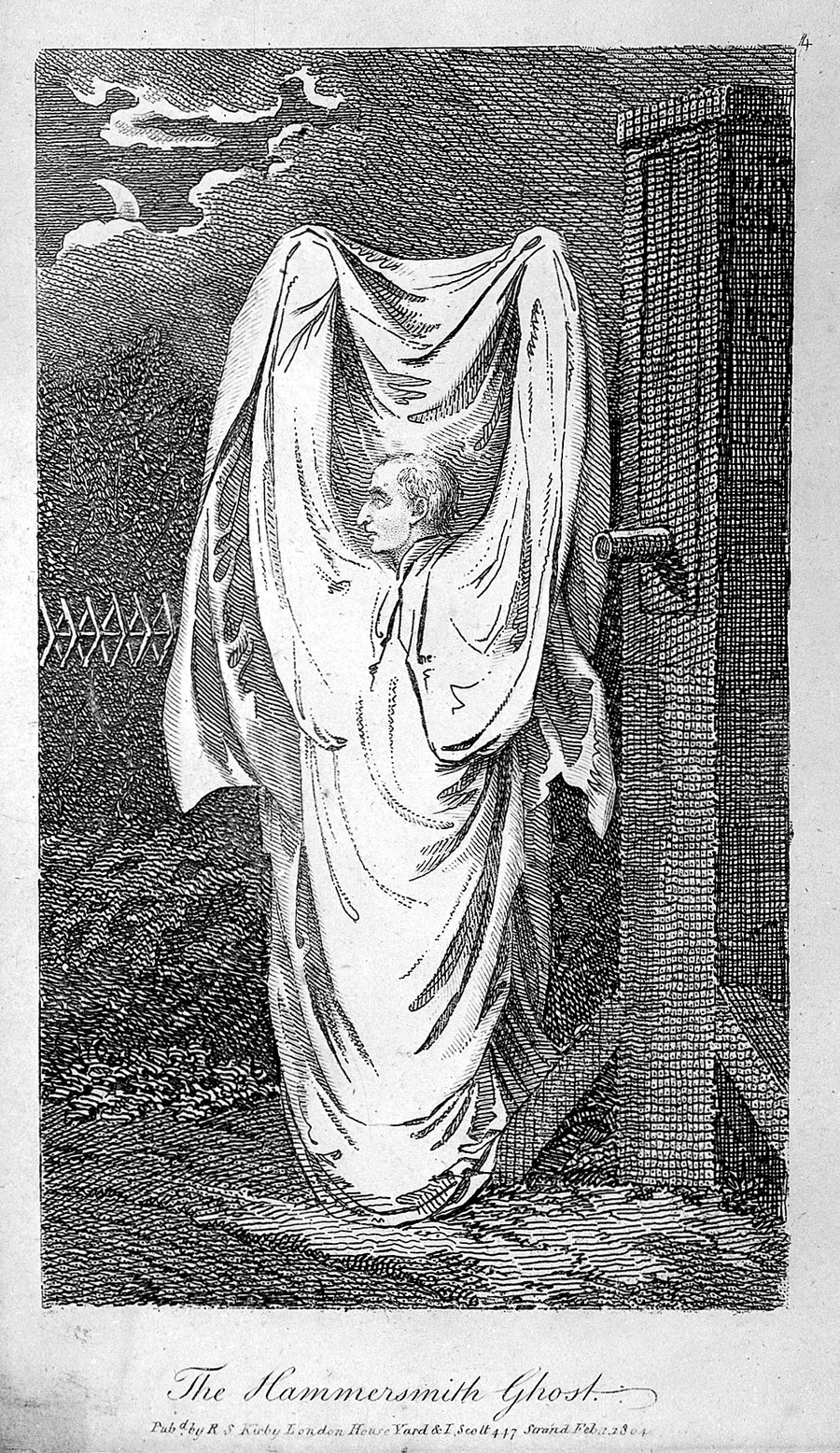
The motif of a ghost naming its killer did have real force in this period and later. The Greenbrier Ghost case of 1897 is the mirror image: a mother’s claimed visions sat beside medical evidence in a real murder conviction. In Cock Lane the claim fell apart, and the law turned on those who made it. In the Hammersmith Ghost case of 1804, it was the man hunting the ghost who was convicted.
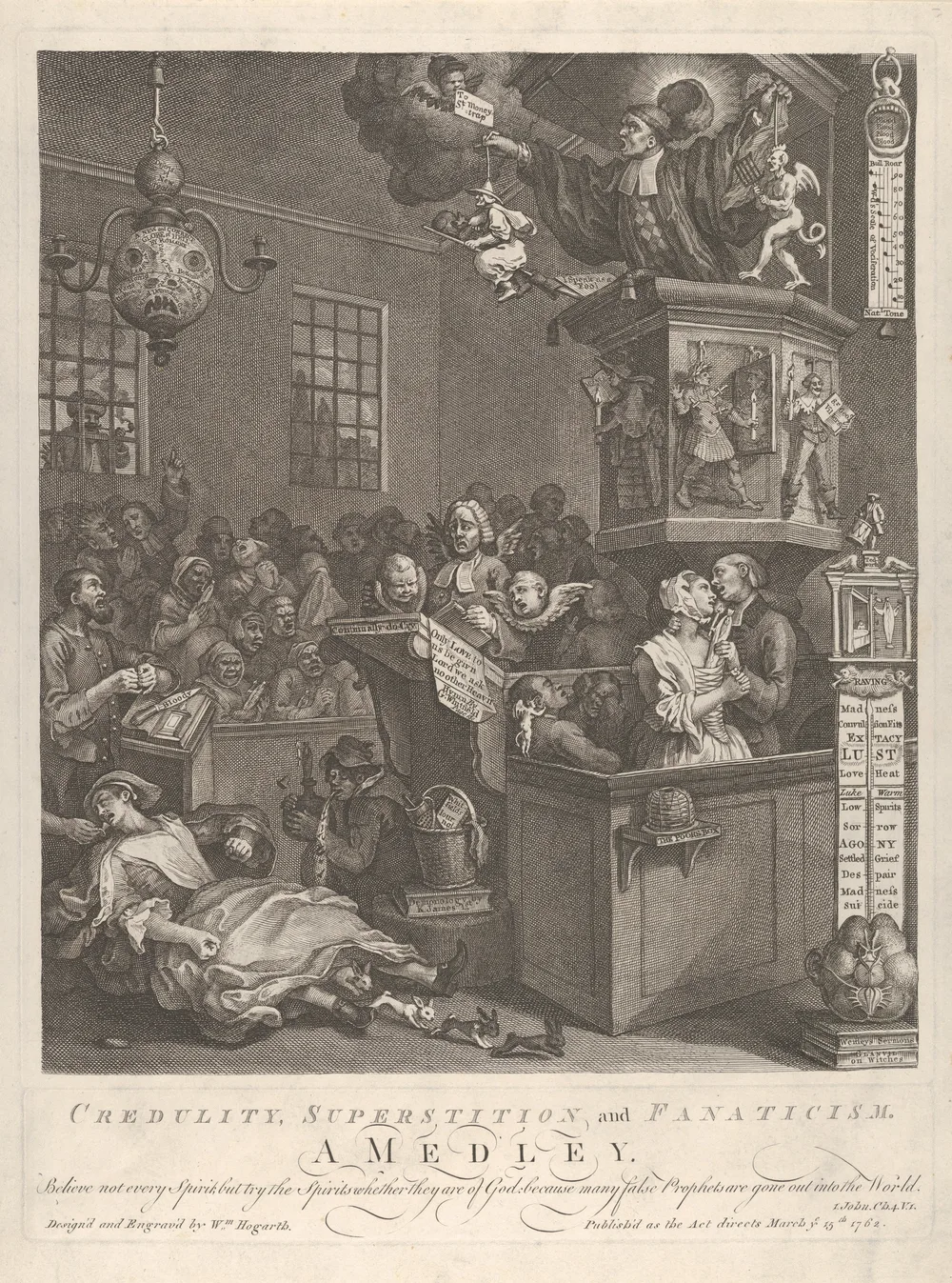
William Hogarth’s Credulity, Superstition, and Fanaticism, published 15 March 1762. Near the top of the thermometer at right, a shrouded ghost with a hammer knocks beside a child in bed. Metropolitan Museum of Art, CC0, via Wikimedia Commons; resized and converted to WebP.
The woman on the floor at lower left, with rabbits at her skirts, is Hogarth’s reference to an earlier English scandal, the Mary Toft rabbit hoax of 1726.
The coffin story that won’t go away
One later claim deserves a warning, because it can make the poison story look alive. In a note printed in Mackay’s 1852 edition, the artist J. W. Archer says that he was sketching in the crypt of St John’s when a sexton’s boy told him he was sitting on the coffin of “Scratching Fanny”. He opened it, and described a preserved face with no sign of smallpox. He suggested this was evidence for poisoning, because he believed some mineral poisons preserved bodies.
This is an anecdote, not a finding. The Annual Register says that the coffin opened in 1762 had “no plate or inscription”, and that the undertaker recognised it by sight. So Archer’s identification, some 80 years later, rests on what a sexton’s boy told him and on a churchwarden’s assurance about tradition. No examination followed, and his medical inference was his own. It should not be treated as evidence against William Kent. No source we read records any charge against him over her death.
Where the sources disagree
| Point | One version | Another version | Our reading |
|---|---|---|---|
| Elizabeth’s age | 11 (Annual Register, Gaston) | 12 (Mackay, Dr Johnson’s House) | About 11-12. The Oxford DNB heading cited by Wikipedia gives her birth as 1749 |
| Was the child tried? | Mackay says she was indicted | The Annual Register names only her parents, Frazer, a clergyman and a tradesman | Not tried. Her mother was also an Elizabeth, the likely cause of later confusion |
| Kent’s name | “Knight” (Bruce) | “Kent” (Gaston, Wikipedia, Dr Johnson’s House) | Kent. Period print used “Mr K—”, and Bruce admits that “Knight” was inference |
| Date of the Clerkenwell test | 31 January (Annual Register) | 1 February (Mackay, Dr Johnson’s House, Moore’s retraction as quoted by Wikipedia) | 1 February is better attested, though the record is not uniform |
| Noises between 1760 and 1762 | Stopped for over 18 months (Annual Register) | Parsons said they never stopped (Mackay) | The first is the earlier source, and the second may be Parsons’s own claim |
| Year of Fanny’s death | 1760 (Lang, Wikipedia) | 1759 (Gaston) | 1760 |
| Johnson at the coffin opening | Yes (Bruce) | The Annual Register’s list on 25 February names no Johnson | Unsupported. His report covers the 1 February vault visit and does not say who went down |
What is documented, claimed and unresolved
Documented:
- Crowds, press coverage and the 1762 test at Clerkenwell.
- Johnson’s group finding no evidence of a spirit.
- The conviction of five people for conspiracy on 10 July 1762, and their punishments.
- The opening of the coffin on 25 February 1762.
Witness claims:
- The knocks and scratches themselves, reported by many people in poorly controlled rooms.
- Visions of a white or shrouded figure, reported by Elizabeth Parsons and a nearby publican, among others.
False or unsupported allegation:
- That Fanny Lynes was poisoned by William Kent. Its only basis was the knocks. The medical attendants said smallpox.
Theory:
- Revenge by Parsons, a child’s trick exploited by adults, dissociation, or a poltergeist.
- Archer’s reading of the preserved body.
Unresolved:
- How the original noises were made.
- Who started them, and how much Elizabeth understood.
- What became of her later. Lang wrote in 1894 that her fortunes were unknown. The Oxford DNB gives her dates as 1749-1807, but we saw only that heading, and have not verified accounts of her later life.
Frequently asked questions
Was the Cock Lane ghost real?
No reliable evidence supported it. Johnson’s group concluded there was “no agency of any higher cause”, and a court convicted five people of conspiracy over it. The exact method behind the noises, however, was never demonstrated.
Who was Scratching Fanny?
It was the popular nickname for the supposed ghost of Fanny Lynes, a real woman who died in Clerkenwell in February 1760, her doctors said of smallpox. She had no part in the accusation made in her name.
Did William Kent poison Fanny?
There is no evidence that he did. The accusation came only from the knock code, her physician and apothecary attributed the death to smallpox, and the court treated the charge as a false one against him.
What was Samuel Johnson’s role?
He took part in the February 1762 investigation and wrote its report. Boswell records this, and also that Johnson was unfairly mocked as a believer.
How did Elizabeth Parsons make the noises?
Nobody established it. She was caught with a small board in February 1762, but the men who caught her said that the sounds were unlike the earlier ones. Silence when her hands were visible or tied suggests she was responsible, and that is as far as the evidence goes.
Was Elizabeth Parsons punished?
Not according to the Annual Register’s list of those tried. Her father was pilloried and imprisoned, and her mother, also named Elizabeth, received a year in prison.
Can you still visit Cock Lane?
Yes. It is a short street near Smithfield in the City of London. We could not confirm whether any part of the 1762 house survives, so treat any building pointed out as the haunted house with caution.
Sources & further reading
- 'A summary account of the proceedings in regard to some strange noises', The Annual Register for 1762, pp. [142]-[147], including the Aldrich and Penn notice, the Clerkenwell report and the sentences (primary; read in the Internet Archive scan of a corrected edition; accessed 1 November 2026)
- James Boswell, The Life of Samuel Johnson (1791), on Johnson, John Douglas and the written account, via Project Gutenberg (primary; accessed 1 November 2026)
- Horace Walpole to George Montagu, 2 February 1762, The Letters of Horace Walpole, vol. 3, via Project Gutenberg (primary; accessed 1 November 2026)
- Wellcome Collection, 'A complete contemporary history of the Cock Lane Ghost', 1762: catalogue record for a volume with two engravings and eight issues of the London Chronicle (catalogue record read, volume not read in full; accessed 1 November 2026)
- Charles Mackay, Memoirs of Extraordinary Popular Delusions (1852 edition), 'Haunted Houses', including J. W. Archer's note on the coffin, via Project Gutenberg (accessed 1 November 2026)
- Andrew Lang, Cock Lane and Common-Sense (1894), via the Internet Archive; also the source for our description of The Mystery Revealed, which we did not read directly (accessed 1 November 2026)
- H. Addington Bruce, Historic Ghosts and Ghost Hunters (1908), ch. V, via Project Gutenberg (accessed 1 November 2026)
- Sean Gaston, 'An Event Without An Object: The Cock Lane Ghost, London 1762-1763', The Literary London Journal 12:1-2 (2015) (accessed 1 November 2026)
- Isaac Lucia, 'The Cock Lane Ghost', guest blog, Dr Johnson's House, 30 October 2024 (accessed 1 November 2026)
- Melvyn Willin, 'Cock Lane Ghost', Psi Encyclopedia, Society for Psychical Research, last updated 5 September 2026, used for Colin Wilson's poltergeist view and Paul Chambers's description of the sources (accessed 1 November 2026)
- Wikipedia: Cock Lane ghost, used for details it attributes to Douglas Grant (1965), Paul Chambers (2006) and period newspapers, none of which we read directly; each such claim is flagged in the text (accessed 1 November 2026)
- The Beauties of All Magazines Selected for 1762, vol. 1, via the Internet Archive (source of the board and room plan; accessed 1 November 2026)
- Metropolitan Museum of Art, William Hogarth, Credulity, Superstition, and Fanaticism, accession 91.1.117 (image source, via its Wikimedia Commons file record; accessed 1 November 2026)