Lore & Explained / Paranormal Cases
The Greenbrier Ghost: Did a Ghost Really Help Convict a Murderer in 1897?
Did a ghost help convict Edward Shue? The 1897 trial reporting separates Mary Heaster’s claimed visions from the murder evidence and later Greenbrier folklore.
Topics: Greenbrier Ghost, Zona Heaster Shue, Elva Zona Heaster Shue, Mary Jane Heaster, Edward Shue, West Virginia folklore, 1897 murder trial, Ghost testimony
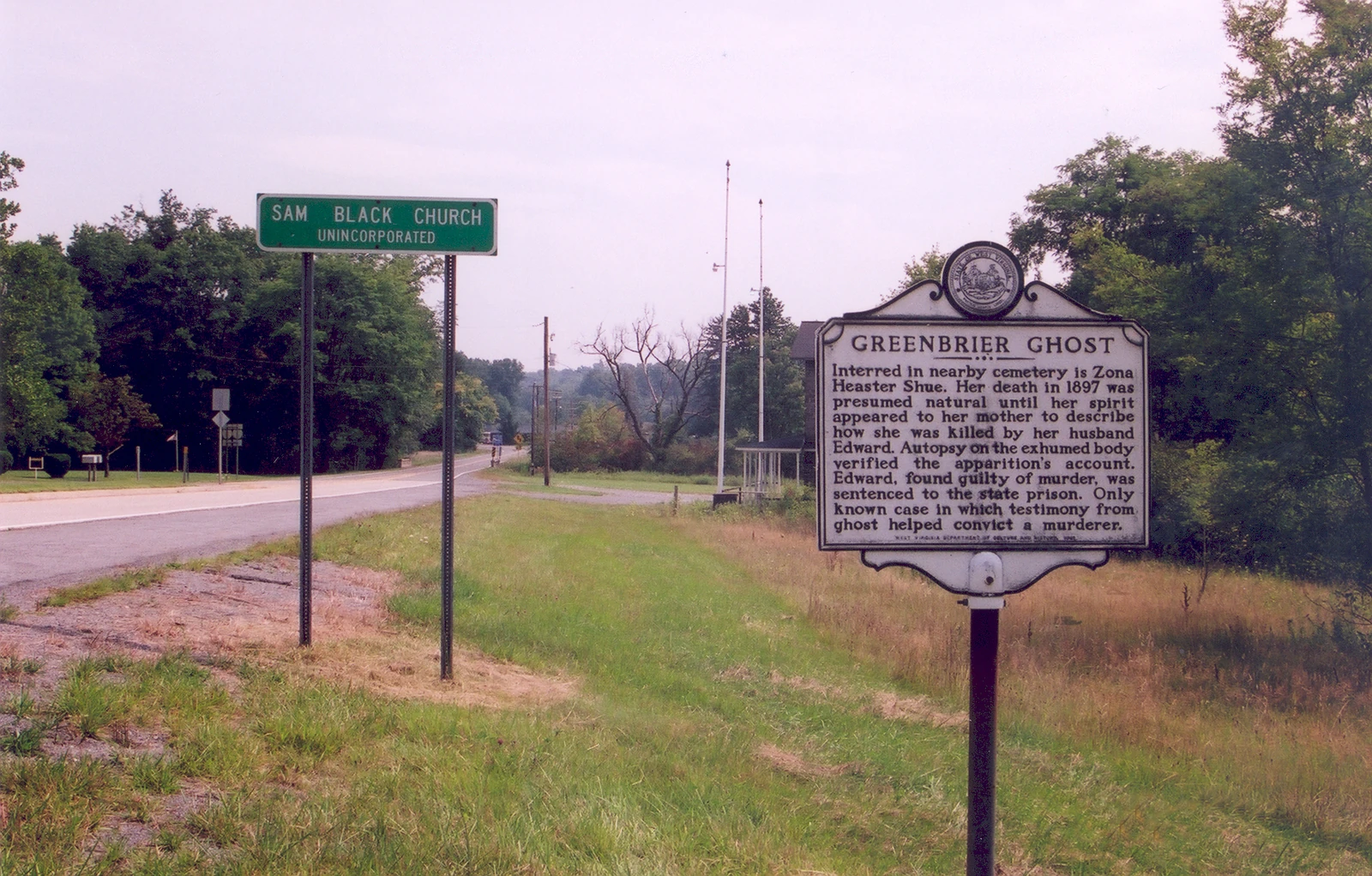
The famous version of the Greenbrier Ghost story sounds like a legal impossibility: a murdered woman returns from the dead, names her killer, and helps send him to prison. A roadside historical marker in West Virginia even describes the case as one in which a ghost’s testimony helped convict a murderer.
There really was a murder trial in Greenbrier County in 1897. A mother really did tell a court that she had seen her dead daughter four times. And a jury convicted the daughter’s husband of murder. But those facts do not mean a ghost appeared in court, that the jury accepted supernatural evidence as proof, or that the haunting can be verified.
The surviving newspapers allow a more revealing reconstruction. They show how a mother’s extraordinary claim entered the testimony alongside medical findings and circumstantial evidence, and how later retellings turned that complicated courtroom episode into an apparently simple ghost story.
Who was Zona Heaster Shue?
Elva Zona Heaster Shue, often called simply Zona, lived in rural Greenbrier County, West Virginia. She married Erasmus Stribbling “Trout” Shue, also known as Edward Shue, a blacksmith. Their marriage was brief. Zona was found dead in their home in January 1897.
Accounts do not always agree on the precise day. A contemporaneous Monroe Watchman trial report reproduced by West Virginia Archives and History identifies January 22; an earlier Greenbrier Independent account, reprinted by the West Virginia Daily News, refers to her death on January 23. The discrepancy is a reason not to pretend that every date in the later legend is certain.
According to the trial reporting, a boy sent to the Shue home on an errand discovered Zona’s body on the floor. Dr. George W. Knapp was called, but the initial examination did not establish the full cause of death. Testimony later described Shue’s involvement in preparing the body, clothing that covered the neck, and the doctor’s interrupted attempt to examine it more closely.
It is important to distinguish a witness account printed in a newspaper from a finding that every reported detail happened exactly as described. What the surviving material clearly establishes is that Zona’s death became suspicious and that investigators eventually reopened the question of its cause.
Why was her body exhumed?
Zona was buried, but unease about her death continued. The Greenbrier Independent report of February 25, 1897 says that local suspicions prompted authorities to order an inquest and exhumation. Doctors examined her remains and identified injuries to the neck.
The later Monroe Watchman trial report describes a dislocation between the upper vertebrae, damaged ligaments and a crushed windpipe. Those were the medically consequential findings reported in 1897. They turned an initially unexplained death into an investigation of possible homicide.
The supernatural story became inseparable from this sequence because Zona’s mother, Mary Jane Heaster, said her daughter had appeared to her and described an assault by her husband. It is tempting to compress the sequence into “a ghost revealed the broken neck.” But suspicion, the exhumation, physical findings and later trial testimony all have their own documentary histories. The mother’s claimed visions were not a substitute for the post-mortem examination.
What did Mary Jane Heaster say she saw?
During the trial, Mary said Zona had returned to her on four occasions. She insisted these were waking appearances, not dreams brought on by grief. According to the testimony reproduced in the Greenbrier Independent of July 1, 1897, she believed the apparition had accused Shue and described an injury to Zona’s neck.
The published questioning reveals details that disappear from shortened ghost-story versions. Mary was pressed on whether her sorrow could have produced dreams, whether she had already known anything about the house, and whether the apparition had described places where evidence might be found. When asked about one possible location, she acknowledged that a search had found nothing there. She did not abandon her belief that she had seen her daughter.
These exchanges are evidence of what Mary said under questioning. They are not independent confirmation that an apparition existed. Nor do they justify confidently diagnosing her experience after the fact. The historical record can establish her words and conviction without establishing the supernatural explanation she gave them.
Did a ghost actually testify in court?
No ghost appeared as a witness. Mary Heaster testified about an experience she believed was supernatural. That distinction is more than a technicality.
The archive introduces the vision testimony as having been brought out by counsel for the accused. The defense questioned Mary on whether she had dreamed the meetings with Zona. That is a much more complicated courtroom scene than the version in which prosecutors simply call a ghost to prove murder.
The contemporary account of the prosecution’s case says explicitly that there was no eyewitness to the killing and that the state depended on circumstantial evidence. It describes the medical observations and conduct attributed to Shue, including his reported objection to further examination of the body, his handling of its clothing, and remarks witnesses said he made after Zona’s death.
Shue denied killing his wife. The Greenbrier Independent reported his defense and the jury’s decision, not a paranormal test or any judicial finding that a spirit had been present.
The popular phrase “the ghost’s testimony convicted him” therefore combines two different things: a real witness’s account of an alleged visitation, and a verdict reached in a homicide case with physical and circumstantial evidence. The West Virginia Encyclopedia preserves the local tradition and the historical marker’s claim, but the period reporting permits — and requires — a narrower account of what the court actually heard.
What happened at the 1897 murder trial?
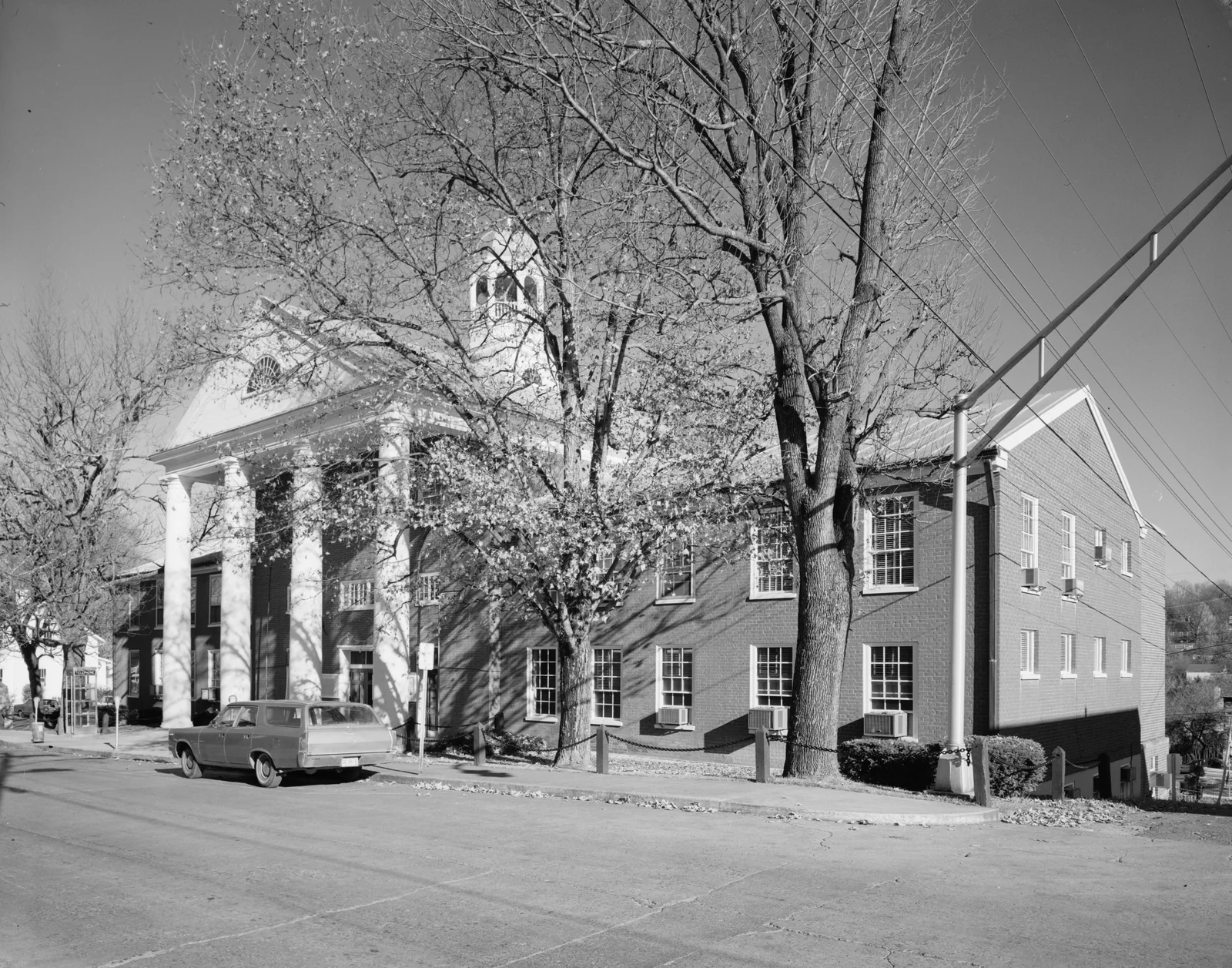
The case was heard in the Greenbrier County Courthouse in Lewisburg. An issue of the Greenbrier Independent dated June 24 records the opening of the proceedings and the jurors sworn to hear the case. Later reports describe medical testimony, the mother’s questioning and Shue’s own denial of guilt.
In a July 8 newspaper report reproduced by West Virginia Archives and History, the jury returned a verdict of first-degree murder, recommending imprisonment rather than execution. Shue received a life sentence.
There is a small but instructive date problem here too. The July 8 issue says jurors returned their verdict “last Thursday afternoon”, which points to July 1. The West Virginia Encyclopedia gives July 8 as the conviction date. The original report’s publication date and its description of the day of the verdict should not be silently treated as identical. Without the complete surviving court record, it is safer to describe the verdict as reported in early July than to insist every later timeline agrees.
The same contemporary report calls the state’s evidence circumstantial and notes the jury’s recommendation of imprisonment. Whether modern readers find the mother’s testimony extraordinary does not change the legal outcome: a man was tried and convicted for the killing of his wife, not for a supernatural offense.
The courthouse and the place where the legend survives
The Greenbrier County Courthouse still stands in Lewisburg. Its survival makes the setting unusually tangible: this is not a ghost tale invented around a demolished fictional mansion. The building dates from 1837, according to the Historic American Buildings Survey photograph record. The article’s header image is a 1974 photograph of that courthouse, not a photograph taken during the trial.
A roadside marker near Sam Black Church also preserves the story. It credits the alleged appearance of Zona’s spirit with helping bring about the conviction. That inscription is valuable as a record of how West Virginia remembers the case, not as a second independent eyewitness to a ghost.
The legend’s durability also owes something to its rare narrative shape. Most courtroom ghost stories leave a haunted place and an uncertain ending. Here, the victim was real, the investigation had a documented outcome, and a family member left an unusually detailed account of seeing the deceased. Those elements make the supernatural interpretation memorable even when the evidence is read cautiously.
What happened to Edward Shue afterward?
Shue was imprisoned following the conviction. The West Virginia Encyclopedia records that he died in prison in March 1900. The historical record supports describing him as a convicted murderer. It does not support using the case to prove the existence of an apparition or to invent a psychological explanation for either the crime or Mary’s experience.
Zona’s story remains attached to her name rather than disappearing into her husband’s prosecution. That is one reason a careful account should not let the ghost-story hook eclipse the person whose death brought the case to court.
What the Greenbrier Ghost case proves — and what it doesn’t
The clearest way to read this case is to keep its layers separate:
- Documented history: Zona died in January 1897; her body was exhumed; doctors reported serious neck injuries; Edward Shue was tried and convicted of murder.
- Documented testimony: Mary Heaster told the court she had seen her daughter four times and believed those appearances disclosed how she died.
- Folklore and local memory: The story became known as the Greenbrier Ghost, and a historical marker describes it as a case in which ghost testimony helped secure a conviction.
- Unverified claim: Neither the trial reporting nor later retellings demonstrate that an actual spirit appeared.
The documentary sources allow the reader to examine the relationship between testimony, belief and evidence rather than choose between a supernatural certainty and an equally unearned claim to know exactly what Mary experienced.
That distinction is useful well beyond Greenbrier County. The history of Borley Rectory shows how later publicity can reshape alleged hauntings, while the Villisca murders show why a real criminal investigation must be kept separate from a house’s later paranormal reputation. Greenbrier is different from both: its ghost story entered the documented courtroom record itself, without becoming proof that a ghost was there.
Frequently asked questions
Who was the Greenbrier Ghost?
The name refers to Elva Zona Heaster Shue, a West Virginia woman who died in 1897. Her mother later said Zona’s spirit had appeared and accused her husband of killing her.
Was the Greenbrier Ghost real?
The death, exhumation, murder trial and the mother’s testimony are documented. The alleged apparition was Mary’s claim; the surviving evidence does not establish that a spirit appeared.
Did a ghost convict Edward Shue?
No. A jury convicted Shue based on a case described by contemporary newspapers as circumstantial. Mary testified about her claimed visions; a ghost did not appear in the courtroom or give independently verified evidence.
Why do different sources give different dates?
Contemporary accounts disagree about the exact January date of Zona’s death. Later summaries also give a July 8 conviction date even though the newspaper issue dated July 8 refers to the verdict being returned the preceding Thursday. The disagreement is a reminder to distinguish an event’s date from the date on which a newspaper reported it.
Where did the trial take place?
It was heard at the Greenbrier County Courthouse in Lewisburg, West Virginia. The building survives, but the images used here were made decades later and should not be mistaken for photographs of the 1897 proceedings.
Sources & further reading
- West Virginia Archives and History: The Greenbrier Ghost — contemporary 1897 trial accounts: Mary’s examination, medical testimony and verdict
- The West Virginia Encyclopedia: Greenbrier Ghost, Dennis J. Deitz — folklore overview; dates cross-checked against period reporting
- Greenbrier County Convention & Visitors Bureau: The Greenbrier Ghost, Belinda Anderson — courthouse and local heritage context
- West Virginia Daily News: reprint of the Greenbrier Independent, February 25, 1897 — exhumation and early suspicions
- U.S. Federal Highway Administration: Greenbrier Ghost historical-marker photograph and public-domain statement
- Library of Congress/HABS photograph of Greenbrier County Courthouse via Wikimedia Commons