The Index / Historic Trials
The Hammersmith Ghost Murder: What the 1804 Trial Actually Decided
In 1804 a Hammersmith bricklayer in white work clothes was shot as a ghost. The trial record shows the mistake itself was not what decided the verdict.
Topics: Hammersmith, Old Bailey, Georgian London, Hoaxes, 19th century, Trials, Self-defence
On the night of 3 January 1804, Francis Smith, a 29-year-old excise officer, shot and killed Thomas Millwood, a young bricklayer walking down a dark lane in Hammersmith in his white working clothes. Smith was out hunting a “ghost” that had been frightening the village, and he was convicted of murder and sentenced to death at the Old Bailey. He was reprieved the same evening and later pardoned on condition of a year in prison. No evidence of a spirit was ever produced, and the court treated the ghost as a person in disguise.
The case is usually told as the story of a fatal mistake that took the law 180 years to resolve. Read the trial reports and something else appears. The judges said Smith would have been guilty of murder even if he had shot the real hoaxer. His mistake about who stood in the lane was not what convicted him.
The short version
| Date | Event | Status |
|---|---|---|
| Late 1803 | Talk of a ghost spreads in Hammersmith. Witnesses put it at five weeks, or six weeks to two months, before the shooting | Documented as a rumour |
| 29 December 1803 | Watchman William Girdler chases a sheeted figure, which escapes | Sworn testimony |
| 31 December 1803 | Millwood tells his mother-in-law that people in a carriage took him for the ghost | Testimony about his own account |
| 3 January 1804 | Smith shoots Millwood in a lane off Black Lion Lane | Documented |
| Within days | A coroner’s jury sits at the Black Lion inn; Smith is sent for trial for wilful murder | Documented |
| 13 January 1804 | Trial, conviction and death sentence; a respite arrives that evening | Documented |
| 25 January 1804 | Pardon on condition of a year’s imprisonment | Reported in the Newgate Calendar |
| After the trial | Shoemaker John Graham is said to have admitted being the ghost | Later claim, unconfirmed |
| 1983 and 2008 | R v Williams (Gladstone) and section 76 set out the modern law on mistaken belief | Documented; the link to 1804 is later commentary |
A note on the sources
Three kinds of evidence survive, and they do not carry the same weight.
The Old Bailey Proceedings give the testimony in question-and-answer form but leave out the judge’s speech. The New Annual Register for 1804 prints a long report of the inquest and the trial, including that speech, and it is the only place we found the inquest evidence. The Annual Register has a shorter summary. These were published close to the events.
Later books largely repeat one another. Thomas Faulkner’s 1813 history of Fulham and the 1841 Chronicles of Crime tell the story of the frightened pregnant woman in almost the same words, which points to shared text, not independent confirmation. Modern retellings then add further layers. We did not read the 1804 pamphlet account in Kirby’s Wonderful and Scientific Museum, or any newspaper from that month.
The reports also spell names differently. The Proceedings say Millwood and Girdler. The New Annual Register says Milward and Grinfield. We use the Proceedings’ spelling.
Who Thomas Millwood was
Most retellings give Millwood one role, the man in white. The inquest report offers a little more. His sister, called Nancy there and Ann at the trial, said he was 22 and supported himself and his wife by his work. Some modern retellings give a different age, but this is the earliest statement we found and it comes from his family. He was a journeyman bricklayer. His mother-in-law, recorded as Mrs. Fulbrooke or Phebe Foulbrook, said he lived at her house and that his wife was pregnant. On the night of the shooting she sent word that the wife should not be brought home.
The clothes were ordinary for his trade. John Locke, a wine merchant, described them in court: white linen trousers washed very clean, a new white flannel waistcoat and an apron.
Both women told the inquest that he had never played the ghost. Girdler, who had chased the real figure five days earlier, went further, according to the same report. He said that figure was a tall man in a dark coat with shining metal buttons, “altogether unlike the deceased”. The popular image of an innocent man who merely looked like the ghost needs that qualification. Locke agreed the reported costume matched Millwood’s clothes, but the one witness who had pursued the figure at close quarters did not think it was him.
Three days before he died, Millwood told Mrs. Fulbrooke that two ladies and a gentleman in a carriage on the terrace had taken him for the ghost, and that he had answered angrily. She begged him to wear a greatcoat. She could not recall exactly what he replied, except that he wished the ghost was caught.
The night of 3 January
Smith met Girdler at the corner of Beaver Lane, carrying a gun, and said he was going to look for the ghost. Girdler said he would come round after crying the hour. The two agreed a challenge in case they met in the dark: “who comes there? Friend. Advance, friend.” Nothing suggests anyone else knew it. Girdler, who carried a pistol himself, later heard the shot and ignored it, because he heard guns fired at night almost every quarter of an hour.
Millwood had gone to his parents’ house in Black Lion Lane to wait for his wife, who was out working nearby. His sister testified that she heard the watchman call past eleven and told him to go, as it was not safe for his wife to walk home alone. He left and shut the door. She got up and went to the door straight after him, and then she heard a voice and a gun.
What was said in those seconds is the key disputed fact, and it has reached us in several forms.
| Source | What was said before the shot |
|---|---|
| Smith, as told to Locke | He spoke twice, got no answer, and the figure came towards him |
| Smith’s own defence | He spoke twice, got no answer and became too agitated to know what he did |
| Ann Millwood, Old Bailey Proceedings | “d-n you, who are you, and what are you, d-n you, I will shoot you?”, with the gun going off while the words were being spoken |
| Ann Millwood, Annual Register | “Damn you, who or what are you? Speak, or I’ll shoot you”, with the report following immediately |
| Ann Millwood, New Annual Register trial report | “Tell me who you are, otherwise I will instantly shoot you”, with the gun going off soon afterwards |
Only Smith reported two challenges and an advancing figure. Modern accounts tend to give this as fact. Millwood’s sister, the only other witness to the words in the reports we read, described a threat and little or no gap before the shot. She was at the family’s door on a very dark night, so her evidence does not rule out his version, but it does not support it either. No third witness to the exchange was called.
Smith then went to find help. He told Girdler he had hurt a man and feared it was very bad, and he told Locke he had shot a man he believed to be “the pretended ghost of Hammersmith”. The phrase matters, because a pretended ghost is a living person. Locke said Smith offered to give himself up at once. The inquest report adds a harder detail from the same witness: Smith did not at first seem to think he had done any harm in killing the ghost, and became much agitated only after Locke pointed out what might follow. At the trial, cross-examined by the defence, Locke spoke warmly of Smith’s character, and that detail does not appear in the Proceedings.
Ann Millwood, who had tried and failed to convince her parents and a young man in the house that her brother had been shot, went out alone and found him in the lane. The body was taken to the Black Lion. The surgeon, Mr. Flower, said a gunshot wound from small shot to the lower left jaw had reached the spine and caused death. The inquest report says powder had blackened the skin, and took that as a sign the gun was fired at close range.
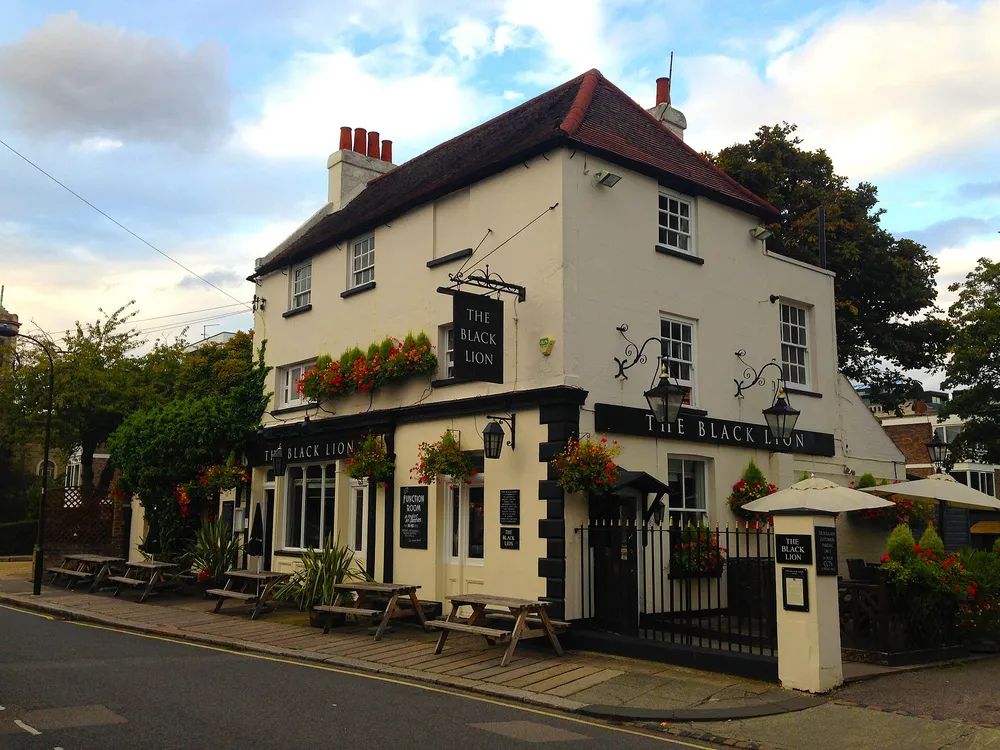
The Black Lion in Hammersmith in 2017. The inquest was held at an inn of this name, and this pub’s listing dates the building to the late 18th century, but we could not confirm from the sources we read that it is the same structure unchanged. Photo: Giancarlo Mariot, CC BY-SA 4.0 via Wikimedia Commons; resized and converted to WebP.
The trial
Smith was tried on Friday 13 January, according to both annual registers and Faulkner. Online references sometimes give 11 January, apparently because the Old Bailey’s reference number carries the date of the session. The New Annual Register says he tried to leave his defence to his counsel and was told they could only examine witnesses, so he spoke for himself. He said he went out with a good intention and had no malice against the deceased. Twelve witnesses gave him a good character.
The defence called Mrs. Fulbrooke to show that Millwood’s clothes had been mistaken before. It also called Thomas Groom, a brewer’s servant, who said someone had seized him by the throat in the churchyard. Groom felt something soft “like a great coat”, which is hardly evidence for a spirit.
The Lord Chief Baron, whom Wikipedia names as Sir Archibald Macdonald citing a collection of trials from 1804, told the jury what the case was about. In the report in The New Annual Register, he said malice in law did not require spite against the victim. Killing out of fear for one’s own safety, or by accident, might be manslaughter, but such circumstances could not be found here. Nobody could say, “I will of my own accord go out and shoot this abominable person, who has alarmed the whole neighbourhood.” It would have been enough to try to apprehend him.
The jury retired for somewhere between 45 minutes and an hour and a quarter, depending on the report, and returned manslaughter. The bench refused it. According to the Proceedings, the jury could only convict or, if they disbelieved the prosecution’s witnesses, acquit, and “the prerogative of shewing mercy lay in the Crown”. Mr. Justice Rooke and Mr. Justice Lawrence agreed. The jury turned round, and after a short conversation found Smith guilty.
The recorder sentenced him to hang on the following Monday, with his body to go to the surgeons for dissection, the same penalty of dissection later imposed on William Burke. Smith was too agitated to walk back unaided. The Lord Chief Baron reported the case to the king, and the Newgate Calendar says a “respite during pleasure” reached the Old Bailey before seven o’clock that evening. Smith received a pardon on 25 January, on condition of a year’s imprisonment.
What actually decided the verdict
This is where the common telling goes astray. The case is often summarised as a man convicted despite an honest mistake. The reports show the mistake was barely relevant to the judges’ reasoning.
Their position, as reported in The New Annual Register and the Newgate Calendar, ran like this:
- Impersonating a ghost was a misdemeanour. It could justify arresting the culprit, not shooting him.
- If Millwood had been the hoaxer, Smith would still have been guilty of murder.
- Even a felon could not lawfully be killed by a private person who chose to punish him. An officer who used a deadly weapon where it was not needed for the arrest could also be guilty of murder.
- Smith had not been caught by surprise. He had gone out expecting exactly this encounter and had taken a gun.
On this reasoning, it made no difference who stood in the lane. The court was refusing to accept a private citizen’s decision to shoot a nuisance. This also answers a question modern readers often ask about superstition. Nobody at the trial argued that Smith thought he was firing at a dead man’s spirit, and the language in court was about a “mischievous person” and a “pretended ghost”.
The jury’s manslaughter verdict shows that twelve men wanted a lesser finding, and the speed of the respite suggests the judges may have felt similarly. The bench itself pointed to the Crown for mercy. The conviction and the reprieve were two halves of one outcome.
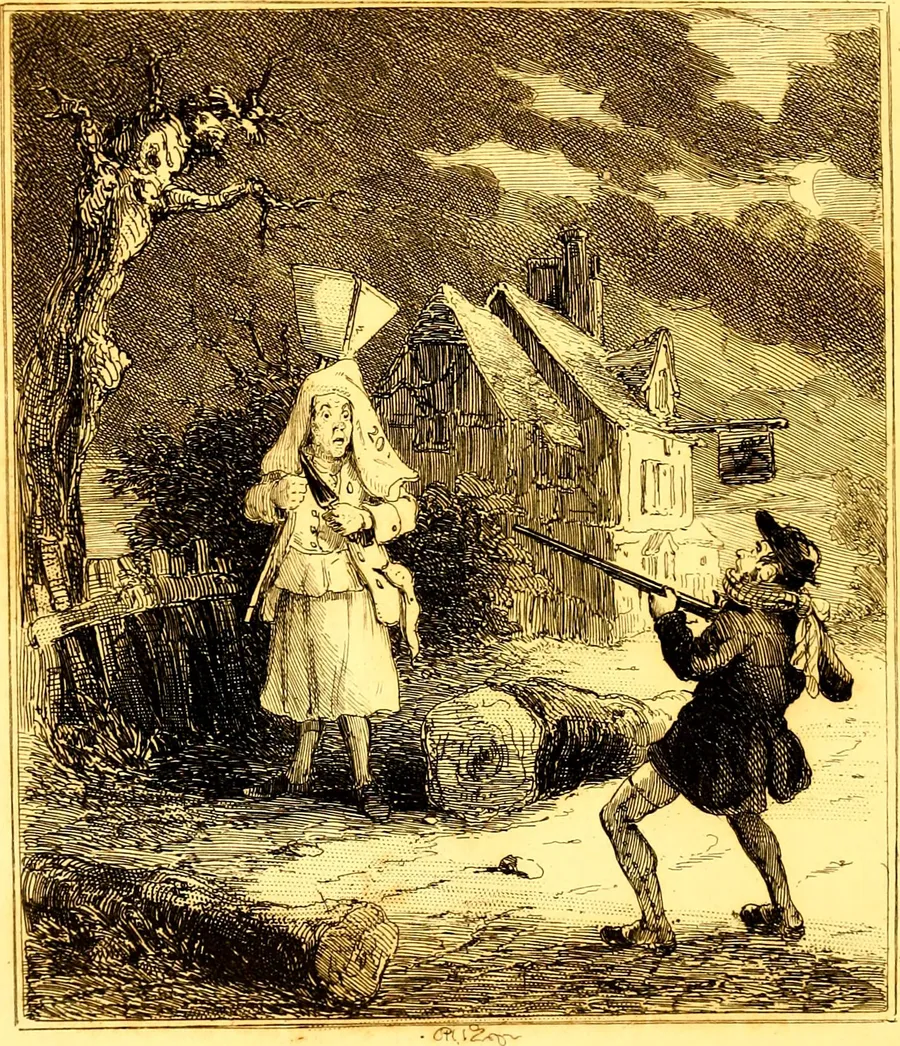
“Shooting a Ghost”, plate by “Phiz” (Hablot K. Browne) for The Chronicles of Crime, imprint dated 1 October 1840. Within a generation a young man’s death had become a comic illustration. It is not evidence of how the scene looked: both trial witnesses and period reports stress how dark the lane was. No known copyright restrictions, via Wikimedia Commons; resized and converted to WebP.
Who was the real ghost?
The hoaxer was never identified in any record from 1804 that we read. Modern accounts name John Graham, a shoemaker, who is said to have admitted dressing in a sheet to frighten his apprentice or apprentices, because they had been scaring his children with ghost stories.
That story may be true, but its footing is weaker than it looks:
- The Library of Congress post and Crime Magazine give it without a period source that we could see. Wikipedia cites two modern folklore reference books, which we did not read.
- Accounts disagree on timing. Crime Magazine says two days after the shooting, with Graham surrendering to magistrates and being bailed. Mental Floss says the following week.
- A search of the machine-read text of both annual registers for 1804 found no Graham connected to the case, though damaged text could hide a mention.
- Faulkner’s history, written nine years later, still called the culprit “an unknown person”. The Newgate Calendar entry we read does not name him either.
- Wikipedia, citing its folklore sources, calls Graham elderly. Girdler described a tall man who “darted off as swift as an arrow”. That is no disproof, because more than one person may have played the part, but it is worth noting.
We would treat Graham as a later report that needs a 1804 source, probably a newspaper, before it can be called established. No record we found shows he was ever punished, and Crime Magazine says the same.
The inquest report also suggests a possible extra motive for the men searching the lanes. Locke said he had heard of no formal reward, but believed a clergyman and another gentleman had each promised five guineas to whoever discovered the ghost. None of the modern retellings we read mentions this.
Documented, claimed, rumoured
Documented. Millwood’s death, Smith’s conviction and death sentence, the rejected manslaughter verdict, the fact of a local ghost scare and the armed search for it. The respite is reported consistently, and the conditional pardon appears in the Annual Register, Faulkner and the Newgate Calendar.
Sworn testimony, not independently confirmed. Girdler’s chase of the sheeted figure, Groom’s assault in the churchyard, Millwood’s run-in with the carriage party as Mrs. Fulbrooke related it, and Smith’s claim that he called out twice.
Rumour and later retelling. The woman who died of fright after being seized near the churchyard. Faulkner and the Newgate tradition describe her, without a name. Asked in court about harm done to any woman, Girdler answered: “I have heard tell of it, but I don’t know it.” Crime Magazine notes such tales were never substantiated. Faulkner also has a waggoner abandoning eight horses and sixteen passengers. The idea that the ghost was the spirit of a man who had cut his throat a year earlier is reported as local talk, and is folklore in the strict sense.
Paranormal claim. The Library of Congress post repeats that Millwood’s spirit is said to linger at the pub, and Mental Floss, citing a BBC article we could not open, says local legend has it returning every 50 years. We found no evidence for this, and it is told as a legend even by the writers who repeat it.
Unresolved. Who played the ghost, whether one person or several did, and what was actually said in the lane.
Details that change in the retelling
| Common version | What the early sources say |
|---|---|
| Shot at about 10.30 | Inconsistent. In the Proceedings, Locke met Smith after the shooting at “half past ten”, yet Girdler met Smith before it at “about half past ten”, and Ann Millwood’s account runs past eleven. At the inquest Locke said between eleven and twelve. A time after eleven fits best |
| Tried on 11 January | The session is dated 11 January; the registers and Faulkner date the trial to 13 January |
| Smith was a customs officer | The Proceedings and registers say Excise |
| A year of hard labour | The sources from the period that we read say a year’s imprisonment, and the Annual Register says in Newgate. Mike Dash says six months; we found no support for that in these reports |
| Millwood was mistaken for the ghost twice, or twice that day | Mrs. Fulbrooke described one incident on the Saturday. His sister told the inquest he had once been taken for it, and the Annual Register says once before |
| Thomas Groom was a brewer | He was servant to a brewer, Mr. Burgess |
The legal legacy, and an overstated link
Popular accounts say the case left a gap in the law until the Court of Appeal decided R v Williams (Gladstone) on 28 November 1983. Williams had intervened in what he took to be an assault on a youth, when the man he confronted was actually trying to detain a suspected thief. Lord Lane held that a defendant in that position should be “judged against the mistaken facts as he believes them to be”, even if the mistake was unreasonable, although unreasonableness can bear on whether the belief was honestly held.
Section 76 of the Criminal Justice and Immigration Act 2008 now puts this in statute, with an exception for mistakes caused by voluntary intoxication. Its explanatory notes say it does not change the existing reasonable force test.
Two cautions. First, the judgment in Williams, in the copy we read, does not mention Hammersmith or Francis Smith at all. The connection is one drawn by later commentators, a fair comparison of two cases about mistaken belief, not a line of authority running directly from one to the other.
Second, some retellings suggest the modern rule would have saved Smith. This is our own reading and not legal advice, but we doubt it would be so simple. Modern law judges the force used on the facts as the defendant believed them. Smith believed he faced the hoaxer, whom the judges treated as a minor offender he could have arrested. The question for a modern jury would be whether firing a gun at that person was reasonable force in the circumstances he believed existed. Smith’s stronger argument would be fear of an advancing figure in the dark, which is the part of the story that rests on his word alone. The 1804 judges did not give that argument weight. A modern court might, but section 76 would not decide it for him.
Mike Dash’s survey of similar cases shows that the law could go either way elsewhere. He reports acquittals in India in 1926 and 1942 of people who attacked figures they took for ghosts, where a belief in good faith was accepted, and the manslaughter conviction of a man in Canada in the 1890s who shot someone he took for a windigo.
Why the case still reads differently from other London ghost scares
Hammersmith belongs with cases where a ghost story ended up in court, but its shape is unusual. In the Cock Lane affair of 1762, the law punished the people who kept a false haunting going. In the Greenbrier Ghost case of 1897, a mother’s reported visions sat beside the evidence in a real murder trial. In Hammersmith the court did not need to consider the ghost’s nature at all. The person who died had nothing to do with it, and the only proven death came from the response. The Library of Congress post adds that reports of the ghost resurfaced in 1824 and that Spring-Heeled Jack later took its place in the public imagination, a sign of how readily a frightening figure in the dark could be reinvented.
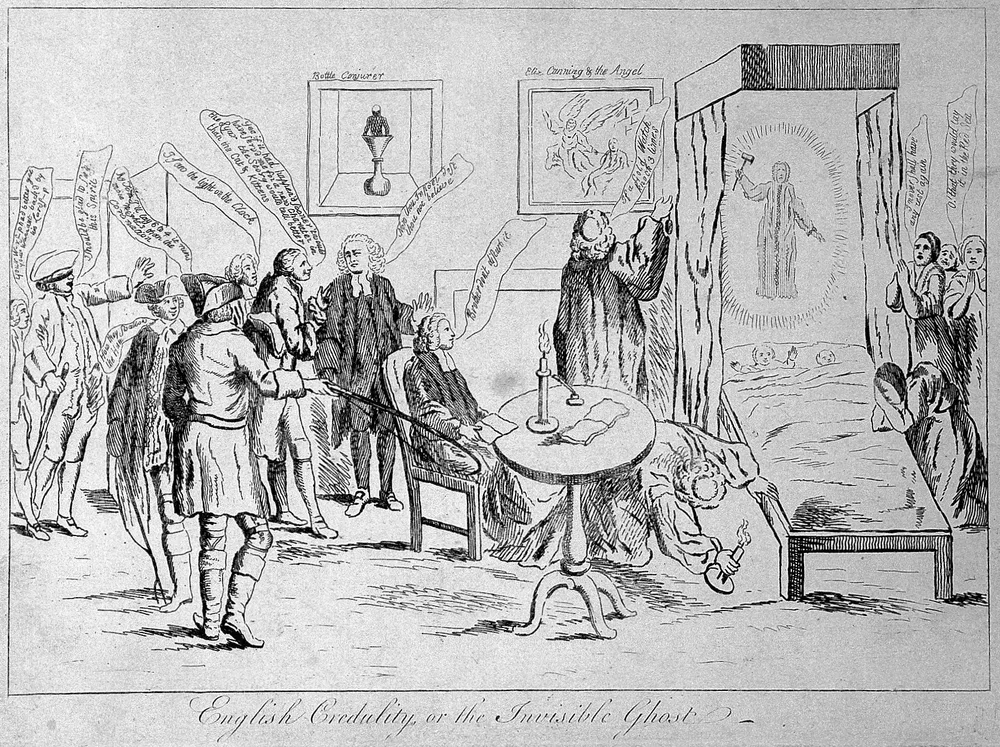
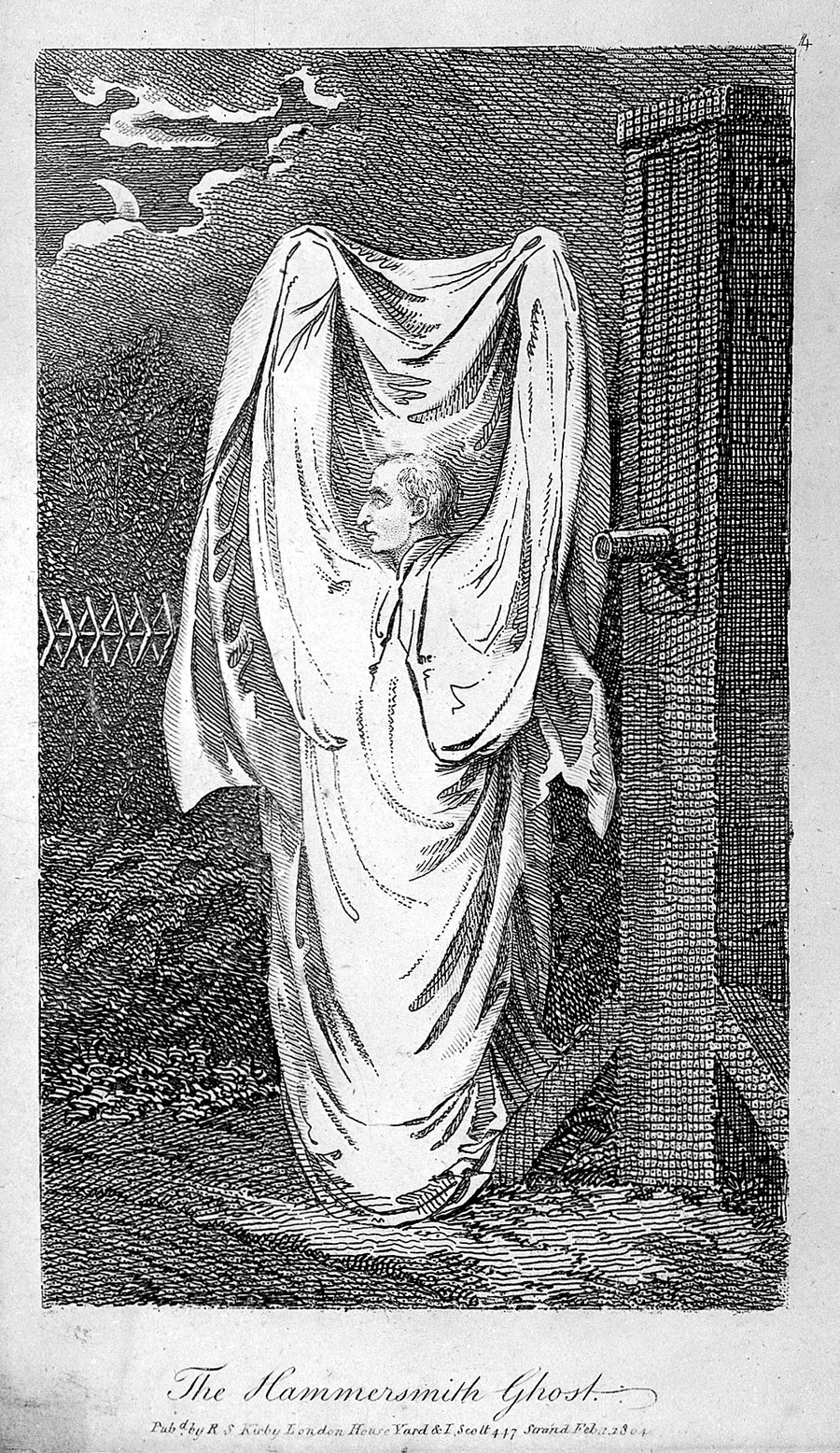
The engraving at the top of this page was published on 1 February 1804, less than a month after Millwood died. It shows an ordinary man’s face inside the sheet. That was how the story was understood from the start: as a man playing a ghost, and another man with a gun.
Frequently asked questions
Was the Hammersmith Ghost real?
There is no evidence of a supernatural ghost. Witnesses described a person in a sheet, and the watchman who chased it saw the figure throw off the sheet and run. The court treated it throughout as a person committing a misdemeanour.
Who was killed in the Hammersmith Ghost case?
Thomas Millwood, a young bricklayer, whose white working clothes resembled the reported costume. Early reports also spell his surname Milward. His family said he had never played the ghost, and the watchman said the figure he had chased looked nothing like him.
Was Francis Smith hanged?
No. He was sentenced to death on 13 January 1804 and to dissection afterwards, but a respite arrived that evening. The Newgate Calendar says he was pardoned on 25 January on condition of a year’s imprisonment.
Why couldn’t the jury find manslaughter?
The judges ruled that nothing in the evidence reduced the killing to manslaughter, such as a sudden provocation or fear for his own safety, and told the jury to convict of murder or acquit. They added that mercy was a matter for the Crown.
Did John Graham really confess to being the ghost?
Modern sources say he did, but we could not trace the claim to a record from 1804, and Faulkner still called the culprit unknown in 1813. Treat it as plausible and unconfirmed.
Did this case change the law on self-defence?
Not directly. The modern rule on mistaken belief comes from R v Williams (Gladstone) in 1983, now reflected in section 76 of the Criminal Justice and Immigration Act 2008. That judgment does not mention the 1804 case. The link is a later comparison.
Sources & further reading
- Old Bailey Proceedings, trial of Francis Smith, reference t18040111-79, January 1804 session (primary; full text read through the project's data service; accessed 2 November 2026)
- The New Annual Register for 1804, Principal Occurrences for January, reports of the inquest at the Black Lion and of the Old Bailey trial, pp. (5)-(14) (period report; read in the Internet Archive's machine-read text, which is damaged in places; accessed 2 November 2026)
- The Annual Register for 1804, Chronicle, entry for 13 January (period report; read in the Internet Archive's machine-read text; accessed 2 November 2026)
- Thomas Faulkner, An Historical and Topographical Account of Fulham, including the Hamlet of Hammersmith (1813), pp. 376-377, via the Internet Archive (accessed 2 November 2026)
- The Newgate Calendar, 'Francis Smith', Ex-Classics online transcription, including the judges' remarks, the respite and the pardon; the transcription does not state its edition (accessed 2 November 2026)
- Camden Pelham, The Chronicles of Crime, or The New Newgate Calendar (1841), plate 'Shooting a Ghost' and opening of the Smith entry, as reproduced on the Wikimedia Commons file record (accessed 2 November 2026)
- R v Williams (Gladstone) [1983] EWCA Crim 4, (1984) 78 Cr App R 276, Court of Appeal, 28 November 1983, BAILII (primary; read in an Internet Archive copy of the BAILII page; accessed 2 November 2026)
- Criminal Justice and Immigration Act 2008, section 76, legislation.gov.uk (primary; accessed 2 November 2026)
- Criminal Justice and Immigration Act 2008, Explanatory Notes on section 76, legislation.gov.uk (accessed 2 November 2026)
- Clare Feikert-Ahalt, 'The Case of a Ghost Haunted England for Over Two Hundred Years', In Custodia Legis, Law Library of Congress, 30 October 2015 (accessed 2 November 2026)
- Martin Baggoley, 'The Hammersmith Ghost and the Strange Death of Thomas Millwood', Crime Magazine, 9 April 2015; names no source for its account of John Graham (accessed 2 November 2026)
- Mike Dash, 'Ghosts, witches, vampires, fairies and the law of murder', A Blast From The Past, 25 June 2010 (accessed 2 November 2026)
- Stacy Conradt, 'The English Court Case Inspired by a Ghost', Mental Floss, 6 January 2016, used only for the Black Lion legend it attributes to BBC News; we could not open the BBC article (accessed 2 November 2026)
- Wikipedia: Hammersmith Ghost murder case, used for the facts of Williams and for its citations to Westwood and Simpson (2008), Roud (2010) and Medland and Weobly (1804), none of which we read directly; each such claim is flagged in the text (accessed 2 November 2026)
- British Listed Buildings, Black Lion Public House, Hammersmith, reproducing the Historic England listing, entry 1192979 (accessed 2 November 2026)