The Index / Hoaxes
Mary Toft and the Rabbit Births of 1726: What the Records Actually Show
Mary Toft did not give birth to rabbits. Her 1726 confessions, the doctors' reports and sworn depositions show how the hoax ran and what is still uncertain.
Topics: Mary Toft, Godalming, Hoaxes, Georgian England, 18th century, History of medicine, William Hogarth
Mary Toft did not give birth to rabbits. In the autumn of 1726, pieces of dead rabbit and other animals were placed inside her body and then “delivered”, and for about two months the king’s own anatomist, among others, accepted them as births. The fraud came apart in London in the first week of December, after a close watch on her room, a smuggled rabbit and a set of sworn statements from the rabbit sellers of Godalming. Toft then confessed under open threat.
That much is settled. Who planned it is not. Toft gave three different accounts in six days, and each one blamed someone else. Read beside the doctors’ own pamphlets, those confessions also show details that the usual telling of this story leaves out, and they correct at least two claims that are still widely repeated.
The short version
- Who she was: a poor farm labourer from Godalming, Surrey, baptised on 21 February 1703, according to Godalming Museum. St. André recorded that she could neither read nor write.
- What happened: after what she described as a miscarriage, animal parts began to be “delivered” from late September 1726. By the end of November the claimed total had reached seventeen.
- Who vouched for it: John Howard, a Guildford surgeon and man-midwife of thirty years’ practice, and Nathanael St. André, surgeon and anatomist to George I, who put his belief in print.
- How it ended: a porter’s sworn statement on 4 December, depositions before Lord Onslow, and a threat of a painful operation from Sir Richard Manningham. She began confessing on 7 December.
- What happened to her: about four months in custody, then release when no prosecution followed. She died in Godalming in January 1763.
A note on the sources
The evidence is unusually rich, but none of it is neutral. St. André and Manningham wrote to protect their reputations, and Manningham says so in his closing lines. The depositions were gathered to expose the fraud. The confessions are the closest we can get to Toft’s own voice, but they are hurried notes made by James Douglas, a sceptical physician, while he and a magistrate were pressing her. Dennis Todd, who transcribed them, warns that Douglas slides between her words and his own narration in mid-sentence.
The confession quotations below come from Todd’s transcription, and we have kept the original spelling. The pamphlets were read in machine-read scans, checked against Seligman’s 1961 summary where the text was damaged. Dates are in the Old Style calendar that England still used, as they appear in the sources.
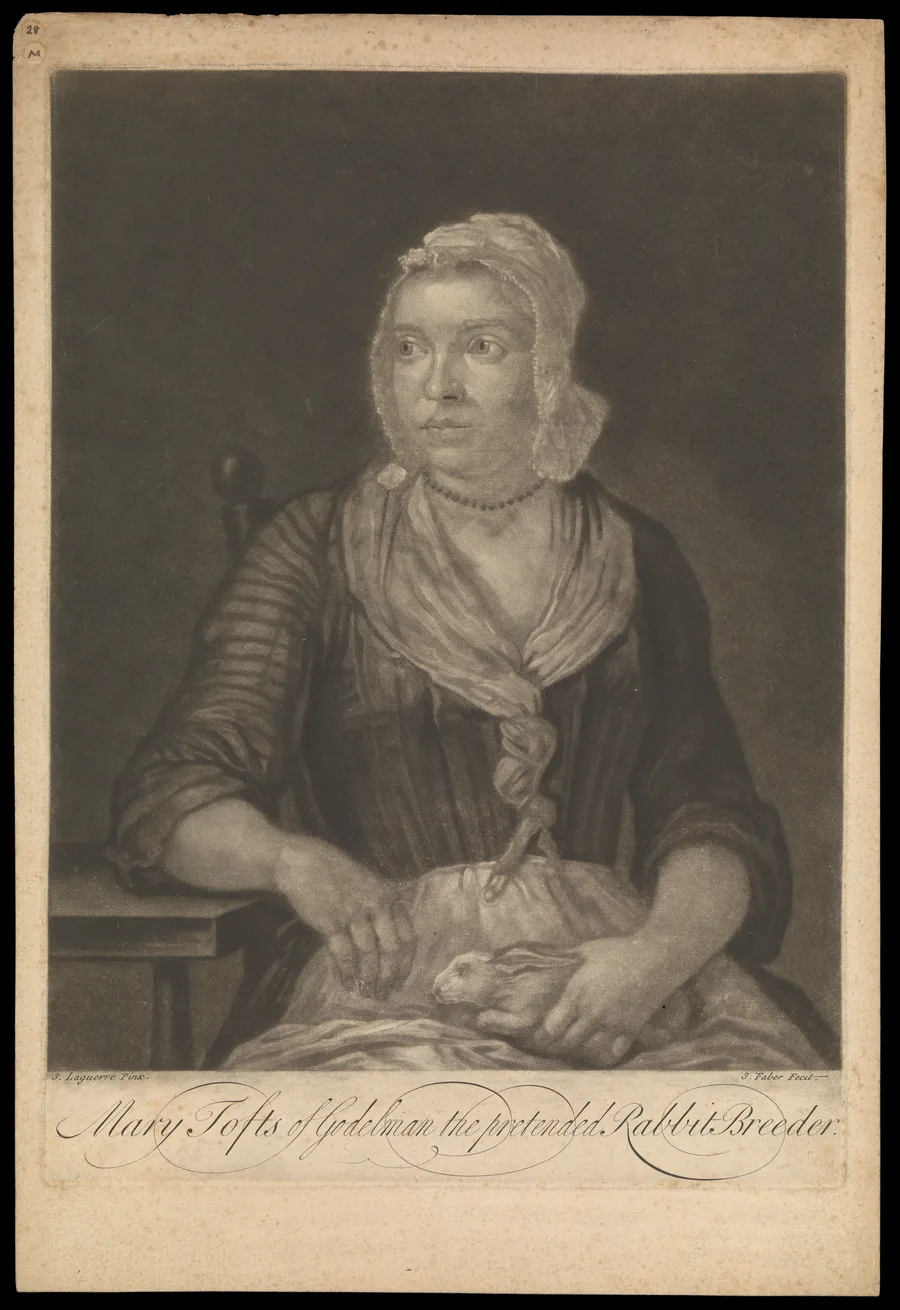
“Mary Tofts of Godelman the pretended Rabbit Breeder”, mezzotint by John Faber after a portrait by John Laguerre. The rabbit in her lap is part of the joke, not a record of how she lived. Wellcome Collection (L0069041), CC BY 4.0, via Wikimedia Commons; resized and converted to WebP.
How the story began
The earliest version we have comes from Toft herself, as St. André recorded it in November. On 23 April 1726, he wrote, she was weeding a field when a rabbit sprang up, and she and another woman chased it without success. She believed she was about five weeks pregnant. She dreamed of rabbits that night and, by this account, longed to eat them for months, “being very poor” and unable to buy any.
About seventeen weeks later she had heavy bleeding and pain and passed what she described as a lump of flesh. Three weeks after that it happened again. On 27 September she sent for her mother-in-law, Ann Toft, who was a midwife, and something was passed that was carried to Howard in Guildford.
Howard’s first reaction deserves attention. St. André’s account and the confessions agree that he did not believe it at first. Toft’s first confession says he suspected “they had a mind to impose upon him”, and her third has him telling her husband that somebody had played a trick. He went to Godalming anyway, and then he changed his mind.
By 9 November he was writing to a Mr. Davenant, who had taken an account of the case at Guildford, that the eleventh rabbit had just been taken away and “up leap’d the twelfth”. St. André printed that letter. In it Howard invited any “curious Person” to come post-haste and see for himself.
Why trained men accepted it
St. André and the politician Samuel Molyneux, secretary to the Prince of Wales, reached Guildford on 15 November. Within minutes St. André took from Toft the skinned trunk of a rabbit, and over the evening he took the skin and the head. He dissected the remains, floated pieces of lung in water, and compared them with ordinary rabbits, later demonstrating four of the specimens before the king on 26 November.
His conclusion is the part modern retellings usually flatten. He did not argue simply that Toft had imagined rabbits into being. He argued from anatomy. The animals, he said, looked like common rabbits outside but kept features of unborn young inside, which “proves” they were “not bred in a natural Way”. He guessed they formed in her Fallopian tubes.
It looked like careful work, but it rested on a basic flaw that his own pamphlet shows. Every “rabbit” in his report arrived in parts: paws, then organs, then trunk, head and skin. Four or five lacked internal organs entirely. The nurse Mary Costen later swore she had seen seven delivered, all “in several pieces, and not whole”. Even so, the pieces were reassembled into the very animals the theory required.
Doubt was already in the room. Molyneux added a signed note to St. André’s pamphlet, saying he had seen no fraud but would not take it upon himself to judge whether the animals were unnatural or a fraud was possible.
Lord Hervey, as quoted by Todd, wrote that all the eminent physicians, surgeons and man-midwives in London were there “Day & Night to watch her next production”. As Toft’s fame spread, the number kept climbing:
| Date | Claimed count | Source |
|---|---|---|
| 9 November | Eleventh taken, twelfth “leaping” | Howard’s letter, in St. André |
| 15 November | Fifteenth | St. André |
| 20 November | Part of the sixteenth | St. André, on Ahlers’s visit |
| 28 November | Seventeen | Manningham |
| After 28 November | An eighteenth promised in an appendix | Note in St. André’s pamphlet |
The evidence that broke it
The hog’s bladder. On 28 November Manningham, sent at the king’s wish, examined Toft and removed a piece of what Howard insisted was birth membrane. He thought it looked and smelled like hog’s bladder. He asked for one to compare, and one was fetched from the house straight away, a fact he says “added to my Jealousy”. Toft cried. He told St. André and Howard what he thought, a heated argument followed at the White Hart inn, and he agreed to say nothing publicly for the moment.
Her first confession matches him on this: the woman who supplied her sometimes brought pieces “in a hogs bladder”, and she admits she may have used the bladder itself.
The porter. Toft was moved to Lacy’s Bagnio in Leicester Fields on 29 November and watched closely. On 4 December she had strong pains, and several doctors, including the sceptics, agreed that something was about to come. That evening the Bagnio’s porter, Thomas Howard, who should not be confused with the surgeon’s brother of the same name, swore before the magistrate Sir Thomas Clarges that he had helped smuggle in a rabbit. Toft and her sister-in-law Margaret said it was only for eating.
The rabbit sellers. Lord Onslow, at Guildford and Clandon, had been taking depositions on 3 and 4 December. They are the most damaging documents in the case, and they get less attention than the prints.
Edward Costen sold Joshua Toft two young rabbits at threepence each, and said Joshua told him a dead one “would have done as well for me as a live one”. Richard Stedman said Joshua took two small rabbits whatever their size, killed them on the spot and told him there was no need to let anybody know. The Quaker currier John Sweetapple removed the entrails of two for him and heard that he was going to Guildford. Mary Peytoe sold him one or two, then seven or eight more within about ten days, and watched him kill and gut two that he said he had to carry to Guildford.
The food story. Two witnesses swore that no rabbit was cooked for Toft in Guildford, and one reported her saying she could not eat rabbit for a thousand pounds. That sits badly with her explanation for the smuggled rabbit in London. It also conflicts with Manningham, who lists rabbit in her diet at the Bagnio on 1 December.
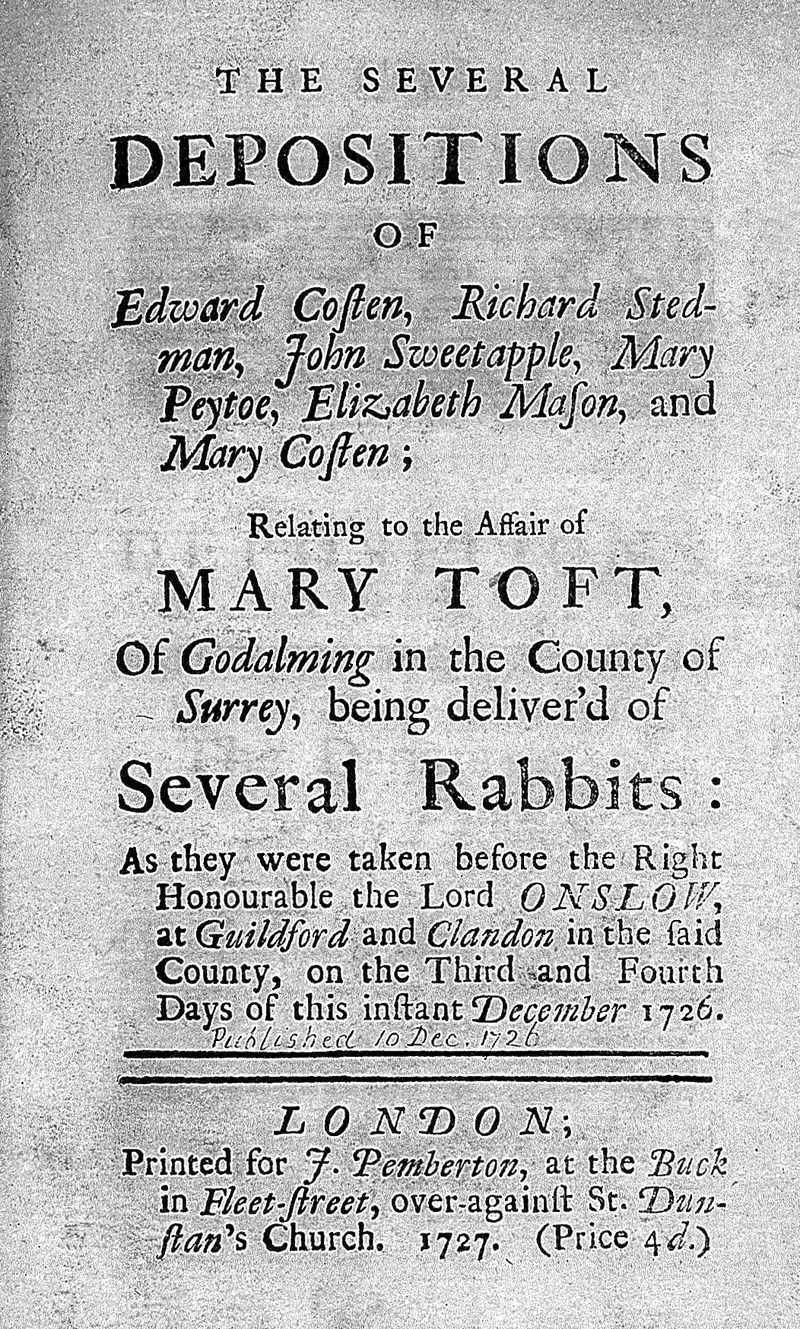
Title page of the depositions. The printed imprint says 1727, but an old handwritten note on this copy says it was published on 10 December 1726, and the text itself refers to “this instant December”. Wellcome Collection (L0005855), CC BY 4.0, via Wikimedia Commons; resized and converted to WebP.
The confession was forced, and the record says so
On 5 December Manningham wrote to Molyneux that he now saw “such Evidence of Roguery” that he believed the whole thing a fraud. He also persuaded Clarges to keep her at the Bagnio rather than send her to prison, so that doctors could still reach her.
His own diary describes what happened next. On 6 December Clarges “threaten’d her severely”. Manningham told her that he would try “a very painful Experiment” on her unless she confessed, and that if she did confess, nobles who were present would speak on her behalf. Urged to confess and avoid “so terrible an Operation”, she begged to be left alone until morning. She began confessing on 7 December before the Duke of Montagu, Lord Baltimore, Douglas and Manningham.
This doesn’t make the confession false. The rabbit sellers, the bladder and the physical evidence all support the core admission. But it does mean that the details she gave, and especially the names, came from a frightened woman trying to work out what her questioners would accept.
Three confessions, three different stories
This is where the case stops being a tidy story about gullible doctors.
| 7 December | 8 December | 12 December | |
|---|---|---|---|
| Who started it? | An unnamed woman, wife of a travelling knife grinder, whom Toft met by chance | Denies that anyone advised her | “Ann Tofts My husbands mother” |
| Who put the pieces in? | The woman at first, then Toft herself | Says she knew of nothing being put in, and thinks Ann and Howard must have done it | Ann, then Toft |
| Did Howard know? | “protests and declares” he never knew | Thinks he and Ann must have been responsible | Says that if he suspected, “he never said any thing to me about it” |
| Her husband? | Cleared | Not accused | Brought rabbits but “knew nothing what I did with them” |
The first version asks a lot of the reader. It clears every relative and blames a stranger, although the notes do give the name of a Godalming shoemaker through whom to look for her, and we found no record of what came of that. By the next day Toft was saying there had been no such woman. The same day’s notes contain the line that gives the second confession its power: “now ashamed to tell you the truth after I have told somany lyes”.
The third account, taken after she had been sent to Bridewell, is the most specific. Asked who first put her up to it, she named Ann Toft, and said Ann told her that if she went through with it she “should get a good living”. It is also the last version, reached after days of pressure. That doesn’t make it true, and it doesn’t make it false.
Her statement about Joshua is hard to square with the depositions. A man who bargains for dead rabbits, has them gutted and asks a seller to keep quiet doesn’t look like someone who knew nothing. That is our reading of the sworn statements, not a finding by any court.
Details that cross-check
Comparing the confessions with the doctors’ pamphlets turns up some small matches. This comparison is our own, and it has a limit: St. André’s pamphlet was in print before the first confession, so Douglas could have asked leading questions about any of these points.
- The fish bone. St. André reported finding in the gut of the first animal a slender white body shaped like a very small fish bone, and he passed on without comment. Toft’s third confession says Howard found in the first remains the backbone of an eel from a meal she had eaten the previous Sunday. These may be the same object. If so, an early clue was written up as anatomy.
- The torn paper. St. André recorded her describing a pain like coarse brown paper tearing inside her. The first confession uses the same comparison, and adds that she was menstruating at the time, which she gave as the reason for the blood. St. André noted blood for the first time the next morning.
- The guinea. Toft’s account of Ahlers giving a guinea and promising a pension matches the sworn statements St. André printed against him.
- The cat. St. André thought the first specimen’s paws and organs resembled a cat’s, and took that as a sign of something unnatural. Manningham’s summary of the first confession and the third confession itself both mention a cat.
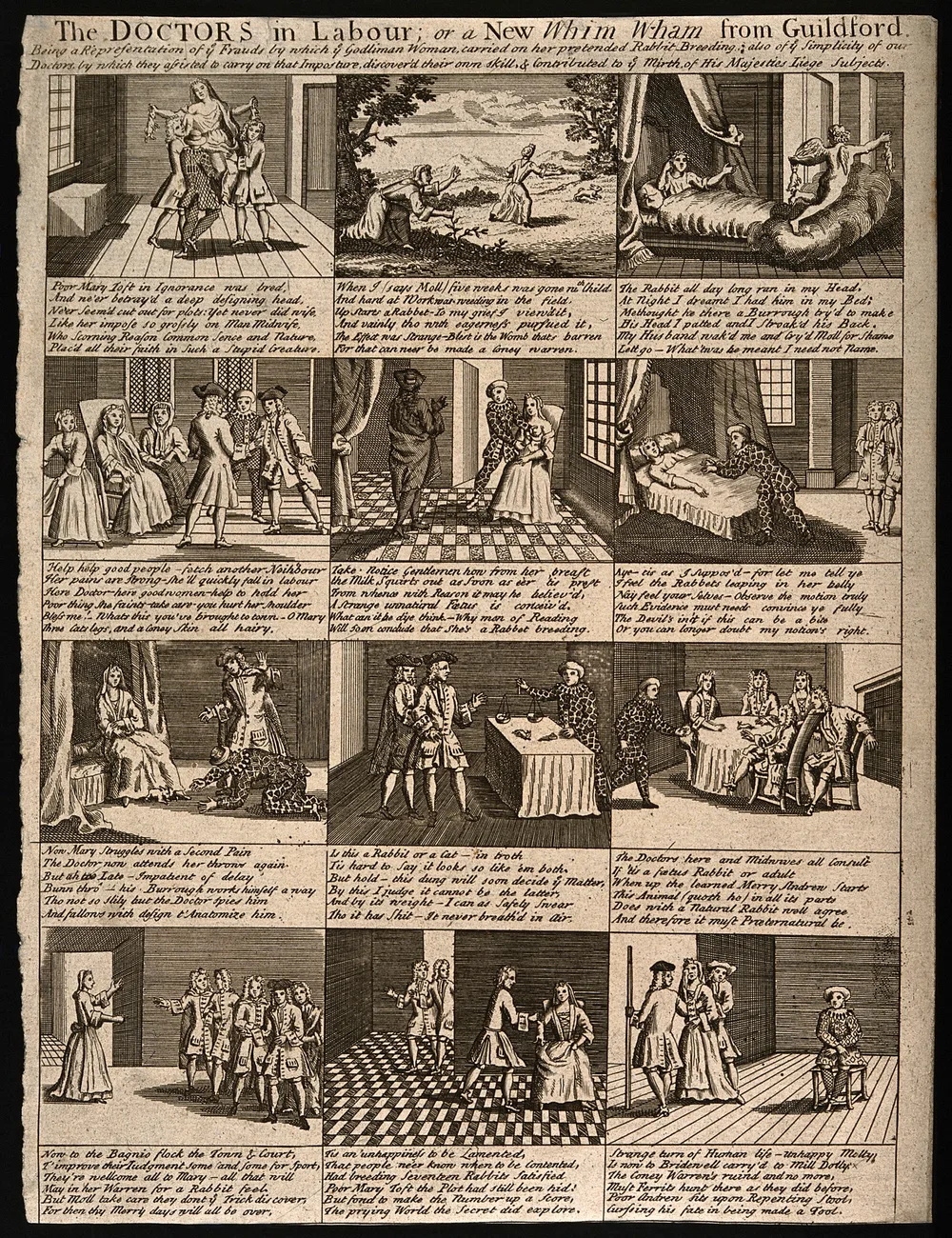
The Doctors in Labour; or a New Whim Wham from Guildford, a broadside in twelve scenes with mocking verses. The last panel sends “unhappy Molly” to Bridewell and seats “Poor Andrew”, meaning St. André, on a repenting stool. This is satire, not evidence of what happened in the rooms it shows. Wellcome Collection (V0014995), CC BY 4.0, via Wikimedia Commons; resized and converted to WebP.
The Ahlers dispute
Cyriacus Ahlers, surgeon to the king’s German household, visited on 20 November and later claimed to have become highly suspicious during that visit. In his Some Observations, as summarised by Seligman, he described Howard blocking his examinations and Toft laughing at jokes between labour pains. Back in London he found the rabbit had been cut with a sharp instrument, and that its droppings contained hay, straw and corn. Russell’s account says he told the king of his suspicions on 21 November.
St. André’s pamphlet, published days earlier, tells the opposite story. It prints affidavits from Howard, his brother and others swearing that Ahlers declared himself “fully satisfied”, gave Toft a guinea and promised to seek her a pension. Ahlers’s answer, in Seligman’s summary, was that he hid his suspicions and pretended sympathy.
Both versions can be partly true, and all the witnesses had reasons to shade them. The hay and corn are strong evidence if he reported them accurately, but his claim about his own suspicions was made after the event, like every other doctor’s defence in this story. Harvey’s summary of the case is that no doctor declared it a hoax until Toft confessed.
What happened afterwards
St. André gave up quickly. His notice in the Daily Journal of 9 December called the affair “a most abominable Fraud” and asked to be separated from its guilty actors. Ashworth says his career at court was ruined. Douglas and Manningham fell out in print over who had suspected what and when.
Toft was charged as a “Notorious and Vile Cheat”, and Seligman says the prosecution was brought under a statute of Edward III. She was held in Tothill Fields Bridewell, where crowds came to look at her. Newspapers reproduced on the Andrews local-history page say she was discharged at the Westminster Quarter Sessions in April 1727 because nobody prosecuted. Russell suspects this was to spare the establishment further embarrassment, while Rogers says the case did not meet the legal standard for fraud. Neither reason appears in the records we read.
None of the sources we read records a conviction of anyone in the affair.
Her later life is thinly recorded. The Royal College of Surgeons blog and the museum say that the Duke of Richmond showed her as a curiosity when he stayed in Godalming, and that she was charged in 1740 with receiving stolen fowls. Russell says a jury acquitted her. She was buried at Godalming on 13 January 1763, and the entry quoted by Andrews reads: “Mary Toft Widow, the Imposteress Rabbett Breeder.” The name followed her into the parish register.
Where the sources and retellings disagree
| Claim | What we found |
|---|---|
| “Howard was fined £800” | Repeated in some modern summaries, including Wikipedia. The Ipswich Journal report of 7 January 1727, as reproduced by Andrews, describes a fresh recognizance of £800, a bond to appear and answer the charge, not a penalty. Russell and Rogers say the case against him was dropped. |
| The confession dates | Some modern summaries run them together as 7, 8 and 9 December. Douglas’s manuscripts, per Todd, are headed 7, 8 and 12 December, and Ashworth agrees. The manuscripts should win. |
| “Rabbit sales collapsed” | The claim that rabbit consumption in London fell by two-thirds appears in a 1727 pamphlet quoted by Seligman, signed “Lemuel Gulliver”. That is a satirical pen name. We found no sales record behind it, so it should be treated as part of the joke. |
| Toft’s later life | Ashworth found no records of her after her return home. The RCS blog, Godalming Museum and Andrews cite parish and newspaper records. The fuller picture has the better sources. |
| Her age | Baptism in 1703 makes her about 23. Russell says 25, and Rogers’s page header offers “1701?”. |
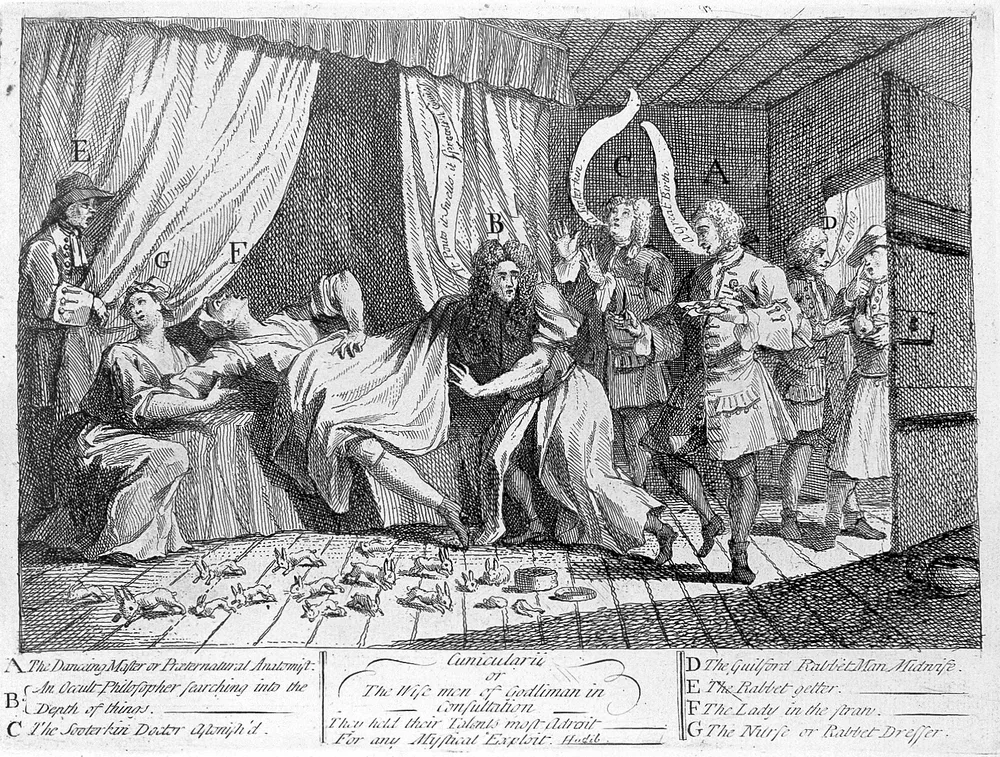
| Who is who in Hogarth’s print | Wellcome identifies B as Molyneux, or a hybrid figure, and C as John Maubray. The British Museum’s description, as carried on Commons, gives B as Manningham or Molyneux and C as Maubray or Ahlers. Seligman says leading surgeons paid a guinea each for the print, but he gives no source for this. |
| A broken leg in a warren, 1736 | The Caledonian Mercury, per Andrews, reported that she broke her leg when her foot slipped into a rabbit burrow. It is too neat, and we could not confirm it. Treat it as a press item, possibly a joke. |
What is documented, claimed and unresolved
Documented:
- The depositions about rabbit purchases, St. André’s pamphlet and retraction, and Manningham’s diary, including his own account of the threat.
- Three confessions in Douglas’s hand, dated 7, 8 and 12 December 1726.
- Her time in custody, and her burial on 13 January 1763.
Claimed, and only as good as the person claiming it:
- Everything Toft said about who planned the fraud.
- Howard’s and St. André’s reports of “leaping” rabbits in her body. Manningham did feel strong movements himself, but he later put them down partly to artifice and partly to real convulsions, which he said continued while she slept.
- Ahlers’s account of his own early certainty.
Disputed by historians:
- How far the confessions can be trusted. Harvey says other historians sidelined them for being inconsistent. She argues the inconsistencies are themselves a way back to Toft’s experience. In her reading the case is best understood through power among women around childbirth, not only through the doctors.
Unresolved:
- Who devised the scheme: Ann Toft, Mary, Joshua, or some combination.
- Whether John Howard was a dupe or a participant. Hogarth clearly implied the second, and Ahlers suspected it, but the sources we read record no conviction.
- What Toft’s symptoms were. Sceptical doctors recorded pains and convulsions that they could not entirely dismiss, and she reported heavy bleeding that may have been real. Nobody could examine her today, and we won’t offer a diagnosis.
How it should be read now
For a long time this was a story told at the expense of two groups: the foolish doctors and the “stupid” peasant woman, a word used in St. André’s pamphlet and the satirical verse alike. The doctors were not fools. Their failure was more ordinary. Each had staked his name on what he had personally pulled from a patient, and that made the evidence feel stronger than it was.
Toft is harder to place, and the records don’t let us make her simply a victim or a schemer. She was very poor. She could not read the pamphlets written about her. By her own account the process tore at her body and put her “in a most violent Rack and torture”, and she took part in it knowingly for weeks, by every version but her second. Harvey’s work makes the point that calling it a hoax can hide how physically real and distressing it was for the person at the centre.
The affair belongs with other cases in which a claim turned on a woman or a girl and a room full of men testing her. Thirty-six years later, Hogarth was still using Toft: in his 1762 print Credulity, Superstition, and Fanaticism, she lies on the floor among rabbits, in the same picture that mocks the Cock Lane ghost. As with the Fox sisters’ confession, an admission of fraud doesn’t settle everything, because it has to be read for who extracted it and why. The Cottingley Fairies show the same respected-expert problem two centuries on, and the dancing plague of 1518 shows physicians explaining a baffling event within the medical ideas of their day.
The story has also returned as fiction, including Dexter Palmer’s Mary Toft; or, the Rabbit Queen (2019) and Noémi Kiss-Deáki’s Mary and the Rabbit Dream (2024). Those are novels. For a scholarly history, the book to find is Karen Harvey’s The Imposteress Rabbit Breeder (2020), which we did not have access to for this article.
Frequently asked questions
Did Mary Toft really give birth to rabbits?
No. It is biologically impossible, and Toft herself confessed in December 1726 that pieces of animals had been placed inside her body and then removed as if they were being born. Sworn testimony shows that her husband was buying young rabbits in Godalming during the same weeks.
How many rabbits did Mary Toft supposedly deliver?
The usual figure is seventeen, the number Manningham gives for 28 November, and St. André’s pamphlet promised an account of an eighteenth. The figure should be treated with care, because these “rabbits” arrived as parts and were reassembled by the men counting them.
Who exposed the hoax?
No single person did. Ahlers says he suspected it on 20 November, and Manningham identified the hog’s bladder on 28 November. The decisive steps came on and after 4 December: the porter’s sworn statement to Sir Thomas Clarges, Lord Onslow’s depositions and the pressure placed on Toft by Clarges, Manningham and Douglas.
Who was behind the Mary Toft hoax?
Nobody knows for certain. Toft blamed a stranger on 7 December, then suggested her mother-in-law and Howard on 8 December, and named her mother-in-law, Ann Toft, as the instigator on 12 December. Her final account is the most detailed, but it was obtained under pressure.
Was Mary Toft punished?
She spent about four months in custody in Tothill Fields Bridewell, then was discharged in April 1727 when no prosecution followed. She lived on in Godalming and was buried there in January 1763, under the label “Imposteress Rabbett Breeder”.
What does Hogarth’s Cunicularii show?
It is a satirical etching of 1726 showing Toft in bed, with her husband and his sister Margaret beside her, while lettered doctors react with absurd pronouncements. Howard is at the door being offered another rabbit. The butt of the joke is largely the medical men.
Was John Howard fined £800?
The contemporary newspaper report we traced describes a recognizance of £800 to answer a charge, which is a bond rather than a fine. Later accounts say the case against him was dropped.
Sources & further reading
- Mary Toft's three confessions, taken down by James Douglas on 7, 8 and 12 December 1726, University of Glasgow Library, Douglas Papers D324, D327, D328, transcribed by Dennis Todd, Georgetown University, posted with the library's permission (primary; accessed 2 November 2026)
- Sir Richard Manningham, An Exact Diary of What Was Observ'd During a Close Attendance upon Mary Toft (London, 1726), Internet Archive machine-read text of the Wellcome copy (primary; accessed 2 November 2026)
- Nathanael St. André, A Short Narrative of an Extraordinary Delivery of Rabbets (imprint 1727; the narrative is dated 28 November 1726), including the affidavits about Cyriacus Ahlers, Internet Archive machine-read text (primary; accessed 2 November 2026)
- The Several Depositions of Edward Costen, Richard Stedman, John Sweetapple, Mary Peytoe, Elizabeth Mason and Mary Costen (imprint 1727), sworn before Lord Onslow on 3 and 4 December 1726, with St. André's advertisement of 9 December, Internet Archive machine-read text (primary; accessed 2 November 2026)
- S. A. Seligman, 'Mary Toft: The Rabbit Breeder', Medical History 5 (1961), pp. 349-360, Cambridge University Press; used for Ahlers's Some Observations (1726), Douglas's Advertisement and the Gulliver pamphlet, none of which we read directly (accessed 2 November 2026)
- Karen Harvey, 'What Mary Toft Felt: Women's Voices, Pain, Power and the Body', History Workshop Journal 80 (2015), pp. 33-51, abstract only, University of Birmingham research portal (accessed 2 November 2026)
- Karen Harvey, 'Magical Source: Mary Toft's Confessions', Birmingham Eighteenth Century Centre blog, 7 June 2022 (accessed 2 November 2026)
- Karen Harvey, 'Mary Toft's First Confession', Early Modern and Eighteenth Century Centre blog, University of Warwick, June 2022 (accessed 2 November 2026)
- Wellcome Collection, catalogue record for Hogarth's etching, reference 17342i, including its identification of the lettered figures (accessed 2 November 2026)
- Corinne Hogan, 'A Hare-Raising Tale', Royal College of Surgeons of England Library blog, 29 March 2018 (accessed 2 November 2026)
- William B. Ashworth Jr., 'Scientist of the Day: Mary Toft', Linda Hall Library, 13 January 2022 (accessed 2 November 2026)
- Niki Russell, 'Mary Toft and Her Extraordinary Delivery of Rabbits', The Public Domain Review, 20 March 2013 (accessed 2 November 2026)
- Pat Rogers, profile of Mary Toft, The Grub Street Project, October 2022 (accessed 2 November 2026)
- Rhiannon Jones, 'Mary Tofts (1703-1763)', Godalming Museum (accessed 2 November 2026)
- Ann Andrews, 'The Rabbit Woman of Godalming', The Andrews Pages, a local-history page reproducing 1727-1763 newspaper reports and the burial entry; we read these reports only as reproduced there (accessed 2 November 2026)
- Francesca Peacock, review of Mary and the Rabbit Dream, The Spectator Australia, 27 July 2024 (accessed 2 November 2026)