The Index
Codex Gigas Explained: What Is Really in the Devil's Bible?
What is in the Codex Gigas? Explore its biblical and historical texts, Devil and Heavenly City images, Swedish history and the unsupported one-night legend.
Topics: Codex Gigas, Devil's Bible, Medieval Manuscripts, Bohemia
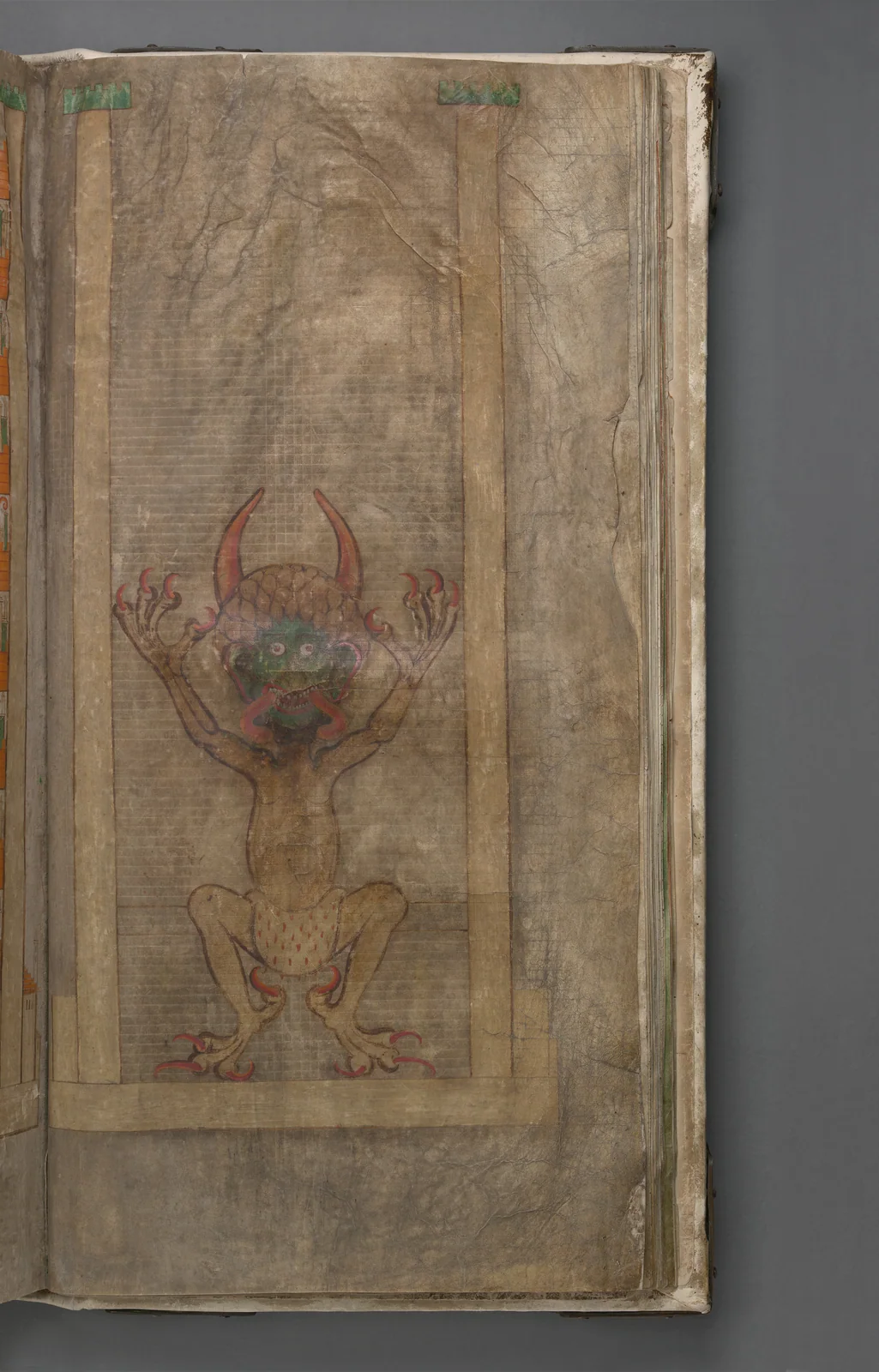
Codex Gigas, often called the Devil’s Bible, is a vast medieval manuscript containing biblical books alongside history, medicine and other texts. Its famous full-page Devil is real. The story that the Devil helped a desperate scribe finish the entire book in one night is a legend about its creation.
The nickname can make the manuscript sound like an anti-Bible or a book devoted entirely to Satan. Opening the digitized volume gives a very different impression: a large compilation whose contents cannot be reduced to its most frequently reproduced image.
What is actually inside the Devil’s Bible?
The Library of Congress description and digitization identify a thirteenth-century manuscript from Bohemia. Its contents include the Old and New Testaments, works by Josephus, Isidore of Seville’s Etymologies, medical texts, Cosmas of Prague’s chronicle and a calendar.
| Material | Why it matters |
|---|---|
| Biblical books | The nickname does not mean scripture has been replaced by a Satanic text |
| Josephus and Cosmas | Historical writing shares the volume with religious material |
| Isidore’s Etymologies | The compilation includes a broad medieval reference work |
| Medical texts and calendar | Its purposes extend beyond displaying the famous illustration |
A compilation can place subjects together without making every page the same kind of text. A historical narrative, a calendar and scripture ask different things of their reader.
The National Library of Sweden’s guide also notes magical formulae and incantations among the contents. Those passages deserve to be identified, but their presence does not turn the entire compilation into a book devoted to the Devil.
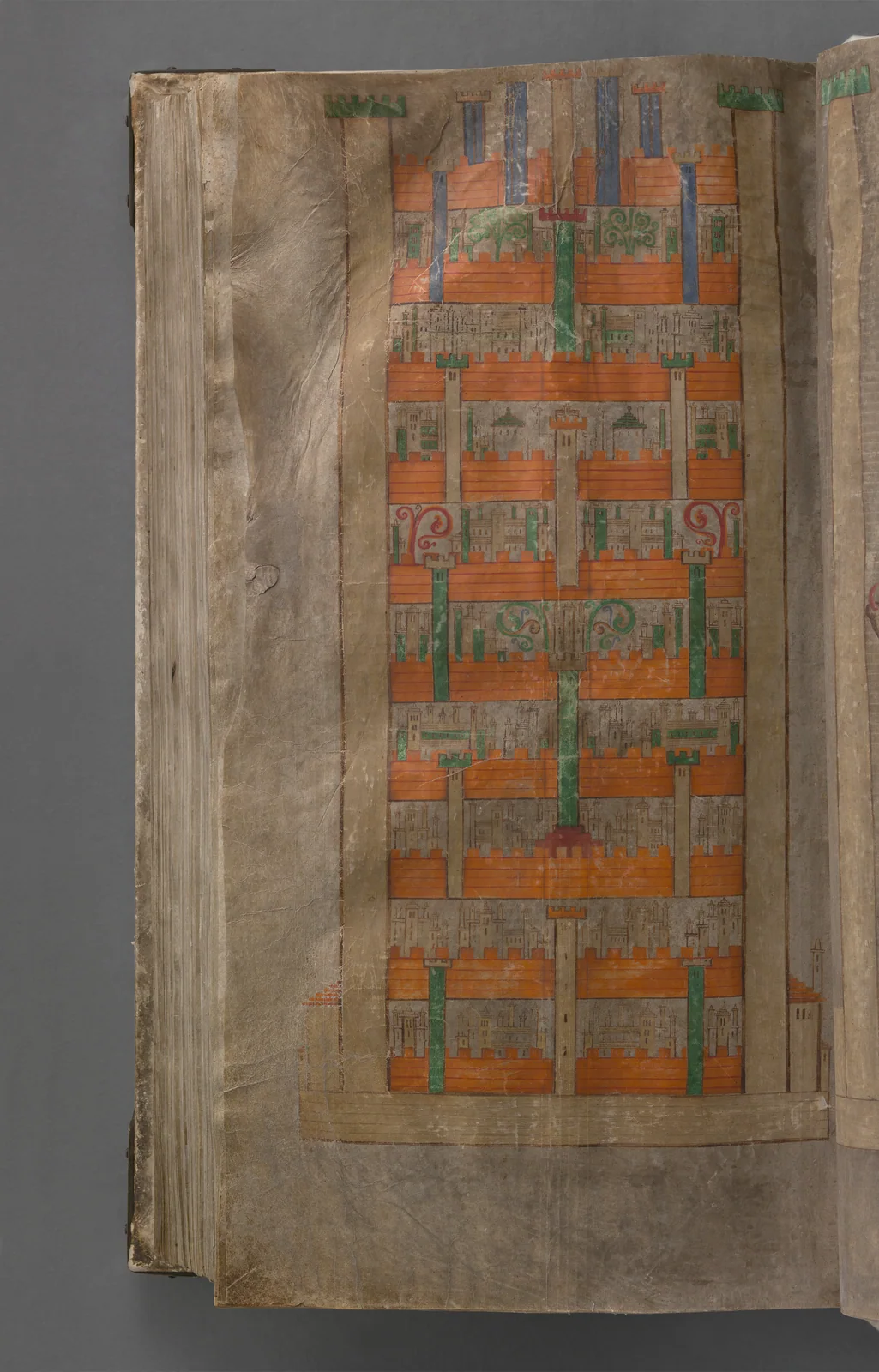
The Heavenly City image faces the Devil page; viewing both restores their visual relationship. Source. Unknown medieval scribe / National Library of Sweden. Public domain. Resized and converted to WebP.
Why is there a portrait of the Devil?
The extraordinary image gives the manuscript its familiar nickname. The figure faces outward with raised arms, horns and claws. Its strong outline and relatively open surrounding space make it memorable even in a small reproduction.
The facing image of the Heavenly City is equally important. Looking at the two together restores a visual relationship that is lost when the Devil is isolated on a social-media card. An image of evil inside a Christian manuscript is not, by itself, evidence that the book endorses evil.
The illustration can be described directly from the page, but its presence does not identify the artist’s every intention. It also does not establish a pact with the being depicted. Pictures of supernatural figures are historical artifacts of representation, not proof of supernatural authorship.
Was the manuscript written in one night?
The National Library of Sweden’s visitor guide recounts the legend: a lone scribe faces an impossible overnight task and asks the Devil for help. The library explicitly treats this as a story without a factual basis.
The tale explains an astonishing object through an astonishing origin. That is a recognizable narrative move, but it cannot replace evidence about manuscript production. Even if work is attributed to one scribe, “one scribe” and “one night” are entirely different claims.
It is also unwise to turn a modern estimate of writing time into a known diary of the manuscript’s creation. Without a contemporary day-by-day record, a precise total would need to be identified as an estimate and its assumptions explained.
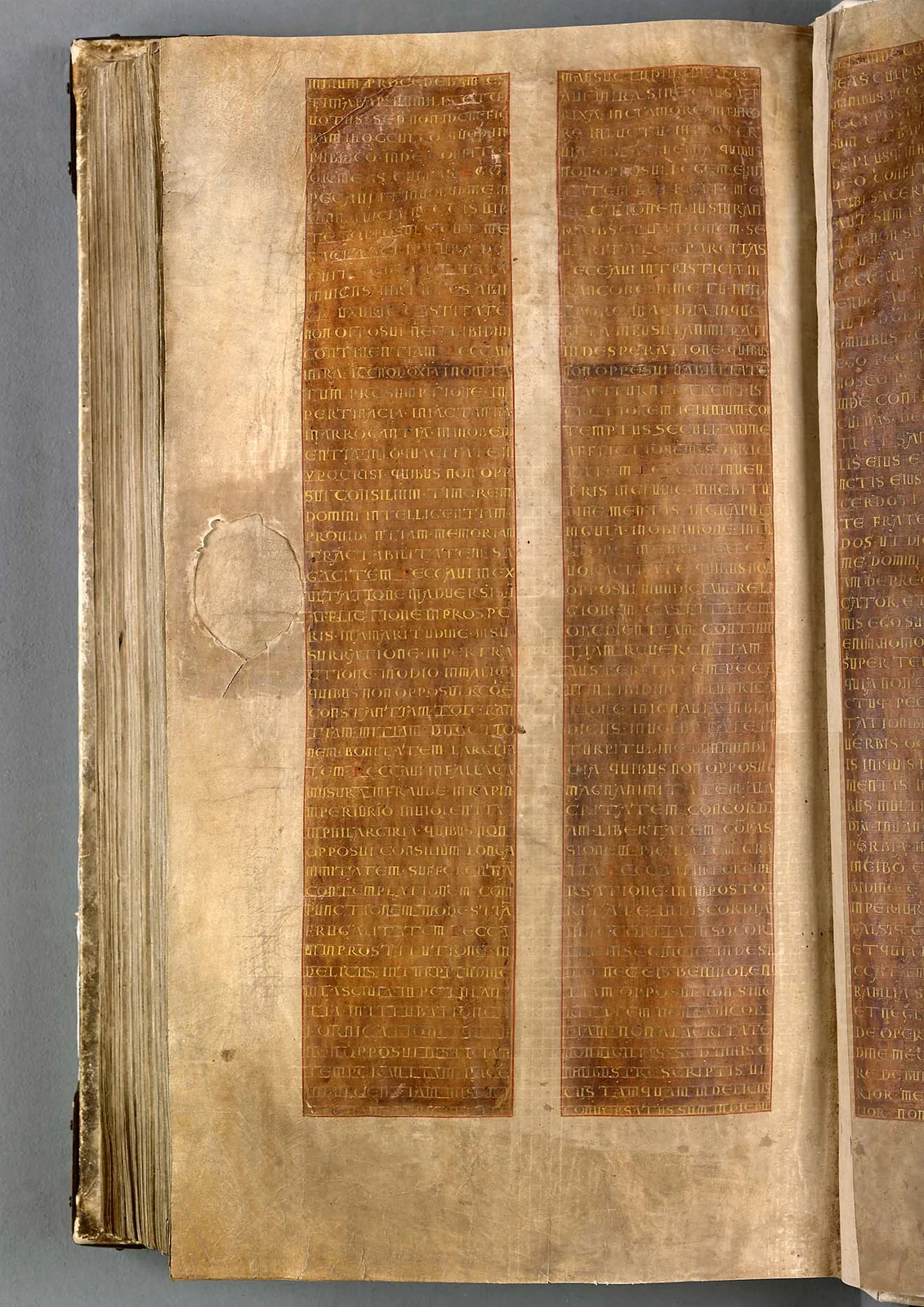
Folio 286 verso offers a view of the manuscript’s written pages beyond the famous full-page image. Source. Unknown medieval scribe / National Library of Sweden. Public domain. Resized and converted to WebP.
How did it reach Sweden?
The manuscript entered Rudolf II’s collection in the late sixteenth century. Swedish forces took it from Prague as war booty in 1648, near the end of the Thirty Years’ War. It is preserved by the National Library of Sweden in Stockholm.
That documented movement is more informative than an invented chain of cursed owners. It places the book within collecting, war and the transfer of cultural property. Its survival and present location have a history independent of the one-night legend.
Is it a grimoire like the Necronomicon?
The comparison needs two corrections. The Codex Gigas is a genuine medieval manuscript with a varied contents list. Lovecraft’s original Necronomicon is an invented book inside fiction, although later authors have published real books under that name.
Likewise, a sensational nickname should not make every old manuscript an occult manual. Reading the catalogue and the pages is the simplest way to avoid that mistake. For another famous legend whose modern form is later than its supposed setting, see the Golem of Prague.