The Index / Dark History
The Voynich Manuscript Explained: What We Know About the World's Most Famous Unreadable Book
Radiocarbon dating places the Voynich Manuscript's vellum in the early 1400s. Its script has never been deciphered, and every proposed solution, including recent viral claims, has been rejected by scholars.
Topics: Voynich Manuscript, Unsolved Mysteries, Dark History, Cryptography, Medieval Manuscripts
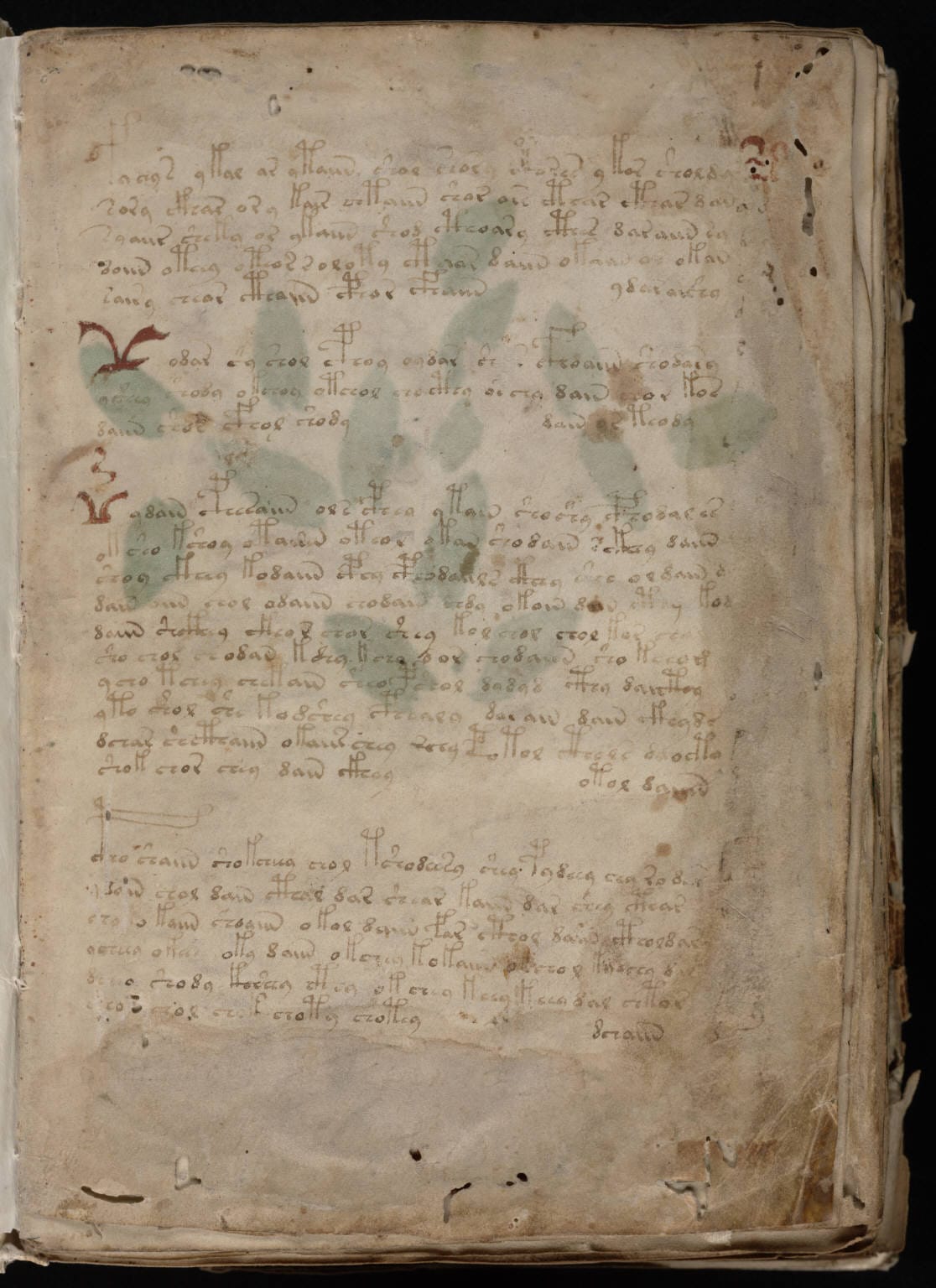
Public Domain, via Wikimedia Commons
The Voynich Manuscript is a roughly 240-page medieval book, radiocarbon-dated to the early 1400s, filled with illustrations of plants that don’t match any known species and pages of fluent-looking text written in a script no one has ever read. It’s held at Yale’s Beinecke Rare Book and Manuscript Library, fully digitized and freely viewable online, studied by professional cryptographers including World War II codebreakers. Despite all of that, no proposed decipherment has ever earned scholarly consensus, and it’s genuinely unresolved whether the text encodes real information at all.
What the Manuscript Actually Contains
The manuscript runs to roughly 240 vellum pages (evidence suggests the original was closer to 272 pages across 20 quires, with some now missing), most filled with both illustrations and dense handwritten text. Scholars generally divide it into six informal sections based on subject matter: an herbal section of plant drawings, spanning roughly 126 pages, most showing a single unidentified plant per page; an astronomical section of about 17 pages with circular diagrams, zodiac symbols, and nude female figures holding stars; a balneological section of roughly 20 pages depicting nude women bathing in elaborate pools connected by pipework; a cosmological section of about 14 pages with abstract circular diagrams, including a large fold-out page nicknamed the “Rosettes”; a pharmaceutical section of about 16 pages showing isolated plant parts alongside apothecary jars; and a final “recipes” section of roughly 25 pages of dense text marked with star symbols in the margins.
A page from the manuscript’s herbal section — none of its plant illustrations have been definitively matched to a known species. Source. Public domain.
What Radiocarbon Dating Actually Established
In 2009, researchers at the University of Arizona radiocarbon-dated samples of the manuscript’s vellum, placing its creation between 1404 and 1438. A follow-up protein analysis in 2014 confirmed the vellum was calfskin, made from roughly 14 to 15 complete hides, and testing found no evidence the parchment had been written on before — it isn’t a palimpsest with older text underneath. This dating is one of the manuscript’s few genuinely settled facts, and it rules out a significant category of proposed origins, including later forgery theories that would place its creation well after the confirmed 15th-century vellum.
Where the Manuscript Has Actually Been
The earliest confirmed owner is Georg Baresch, a 17th-century alchemist in Prague, documented through a 1639 letter he wrote to the scholar Athanasius Kircher describing an inexplicable book in his possession. From Baresch, the manuscript is traced through Jan Marek Marci, a rector at Prague’s Charles University, to Kircher himself in Rome around 1665, and eventually into storage within Jesuit holdings. In 1912, Polish-American book dealer Wilfrid Voynich purchased it along with a group of other manuscripts from the Jesuits — the book is named after him, not after its unidentified author. Voynich’s widow, Ethel, inherited it in 1930; a friend, Anne Nill, received it in 1960; antiquarian dealer Hans P. Kraus purchased it in 1961 and donated it to Yale University in 1969, where it’s catalogued as MS 408 at the Beinecke Library. Yale digitized the full manuscript and made it freely available online in 2020.
The Writing System
The manuscript’s text, often called “Voynichese,” is written in an otherwise unknown script — roughly 20 to 25 distinct characters built from simple pen strokes, running left to right across around 38,000 words and more than 170,000 characters total, with no clear punctuation. Statistical analysis has found real language-like patterns in the text: word-length distribution and the ratio of unique to repeated words resemble natural languages, and word frequency roughly follows Zipf’s law, the same statistical pattern seen in real human languages, where a small number of words are used disproportionately often. At the same time, the script’s character-level entropy is notably lower than real languages typically show, meaning certain letters repeat in ways natural language usually doesn’t. Researchers have also identified two distinct dialects within the text, informally labeled Voynich A and Voynich B, associated with different sections of the manuscript, along with evidence suggesting the book was produced by multiple different scribes.
Decades of Failed Decipherment Claims
The list of people who have claimed to crack the Voynich Manuscript is long, and none of their solutions have held up. William Romaine Newbold claimed in 1921 to have found a hidden shorthand system in microscopic pen marks; the claim was later discredited. Leonell Strong proposed in 1945 that the text was the work of philosopher Roger Bacon using a polyalphabetic cipher, without supporting evidence. John Stojko argued in 1978 that the text was Ukrainian; linguists rejected the reading. More recently, in 2018, Gerard Cheshire published a claim that the manuscript was written in a “proto-Romance” language; the linguistics community rejected it essentially unanimously, citing methodological problems with how Cheshire arrived at his translations. A separate 2014 proposal connecting the manuscript’s plants to Aztec herbal traditions and a Nahuatl-language origin has also been widely criticized, in part because it conflicts directly with the radiocarbon dating.
Even genuinely credentialed cryptographers have failed here. William Friedman and John Tiltman, both instrumental in Allied codebreaking during World War II, separately studied the manuscript for years without producing a verified solution. That track record is a significant part of why the manuscript retains its reputation: it isn’t a case of nobody serious having looked closely.
What the Manuscript Might Actually Be
Absent a verified decipherment, researchers have narrowed the plausible explanations to a handful of competing theories. It could be a genuine but unidentified natural language, written in an invented script, though no known language family matches its statistical profile. It could be a deliberately constructed artificial language, an idea supported by the text’s unusually regular word structure. It could be an elaborate cipher — a 2025 study proposed a specific historically plausible cipher method, encoding Latin or Italian text, that reproduces some of the manuscript’s statistical quirks, though it remains unverified as the manuscript’s actual method. It could be a private shorthand or abbreviation system, a theory most scholars now find unconvincing. And it could, at least in principle, be an elaborate hoax or meaningless text — though the confirmed 15th-century vellum and Baresch’s 1639 letter describing the book as already mysterious to its contemporary owner make a modern forgery essentially impossible, leaving open only the harder-to-disprove possibility that it was gibberish from the start.
Why This Article Won’t Give You an Answer
No decipherment has scholarly consensus, and treating any single theory as solved would misrepresent where the actual research stands. What’s genuinely documented is the manuscript’s age, its ownership history back to the 1600s, and its resistance to every serious decoding attempt made against it for more than a century. The honest answer to “what does the Voynich Manuscript say” is still: nobody knows, and no one has been able to prove otherwise.
This kind of case — genuinely old, genuinely documented, and genuinely still unresolved despite serious scholarly attention — sits alongside other coverage on this site like the Dancing Plague of 1518, where the historical event itself is well documented but its explanation remains actively debated, and the Circleville Letters, another case where surviving physical evidence hasn’t been enough to produce an agreed-upon answer.
Frequently Asked Questions
Has the Voynich Manuscript ever been deciphered? No. Multiple claimed decipherments have been published over the past century, including a widely publicized 2018 “proto-Romance” claim, but none have been accepted by the broader scholarly community.
How old is the Voynich Manuscript? Radiocarbon dating conducted in 2009 places its vellum between 1404 and 1438, which most researchers treat as strong evidence for the book’s actual age of creation.
Where is the Voynich Manuscript now? At Yale University’s Beinecke Rare Book and Manuscript Library, catalogued as MS 408. It was donated in 1969 and fully digitized online in 2020.
Could the Voynich Manuscript be a hoax? A modern forgery is essentially ruled out by the confirmed 15th-century vellum and a 1639 letter describing the book as already mysterious to its owner at the time. A period hoax or meaningless text from the original era remains a theoretical possibility.
Who was Wilfrid Voynich? A Polish-American antiquarian book dealer who purchased the manuscript in 1912 from Jesuit holdings being sold off. The manuscript is named after him, not after its unknown original author.


.jpg)