The Index / Unsolved Cases
D.B. Cooper Explained: The Hijacking, Ransom, Evidence, and Why the Case Is Still Unsolved
The real story of D.B. Cooper: the 1971 Northwest Orient hijacking, $200,000 ransom, parachute jump, FBI evidence, suspects, and the mystery that remains.
Topics: D.B. Cooper, Northwest Orient Flight 305, Unsolved Cases, FBI, Aviation History
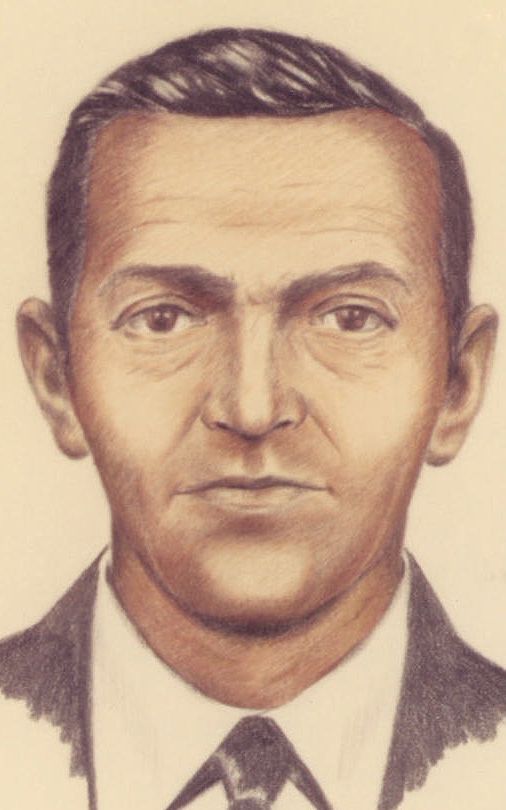
Federal Bureau of Investigation / Public Domain via Wikimedia Commons
The man who boarded Northwest Orient Flight 305 at Portland on November 24, 1971 did not call himself D.B. Cooper. He bought his ticket as Dan Cooper. The familiar initials came from an early reporting error, then stuck so completely that they became the case’s permanent public name.
That small mistake is a useful warning for the rest of the story. A great deal is documented: the hijacking, the ransom, the passengers’ release, the flight south and the missing man. A great deal more has been built out of suspects, rumors and clever-sounding reconstructions. The FBI’s file calls the investigation NORJAK, short for Northwest hijacking. It never established who Cooper was.
The Flight From Portland
Cooper boarded the afternoon Portland-to-Seattle flight in a dark suit, white shirt and black tie. He sat near the rear, ordered a bourbon and soda, and passed flight attendant Florence Schaffner a note. When she did not immediately read it, he told her she should: he had a bomb.
Schaffner sat beside him and saw what she later described as wires and red sticks inside his briefcase. Whether the device was functional has never been established. In a hijacking, though, it did not need to be. Cooper demanded $200,000 in negotiable $20 bills and four parachutes. The request for four made officials wary of an obvious possibility: that he intended to take somebody with him and wanted to prevent the authorities from supplying sabotaged equipment.
Flight 305 circled Seattle while the money and parachutes were assembled. After it landed, Cooper exchanged the passengers for the ransom and parachutes. Only the crew remained: pilots William Scott and William Rataczak, flight engineer H. E. Anderson, and flight attendant Tina Mucklow.
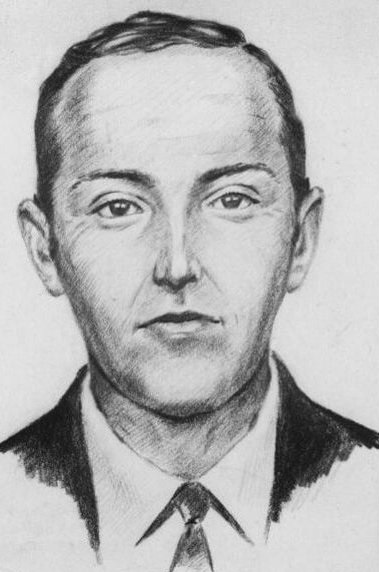
A second FBI composite. The sketches record witness descriptions; they are not photographs or an identification. Federal Bureau of Investigation / Public Domain via Wikimedia Commons.
The Jump
Cooper ordered a southbound course toward Mexico City, with the Boeing 727 flying low and slow, landing gear down and the aft stairs lowered. The 727 mattered. It had a rear airstair that could be opened in flight, a feature that later prompted changes meant to prevent a similar exit.
The aircraft left Seattle after 7:30 p.m. The crew did not see Cooper leave. At about 8:13 p.m., the aircraft’s instruments registered a change of pressure; investigators treated that as the most likely point at which he went down the stairs. The plane landed in Reno with Cooper, two parachutes and the ransom gone.
No one knows where he landed. The flight path, wind estimates, uncertain jump time and the possibility that he could have moved before or after the jump have produced several proposed drop zones in southwest Washington. None has yielded a parachute or a person who can be proved to have been Cooper.
The Money at Tina Bar
The most tangible recovery came in 1980, when eight-year-old Brian Ingram found three decaying bundles of $20 bills on the Columbia River at Tina Bar. The serial numbers matched the ransom. In all, $5,800 was recovered.
The find confirmed that at least part of the ransom entered the river system or reached the riverbank. It did not establish how. A washed-down drop site, deliberate burial, river movement and later human placement have all been proposed. The money is evidence, not a map.
What the FBI Kept
The black clip-on tie Cooper left behind is one of the case’s best-known physical exhibits. Later laboratory work found microscopic particles on it, including industrially associated metals. That has encouraged theories about an aerospace worker, a metallurgist or somebody in a particular kind of manufacturing. It is an intriguing clue, but not a fingerprint. A tie worn in airports, offices and aircraft can acquire material from many places, and the FBI never tied the particles to a named suspect.
Witness accounts, the two composite sketches, ransom serial numbers, parachute records and the flight evidence are stronger ground than most suspect stories. They still leave a large gap.
The Men Most Often Named
Richard McCoy carried out a similar 1972 hijacking, escaped from a 727 by parachute and was caught days later. The resemblance made him a natural candidate, but the FBI did not identify McCoy as Cooper, and important physical and timeline problems remain.
Robert Rackstraw, a Vietnam veteran, became a favored name in documentaries and in claims promoted by investigators. The FBI considered and eliminated him. Publicly available evidence has not overturned that decision.
Sheridan Peterson, a Boeing employee and experienced parachutist, and Kenneth Christiansen, another Northwest employee, have each had advocates. Neither was proved to be Cooper. The same is true of the many people connected through late-life confessions, family memories, resemblance to a sketch, or alleged unexplained money.
This is where the case often goes wrong in retelling. A suspect can fit several details without being the answer. The standard is not “could he have done it?” but “can the evidence identify him?”
Why the Case Remains Open in Public Memory
On July 8, 2016, the FBI redirected its active NORJAK resources to other priorities after 45 years. It did not announce a solution. It said the evidence would be preserved and asked the public to report specific physical evidence related to the parachutes or ransom money.
The agency’s decision is not proof that Cooper survived, died in the jump or got away with the rest of the money. It is a statement about evidence: no lead had reached the level needed to identify and prosecute the hijacker.
The mystery sits naturally beside other cases where a famous name can conceal a thin factual core, including the Circleville Letters and the Zodiac Killer. In each, a compelling story has outlived a definitive answer.
Frequently Asked Questions
Was D.B. Cooper his real name? No. The hijacker used the name Dan Cooper. “D.B.” resulted from an early news error.
Was Cooper ever found? No. The FBI did not identify the hijacker before ending active work in 2016.
How much ransom money was recovered? Three bundles totaling $5,800 were found at Tina Bar in 1980 and matched the recorded ransom serial numbers.
Did Cooper survive the parachute jump? It is unknown. The weather, darkness and clothing made the jump hazardous, but no body, parachute or confirmed trail has resolved the question.