The Index / Dark History
Dyatlov Pass Incident Explained: What Really Happened?
What happened at Dyatlov Pass in 1959? Examine the evidence, the modern snow-slab avalanche explanation, and what remains unresolved in the hikers' deaths.
Topics: Dyatlov Pass, Unsolved Mysteries, Dark History, Soviet Union, Avalanches
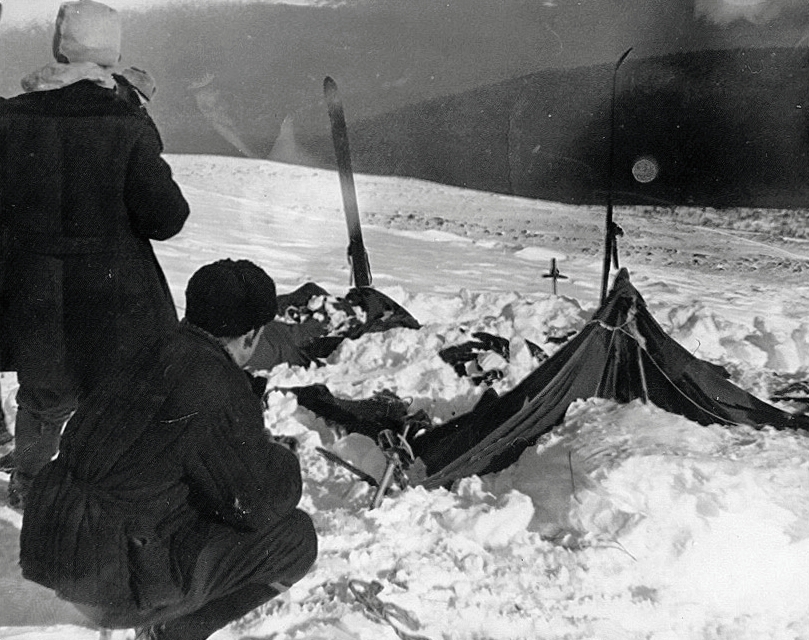
1959 investigation photograph, public-domain claim via Wikimedia Commons.
On the night of February 1–2, 1959, nine experienced Soviet hikers left their tent on an exposed slope in the northern Ural Mountains without the clothing and footwear they would normally need to survive. The tent was later shown to have been cut from the inside. All nine died.
That much is documented. The harder question is why they left.
The Dyatlov Pass incident has accumulated more than six decades of claims about secret weapons, radiation, UFOs, attacks, and the supernatural. Some of those stories grew from real details in the case. Others became detached from what investigators actually recorded.
Today, a delayed snow-slab avalanche is the strongest published scientific explanation for the event that forced the group from the tent. It is not a complete solution to every detail of the case, and the researchers behind the best-known model have been explicit about those limits.
The Expedition
The trip began with ten people. Igor Dyatlov, a 23-year-old engineering student at the Ural Polytechnic Institute, led an experienced ski-trekking group toward Mount Otorten in the northern Urals. The planned route was considered highly demanding by Soviet sports-tourism standards.
One member, Yuri Yudin, turned back on January 28 because of health problems. That decision made him the expedition’s only survivor.
The remaining nine continued through worsening winter conditions. On February 1 they established their final camp on the eastern slope of Kholat Syakhl, a mountain whose Mansi name is often translated as “Dead Mountain.” The darker claim that the hikers had entered a forbidden or cursed sacred site is not supported by the original witness material. Mansi witnesses interviewed in 1959 did not describe the slope as off-limits to outsiders.
The hikers cut a level platform into the snow to pitch their tent. That detail would become important more than sixty years later, when avalanche researchers modeled whether a small slab could have released above them after wind-loaded snow accumulated on the slope.
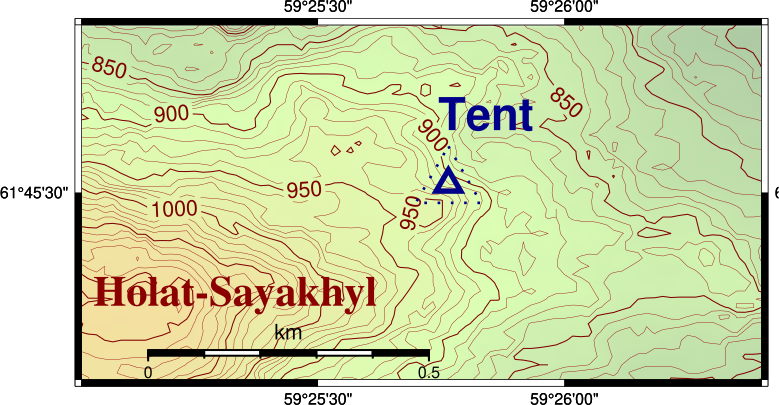
The tent’s location on the slope of Kholat Syakhl (“Dead Mountain”), based on 1959 investigation records. Merikanto, Wikimedia Commons (CC BY-SA 4.0).
The group was expected to send word after returning to the settlement of Vizhai in mid-February. When no message came, concern grew. An organized search began around February 20–21, and searchers found the abandoned tent on February 26.
What Searchers Found at the Tent
The tent still contained most of the equipment the group would have depended on in extreme cold: boots, warm clothing, food, cameras, and other personal belongings.
A forensic examination completed in April 1959 found three major cuts in the tent fabric and concluded that those cuts had been made from inside the tent with a sharp object. Digitized copies of the original forensic material survive in archives of the 1959 case.
Searchers also recorded a line of footprints heading downhill toward the forest. Accounts differ slightly on the exact number visible, commonly describing eight or nine sets of prints, but they were consistent with members of the group moving away from the tent. Some prints had been made in socks, felt footwear, or with feet that were poorly protected for the conditions.
The descriptions are important because they do not read like evidence of a fight around the campsite. Investigators found no established trail of an outside group and no convincing signs of hand-to-hand struggle at the tent.
A flashlight found on snow near or above the tent has become one of the smaller mysteries of the case. Its exact significance is unknowable, but it is a good example of how ordinary objects at an incomplete scene can acquire enormous weight once the central event has no surviving witness.
The Bodies and the Injuries
The victims were not all found at once.
Four bodies — Yuri Doroshenko, Yuri Krivonischenko, Igor Dyatlov, and Zinaida Kolmogorova — were found on February 27. Rustem Slobodin was found on March 5. The remaining four — Lyudmila Dubinina, Semyon Zolotaryov, Nikolai Thibeaux-Brignolle, and Aleksander Kolevatov — were discovered in a ravine in early May. Records around the final recovery differ by roughly a day, with May 4 and May 5 both appearing in later chronologies and case material.
At the tree line
Doroshenko and Krivonischenko were found near a cedar at the forest edge beside the remains of a small fire. They were lightly dressed, and broken branches several meters above the ground suggested that someone had climbed or pulled at the tree. Burns were documented on the bodies, but the precise sequence that produced them cannot be reconstructed with certainty.
Both men died of hypothermia.
Between the cedar and the tent
Dyatlov, Kolmogorova, and Slobodin were found on the slope between the tree line and the tent. Their positions have long been interpreted as evidence that they may have tried to return uphill.
All three were officially judged to have died from hypothermia. Slobodin had a skull fracture, but the original medical examination did not consider it the cause of death.
In the ravine
The last four were found under deep snow in or near a stream channel beyond the cedar. They were more heavily dressed than the first two victims, which is consistent with members of the group redistributing clothing as the emergency worsened.
Three had major trauma. Thibeaux-Brignolle suffered severe skull damage. Dubinina and Zolotaryov had extensive chest fractures. The severity of the internal injuries compared with the relatively limited corresponding external trauma was one of the most difficult features of the original investigation.
Forensic examiner Boris Vozrozhdenny later compared the level of force required for some of those injuries to the kind of force seen in a high-speed vehicle impact. The 1959 investigation did not find evidence that a person using a conventional weapon had produced the injuries.
Officially, six of the nine deaths were attributed to hypothermia and three to traumatic injuries.
What the 1959 Investigation Actually Concluded
The original criminal case was Case No. 659. Ivdel prosecutor Vasily Tempalov opened the case after the search began, and prosecutor-criminalist Lev Ivanov later became the lead investigator.
By the time the case was closed on May 28, 1959, investigators had established several important points but had not identified a precise mechanism for the disaster.
The closing resolution ruled out a straightforward criminal attack and attributed the deaths to a natural force the hikers could not overcome, a phrase often translated into English as a “compelling” or “overwhelming natural force.”
That wording did not explain why the group left the tent, which is one reason speculation survived.
What About the Radiation?
Radiation is a real part of the case, but it is often described far more dramatically than the original testing supports.
Late in the investigation, radiological testing found somewhat elevated beta-emitting contamination on several clothing samples from the ravine group. The same testing reported natural levels in the biological samples that were examined, and part of the contamination washed off during testing. The laboratory could not identify the specific radioactive substance.
The later Russian prosecutorial review suggested that the contamination may have predated the expedition and could have been connected to exposure in the East Ural radioactive trace associated with the 1957 Mayak/Kyshtym nuclear accident. Whatever its source, the radiation findings have never been shown to explain why the group fled the tent or how they died.
That distinction matters: radiation was detected; a radiological cause of the incident was not established.
The Missing Eyes and Tongue
The condition of the ravine bodies has probably generated more sensational retellings than any other part of the case.
Dubinina had lost her tongue and significant facial soft tissue. Other ravine victims also had missing or damaged soft tissue around the face and eyes. Those details are real.
The leap from that fact to deliberate mutilation is not supported by the forensic record. The bodies had remained under deep snow for months and were found in a wet ravine or stream environment. Decomposition, water exposure, and post-mortem animal activity provide ordinary mechanisms for soft-tissue loss. The autopsy evidence did not establish that someone had removed those tissues while the victims were alive.
Similarly, reports of unusual skin color or gray-looking hair at funerals are not evidence of an exotic weapon. Post-mortem changes, prolonged environmental exposure, lighting, and embalming make retrospective descriptions of appearance unreliable as proof of a cause.
Were the Mansi Involved?
Early suspicion did fall on local Mansi people, and several were questioned. But the theory weakened as the physical evidence was examined.
The campsite did not show evidence of a struggle with outsiders. Searchers did not establish a second party’s trackway leading away from the tent. Witness material also undermined the later story that Kholat Syakhl was a forbidden sacred mountain the hikers had violated.
The Mansi attack theory is therefore best understood as part of the early investigation and later folklore around the case, not as an evidence-supported explanation of the deaths.
The 2019–2020 Prosecutorial Review
A common summary says Russia simply “reopened the case” in 2019. The procedural reality was narrower.
Russia’s Prosecutor General’s Office and the Sverdlovsk regional prosecutor’s office carried out a new review of the old materials and commissioned examinations, but officials said at the time that they were not reopening the 1959 criminal case itself. The review concentrated on natural explanations, including avalanche and severe weather.
In July 2020, prosecutor Andrey Kuryakov publicly announced the review’s conclusion: an avalanche and the extreme conditions that followed were considered the most likely explanation. Contemporary reporting from RIA Novosti described the prosecutor’s office as having examined several major versions before settling on the natural-disaster scenario.
That conclusion gave avalanche theory official support, but it did not settle the scientific objections that had followed the idea for decades. The slope appeared too gentle. There was no obvious avalanche debris when the tent was found. And the unusual injuries still needed a plausible mechanical explanation.
The 2021 Slab-Avalanche Model
The strongest modern attempt to answer those objections came from avalanche researcher Johan Gaume of EPFL and geotechnical engineer Alexander Puzrin of ETH Zurich.
Their peer-reviewed paper, published in Communications Earth & Environment in January 2021, did not claim to solve the whole mystery. It asked a narrower question: could a small delayed slab avalanche have occurred at the tent site despite the apparent problems with avalanche theory?
Their answer was yes, under a specific set of conditions.
The model used an inclination of about 28 degrees for the buried weak layer above the tent, even though the broader slope can look gentler. It proposed that cutting into the slope to create the tent platform weakened the snowpack, while strong winds continued depositing snow above it.
Depending on the assumed snow properties and deposition rate, the model found that slab release could occur after roughly 7.5 to 13.5 hours. That kind of delay would explain why the group could spend hours at the campsite before a failure occurred.
The researchers then simulated a relatively small slab striking people lying on the tent floor. Their numerical work showed that compact wind-slab blocks could produce severe chest deformation when a body was pressed against a rigid base. Importantly, the modeled injuries were mostly in the moderate-to-severe, non-fatal range. The paper therefore does not prove that the avalanche itself caused all three officially fatal trauma injuries.
The authors explicitly acknowledged another possibility: the most serious chest injuries could have occurred later in the steep ravine where the final four victims were found.
That nuance is often lost when the study is summarized as “science solved Dyatlov Pass.”
The paper itself says solving the entire mystery was beyond its scope. It established the physical plausibility of a delayed slab release. It did not reconstruct every action the hikers took after leaving the tent. (Gaume & Puzrin, 2021)
Later Expeditions Strengthened the Avalanche Case
A 2022 follow-up by Puzrin and Gaume added field evidence that was unavailable when the first paper was published.
Expeditions to the Dyatlov Pass area documented slab avalanches on nearby slopes. In January 2022, guides observed two slab avalanches under weather conditions the researchers considered comparable to the night of the tragedy. One small avalanche became practically invisible in less than an hour as wind-transported snow covered its traces.
That observation matters because one of the classic objections to avalanche theory was the absence of a clear debris field when searchers reached the tent weeks after the deaths.
The follow-up does not prove that an avalanche struck the Dyatlov tent in 1959. It does show that the wider claim that slab avalanches do not occur in the area is wrong. (Puzrin & Gaume, 2022)
What the Avalanche Theory Still Does Not Explain
The modern slab model is powerful because it answers several old objections at once. It provides a plausible delayed trigger, explains how a failure could occur on locally steeper buried terrain, and shows why a relatively small slab might leave little obvious evidence weeks later.
But it still leaves important questions.
The exact sequence after the hikers left the tent cannot be reconstructed. It is uncertain where the most severe injuries occurred. If anyone was badly incapacitated at the tent, moving that person more than a kilometer downhill would have been extremely difficult. The reasons for particular decisions — why the group did not return sooner, exactly how clothing was redistributed, and how the final ravine group ended up where they did — remain partly inferential.
Those uncertainties are not evidence for UFOs, weapons, or murder. They are simply the limits of a case with no surviving eyewitness to the critical hours.
Is Dyatlov Pass Solved?
Not in the sense that every event can be reconstructed with certainty.
The best-supported modern explanation is that a rare, delayed snow-slab failure forced the group out of the tent, after which extreme cold, wind, darkness, injuries, and poor visibility turned the evacuation into a fatal survival emergency. The 2021 model showed that such a slab is physically plausible, and the 2022 field work demonstrated that small slab avalanches do occur in the area and can disappear quickly under wind-blown snow.
That is much stronger evidence than the popular theories involving secret weapons, Mansi attackers, or paranormal activity.
Still, the debate has not disappeared. In June 2026, relatives of several of the hikers, represented by lawyers, said they intended to seek a new criminal case and new examinations. Their request does not overturn the avalanche evidence, but it shows that the legal and family debate around the original investigation remains active. (Rossiyskaya Gazeta, June 2, 2026)
The Dyatlov Pass incident is therefore better described as substantially explained but not reconstructed in every detail. Modern science has supplied a credible mechanism for the event that may have started the disaster. It has not filled in every missing minute of the night.
For another historical mystery where later stories outgrew the documentary record, see the Mary Celeste.