The Index / Dark History
The Dancing Plague of 1518: What Really Happened in Strasbourg?
In July 1518, a woman began dancing uncontrollably in Strasbourg. Within a month, hundreds had joined her, some reportedly dying of exhaustion. The city's own records are real; the diagnosis still isn't settled.
Topics: Dancing Plague, Strasbourg, Dark History, 1518, Medical History
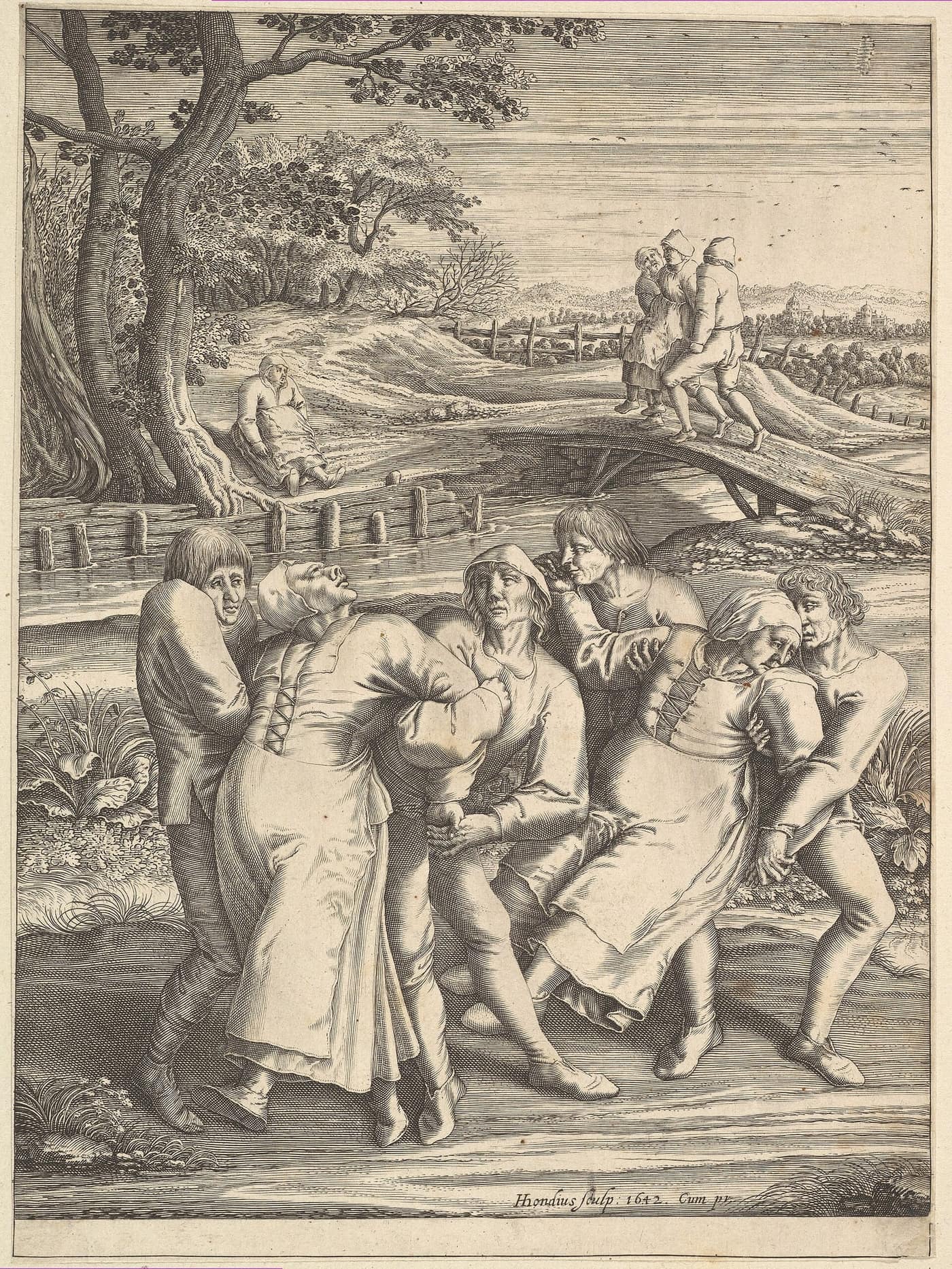
After Pieter Bruegel the Elder / Hendrick Hondius, 1642, via The Met (CC0)
On July 14, 1518, a woman in Strasbourg known to history as Frau Troffea stepped into the street and began to dance. She had no music. She didn’t stop for days. Within a week, roughly three dozen other people had joined her, and by the following month, contemporary accounts describe as many as 400 people dancing through the city’s streets, some reportedly to the point of collapse, injury, or death. The city council’s documented response, and the physicians’ accounts written at the time, are real historical records. What actually caused it is still debated by historians, and no single explanation is universally accepted as settled fact.
How It Started
Frau Troffea’s initial dancing is described in city records and later chronicles as beginning without any apparent trigger, music, or celebration. Within about a week, documented accounts describe more than thirty other Strasbourg residents dancing alongside her, and the numbers kept climbing through the following weeks. Estimates of the peak vary across surviving sources, but contemporary and near-contemporary records point to a range roughly between 50 and 400 people afflicted at once — a very wide range, which is itself a reminder of how imprecise record-keeping was even for events officials were actively trying to document.
What the Dancers Experienced
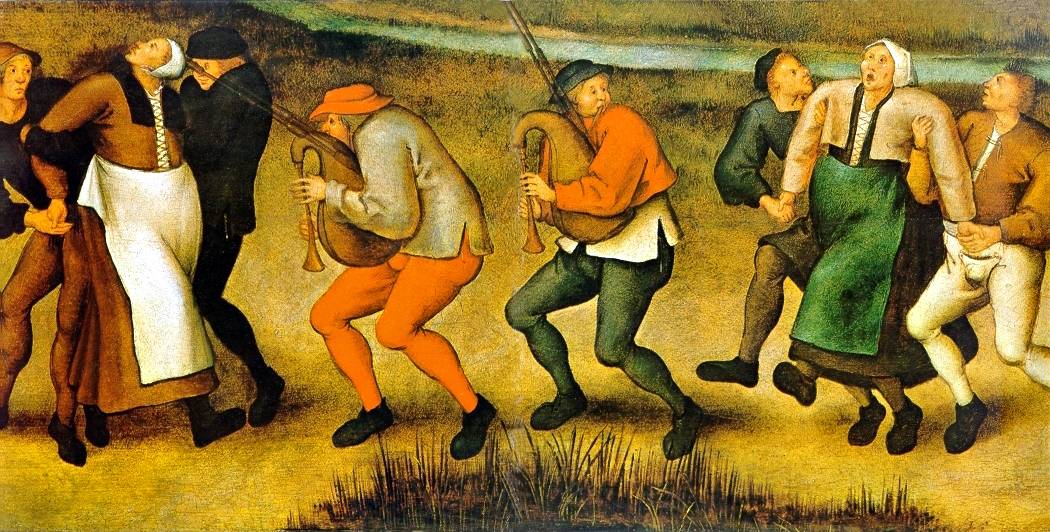
Pieter Brueghel the Younger’s depiction of dancing mania among pilgrims at Molenbeek — a later artistic treatment of the same regional phenomenon, not a courtroom record of the 1518 Strasbourg outbreak itself. Public domain, via Wikimedia Commons.
Descriptions from the period depict people dancing with visible, uncontrolled compulsion — convulsive, exhausting movement that didn’t appear to be voluntary performance. Accounts describe dancers sweating heavily, their feet swelling and sometimes bleeding inside their shoes, and some displaying blank, seemingly unaware expressions while others reportedly cried out for help even as they continued moving. This wasn’t described, at the time or since, as people choosing to dance for pleasure. It was recorded as something closer to an affliction that had seized them against their will.
How the City Responded
Strasbourg’s city government took the episode seriously enough to leave a real administrative record. Officials initially responded by refurbishing guild halls to give dancers space, and by hiring musicians and strong attendants, apparently working from contemporary medical theory that the best treatment for the condition was to let it run its course through continued dancing until it burned out. That approach was abandoned within weeks. Authorities reversed themselves and banned public music and dancing across the city, a shift historians connect to growing fear that the affliction was tied to the wrath of Saint Vitus, a saint associated in regional folk belief with dancing compulsions and curses, and that continued dancing and music might be spreading rather than curing it.
The Contemporary Medical Explanation
Physicians and civic authorities in 1518 largely explained the outbreak through the era’s dominant medical framework: the idea that the afflicted had “hot blood” that needed to be worked out through continued physical exertion followed by rest, rather than suppressed. Other contemporaries reached for religious explanations instead, attributing the dancing to divine punishment or to Saint Vitus’s curse specifically. Neither framework resembles anything in modern medicine, but both are genuinely documented as how educated people at the time tried to make sense of what they were seeing.
How It Ended
By late August or early September 1518, the outbreak subsided. The documented resolution involved authorities sending afflicted dancers on a pilgrimage — a journey of several days — to a shrine dedicated to Saint Vitus in Saverne, seeking what contemporaries understood as spiritual rather than medical treatment. Whether that pilgrimage caused the episode to end, coincided with it ending for unrelated reasons, or simply marked the point where exhaustion, weather, or changing conditions brought the affliction down on its own, isn’t something the surviving records settle.
Death toll estimates from the period are inconsistent and hard to verify against modern standards of evidence. Some retellings cite figures as high as fifteen deaths a day at the outbreak’s peak, but historians examining Strasbourg’s actual city council records and physicians’ notes have found no explicit, itemized death count preserved from the event itself. That a real, documented civic crisis occurred is not in question. The exact human cost of it is harder to pin down than the more dramatic retellings usually suggest.
Ergot Poisoning: A Popular but Contested Theory
One of the most widely repeated modern explanations is ergot poisoning — the idea that dancers had unknowingly consumed grain contaminated with a hallucinogenic, convulsion-inducing fungus (the same fungus sometimes linked to other historical mass-illness episodes). Historian John Waller, who has written the most detailed modern academic study of the 1518 outbreak, rejects this theory. His argument is a physiological one: ergot poisoning constricts blood flow to the extremities and produces symptoms broadly inconsistent with the sustained, coordinated, multi-day dancing described in the sources. He also points to the geographic spread of the region’s dancing-mania episodes along river and trade routes as a pattern that fits social contagion better than an isolated contaminated grain supply.
Mass Psychogenic Illness: The Leading Modern Theory
Waller’s own explanation, laid out in his book A Time to Dance, a Time to Die, centers on stress-induced mass psychogenic illness — a documented psychological and social phenomenon in which extreme collective stress, combined with a shared cultural framework that makes a specific symptom “available” as an outlet, produces genuine, involuntary physical symptoms across a group. Waller situates 1518 Strasbourg within a period of severe regional hardship: recent famine, disease, and a local religious tradition that specifically primed people to interpret certain compulsive symptoms as a curse from Saint Vitus. Under that framework, the dancing wasn’t performance or fraud — it was a real, if not conventionally medical, response to genuine communal suffering, channeled through a specific cultural script that told people what an affliction like this was supposed to look like.
This isn’t a fringe theory, and it isn’t presented by Waller or other historians as a certainty either. The 1518 Strasbourg dancing plague was also not an isolated event — historical records document several earlier and later dancing-mania episodes in the same broader Rhineland region across the medieval and early modern periods, a pattern that supports treating it as a recurring regional phenomenon with social and psychological roots rather than a one-off medical mystery.
Cases like this — where a strange historical event is genuinely documented, but the explanation is genuinely still debated among historians rather than settled — connect to other coverage on this site, including the Salem Witch Trials, where documented persecution and unverifiable supernatural claims sit side by side in the historical record, and Anneliese Michel, a much later case where physical and psychological suffering were also interpreted through a specific religious framework rather than a medical one.
Frequently Asked Questions
Did the Dancing Plague of 1518 really happen? Yes. It’s documented in Strasbourg’s own city records and contemporary physicians’ and chroniclers’ accounts. The event itself isn’t in dispute; the explanation for it is.
How many people died in the Dancing Plague of 1518? This isn’t precisely known. Some popular accounts cite figures as high as fifteen deaths a day at the outbreak’s peak, but historians have not found an itemized death count in the surviving Strasbourg records.
What caused the Dancing Plague of 1518? No single cause is universally accepted. The leading modern academic theory, from historian John Waller, points to stress-induced mass psychogenic illness tied to regional hardship and religious belief about Saint Vitus. Ergot poisoning is a popular alternative theory but is considered unlikely by Waller and other researchers for physiological reasons.
How did the Dancing Plague of 1518 end? Authorities sent the afflicted on a pilgrimage to a shrine of Saint Vitus in Saverne. The outbreak subsided around the same time, in late August or early September 1518, though the exact cause of its end isn’t documented with certainty.
Was the 1518 Strasbourg outbreak the only dancing plague in history? No. Historical records document multiple dancing-mania episodes in the same broader region across the medieval and early modern periods, which supports treating 1518 as part of a recurring regional pattern rather than an isolated event.