The Index
The Franklin Expedition: The Real History Behind The Terror
Explore the Franklin expedition's records, Inuit knowledge and discovered wrecks, and separate the real Arctic disaster from the fiction of The Terror.
Topics: Franklin Expedition, HMS Erebus, HMS Terror, Arctic, The Terror
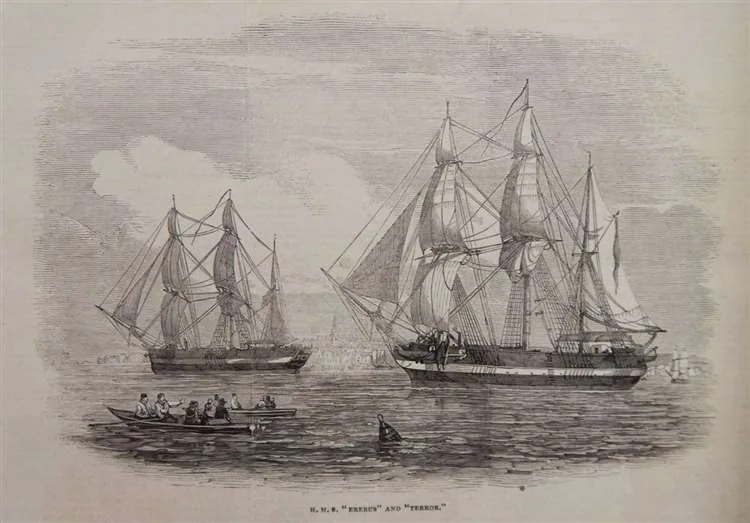
The Franklin expedition was a real Arctic voyage that ended in the loss of HMS Erebus, HMS Terror and the 129 men who continued north after the expedition’s stop in Greenland. The first season of The Terror uses that disaster as the basis for historical horror. Its detailed ships and real names do not make every scene a documented event.
The surviving evidence includes a brief written record, graves, artifacts, Inuit accounts and the two shipwrecks. Together they tell a much fuller story than “two ships vanished,” while still leaving important gaps.
What was the expedition trying to do?
Sir John Franklin’s expedition left England in May 1845 to pursue the Northwest Passage. Parks Canada’s chronology records 134 officers and crew at departure. After men returned from Greenland, 129 continued aboard the two ships.
They wintered at Beechey Island in 1845–46. The ships became trapped in ice off King William Island in September 1846. The distinction between the departure total and the continuing crew explains why accounts can give different numbers without referring to different expeditions.
The ships carried substantial provisions and equipment considered advanced by their European planners. Preparation did not guarantee that they could escape prolonged ice or maintain health through it.
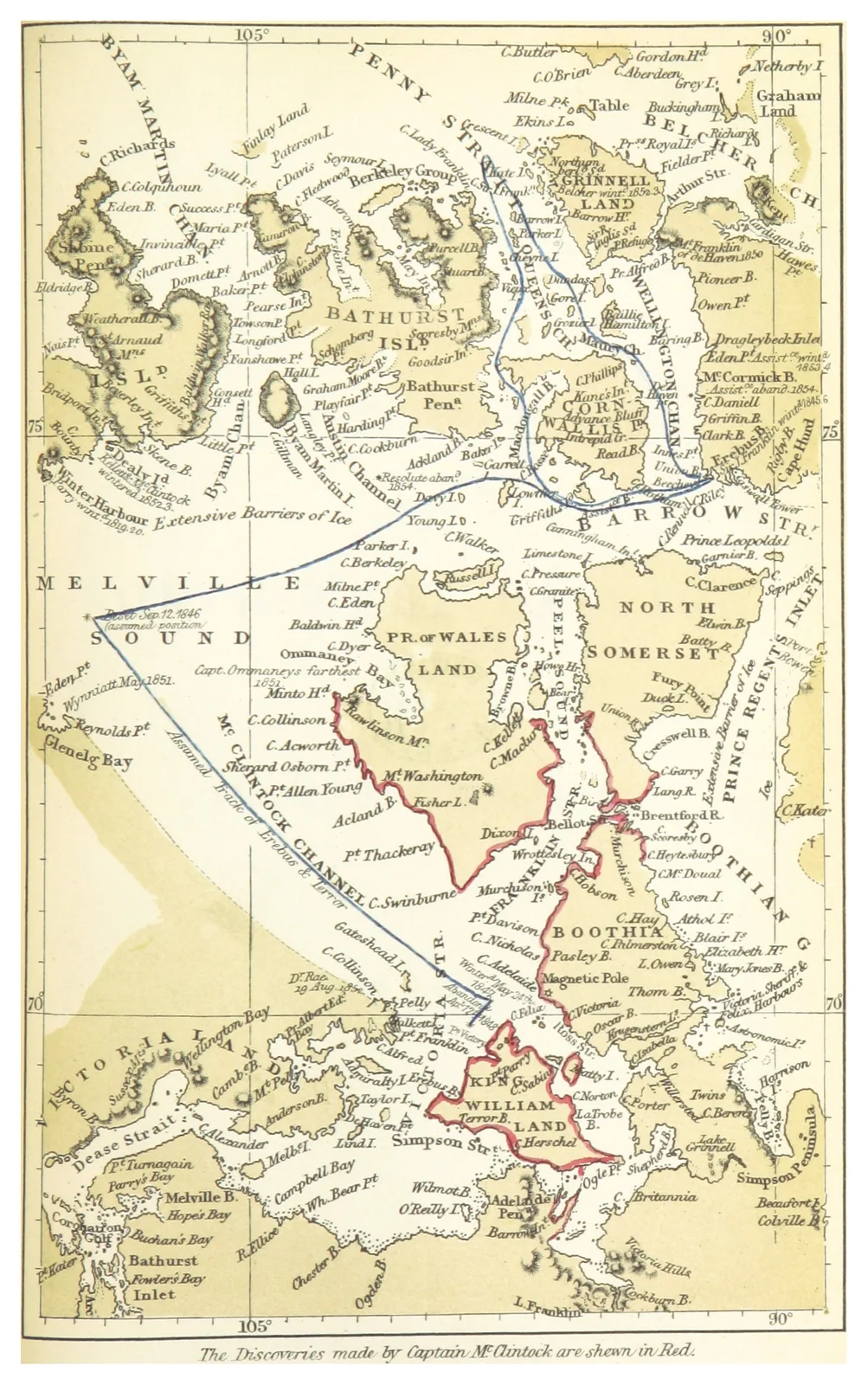
An 1860 reconstruction of probable routes, made long before the wreck discoveries of 2014 and 2016. Source. Historical map (1860) / Wikimedia Commons. Public domain. Resized and converted to WebP.
What does the Victory Point note actually say?
The document contains two messages written at different stages. The first, dated 28 May 1847, reports that all is well. The later annotation, dated 25 April 1848, records a radically changed situation.
According to that annotation, Franklin died on 11 June 1847, the ships were abandoned on 22 April 1848, and 105 survivors were under Francis Crozier’s command. It records 24 deaths by that point and a plan to start toward Back’s Fish River the following day.
The Canadian Museum of History publishes a transcription. Reading both messages matters: the first statement does not describe conditions in April 1848, and the later note does not narrate every event after departure from the ships.
It is a limited piece of testimony, not a complete expedition diary. Claims about conversations, private motives or the exact sequence of every subsequent death need other evidence.
Why are Inuit accounts central?
Inuit knowledge preserved information about the men, their movements and the ships. Parks Canada’s account of its Inuit oral history project acknowledges the role of that knowledge, alongside modern survey technology, in the wreck discoveries.
A version of the story that begins with Europeans losing the ships and ends with technology finding them leaves out a crucial source of knowledge. Oral testimony should be identified and assessed carefully, just as written testimony should, rather than dismissed because it was not a Royal Navy log.
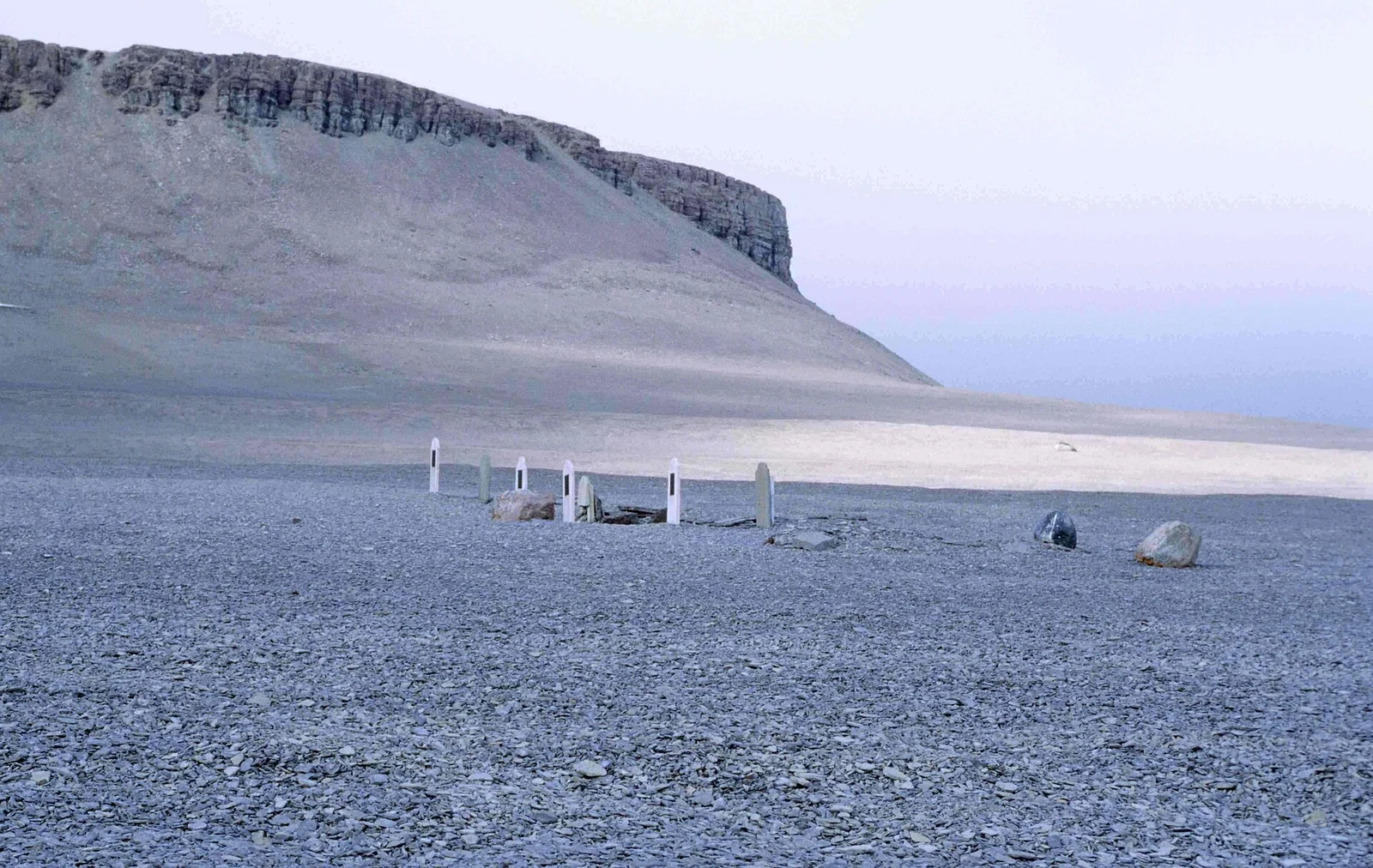
Graves at Beechey Island, photographed by Ansgar Walk in 1997. Source. Ansgar Walk. CC BY-SA 2.5. Resized and converted to WebP.
Were Erebus and Terror ever found?
Yes. Erebus was located in 2014 and Terror in 2016. Their discoveries changed the physical evidence available for research. A lost expedition does not mean that its ships remain undiscovered today.
Finding a wreck also does not answer every question immediately. Archaeological work must connect objects, locations and conditions with other sources. The historic map reproduced here is a nineteenth-century reconstruction of possible routes, not a map produced after the modern wreck discoveries.
What killed the men?
The evidence points to a disastrous combination of prolonged entrapment, exposure, hunger and illness, rather than a securely established single cause for everyone. Research discussed by Historic England found skeletal evidence consistent with cannibalism, adding physical support to earlier testimony about extreme survival conditions.
That evidence concerns what happened during the catastrophe. It does not identify every participant or justify inventing a complete final scene. Popular explanations involving one poisoned food supply or one decisive mistake should be measured against the limits of the record.
How much of The Terror is true?
AMC describes the series as fictional speculation, even while discussing the production’s historical research. The expedition, vessels and principal historical figures provide a foundation; the drama supplies scenes, characterizations and supernatural horror.
Use the series as a reason to explore the evidence, not as a substitute for it. For another maritime tragedy whose familiar retellings contain additions, read the Flannan Isles lighthouse case and the Mary Celeste.