The Index / Paranormal
Is Telekinesis Real? The Evidence for Psychokinesis
Can people move objects with their minds? Explore telekinesis, the history of psychokinesis experiments, and what controlled studies actually found.
Topics: Telekinesis, Psychokinesis, Parapsychology, Paranormal, Science
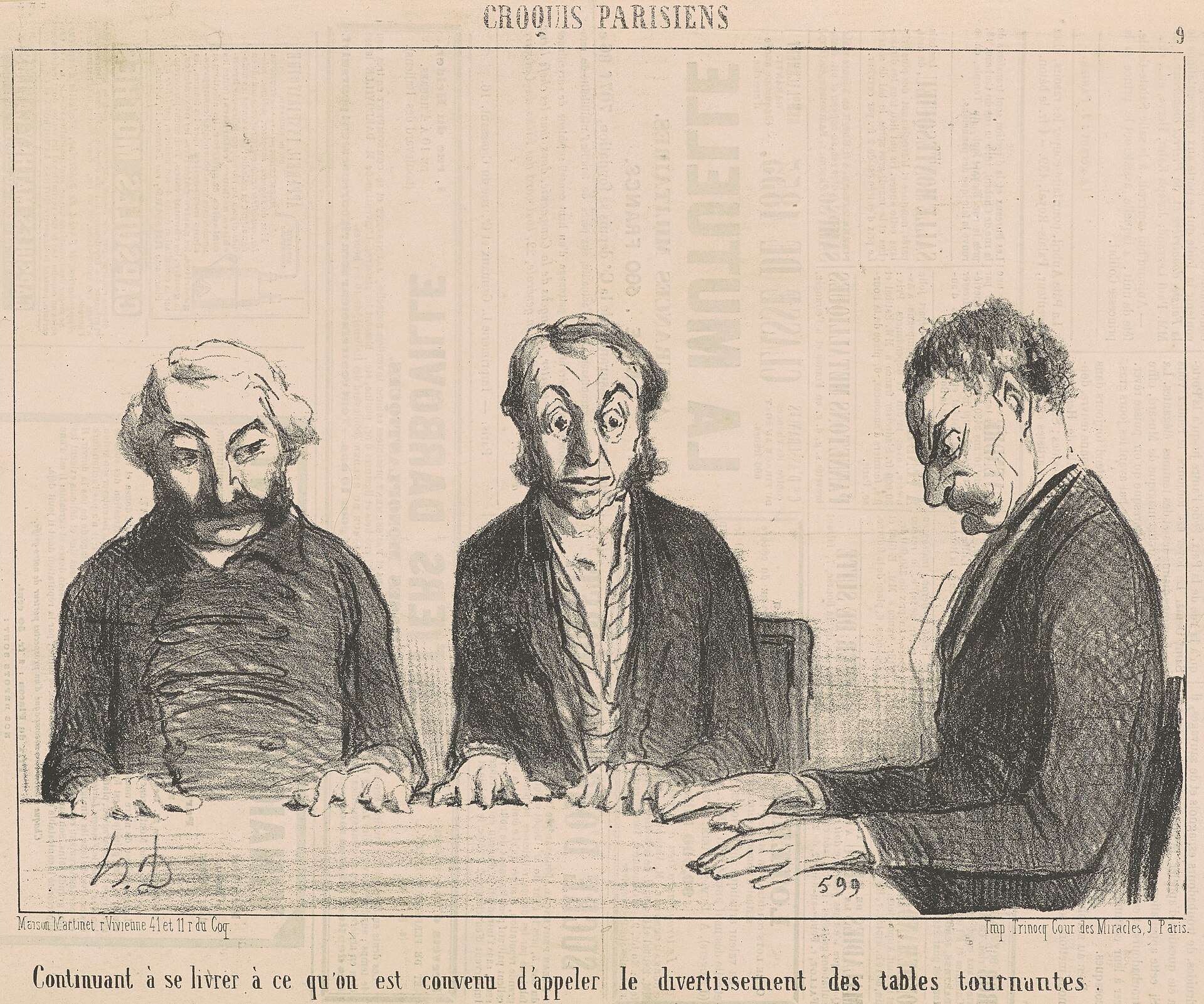
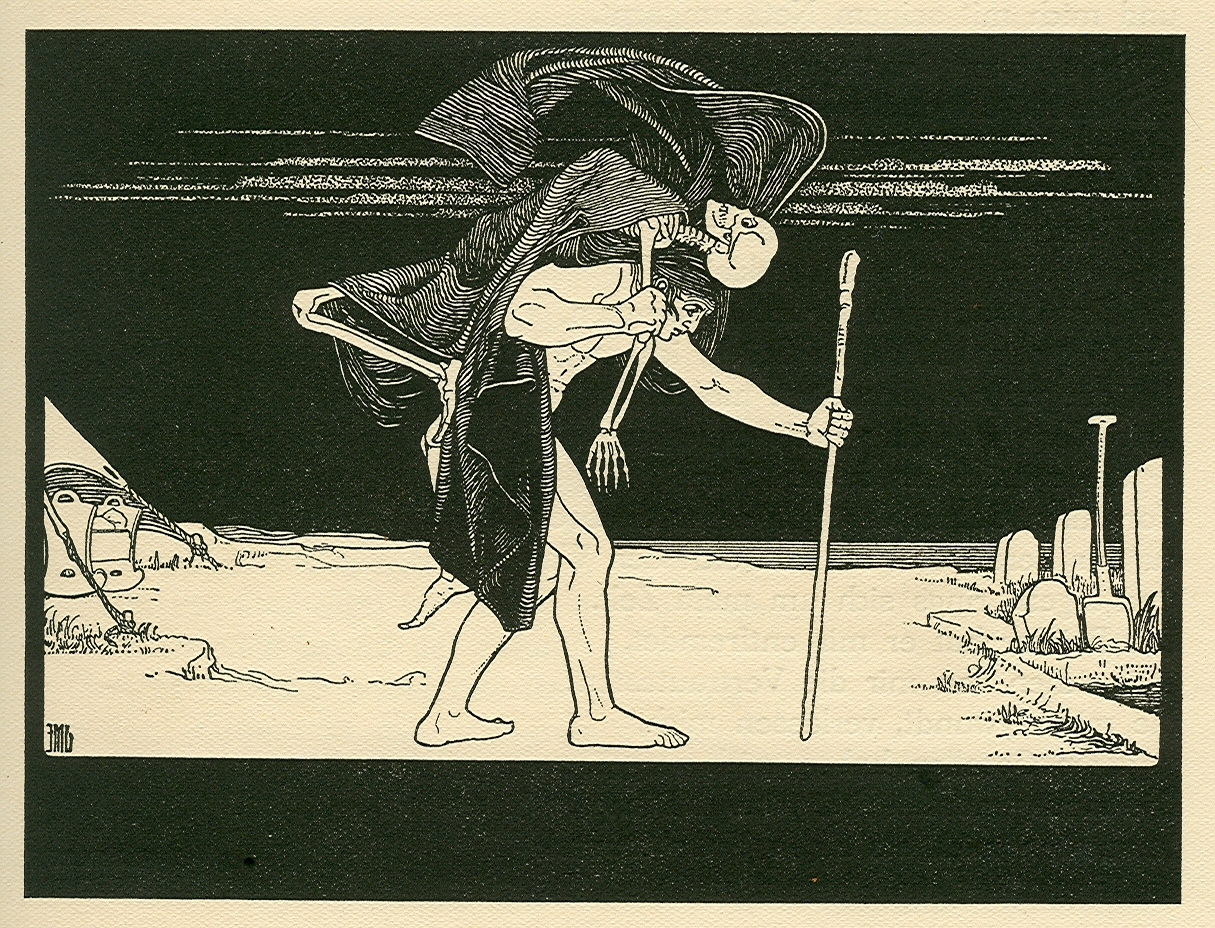
Honoré Daumier / National Gallery of Art (CC0 1.0)
No one has demonstrated telekinesis in a reliably repeatable, controlled experiment. People have reported moving objects without touching them for centuries, and researchers have tested less spectacular versions of the claim with dice and random-number generators. The results have not established a power to move matter by thought. That is a judgment about the evidence, not a claim that every witness is dishonest.
The image most people have in mind is unmistakable: an object lifts from a table while everyone stands back. In the laboratory, the question has usually been much smaller. Could a person’s intention make a coin, die, or electronic randomizer land one way more often than chance predicts? The gap between those two questions is central to the story.
Telekinesis and psychokinesis: what do the words mean?
Telekinesis usually means moving an object at a distance without a known physical force. Psychokinesis, often shortened to PK, is the broader parapsychology term for a claimed mental influence on a physical system. In everyday speech the two are often interchangeable. Researchers also distinguish macro-PK, a visible movement or change, from micro-PK, a proposed tiny statistical influence detectable only after many trials. These are labels for claims and experiments, not established kinds of force.
Psychokinesis should also be separated from extrasensory perception. Guessing a hidden card would be an information claim; making the card move would be a physical one. J. B. Rhine’s Duke laboratory studied both, but evidence offered for one cannot establish the other.
The tables that moved before the laboratory existed
In the nineteenth century, groups gathered around tables, placed their hands on them, and waited for knocks, tilts, and movement. Spiritualists could interpret the motion as communication from the dead. Others proposed a force from the living participants. The distinction mattered: the same moving table could support very different stories, depending on what a sitter already believed.
Honoré Daumier’s lithograph, used above, made the table-turning craze a subject of satire. A later photograph shows another séance setting, with a table apparently raised. Neither picture records a controlled test of psychic power.
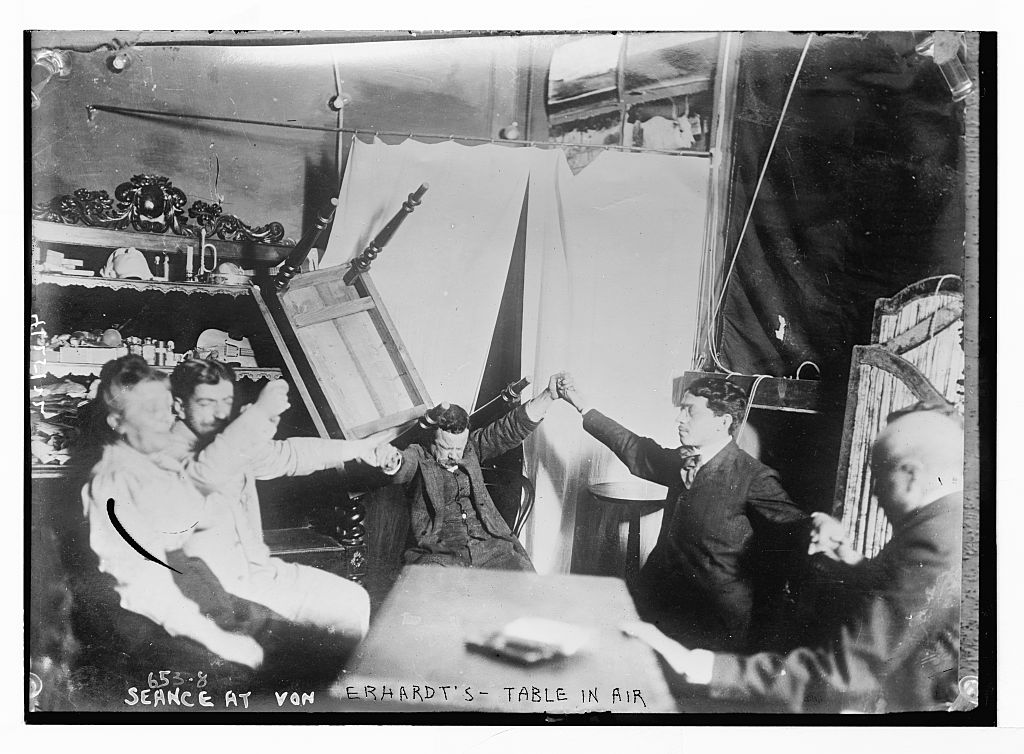
A 1909 séance photograph titled “Table in the air.” It documents a photographed scene, not the cause of the table’s position. Bain News Service / Library of Congress, public domain in the United States; the Library reports no known publication restrictions.
Physicist Michael Faraday offered a simple way to test the table claim in 1853. He put a layered apparatus between the sitters’ hands and the table. Its indicators showed that the hands exerted pressure in the direction of the table’s movement. When the participants could see the indicator and correct their own pressure, the movement stopped. Faraday’s published account did not require sitters to be lying: a person can make small, unintentional movements while sincerely believing they are passive. This is an early, concrete demonstration of what later discussion calls the ideomotor effect.
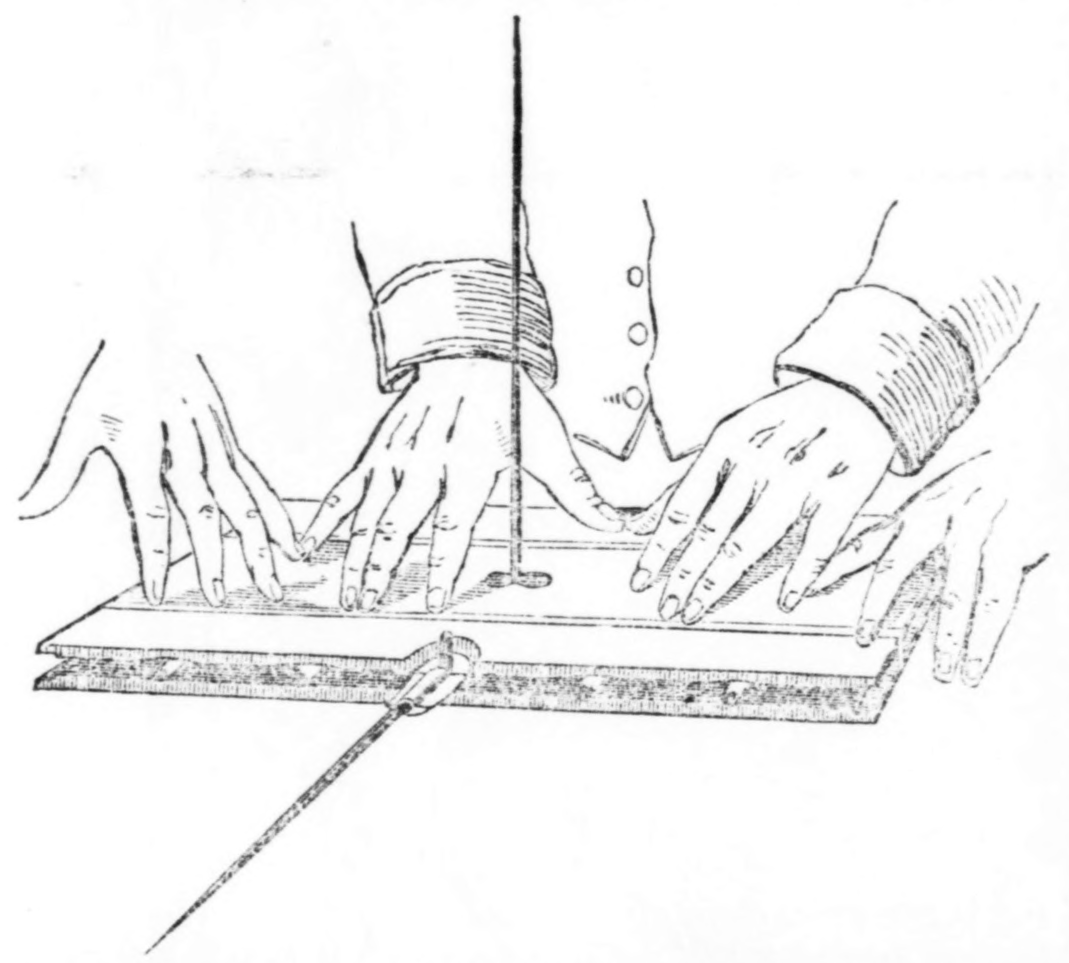
Faraday’s apparatus as illustrated in The Illustrated London News on July 16, 1853. Source. Michael Faraday / public domain, Public Domain Mark 1.0.
His experiment explains a particular kind of table turning. It does not explain every subsequent object-movement report. It does show why a witness’s certainty that “nobody pushed” is not, by itself, a measurement of force.
From séances to dice and electronic randomness
The Society for Psychical Research, founded in Britain in 1882, tried to investigate extraordinary reports systematically. Its work preserved testimony as well as disputes about how much testimony could prove. Twentieth-century experimenters increasingly turned from dramatic séances to repeatable trials. At Duke, J. B. Rhine and colleagues tested whether intention could alter the fall of dice. Duke’s account of the laboratory records its broader work on purported psychic phenomena; an unusual run of dice was a proposed effect to test, not a demonstration that thought had moved the dice.
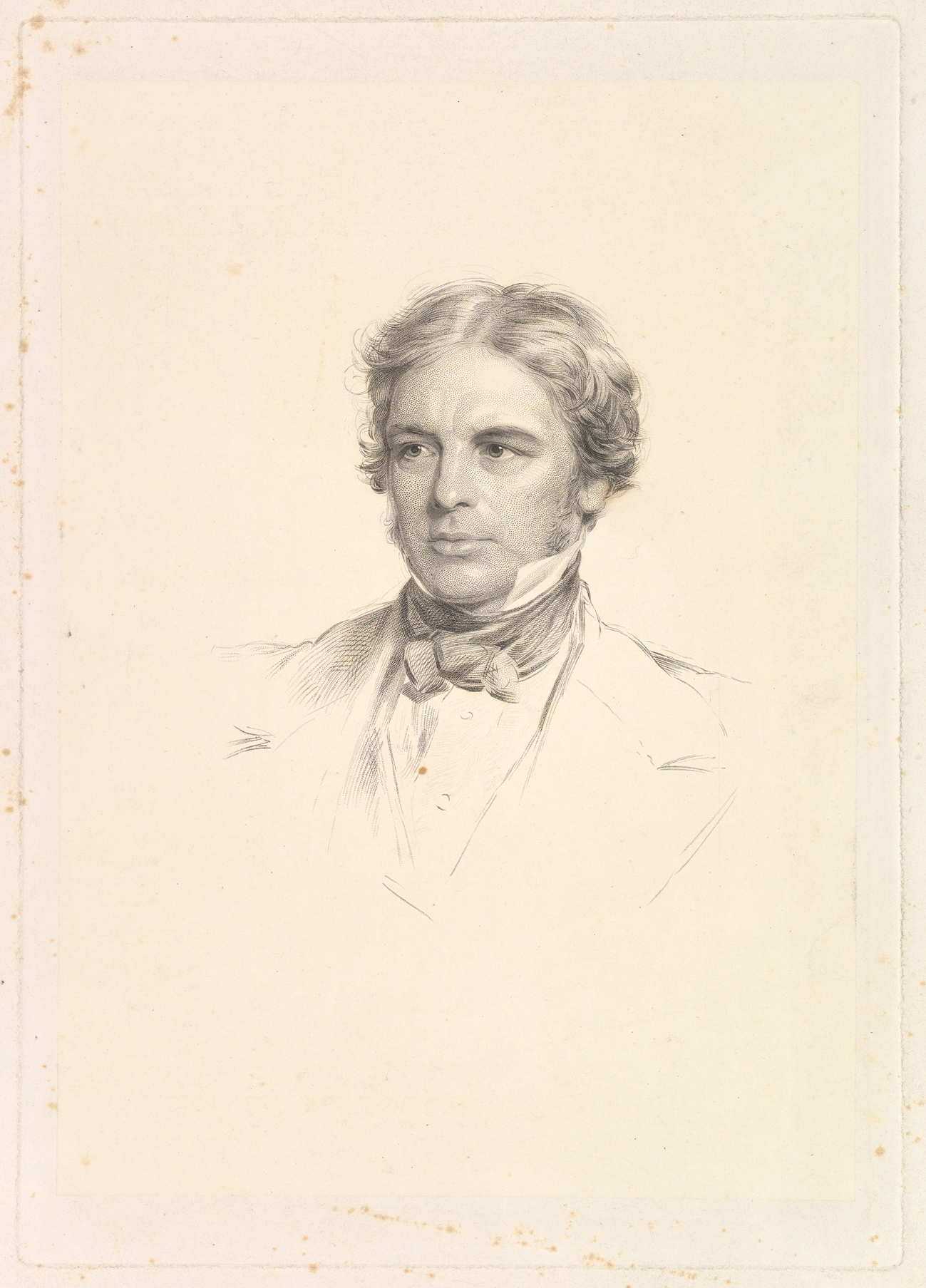
Michael Faraday, who tested the table-turning claim rather than accepting its apparent movement as an explanation. Engraving by William Holl the Younger after George Richmond, 1852. Metropolitan Museum of Art, CC0 1.0; commercial reuse permitted.
Electronic random-number generators later offered a different target. Rather than watch a spoon bend, participants tried to make a stream of random outputs favor one result. Princeton’s Engineering Anomalies Research laboratory, known as PEAR, spent decades examining such proposed mind–machine interactions. Princeton Alumni Weekly’s history describes millions of trials and a lab that closed in 2007. The program’s duration and volume of data are historically significant; they do not settle whether the effect was real.
The strongest reason for caution is how small and unstable the reported effect becomes under scrutiny. A 2006 meta-analysis pooled 380 random-number-generator studies. It found a statistically significant but very small overall departure from chance. The effects varied greatly between studies, and larger studies tended to report smaller effects. The authors found that publication bias could, in principle, account for the pattern. “Statistically significant” here does not mean a usable or independently confirmed power.
A later online experiment with 12,571 participants tested a micro-PK prediction using quantum-based randomness. Its Bayesian analysis favored the no-effect hypothesis for that data. One null study cannot erase every previous study, just as a small positive result cannot establish a new human ability. Together, these findings show why independent replication and strong controls matter more than a striking individual result.
Famous claimants and the problem of controls
Uri Geller’s spoon-bending performances made visible PK a television phenomenon. A bent utensil can be compelling to watch, but a performance cannot show whether the bend came from an unknown mental force, ordinary manipulation, or stage technique without controls over the object and the observer’s view. Repeating a stunt under loose conditions does not solve that problem.
Soviet claimant Ninel “Nina” Kulagina became known through filmed object-movement demonstrations. A 1978 Defense Intelligence Agency report discussed the reports but explicitly said that adequate documentation and verification of the apparent effects were unavailable. A declassified government document records interest in a claim; it is not government confirmation that the claim was true.
James Randi’s Project Alpha exposed another weakness. Two young magicians, Steve Shaw (later Banachek) and Michael Edwards, posed as psychic subjects in a research setting and produced apparent phenomena by trickery. Randi described the operation in his 1983 account. The episode does not prove that every PK report is a trick. It demonstrates that an experiment can be fooled when subjects can handle materials or exploit blind spots in observation; its ethics were also disputed. A convincing test has to make ordinary manipulation genuinely difficult, not merely unlikely in the investigator’s opinion.
What about poltergeists and unconscious PK?
Some parapsychologists proposed recurrent spontaneous psychokinesis (RSPK) to explain disturbances attributed to a living person, sometimes an adolescent under stress. That is a hypothesis about the cause of reported events. It has not supplied a reproducible mechanism for moving objects. Our poltergeist overview and Enfield case history examine the testimony, known instances of trickery, and unresolved incidents on their own terms. Calling a disturbance RSPK does not turn it into evidence for PK.
Does physics leave room for telekinesis?
Science can test the proposed effect without first having a complete theory of how it might work. A clearly moving object under secure observation would be worth investigating even if nobody had an explanation. But a repeatable effect has not been established. Invoking “quantum” language cannot bridge that evidentiary gap: the randomizer studies still have to show that human intention, rather than chance, bias, or a flaw in the apparatus, changed their outputs.
That is why the best answer to “is telekinesis real?” remains unproven. Historical séances, filmed demonstrations, intriguing statistical findings, and sincere witness accounts are different kinds of material. None currently demonstrates reliable movement of objects by thought alone.
Why Carrie still makes the question irresistible
Stephen King’s Carrie imagines a power that is immediate, visible, and terrifying. Amazon’s September 2026 announcement schedules Mike Flanagan’s eight-episode adaptation for Prime Video on October 7, 2026. Its telekinesis belongs to fiction. The real history is less cinematic and more revealing: each generation has devised a new way to ask whether intention can affect matter, and each test has had to confront the same question of what else could have moved it.
Frequently asked questions
Can people move objects with their minds? No controlled, independently repeatable demonstration has established that ability. Accounts of movement still need to rule out contact, air currents, equipment effects, error, and deliberate manipulation.
What is the difference between telekinesis and psychokinesis? Telekinesis usually refers to moving an object at a distance. Psychokinesis is a broader term for a claimed mental influence on physical events, including proposed tiny effects in random-number tests.
Did random-number studies prove psychokinesis? No. A 2006 review found a very small pooled effect across many studies but also a pattern compatible with publication bias. A large 2018 study found evidence favoring no effect in its own data.
Is RSPK an explanation for poltergeists? It is a proposed parapsychological explanation, not an established physical mechanism or a demonstrated cause of any particular disturbance.
Sources & further reading
- Society for Psychical Research, Institutional History
- Encyclopedia of Occultism and Parapsychology, Telekinesis and Psychokinesis
- Faraday, Experimental Investigation of Table-Moving (1853)
- Duke University Libraries, Early Studies in Parapsychology at Duke
- Princeton Alumni Weekly, PEAR Laboratory History
- Bösch, Steinkamp and Boller, Psychokinesis RNG Meta-Analysis (2006)
- Maier, Dechamps and Pflitsch, Micro-Psychokinesis Experiment (2018)
- Defense Intelligence Agency, Kulagina Research Report (1978)
- James Randi, The Project Alpha Experiment (1983)
- Amazon, Carrie Series Release Announcement (2026)