The Index / Occult History
How Did Harry Houdini Die? The Halloween Death and Punch Story Explained
Houdini's recorded cause of death was peritonitis following appendicitis. Why the punch story is disputed, and what a new centenary claim changes.
Topics: Harry Houdini, Spiritualism, Spirit photography, Halloween, 1926

Harry Houdini’s officially recorded cause of death was diffuse peritonitis following a ruptured appendix. The accepted date is 31 October 1926, in Detroit. The familiar claim that a student’s punch simply killed him compresses a disputed sequence into a certainty the historical accounts do not support.
The Halloween centenary brings a fresh disagreement about his final days. It also offers a reason to separate the medical account, the punch story and Houdini’s very real campaign against fraudulent mediums.
What happened before Houdini died?
In his account for Yale University Press, biographer Adam Begley describes Houdini feeling ill before student J. Gordon Whitehead struck his abdomen in Montreal. Houdini kept performing and travelled to Detroit.
| Event | What Begley’s account establishes |
|---|---|
| Montreal encounter | Whitehead punched Houdini while testing the performer’s ability to withstand abdominal blows. |
| Detroit performance | A doctor suspected acute appendicitis, but Houdini continued with his engagement. |
| Hospital treatment | Surgery on 25 October found a ruptured appendix. |
| Recorded death | Diffuse peritonitis, the abdominal infection associated with the rupture; 31 October 1926. |
This is a historian’s reconstruction, not a newly examined medical record. It does not support a death during an underwater escape.
Did the punch cause the appendicitis?
The sequence is better established than the causal link. Begley argues against the punch causing appendicitis or immediately rupturing the appendix. The McGill University Archives overview instead suggests that the blows aggravated an already developing condition.
The accounts even differ on timing: McGill places the visit and encounter on 20 October, while Begley dates the dressing-room incident to 22 October. Both identify Whitehead and describe blows followed by continued travel and illness. Neither agreement on the encounter nor its proximity to death proves precisely what the punches did internally.
Calling Whitehead the man who definitively killed Houdini goes beyond that evidence. So does treating a supernatural curse as a medical explanation.
Why is a new book questioning the death date?
The Associated Press reported on 31 October 2026 that Larrian Gillespie’s Houdini: The Man Who Died Twice argues for 30 October and postoperative intestinal blockage. AP describes conflicting documents: a doctor’s affidavit gives the 30th, while the state death certificate gives the 31st. Houdini scholar Bruce Averbook disputes the proposed date change; John Cox calls for another opinion.
This is a contested revision, not an established replacement for the recorded diagnosis and date. The underlying records have not been independently re-examined for this article.
Houdini’s spirit photographs were demonstrations of trickery
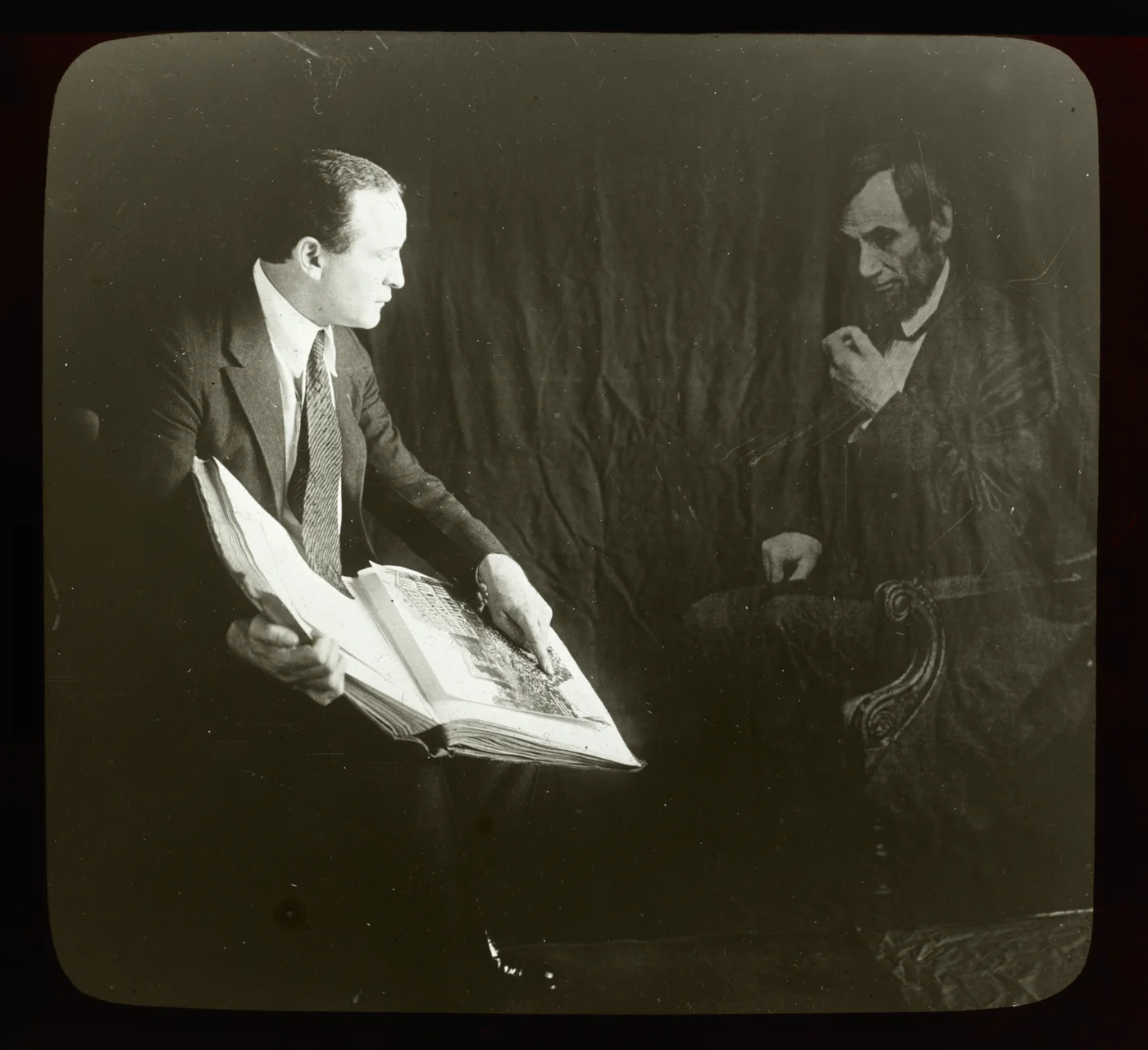
The Library of Congress’s centenary essay describes Houdini exposing mediums who claimed to communicate with dead relatives. His deliberately constructed photograph with Abraham Lincoln illustrates how an apparent apparition could be manufactured.
The photograph documents a demonstration of technique. It does not document contact with Lincoln. That distinction also matters when reading the older Fox sisters and Spiritualism story, where reported phenomena and explanations developed into a much wider movement.
Houdini left roughly 4,000 books on magic, witchcraft, spiritualism and related subjects to the Library of Congress, with volumes dating back to 1489. The collection is a firmer surviving legacy than a claim that his Halloween death proved supernatural forces were at work. The date is part of his public remembrance; the history of Halloween is a separate subject from the evidence about his final illness.
Sources & further reading
- Library of Congress: Death of the Magician, centenary essay, 28 October 2026
- Adam Begley, Yale University Press: Did Houdini Really Die after Being Sucker Punched?, 11 March 2020
- McGill University Archives: Did a McGill student accidentally kill Harry Houdini?, 16 September 2026
- Associated Press: Houdini's centennial spotlight and the new death-date dispute, 31 October 2026
- Wikimedia Commons: Houdini and Lincoln, historical spirit-photography demonstration and rights record