Lore & Explained / Folklore
Where Did Halloween Come From? Samhain, All Hallows and the American Holiday
Halloween is All Hallows' Eve, not a single surviving Celtic rite. What Samhain, All Saints, souling and trick-or-treating each actually document.
Topics: Halloween, Samhain, All Hallows, All Saints, Trick-or-treating, Folklore history
Halloween is the evening before All Saints’ Day, which is why its older English name is All Hallows’ Eve. In the Western Christian calendar All Saints falls on November 1 and the commemoration of all the faithful departed falls on November 2. Medieval Irish literature also uses Samhain for the start of winter, at the same turn of the season. Those are two documented facts. They are often pressed into a third claim that the sources do not secure: that a single ancient Celtic feast of the dead was renamed and has continued, unchanged, as the modern holiday.
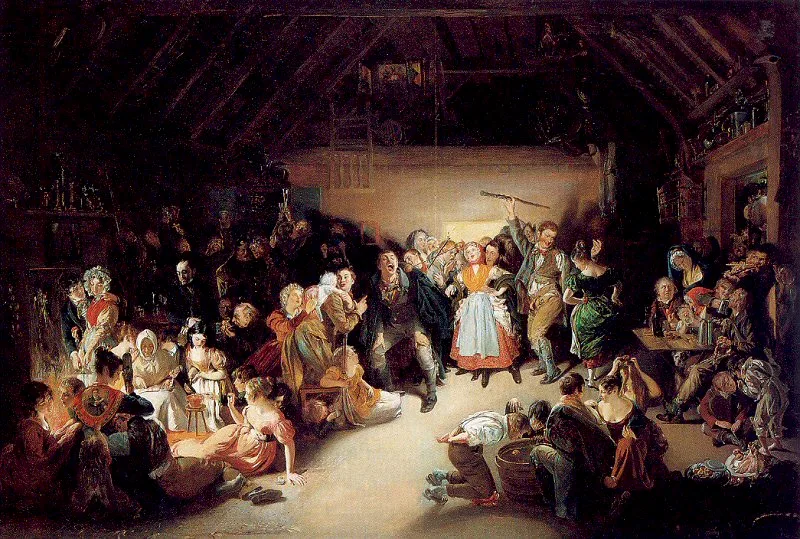
Hero image: Daniel Maclise, Snap-Apple Night (1833), a painting of an Irish indoor gathering with firelight and party games. It records a nineteenth-century idea of the night, not a prehistoric ritual. Via Wikimedia Commons. Public domain. The artist died in 1870. Resized and converted to WebP.
What does the name Halloween actually mean?
It means the eve of All Hallows. “Hallow” is an old English word for a saint. All Hallows’ Day is All Saints’ Day. Halloween, or Hallowe’en, is the night before it. Hallowmas is another name for the feast itself.
That naming is not a modern marketing invention. In The Two Gentlemen of Verona, Speed tells Valentine that one mark of a lover is to “speak puling, like a beggar at Hallowmas.” The joke only works if an Elizabethan audience already recognized whining beggars at that feast. It shows that begging was associated with Hallowmas in Shakespeare’s England. It does not describe costumes, pumpkins or a phrase anything like “trick or treat.”
The three days are easy to mix up, so the calendar is worth stating plainly:
| Date | Name in the Western calendar | What the name refers to |
|---|---|---|
| October 31 | Halloween, All Hallows’ Eve | The eve of All Saints |
| November 1 | All Saints’ Day, All Hallows, Hallowmas | The feast of all saints |
| November 2 | All Souls’ Day | The commemoration of the faithful departed |
Was Samhain the Celtic New Year and a feast of the dead?
Samhain is a real name in medieval Irish literature for the opening of winter. The further claim, that ancient Celts everywhere kept it as their New Year and their great feast of the dead, is a much later scholarly construction.
In The Wooing of Emer, a gloss calls Samuin the end of summer and divides the year in two: summer from Beltaine, the first of May, to Samuin, and winter from Samuin back to Beltaine. That is a medieval explanation of the seasons, not a report that every Celtic-speaking people held one rite, and it says nothing about ghosts. CELT’s text of Kuno Meyer’s translation has the wording. Hutton’s chapter in The Stations of the Sun treats Samhain as the major early medieval Irish festival at the opening of winter, when assemblies could be held.
The New Year and feast-of-the-dead story is younger. In 2024 Hutton traced it from John O’Donovan’s 1847 reading of Sanas Cormaic, through Sir John Rhys, to Sir James Frazer’s argument in The Golden Bough that All Souls was a pagan festival the Church failed to suppress. Popular books were still repeating both ideas a century later. Hutton’s conclusion: the New Year evidence is indirect and inconclusive, and the evidence for a feast of the dead is close to nonexistent. Neither is strictly disproved. Neither is established fact about the pre-Roman Iron Age. “The Celtic New Year and Feast of the Dead.”
People can still keep a pagan new year or a commemoration of the dead at Halloween. Hutton says that modern practice does not need, and does not prove, the ancient precedent. The same limit applies to fiction. Sam in Trick ’r Treat was invented in 1996. He is not a Samhain deity.
Did the Church move All Saints to November 1 to replace Samhain?
The Western feast is kept on November 1. A deliberate move made in order to replace Samhain is not a demonstrated fact.
Churches first remembered martyrs on local anniversaries, and a shared martyrs’ feast appears in the East on more than one date. In Rome, Pope Boniface IV dedicated the Pantheon to Mary and all the martyrs on May 13, in 609 or 610. The 1907 Catholic Encyclopedia states that Gregory III (731–741) then consecrated a chapel in St. Peter’s to all the saints and fixed November 1, and that Gregory IV (827–844) extended that date to the whole Church. Mershman, “All Saints’ Day.” A later reference article says how November 1 was chosen “has not yet been demonstrated,” that Gregory III’s dedication date is not known precisely, and that there is no consensus for the story that Gregory IV merely moved the May feast. Bede mentions an All Saints feast. In 799 Alcuin commends a November 1 observance at Salzburg. None of that is an order to suppress Samhain. “All Saints, Solemnity of.”
All Souls is a second feast. The Catholic Encyclopedia puts the commemoration of the faithful departed on November 2 and says St. Odilo of Cluny ordered an annual commemoration in his monasteries, from which it spread. It does not say he picked the date to Christianize Samhain. Mershman, “All Souls’ Day.” Frazer later turned All Saints and All Souls into a failed suppression of a Celtic feast of the dead. Hutton’s point is that the sequence became famous by repetition.
What did people actually do on the night?
Different communities left different records: divination games, fires, mischief, visiting, and food given at the season. No single checklist covers all of them.
Robert Burns’s “Halloween” (1785) is a west-of-Scotland snapshot. His note says the night “is thought to be a night when witches, devils, and other mischief-making beings are abroad,” and that fairies were said to hold an anniversary. He also describes charms, including pulling a kale stalk in the dark as a sign of a future spouse. The poem records belief and games in one region. It does not confirm that those beings were abroad, and it does not describe ancient Ireland. The poem and note.
Daniel Maclise’s Snap-Apple Night (1833) paints a crowded Irish barn, a fire and the apple game named in the title. It is a composed picture by an artist who died in 1870, not a photograph and not a ritual manual. Mirror fortune-telling from the same layer of party custom has a separate later life in the Bloody Mary legend. Carved turnips, and later pumpkins, are a different paper trail again, set out in why jack-o’-lanterns have faces. A face on a vegetable can be a joke, a fright or a picture of a spirit. It does not identify an Iron Age lantern.
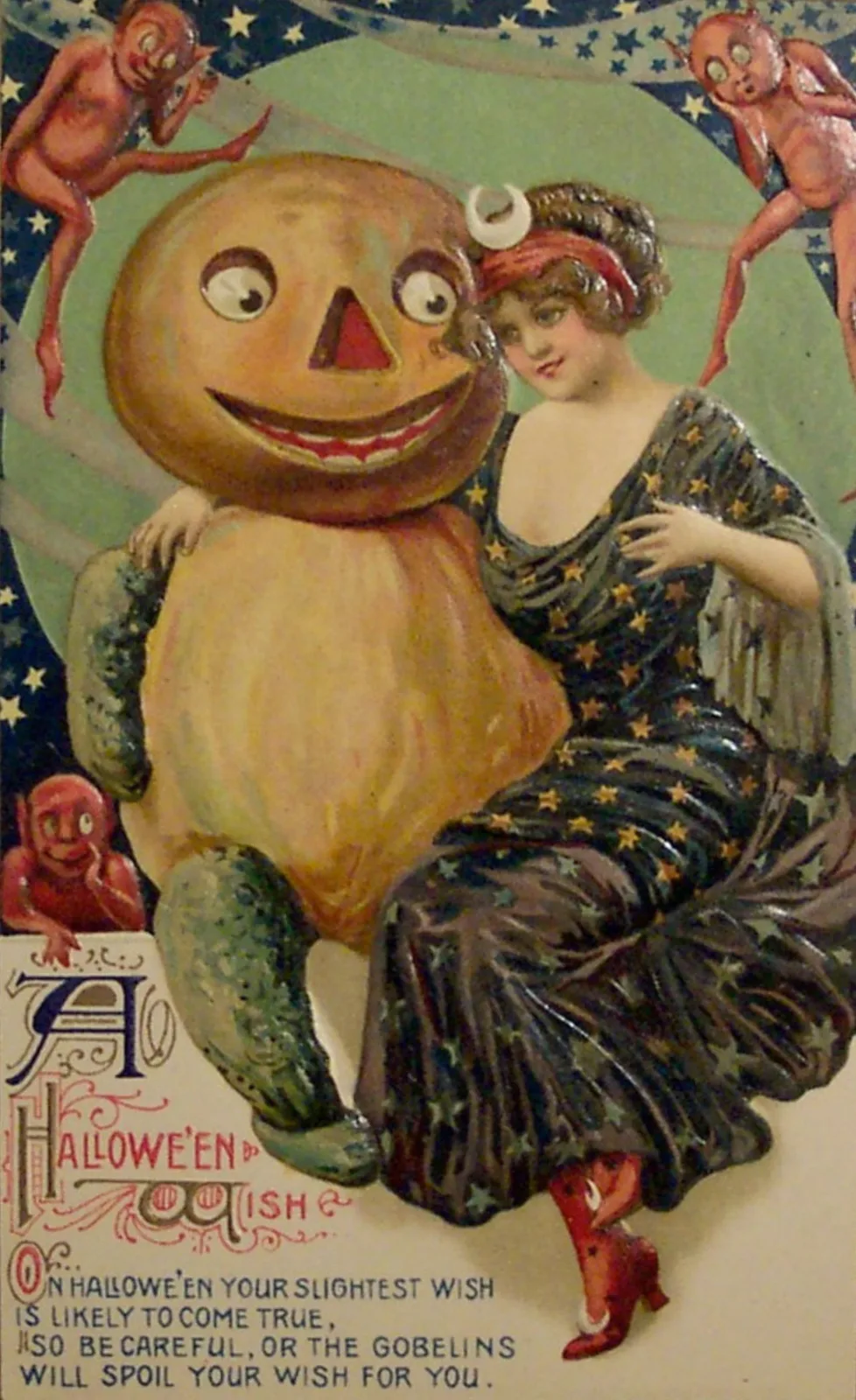
John Winsch, “A Halloween Wish,” a 1912 American postcard. The printed verse says a slight wish is likely to come true on Hallowe’en, and that goblins may spoil it. That is commercial season’s art, not a field report of a surviving rite. Via Wikimedia Commons. Public domain. Resized and converted to WebP.
Is trick-or-treating just souling under another name?
Souling and Hallowmas begging are older. Candy routes under the name trick-or-treating are a twentieth-century North American practice.
English souling means going house to house for soul cakes, often with prayers for the dead around All Souls. In parts of Scotland, guising meant performing in disguise for a reward. Cheshire soul-caking plays were still performed in the 1970s.
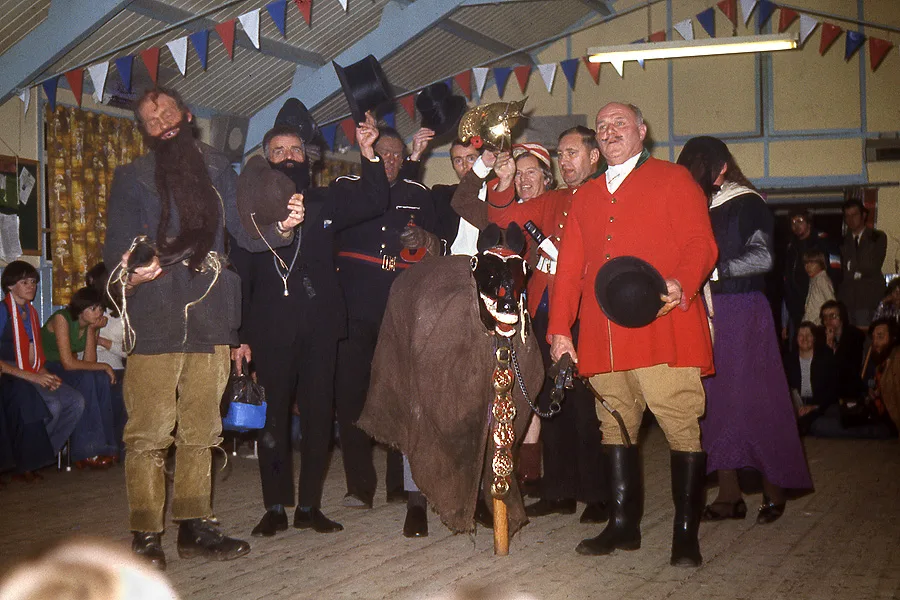
The Antrobus Soul Cakers in a Cheshire village hall, photographed by Simon Garbett in the mid-1970s. The hobby horse and costumes belong to a local mumming play performed around the season. All Souls’ Day is November 2, not October 31. This is a twentieth-century performance, not a medieval document. The photographer released this scan to the public domain and asked for credit outside Wikipedia; he retained rights in the original transparency and in higher-resolution scans. Wikimedia Commons.
Samira Kawash’s 2011 study in the American Journal of Play argues that those parallels have been overread. Choosing souling, guising or Guy Fawkes begging as the single origin, she notes by way of Tad Tuleja, often follows a preferred national story. Her newspaper evidence puts children demanding a “trick or treat” no earlier than the late 1920s. One early item she cites is the Lethbridge Herald of November 4, 1927, reporting the demand at Blackie, Alberta. Further reports turn up in the 1930s. Adults in several of them sound as if the custom is new, which is a poor fit for an old inheritance they would already have known. Kawash, “Gangsters, Pranksters, and the Invention of Trick-or-Treating.”
Ruth Edna Kelley’s The Book of Hallowe’en (1919) points the same way from the American side. A librarian in Lynn, Massachusetts, she describes gates carried off, flour thrown, “door-bells” rung and things thrown into halls, and she calls the night one of “ghostly and merry revelry.” In the Project Gutenberg text, doorbells are a prank. The phrase “trick or treat” does not appear. Kelley (1919).
Soul cakes and guising show that asking for food at this season is old. They do not produce the American phrase or the candy route.
Which familiar claims hold up?
The table below separates the claim people usually hear from the narrower thing the record supports.
| Familiar claim | What the record supports | What it does not establish |
|---|---|---|
| Halloween was originally Samhain, the Celtic New Year and feast of the dead | Medieval Irish texts place Samhain at the start of winter. Hutton finds the New Year and feast-of-the-dead claims largely in Victorian and Edwardian scholarship | A proven pan-Celtic rite that “became” the modern holiday |
| The Church moved All Saints to November 1 to replace that rite | All Saints is November 1 in the West; All Souls is November 2; earlier martyrs’ feasts used other dates. Writers disagree on how November 1 was fixed | A documented policy of suppressing Samhain |
| Trick-or-treating is ancient souling | Hallowmas begging is in Shakespeare. Souling and guising are later recorded customs. A Cheshire soul-caking play was still performed in the 1970s | The American candy ritual before the late 1920s |
| Witch costumes come from the Salem trials | Salem was a 1692 legal episode in Massachusetts, with executions | The origin of Halloween costume parties |
| Jack-o’-lanterns were carved at ancient Samhain | Turnip lanterns and later pumpkin faces are documented in more recent folklore and print | A dated ancient prototype for the porch pumpkin |
Why do witches, ghosts and black cats dominate the pictures?
Seasonal print, parties and film reused a stock of figures. Those figures do not share one pagan source.
Burns reported what people in 1785 thought was abroad. The Winsch postcard and Kelley’s book show the same cast becoming decoration.
Salem is the history the costumes borrow most often, and it is a different subject. The National Endowment for the Humanities, summarizing the trial records, counts 19 people hanged, one pressed to death, and five more dead in jail. That was a legal persecution in 1692. It did not found the costume party. The records belong in the Salem trials. The English prosecutions of 1612 belong in the Pendle cases.
Other figures arrive the same way. Krampus belongs to Alpine St. Nicholas custom in early December. The Ouija board has its own spiritualist history, even when a Halloween party includes one. Friday the 13th is a separate calendar fear. A date can collect stories without giving them one origin.
What should be filed as folklore, and what as history?
The calendar names, the Irish seasonal term, the papal and monastic notices, Burns, Shakespeare, Maclise, Kelley and Kawash’s newspaper trail are history: words and events with dates. The games, soul cakes, guising, turnip lanterns and stories about who was abroad are folklore. They are real practices, and they still need a place and a century. “An old custom in the west of Scotland” is not “the ancient Celts did this.”
Claims that witches, fairies or the dead were actually present, or that a kale stalk revealed a future spouse, stay claims. The sources record that people said so. Frazer’s pagan-survival story, and the idea that trick-or-treating is unchanged souling, are later retellings. A retelling can be influential and still be unproven.
Frequently asked questions
Is Halloween a pagan holiday?
It is the eve of a Christian feast, on a season medieval Irish sources call the start of winter. A modern pagan observance is a present-day practice. Calling the whole holiday an ancient Celtic feast of the dead goes beyond the evidence.
Is Samhain the same thing as Halloween?
No. Samhain is a medieval Irish name for the start of winter. Halloween is the English name for the eve of All Saints. They share a season. They are not one festival.
When did trick-or-treating start?
Printed descriptions of children using the phrase cluster from the late 1920s onward, including a 1927 account from Blackie, Alberta, in Kawash’s survey. A 1919 American description of Halloween pranks does not use the phrase. Older European begging customs are related only at a distance.
Did the Catholic Church invent Halloween to replace Samhain?
The Church developed All Saints and All Souls on November 1 and 2. Halloween is the eve of All Saints. Historians do not have a secure document showing that November 1 was selected as a replacement for Samhain. That replacement story is an interpretation, associated especially with Frazer, and later work has treated it as unproven.
Were the first jack-o’-lanterns part of ancient Samhain?
Carved turnips and, later, pumpkins belong to more recent Irish, British and American customs. They are part of Halloween’s recorded material culture. They are not evidence for a lantern rite in the Iron Age. The separate history is in our jack-o’-lantern explainer.
Sources & further reading
- Ronald Hutton, "The Celtic New Year and Feast of the Dead," Folklore 135, no. 1 (2024): 69–86
- Ronald Hutton, "Samhain," in The Stations of the Sun (Oxford University Press, 1996), chapter abstract
- Ronald Hutton, Samhain chapter, DOI record for The Stations of the Sun
- Ronald Hutton, "The Celtic New Year and Feast of the Dead," open-access PDF, Folklore (2024)
- CELT: The Wooing of Emer, Kuno Meyer translation (Samuin as the start of winter)
- Francis Mershman, "All Saints' Day," The Catholic Encyclopedia (1907)
- Francis Mershman, "All Souls' Day," The Catholic Encyclopedia (1907)
- Encyclopedia.com: All Saints, Solemnity of (on the unsettled route to the November 1 date)
- William Shakespeare, The Two Gentlemen of Verona, Speed to Valentine, "a beggar at Hallowmas" (MIT Shakespeare)
- Robert Burns, "Halloween" (1785), with the author's note, via Project Gutenberg
- Ruth Edna Kelley, The Book of Hallowe'en (Boston: Lothrop, Lee & Shepard, 1919), via Project Gutenberg
- National Endowment for the Humanities: Records of the Salem witch trials (19 hanged, one pressed to death, five dead in jail)
- Samira Kawash, "Gangsters, Pranksters, and the Invention of Trick-or-Treating, 1930–1960," American Journal of Play 4, no. 2 (2011)
- Wikimedia Commons: Snap-Apple Night, Daniel Maclise, 1833 (public domain)
- Wikimedia Commons: A Halloween Wish, John Winsch postcard, 1912 (public domain)
- Wikimedia Commons: Antrobus Soul Cakers, Simon Garbett, mid-1970s (PD-self dedication of this scan)
- Morbid Index: jack-o'-lanterns, turnips and Stingy Jack
- Morbid Index: Sam from Trick 'r Treat is not a Samhain deity
- Morbid Index: Bloody Mary and older Halloween mirror divination