Lore & Explained / Demons & Occult
Incubus and Succubus Explained: Medieval Demon Lore, Sleep Paralysis, and the History Behind the Myth
Augustine took incubi seriously as fact in 426 AD. By the Malleus Maleficarum, demonic sexual encounters had become evidence in witch trials. Here's the documented history.
Topics: Incubus, Succubus, Medieval Demonology, Witch Trials, Demons & Occult
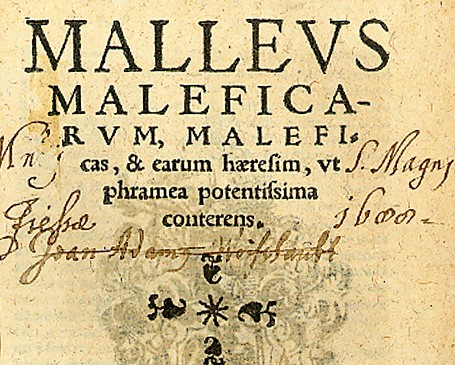
University of Sydney Library, 1520 edition (Public Domain)
An incubus is a male demon said to lie on top of sleeping women; a succubus, its female counterpart, lies beneath sleeping men. Both names describe the act directly — Latin incubare, “to lie upon,” and succubare, “to lie beneath.” What’s worth tracing carefully is how a folk explanation for nighttime sexual dreams and unexplained paralysis hardened, over roughly a thousand years of Christian theology, into evidence used against real people accused of witchcraft.
Where the Names Come From
Incubus derives from the Late Latin incubo, meaning “nightmare” in the specific older sense of something that lies down on a sleeper, from incubare, “to lie upon” or “to hatch.” Succuba, the root of “succubus,” comes from succubare — sub- (“under”) plus cubare (“to lie”) — meaning roughly “one who lies beneath.” Both terms describe a physical posture and an act, not an origin story or a specific mythological lineage; they’re functional Latin descriptions that predate their later, more elaborate Christian theological framing.
Augustine: Taking the Claim Seriously
Augustine of Hippo, writing The City of God around 426 AD, is a genuinely important early data point, because he doesn’t dismiss the phenomenon — he treats widespread testimony about it as credible evidence. Augustine wrote that many people either claimed direct experience or had heard reliable secondhand accounts of “Satyrs and Fauns, whom the common folk call incubi,” approaching and seeking intercourse with women, concluding it would be “folly to deny” such a consistent body of testimony. This matters because it shows the belief wasn’t a late medieval invention layered onto earlier, more innocent folklore — one of Christianity’s most influential early theologians was already treating incubi as a real phenomenon worth taking seriously centuries before the witch-trial era that would later weaponize the idea.
Aquinas and the Theological Refinement
Thomas Aquinas, writing in the 13th century, engaged directly with Augustine’s account and developed a more theologically precise position: demons themselves couldn’t literally father or bear children, since they lack physical bodies and reproductive capacity in the human sense, but Aquinas argued a demon could function as an intermediary — appearing as a succubus to collect semen from a man, then appearing as an incubus to deliver it to a woman, producing a human child rather than a literal demon-human hybrid. This mechanism, sometimes called the “succubus-incubus” transfer, let medieval theology account for reported demonic-seeming pregnancies without requiring demons to possess a biology they were understood not to have.
The title page of a 1520 edition of the Malleus Maleficarum (Hammer of Witches), the 1487 treatise that helped turn incubus and succubus belief into evidence used in real witch trials. Source. Public Domain.
The Malleus Maleficarum and Witch Trials
By the time Heinrich Kramer published the Malleus Maleficarum (“Hammer of Witches”) in 1487, incubus and succubus belief had moved from theological speculation into practical use as an interrogation and prosecution tool. The treatise described demonic sexual encounters as a mechanism by which witches supposedly gained power or bore cursed or marked offspring, sometimes referred to in later commentary using the term “cambion” for the resulting half-demon child. This is the point where the folklore stops being a relatively abstract theological question and becomes directly, materially dangerous: confessions to demonic sexual contact, often extracted under coercion, functioned as accepted evidence in witch trials across Europe during the following two centuries, contributing to real convictions and executions of real people, overwhelmingly women.
Gender and the Weight of the Accusation
It’s worth being direct about an asymmetry in how this folklore actually functioned historically: succubus-related accusations and the broader demonic-temptation framework were disproportionately deployed against women, reflecting and reinforcing existing theological and social suspicion of female sexuality specifically. Male “victims” of a succubus were generally treated with more sympathy, framed as a man being led astray by demonic temptation, while women accused of succubus-like behavior or of consorting with an incubus were far more likely to be treated as willing, culpable participants in the encounter — a double standard that mapped directly onto who actually stood trial for witchcraft during the height of the European witch persecutions.
Nocturnal Emissions and Explaining the Body
A recurring practical function of incubus and succubus belief was explaining bodily experiences that needed some account within a religious worldview that treated involuntary sexual response as morally fraught: nocturnal emissions, vivid sexual dreams, and unexplained feelings of pressure or paralysis while sleeping all found a ready explanation in demonic visitation, sparing the sleeper direct moral responsibility for what their body did involuntarily while also keeping the experience within a supernatural, rather than simply biological, framework the theology of the period was equipped to address.
Sleep Paralysis: The Modern Explanatory Framework
Modern sleep medicine offers a well-documented, mechanistic explanation that accounts for a substantial share of what earlier centuries attributed to incubi and succubi: sleep paralysis, the state in which a person regains conscious awareness while the muscle paralysis (atonia) that accompanies REM sleep hasn’t yet lifted. The specific “incubus hallucination” category within sleep paralysis research — a felt weight or pressure on the chest, sometimes combined with the sense of another presence in the room — maps closely onto historical incubus and succubus testimony, and the connection is one of the more solid cross-disciplinary bridges between folklore and modern neuroscience. It’s worth stating carefully rather than as a blanket retroactive diagnosis: sleep paralysis plausibly accounts for a large share of individual historical incubus/succubus reports, but centuries of theological writing, witch-trial testimony, and cultural elaboration involved far more than isolated sleep experiences, including social, political, and coercive dynamics a purely medical explanation doesn’t cover.
The Lilith Connection
Succubus folklore is frequently connected to Lilith, the figure from Jewish folklore associated with nocturnal seduction and harm to infants, with roots tracing back toward ancient Mesopotamian lilitu demon traditions. This connection is real but shouldn’t be overstated as a simple, unbroken lineage — Lilith developed within specific Jewish textual and folkloric traditions with their own theological content and history, while the Christian incubus/succubus framework developed largely independently within Latin Christian demonology. Later folklore and popular culture have often conflated the two more thoroughly than the actual separate historical traditions support, treating “succubus” as effectively synonymous with “Lilith” in a way that flattens two genuinely distinct traditions into one.
Cross-Cultural Night-Visitor Traditions
Traditions describing a threatening or sexually predatory nighttime visitor recur across numerous unrelated cultures — the European mare discussed in connection with sleep paralysis, various East Asian and African folk traditions with their own distinct night-demon figures, and others besides. These are worth treating as separate cultural traditions that may describe a related underlying human experience (plausibly sleep paralysis, among other things), not as regional variants of one single ancient, unified incubus/succubus mythology. Flattening genuinely distinct traditions into “cultures around the world all have their own incubus” overstates the connection between them and understates what’s actually specific to each one.
Modern Popular Culture
Incubi and succubi remain common figures in modern fantasy fiction, tabletop and video games, and horror media, typically stripped of the specific theological weight and witch-trial danger the terms carried historically and reimagined instead as generic seductive-demon archetypes. That’s a legitimate creative use of old folklore material, but it’s worth recognizing as a modern reinvention rather than a continuation of the medieval tradition’s actual content or stakes.
Frequently Asked Questions
What is a succubus? A female demon in medieval Christian demonology said to seduce sleeping men, from the Latin succubare, “to lie beneath.”
What is an incubus? A male demon said to lie upon sleeping women, from the Latin incubare, “to lie upon” — the male counterpart to the succubus.
Did Augustine believe in incubi? Yes. Writing around 426 AD, Augustine treated widespread testimony about incubi as credible and concluded it would be unwise to deny it outright.
How were incubus and succubus beliefs used in witch trials? Confessions or accusations of demonic sexual contact, often extracted under coercion, were treated as evidence in witch trials, particularly following the 1487 publication of the Malleus Maleficarum.
Is sleep paralysis the real explanation for incubus and succubus encounters? It plausibly explains a substantial share of individual historical reports, particularly the “incubus hallucination” pattern of chest pressure and a sensed presence, though it doesn’t account for the full theological and social history built on top of those individual experiences.
Are incubi and succubi connected to Lilith? There’s a real thematic connection, but Lilith developed within a distinct Jewish folkloric and textual tradition, separate from the largely independent development of Christian incubus/succubus demonology — the two are often conflated more than their actual separate histories support.
Were incubus and succubus accusations applied equally to men and women? No. Accusations and their consequences were applied asymmetrically, with women far more likely to be treated as culpable participants and prosecuted, reflecting broader gendered patterns in European witch persecution.
Are incubi and succubi found in cultures outside medieval Europe? Many cultures have their own distinct night-visitor or night-demon traditions, but these should be treated as separate folk traditions rather than regional versions of one single global incubus/succubus myth.