Lore & Explained / Folklore
Why Do Jack-o'-Lanterns Have Faces? The Turnip, Stingy Jack and the Pumpkin
Jack-o'-lanterns began with more than pumpkins. Trace carved turnips, Irish wandering-light folklore and the pumpkin's American history through museum and archive records.
Topics: Jack-o'-lantern, Halloween, Irish folklore, Turnip lanterns, Stingy Jack, Folklore history
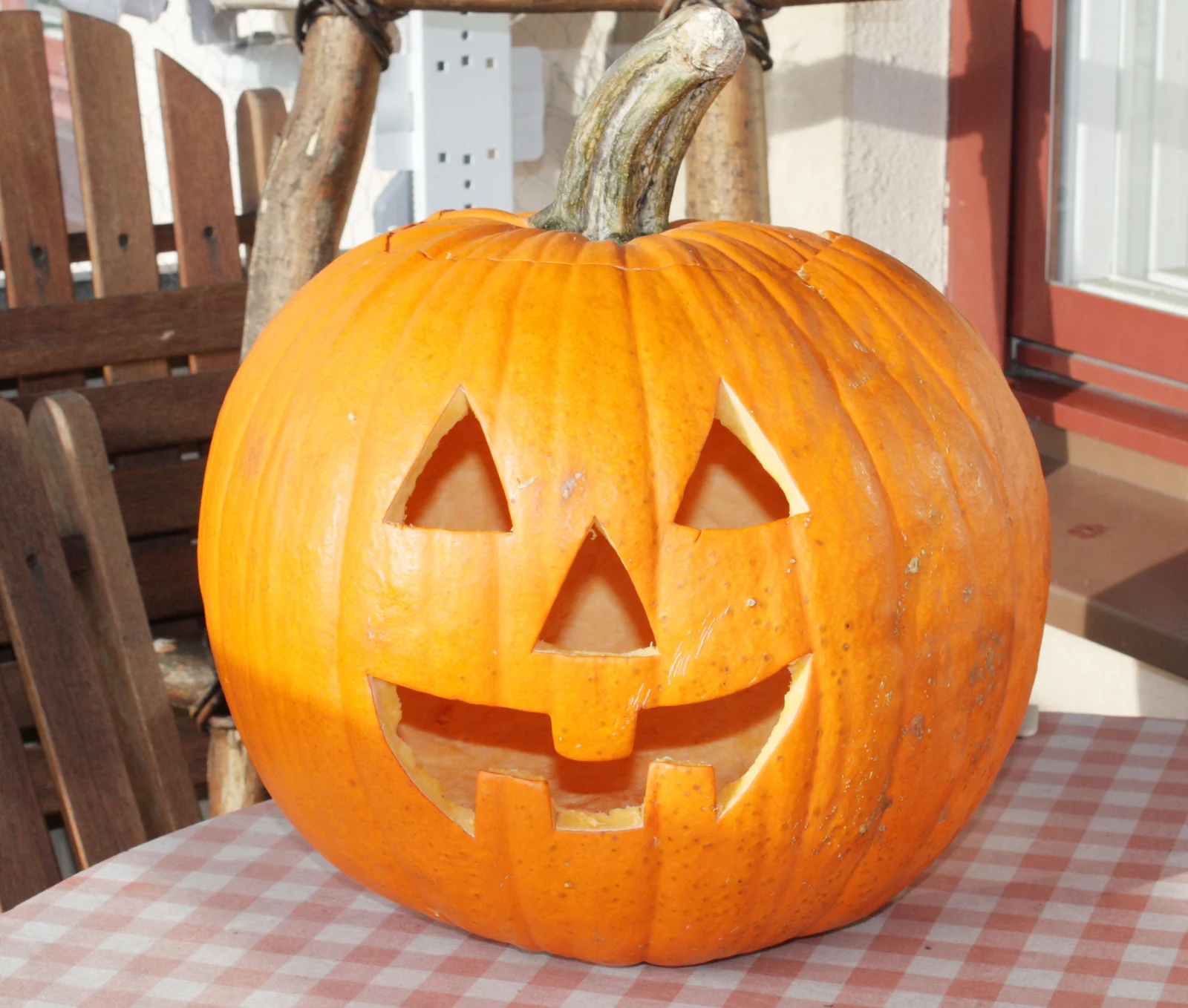
Toyah / Wikimedia Commons; dedicated to the public domain worldwide
Jack-o’-lanterns have faces because a carved and illuminated vegetable can do two jobs at once: look like a person or spirit, and startle the people who see it. The glowing pumpkin on a modern doorstep belongs to a much longer, messier history. In Irish and British traditions, people carved turnips and other root vegetables; stories associated a wandering figure called Jack with lights seen in the darkness; and pumpkins later became the more familiar material in North America.
That does not mean historians can point to one moment when somebody invented the first Halloween lantern. It also does not mean a man named Stingy Jack actually walked the earth. The surviving evidence is a mixture of recorded customs, printed stories, later recollections and changing American celebrations.
Hero image: A modern pumpkin jack-o’-lantern, photographed by Toyah. Source and public-domain dedication. Resized without cropping and converted to WebP. This is a modern example, not a historical photograph of an early lantern.
Before pumpkins, people carved turnips
A hollowed turnip lit from within makes a surprisingly effective face. Its irregular shape, pale skin and ridges can produce a more unsettling result than the smooth orange pumpkin familiar today. In parts of Ireland and Britain, such lanterns were made for the Halloween season long before American-style pumpkin displays became dominant.
The Ulster Folk Museum describes carved turnips among the traditions preserved in accounts of seasonal life in Ulster. Victoria Millar, the museum’s senior curator of history, identifies several overlapping purposes: a lantern might frighten passers-by, amuse neighbors or, within local belief, discourage troublesome fairies and spirits. Those functions are not mutually exclusive. A practical prank can draw its force from a story about something supernatural. Ulster Folk Museum, 20 October 2025.
The museum’s discussion of customs around the beginning of the twentieth century gives us evidence that communities remembered and practised them. It is not a dated archaeological record of people carving faces thousands of years earlier. Claims that a particular turnip lantern is an unchanged survival from ancient Celtic religion require stronger evidence than modern folklore descriptions alone.
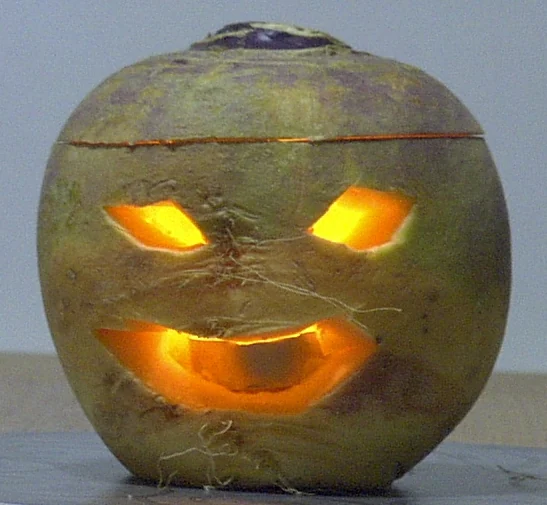
A modern turnip jack-o’-lantern photographed by Geni; the original was uploaded on 1 November 2006. Original photograph, TurnipJackolantern.jpg, offered under CC BY 2.5; converted to WebP at its original 547 × 505 pixels, without enlargement. This modern reconstruction illustrates the material, not a surviving historical artefact.
What did the name “jack-o’-lantern” mean?
The name did not begin as a label for orange porch decorations alone. In folklore, it was also attached to puzzling lights and wandering figures. English-language traditions have several names for lights said to lure travellers away from safe paths, including will-o’-the-wisp and ignis fatuus. Their explanations vary by region and storyteller.
The University of Notre Dame’s Rare Books & Special Collections examined the Dublin Penny Journal of 16 January 1836, which carried a tale called “Jack o’ the Lantern.” In the printed exchange, an uncle attributed mysterious lights near an Irish bog to the wandering Jack, while a younger narrator proposed a natural explanation. The important historical fact is that the story and disagreement were in print in 1836. The account is not independent evidence that a ghost appeared over a bog. Notre Dame Special Collections, 31 October 2024.
That early printed example matters because it catches a belief in circulation without imposing the rules of a single, standardized Halloween tale on everyone who told it. Jack could be understood as a trickster or a restless wanderer; in other contexts, the emphasis fell on an eerie light rather than on a man with a vegetable lantern.
The name therefore connects a folk explanation for lights to a carved object that produces light. The exact chronology of every step between those meanings is harder to establish than the familiar origin story suggests.
The legend of Stingy Jack, and why there is no single version
One of the best-known explanations describes a crafty man who outwits the Devil and ends up condemned to wander. Popular retellings call him Stingy Jack. The main outline is usually recognizable: he secures a bargain, avoids an immediate fate, and ultimately cannot find a permanent home in either Heaven or Hell. He travels with a small light, sometimes said to be a coal inside a hollowed turnip.
But it is a mistake to treat every modern detail as part of a fixed ancient text. In a lecture delivered at the Library of Congress on 29 October 1982, folklorist Jack Santino told one version of the tale. The Library reproduced an excerpt in a 2022 Folklife Today podcast transcript. Santino explicitly recognized that other versions existed.
In the story he told, Jack is a boastful blacksmith who makes a bargain with the Devil. When the Devil returns to claim the bargain, Jack makes use of extraordinary gifts: a chair that will not release its occupant, a tree that will not allow someone to climb down, and a purse that traps a hand. By trapping the Devil, Jack repeatedly postpones the reckoning.
That differs from the familiar short version in which Jack persuades the Devil to turn into a coin and traps him with a cross, as retold by the University of Tennessee’s McClung Museum. The differences are evidence of variant storytelling, not a reason to declare one modern online synopsis the definitive original. What survives most consistently across the better-known variants is the image of someone whose own cleverness leaves him unable to settle anywhere.
Santino’s telling is valuable because it identifies a named folklorist, an identifiable public lecture and the version actually recorded. It cannot tell us the identity of a historical Stingy Jack, because the tale does not establish that such a person existed.
Why carve eyes and a mouth?
The face makes the lantern readable at a glance. A light behind holes cut for eyes and teeth appears animated, even when the surrounding vegetable remains in shadow. That effect works whether a person regards the lantern as a spirit deterrent, a children’s prank or a decoration.
In Ulster’s documented tradition, the museum describes carved turnips as objects used to frighten or amuse and as things believed to protect against unwanted beings. One household’s protective story and another group’s joke could use the same object. Ulster Folk Museum.
This is why the popular answer “faces were carved only to scare away evil spirits” is too narrow. It treats a recorded belief as the exclusive historical purpose, overlooking amusement, mischief and changing local customs. Conversely, calling the old lanterns nothing but practical pranks erases the beliefs their makers sometimes attached to them.
There is another difference worth keeping: a face carved into a turnip is a representation. It does not document the appearance of a creature that people objectively encountered.
How did the turnip become an American pumpkin?
Pumpkins were available in North America, and their hollow interiors and relatively workable flesh made them well suited to carving. The broad association of modern pumpkin jack-o’-lanterns with Irish migration is well established in public-history accounts, including those from the University of Notre Dame and the Library of Congress. The transition, however, was gradual rather than a single act of substitution on a known date.
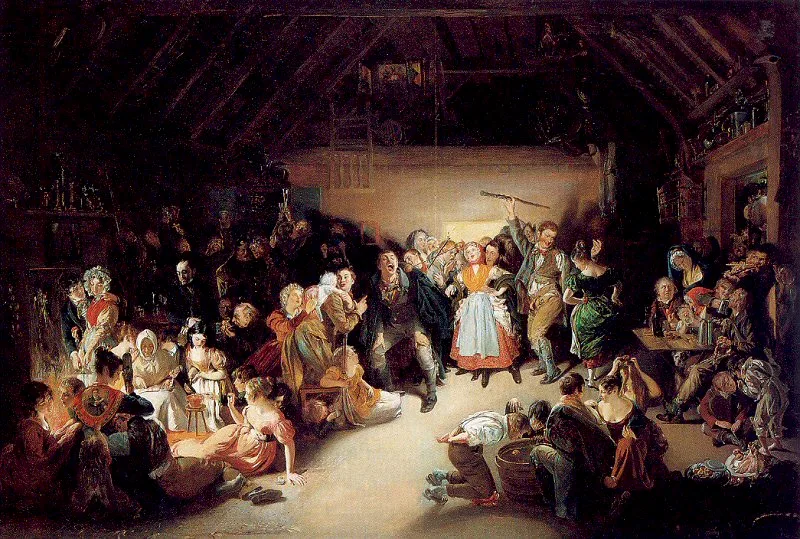
The most revealing archival detail is the 23 November 1867 issue of Harper’s Weekly, highlighted by Notre Dame’s Special Collections. It included a story and illustration titled “The Pumpkin Effigy.” Young pranksters used a carved pumpkin to alarm other people. The article treated the practice as an old custom associated with England.
But the 1867 story was not presented as a report about Halloween. That distinction matters. It documents a carved pumpkin used for mischief in American print, while it does not prove that the finished modern holiday custom had already acquired all of today’s associations. Notre Dame Special Collections.
As Halloween became more visibly commercial and standardized in the United States, the large orange pumpkin made an especially recognizable image. Historical newspaper illustrations record its growing place in seasonal celebrations. The Library of Congress review of historical Halloween newspapers shows how turn-of-the-century publications preserved clues to a changing popular celebration.
That history explains two things at once: the pumpkin is distinctly suited to an American setting, and the underlying lantern story is not a uniquely American invention.
Is the jack-o’-lantern a direct survival of ancient Samhain?
Halloween traditions developed in communities where seasonal festivities, Christian calendar observances, folklore, recreation and local customs interacted over time. Samhain is relevant to the cultural history of Halloween. That broad connection does not supply a dated ancient source for a particular carved face or for the full Stingy Jack legend.
A claim that the first known lantern was carved at Samhain two thousand years ago asks more of the sources than they can support. The accounts considered here establish later recorded practices and printed folklore: an 1836 story about wandering lights, an 1867 illustration of a prank and Ulster recollections preserved in museum archives. They should not be silently converted into proof of a continuous, unchanged ritual stretching back to antiquity.
The story is more interesting when the uncertainty remains visible. Lanterns could be adapted to different vegetables, explained with different supernatural tales and deployed for reasons ranging from a laugh to protection. The practices were neither invented all at once nor static.
For another example of a modern fictional Halloween figure whose invented mythology is sometimes confused with older tradition, see our history of Sam from Trick ’r Treat. For an older divination-related legend that similarly accumulated competing explanations, see our guide to Bloody Mary and the mirror ritual.
Questions people ask about jack-o’-lanterns
Were jack-o’-lanterns originally made from turnips?
Turnip lanterns are documented in Irish and British Halloween traditions, along with other hollowed vegetables. Pumpkins later became the dominant American material. The available evidence does not identify one universally agreed first jack-o’-lantern.
Was Stingy Jack a real man?
There is no reliable historical evidence that the supernatural wandering figure of the folktale was an identifiable real person. He is best understood as a character whose story circulated in variants.
Does a jack-o’-lantern have to be frightening?
No. Historic accounts describe amusement and mischief as well as protective beliefs. The carved face can make a lantern comic, welcoming or unsettling, depending on context and design.
Did people carve pumpkins for Halloween in 1867?
A Harper’s Weekly illustration from 1867 documents a pumpkin effigy, but the specific item discussed by Notre Dame was not explicitly a Halloween story. It is useful evidence for carved pumpkins, not definitive proof of the date when the modern Halloween display began.
Sources & further reading
- Ulster Folk Museum: Unveiling the traditions of Samhain and Halloween (20 October 2025)
- University of Notre Dame Rare Books & Special Collections: An Irish Story Produces a Halloween Icon (31 October 2024)
- Library of Congress: Folklife Today, Scary Stories for Halloween 2022 (includes an excerpt from Jack Santino's 1982 lecture)
- Library of Congress: The Origins of Halloween Traditions (26 October 2021)
- University of Tennessee, McClung Museum: Jack-o’-Lantern Pitcher (coin-and-cross variant)
- Wikimedia Commons: Pumpkin lantern, photo by Toyah (public domain worldwide)
- Wikimedia Commons: TurnipJackolantern, photo by Geni (CC BY 2.5; also offered as CC BY-SA 3.0)