Lore & Explained
Kelpie Explained: Scotland's Dangerous Water Horse
What is a kelpie, and how does it differ from the each-uisge? Explore Scottish water-horse stories, their dangers and the distinctions made by collectors.
Topics: Kelpie, Scottish Folklore, Water Horses, Monsters
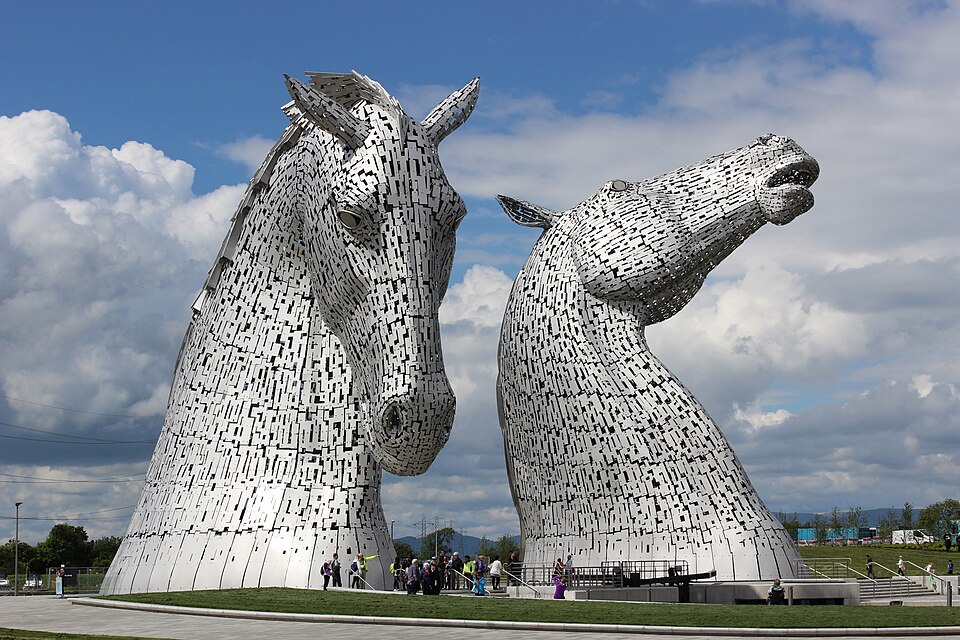
Photographed 2014, near The Helix, Falkirk (CC BY 2.0)
A kelpie is a dangerous water spirit in Scottish folklore, commonly imagined as a horse. Its most familiar appeal is also its trap: an apparently useful or beautiful animal stands near water, someone approaches it, and the encounter turns against them.
There is a complication behind that simple definition. Kelpie and the Gaelic each-uisge, or water-horse, are often brought together in modern explanations, but historical collectors did not always treat them as interchangeable. John Gregorson Campbell explicitly separated them. A good account needs to preserve that distinction rather than fold every Scottish horse-shaped water monster into one biography.
The sculptures pictured above, Andy Scott’s 30-metre steel Kelpies at The Helix park near Falkirk, are a modern public artwork inspired by the legend. They are not a historical depiction and should not be mistaken for one; they show how thoroughly the creature has entered contemporary Scottish public imagination.
A horse where a traveler might need one
The frightening part of a water-horse story is usually not an immediately grotesque appearance. It is the invitation. A horse can offer transport, power and apparent control. The person who mounts it expects to direct it, then discovers that the relationship works the other way around.
The Scottish Maritime Museum’s overview places kelpies within Scotland’s wider traditions of dangerous water beings. Such tales give lakes, rivers and crossings an intentional threat: something is not merely hazardous but seems to want the traveler to make a mistake.
That does not make the creature a documented cause of drowning. The history lies in the stories and beliefs. The water’s real dangers do not require a supernatural animal, and a fatal accident is not proof that one was present.
Kelpie and each-uisge: what is the difference?
In his 1900 collection, Campbell distinguishes the water-horse from the kelpie. In his classification, the water-horse inhabits lochs, while the kelpie belongs to streams and torrents. He also rejects the assumption that the Gaelic water-horse does everything attributed to the kelpie.
This is a statement by a particular collector about the traditions he discusses. It should not be turned into a universal law enforced by every storyteller. But it does show that the distinction is not an invention by modern fans trying to split one monster into two.
The practical reading rule is straightforward: when a source calls its creature an each-uisge, retain that name. When it says kelpie, do not automatically import the entire each-uisge story cycle. A broad comparison can explain the overlap without pretending the words have always meant exactly the same thing.
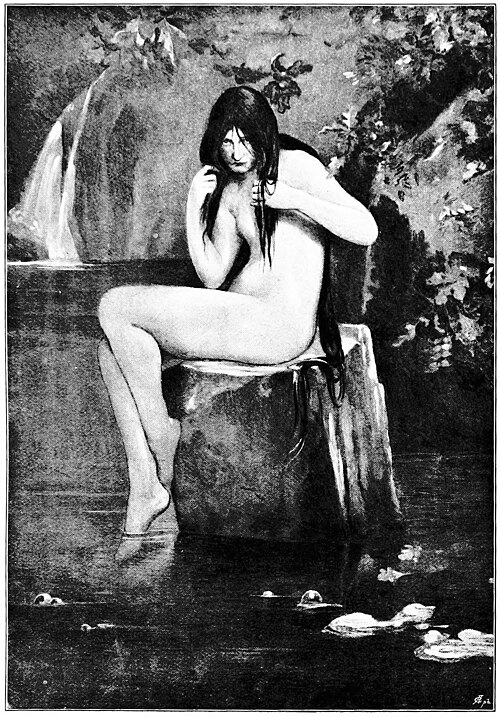
The Kelpie, painted by the Scottish symbolist artist Thomas Millie Dow in 1895 — a late-Victorian artistic interpretation of the water spirit, not a folk illustration from the oral tradition itself. Source. Public domain.*
The water-horse stories are not all alike
Campbell’s water-horse material includes encounters involving riders, children, women and people attempting to control or defeat the being. Individual places matter. A story attached to a particular loch is not simply a generic monster encounter with a Scottish landscape added afterward.
Some tales turn on a person’s inability to escape the animal once contact has been made. Others make recognition the crucial problem: something initially accepted as ordinary must be identified before the situation becomes fatal. The details change, and the collector does not present a single official sequence that every encounter follows.
These are also not uniformly gentle children’s tales. Some versions have violent endings. The warning does not require a detailed description of bodily harm, however. The central reversal is already severe enough: an animal trusted to carry a person carries that person into danger instead.
Why bridles and control matter
A bridle is a powerful storytelling object because it represents control over a horse. In water-horse traditions, attempts to capture or exploit the supernatural animal can therefore reverse the usual danger. The question becomes whether a human can make the being work for them without losing the advantage.
That motif should be described as part of a specific tale, not offered as practical protection. It is also a reminder that the creature’s role can be more complicated than “attacks anyone near a river.” A story may concern labor, ownership, bargains or the consequences of trying to command something that should have been left alone.
For the same reason, a list of fixed weaknesses can be misleading. An object that matters in one account is not automatically an item that defeats every water-horse in every region.
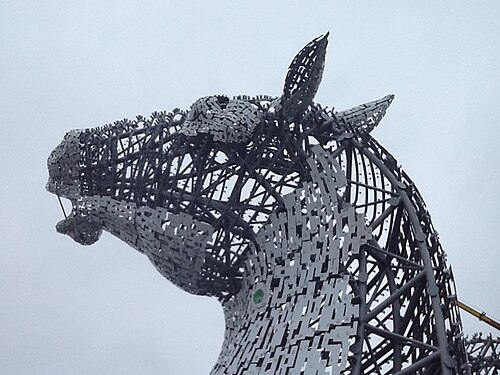
A close-up view of one of the Falkirk Kelpies, showing the sculpture’s steel lattice construction. The artwork draws on the water-horse’s equine form without illustrating any single traditional tale. Source. Public domain.
Are kelpies the same as the Loch Ness Monster?
No. The Loch Ness Monster has its own history of reports, images, investigations and later popular interpretation. Older water-being traditions can provide a useful comparison, but they do not establish that every modern sighting describes a kelpie.
There are two different questions here. One asks what people have imagined might inhabit dangerous water. The other asks what evidence supports a particular reported animal or event. A traditional story can help answer the first without settling the second.
Combining the two indiscriminately weakens both subjects. It strips the folklore of its specific narrative details and gives modern claims an apparent historical confirmation they have not earned.
Reading the landscape without inventing an origin
It is reasonable to notice how well these stories fit the uncertainty of water: a surface conceals depth, a current resists control and a familiar route can become dangerous. That is an interpretation of their effect, not proof that every tale was deliberately invented as a safety lesson.
An oral story can entertain, frighten, explain a place and carry a warning at the same time. A collector may emphasize one of those purposes while a later retelling favors another. There is no need to force all of them into a single theory of origin.
The kelpie remains memorable because it begins with something recognizable. A horse is waiting. The mistake is not failing to notice a monster; it is assuming that recognition means safety.