The Index / Paranormal
Ouija Board Explained: History, Rules, and Why People Think It Works
Who invented the Ouija board, how it got its name, and why the planchette really moves. The documented history behind America's best-selling talking board.
Topics: Ouija Board, Spiritualism, Ideomotor Effect, Paranormal, The Exorcist
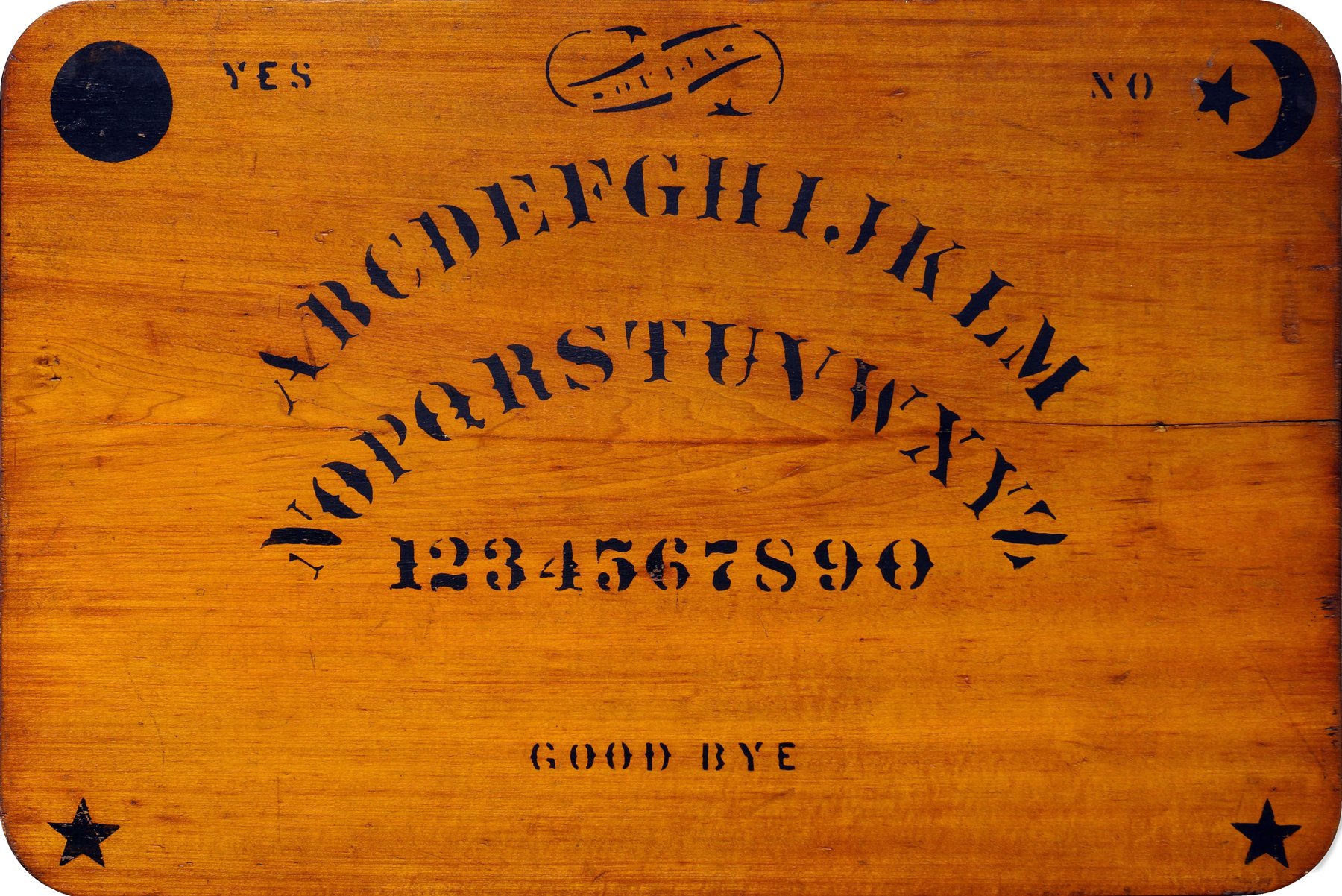
Kennard Novelty Company (c. 1890) / Wikimedia Commons (Public Domain)
There really was a man named Elijah Bond who patented the Ouija board in 1891. There was no ancient curse, no confiscated occult relic, and — despite what the box has implied for over a century — no verified spirit on the other end. What actually happened is a story about a Baltimore novelty company, a trademark dispute, a well-documented psychological effect, and a horror movie that changed how an entire country thought about a toy.
That’s the version this article sticks to. The board’s commercial history is thoroughly documented. The question of why it seems to move on its own has been studied directly. What’s much shakier is everything built on top of both: the internet-era “rules,” the demon with a modern origin story, and decades of retellings that treat 1890s marketing copy as folklore.
What Is a Ouija Board?
A Ouija board is a flat board printed with the letters of the alphabet, the numbers zero through nine, and the words “yes,” “no,” and “goodbye,” used with a small heart-shaped pointer called a planchette. Two or more people rest their fingertips on the planchette, ask a question aloud, and watch it glide across the board to spell out an answer.
Sold since 1891 under variations of the same design, it’s been marketed the entire time as a way to get answers from “the spirit world,” first by Spiritualists genuinely interested in contacting the dead, later by Parker Brothers and Hasbro as a party game sitting on toy-store shelves next to Clue.
Talking Boards Before Ouija
The Ouija board didn’t appear out of nowhere. It arrived at the tail end of a Spiritualist movement that had been experimenting with ways to make spirit contact faster and less exhausting for decades.
Nineteenth-century séances often relied on slow, laborious methods: a medium would recite the alphabet aloud while a spirit supposedly rapped at the correct letter, spelling out messages one agonizing character at a time. The planchette — a small wheeled device holding a pencil, designed for what practitioners called automatic writing — offered a faster alternative starting in the 1850s and 60s, letting a hand rest lightly on the device and simply write.
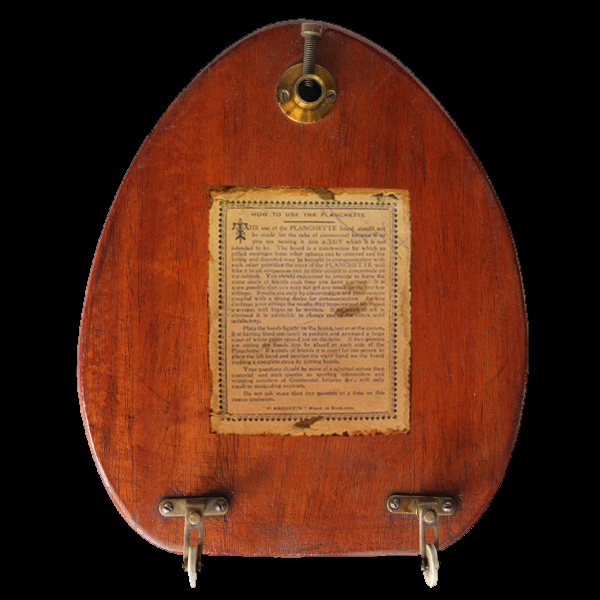
An early British planchette, likely from the 1850s or 1860s — the device that made Spiritualist “automatic writing” faster than reciting the alphabet letter by letter, and a direct ancestor of the modern Ouija pointer. Source. Brandon Hodge / Wikimedia Commons, CC BY-SA 3.0.
By the 1880s, newspapers were reporting a related craze around “talking boards” at Spiritualist gatherings in Ohio and elsewhere: alphabet letters laid out on a flat surface, with a pointer or an inverted glass used to spell out messages instead of writing them by hand. None of this was patented or commercialized yet. It was a homemade parlor practice, popular enough that a Baltimore businessman noticed the demand.
The Kennard Novelty Company
That businessman was Charles Kennard, who in 1890 pulled together a small group of investors in Baltimore — including local attorney Elijah Bond and surveyor Washington Bowie — to found the Kennard Novelty Company and turn the talking-board fad into an actual product.
Bond filed the patent application in May 1890 and drafted the board’s design himself, formalizing what had previously been an improvised parlor game into a manufactured object with a fixed alphabet layout, a printed “yes” and “no,” and a wooden planchette. The U.S. Patent and Trademark Office granted the patent on February 10, 1891.
Who Named It “Ouija”?
The board needed a name, and the story behind the one it got is stranger than most of what followed. According to research by historian Robert Murch, the company asked the board itself what it should be called during a session with Bond’s sister-in-law, Helen Peters, who the founders considered a gifted medium. The planchette spelled out “O-U-I-J-A,” and when they asked what that meant, it reportedly spelled “good luck.”
Murch also noticed something the founders may not have mentioned: Peters was wearing a locket engraved with the name of the popular novelist Ouida, whose picture and name sat right in front of her during the session. Whether “Ouija” came from beyond or from the jewelry on the table is exactly the kind of thing you can’t resolve at this distance — but the locket makes for a far more plausible explanation than spontaneous spirit contact. The popular claim that “Ouija” simply combines the French and German words for “yes” (oui and ja) is not true; it’s a folk etymology that caught on after the fact and doesn’t match the board’s own origin story.
The patent process added its own legend. Family letters describe Bond bringing the board and Peters to the patent office in Washington, where the skeptical chief patent examiner reportedly demanded proof the thing worked before he’d approve it — insisting it correctly spell out his name, which he said neither Bond nor Peters could have known. The planchette did. Murch is candid about the obvious hole in that story: Bond was a patent attorney working the case, and there’s no strong reason to assume he genuinely had no way of learning the examiner’s name beforehand. The patent itself, notably, offered no explanation of how or why the board worked — only that it did, as demonstrated.
William Fuld and the Ouija Boom
William Fuld started as an employee and stockholder at Kennard Novelty, not as the board’s inventor, whatever his later reputation suggested. When internal conflict pushed Kennard and Bond out of the company within a few years, Fuld took control and ran the business through its most successful decades, eventually manufacturing under his own name and building a dedicated Ouija factory in Baltimore.
Fuld died in 1927 after a fall from the roof of that same factory — a building he reportedly claimed the board itself had instructed him to construct. He never publicly claimed to have invented the Ouija board, but his New York Times obituary credited him as its inventor anyway, and that error has been repeated in various forms ever since.
The board kept selling after his death, passing through Fuld family control until Parker Brothers bought the rights in 1966. The timing turned out to be remarkable: in 1967, Ouija boards sold roughly two million units, outselling Parker Brothers’ own Monopoly that year. Hasbro acquired Parker Brothers in 1991 and has kept the Ouija board in production ever since, now sold explicitly as a game rather than a spiritual instrument.
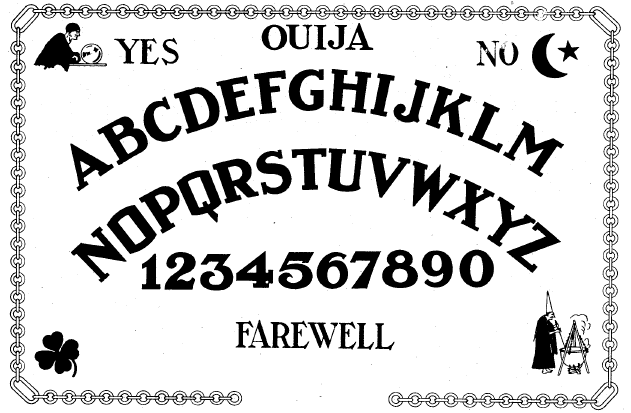
A 1920s Ouija board layout, based on U.S. Design Patent D56,449 — one of several design patents the Fuld company filed to protect the board as competitors copied it. Source. Public Domain via Wikimedia Commons.
Pearl Curran and Patience Worth
The board’s most famous early “success story” belongs to Pearl Curran, a St. Louis housewife who in 1913 began producing poetry and prose at the board that she attributed to a spirit calling herself Patience Worth, said to have lived in seventeenth-century England. Curran’s output was extensive and, by contemporary literary standards, genuinely accomplished enough that it made national headlines and drew interest from serious writers of the day.
Her friend Emily Grant Hutchings tried something similar, claiming her novel Jap Herron had been dictated through the board by the spirit of Mark Twain — a claim Twain’s own estate publicly and firmly rejected. Decades later, Pulitzer Prize-winning poet James Merrill built his 1983 epic The Changing Light at Sandover around years of Ouija sessions with his partner, but Merrill himself was careful about what he claimed: he described the board as a device that seemed to magnify and organize his own imagination, not literal proof of spirit contact.
None of these cases constitute evidence that the board contacted anyone. What they show is a consistent pattern: people producing genuinely creative material through the board and interpreting the experience, sincerely, as external communication.
Why the Planchette Actually Moves
This part isn’t mysterious, and it’s been tested directly. The scientific explanation is called the ideomotor effect: small, involuntary muscle movements that happen without conscious intent, often triggered by a strong expectation of a specific outcome.
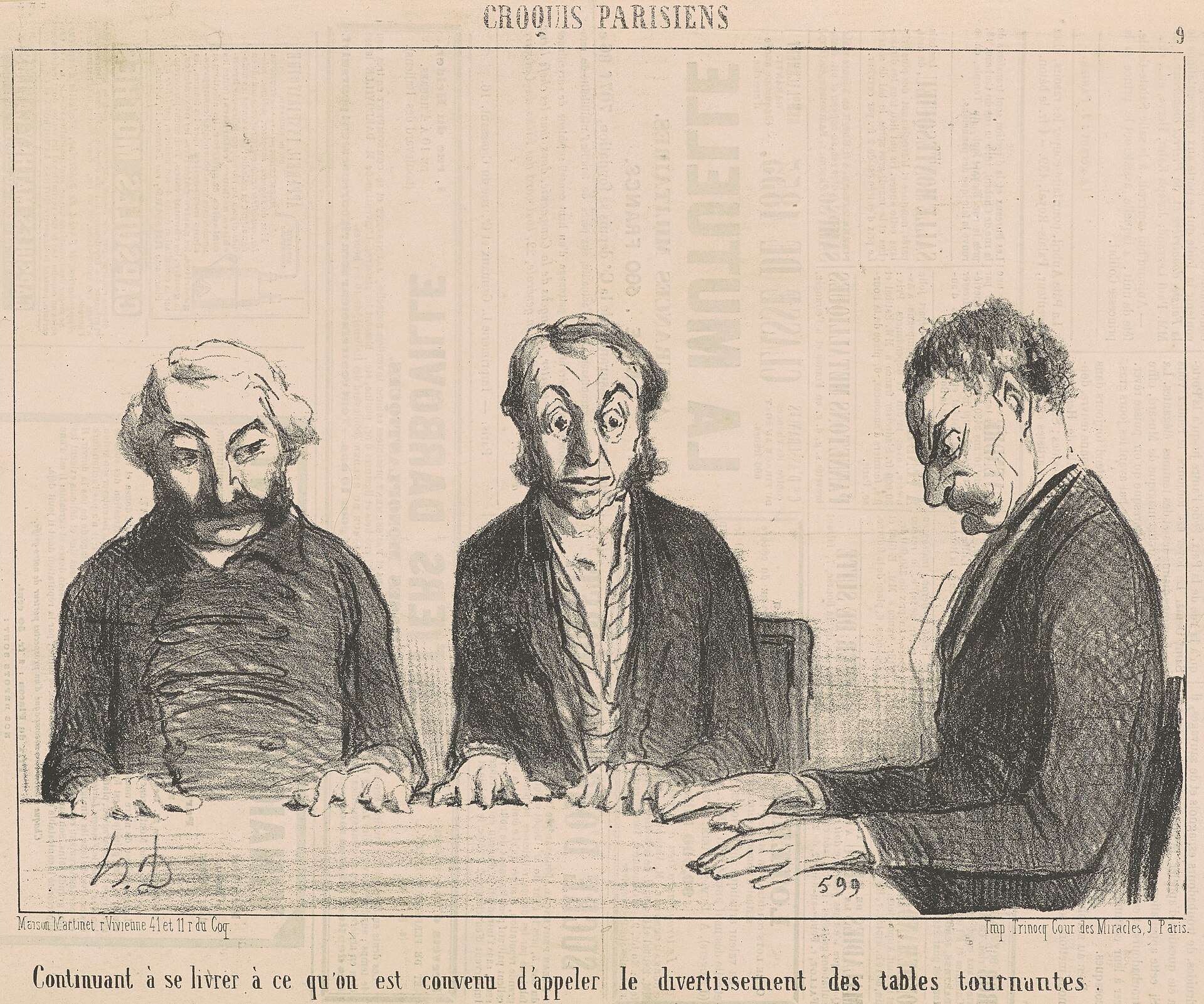
The idea predates the Ouija board by decades. Physician William Carpenter described the underlying mechanism in 1852, and physicist Michael Faraday ran controlled experiments in the 1850s proving that Victorian table-turning séances moved because participants were unconsciously pushing, not because anything was pushing back — a conclusion most Spiritualists at the time simply refused to accept. Psychologist Chris French, who studies the phenomenon at Goldsmiths, University of London, describes the effect on a Ouija board plainly: participants get “a very strong impression that the movement is being caused by some outside agency, but it’s not.” A lightweight planchette on smooth felt feet or casters turns barely perceptible finger tremors into large, fluid movements across the board — and because several people are touching it at once, no individual person feels responsible for steering it.
A 2012 study by researchers Hélène Gauchou, Ronald Rensink and Sidney Fels at the University of British Columbia, published in Consciousness and Cognition, took the question further: does the ideomotor effect only produce noise, or can it reveal information a person consciously believes they don’t know? Participants answered factual yes/no questions by guessing verbally about half the time, but jumped to roughly 65 percent accuracy when they believed a different person was controlling the planchette with them — including in a version where they were blindfolded and told their partner had left the room, while in fact they were moving the board alone. Their own hands were retrieving information their conscious mind claimed not to have, guided by a belief that something else was in control.
That’s a genuinely interesting finding about the unconscious mind. It is not evidence of spirit contact. It’s evidence that people, feeling less responsible for an outcome, sometimes access knowledge they’d otherwise dismiss or second-guess.
Is the Ouija Board Dangerous?
Physically, no — it’s a board and a piece of wood. Psychologically, the picture is a little more nuanced. Because a Ouija session removes any single person’s sense of authorship over what gets spelled out, it can surface things a group might not otherwise say to each other: grief, guilt, aggression, suspicion. Mental health professionals who study grief have noted that some people use talking boards, consciously or not, as a low-stakes way to voice things connected to loss.
None of that requires an outside entity, and none of it makes the board reliably dangerous in a supernatural sense. The genuine risk is closer to ordinary group psychology than demonology: a roomful of people, already primed by decades of horror-movie marketing to expect something sinister, can talk themselves into real fear over a board that is, mechanically, just responding to their own hands.
Where the “Rules” Actually Come From
If you’ve encountered a Ouija board through modern pop culture, you’ve probably also encountered its rulebook: always say goodbye, never play alone, never play in a graveyard, never ask when you’ll die. None of this appears in the original 1890s Kennard Novelty or Fuld marketing, which sold the board as lighthearted parlor entertainment, not as something requiring ritual precautions.
Tracing these specific rules to a single origin point is difficult, because unlike the patent history, they weren’t written down and dated by anyone with a reason to keep records. What’s clear is the pattern: they accumulated gradually across twentieth-century popular occultism and horror fiction, then spread rapidly once internet paranormal forums gave every version of the “rules” a permanent, searchable home. Presenting them as ancient tradition — the way plenty of websites do — isn’t supported by the historical record. They read much more like folklore that formed around a mass-produced object after the fact, the same way ghost stories accumulate around old houses regardless of what actually happened inside them.
Zozo: A Twenty-First-Century Addition
Nothing demonstrates how recent this folklore is better than Zozo, now one of the most widely repeated names in Ouija mythology. The story traces to a specific, dateable source: a paranormal forum post from March 2009, in which a user named Darren Evans described encountering a hostile entity called Zozo during a session. The post spread quickly, other users began reporting similar experiences, and within a few years “Zozo” had accumulated its own mythology — an ancient demon, a consistent figure-eight planchette movement, a supposed centuries-long history.
That supposed history doesn’t hold up. There is no Zozo tradition in nineteenth or early twentieth-century Ouija material, Spiritualist literature, or demonological texts predating 2009. Whatever isolated, harder-to-verify earlier mentions may exist online, the character as it’s now known — complete with its own terminology and warning signs — was assembled by internet paranormal culture within the last two decades, not inherited from any older tradition.
How The Exorcist Changed the Board’s Reputation
The Ouija board spent most of its first eight decades as a game, sold in the same stores and often the same aisle as other family entertainment. That changed largely because of one film.
William Friedkin’s 1973 adaptation of The Exorcist opens with young Regan MacNeil using a Ouija board alone in her house, contacting an entity she calls “Captain Howdy” — which the film reveals, by its climax, was in fact the demon Pazuzu preparing to possess her. It’s worth being clear that this is a fictional plot device: the real historical figure behind the film’s demon, Pazuzu, was an ancient Mesopotamian protective spirit with no documented connection to Ouija boards, talking boards, or twentieth-century Spiritualism at all. Friedkin and novelist William Peter Blatty borrowed the name for its unsettling sound and built an entirely modern possession narrative around it.
The Exorcist was a cultural sledgehammer. A toy that had been advertised for decades as safe family fun was now, in the public imagination, a potential doorway for exactly the kind of entity that had just terrified movie audiences nationwide. Sales reportedly climbed even as the board’s reputation curdled — people bought it more, while trusting it less, which is a strange but very human combination.
What About Documented Paranormal Cases?
Ouija boards show up constantly in later paranormal stories, but it’s worth being precise about what that actually means. In the Enfield Poltergeist case, one of the family’s teenage daughters, Janet Hodgson, said she had played with a Ouija board before the disturbances in her home began. That detail gets repeated often as an origin explanation. The documented investigation into Enfield doesn’t establish that the board caused, triggered, or was even meaningfully connected to what followed — it’s a fact about what Janet said, not evidence of causation.
That pattern holds across most Ouija-adjacent hauntings: a board gets mentioned somewhere in the story, and later retellings quietly promote that mention into an explanation. The board makes a convenient narrative hinge. It rarely holds up as documented cause.
Are Ouija Boards Real?
The board itself is real, obviously — a real object with a real, well-documented commercial history. Whether it can contact spirits is a different question, and no controlled study has ever demonstrated that it can. What controlled studies have demonstrated is the mechanism that makes it move and, more interestingly, the fact that people using it can sometimes access knowledge they don’t consciously believe they have.
That’s a strange and genuinely worthwhile finding about how minds work under the right conditions. It just isn’t the finding the box has been implying since 1891.
Frequently Asked Questions
Who invented the Ouija board? Elijah Bond, a Baltimore attorney, filed the patent in 1890 and received it in February 1891, working with the newly formed Kennard Novelty Company. William Fuld, often mistakenly credited as the inventor, was an early employee who later took over the company.
What does “Ouija” mean? According to the board’s own founding story, the name came from a session with medium Helen Peters, who was told it meant “good luck.” Historian Robert Murch has noted Peters was wearing a locket bearing the name of novelist Ouida at the time, a more plausible source than spirit contact. The popular claim that it combines the French and German words for “yes” is false.
How does a Ouija board move? Through the ideomotor effect — small, involuntary muscle movements made without conscious intent, amplified by a lightweight planchette on smooth casters or felt feet.
Is the Ouija board dangerous? Not physically, and there’s no scientific evidence it contacts anything supernatural. Group psychology can make sessions feel intense, since no individual person feels responsible for what the planchette spells out.
Are Ouija boards real? The board is a real, patented, mass-produced object with a well-documented history. There is no scientific evidence it functions as an actual channel to spirits.
Why do people say “goodbye” when using a Ouija board? This custom isn’t part of the board’s original 1890s marketing. It developed later, through twentieth-century occult culture and horror fiction, rather than tracing to a single documented origin.
Can one person use a Ouija board? Physically, yes, though “never play alone” is one of the most repeated modern rules. Like most Ouija rules, it isn’t part of the board’s documented early history.
Did The Exorcist make Ouija boards scary? It played a major role. The board had been marketed as family entertainment for eight decades before the 1973 film opened with a girl using one alone, right before her possession — reshaping the object’s public image almost overnight.
Sources & further reading
- Smithsonian Magazine: The Ouija Board Can't Connect Us to Paranormal Forces
- The Strong National Museum of Play: Investigating the History of the Ouija Board
- Wikipedia: William Fuld
- Gauchou, Rensink & Fels, "Expression of nonconscious knowledge via ideomotor actions," Consciousness and Cognition (2012)
- TIME: 'Ouija: Origin of Evil' and the True History of the Ouija Board