Lore & Explained / Folklore
Witch Bottles Explained: The Archaeology of Nails, Urine and Counter-Magic
What is a witch bottle? Explore genuine English archaeological finds, seventeenth-century counter-magic and the limits of what the evidence can prove.
Topics: Witch bottles, English folklore, Witchcraft history, Counter-magic, Archaeology, Bartmann jugs
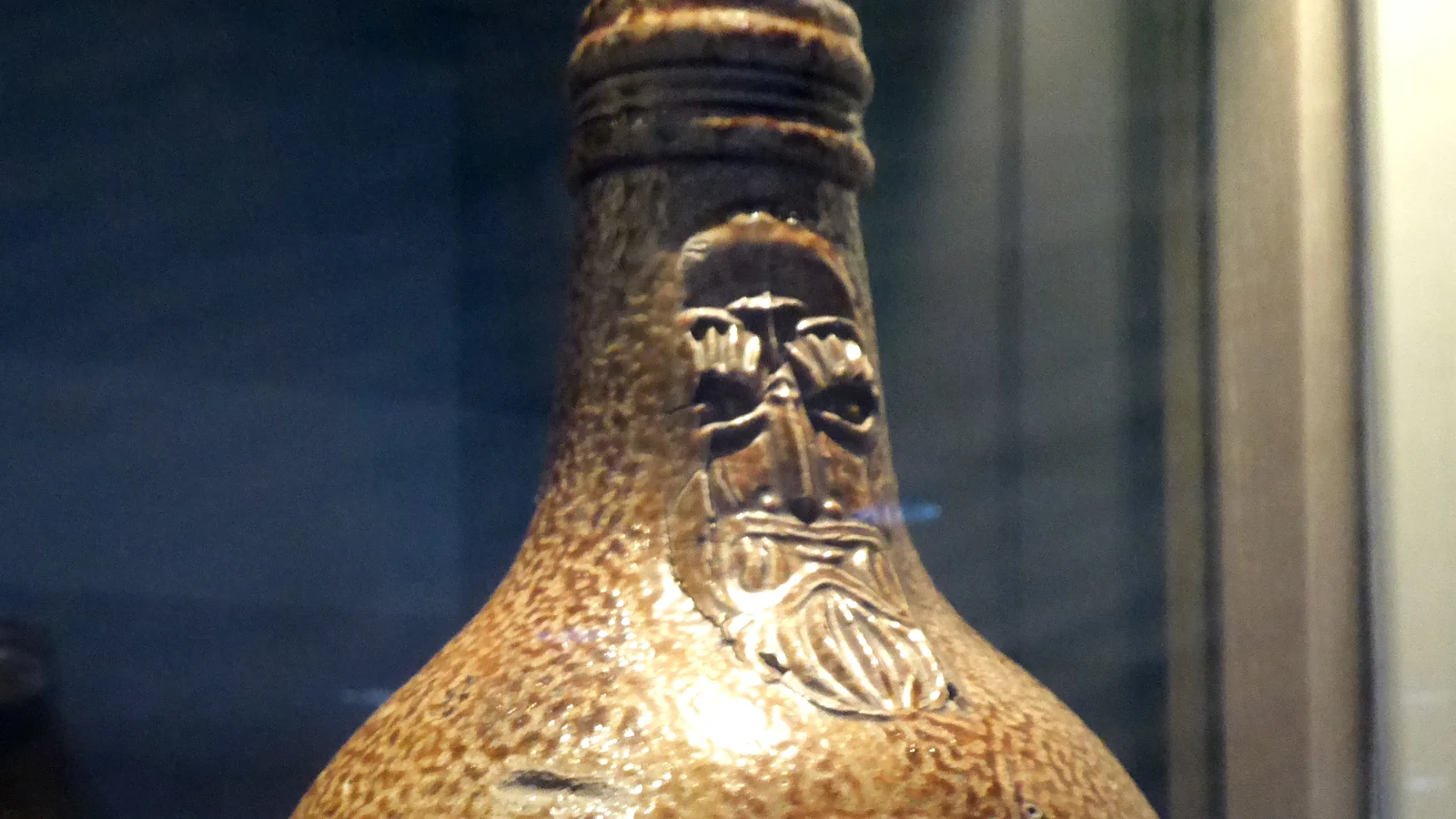
Ethan Doyle White / Wikimedia Commons, CC BY-SA 4.0; cropped, resized and converted to WebP
A witch bottle was an ordinary container repurposed as a protective charm or supposed cure for bewitchment. Archaeologists have recovered stoneware jugs and glass vessels containing bent pins, nails and, in some cases, bodily materials. The objects are real. The supernatural effects attributed to them were beliefs, not results that archaeology can verify.
The distinction matters because a bottle concealed beneath a floor can tell us something unusually personal about the people who lived above it. Someone may have feared that an illness, a run of misfortune or a threatening neighbor was the work of witchcraft. A bottle offered a way to act on that fear without knowing whether any supposed curse existed.
The strongest evidence is not a modern list of ingredients on a witchcraft website. It comes from excavated objects, museum collections and surviving texts describing what people thought a counter-charm could accomplish.
Hero image: Detail of the bearded face on a seventeenth-century Bartmann jug displayed in the City of London’s Guildhall, photographed by Ethan Doyle White. It is an archaeological object associated with witch-bottle use, not a photograph of magic taking place. Original image · CC BY-SA 4.0. Cropped, resized and converted to WebP. This image adaptation is also licensed CC BY-SA 4.0.
What exactly is a witch bottle?
The term refers to a class of deliberately prepared and concealed vessels, particularly associated with England in the seventeenth century. They are also called counter-witchcraft bottles because the purpose described in historical sources was often to turn a harmful spell back on the person believed to have cast it.
Museum of London Archaeology (MOLA), working with historians Owen Davies and Ceri Houlbrook, describes the surviving vessels as either objects for ritual protection or containers holding a supposed prepared cure against witchcraft. Finds include pins and nails, sometimes accompanied by urine, nail clippings or thorns. Their locations range from domestic hearths and floors to ditches, churchyards and riverbanks. MOLA’s research project.
That definition already introduces a caution. Not every bottle found inside a wall was a witch bottle. A container might have held medicine, been discarded or been placed there for a different reason. The objects are identified through a combination of their contents, dating, setting and historical parallels—not by a label left by their owners.
Why were bent pins and nails put inside?
For people who believed they were bewitched, a bottle was meant to provide a physical way of countering an invisible attack. The metal inside could represent pain inflicted on an alleged witch. In some explanations, the bottle stood in for the witch’s bladder; heating it or keeping its contents warm was believed to make the suspected attacker suffer until the curse was lifted.
The Salisbury Museum object described by Wessex Museums offers a precise historical example. The vessel was found buried upside down at Downton, Wiltshire, and is dated to the late seventeenth century. It was probably first used for beer. Nails and pins inside were later interpreted as ingredients in a counter-charm. The museum relates the belief to Joseph Blagrave’s Astrological Practice of Physick (1671), which gave a contemporary description of a bottled remedy against supposed enchantment.
This was an early modern prescription rooted in ideas about witchcraft and illness. It was not a medically effective treatment demonstrated by the presence of nails in a bottle. Nor does every archaeological witch bottle contain the exact set of ingredients described in one printed remedy.
The practice is sometimes loosely called sympathetic magic: an object is linked to a person through something believed to belong to or represent that person. But that modern explanatory term should not erase the different ways contemporaries understood medicine, religion and magic.
What did the seventeenth-century bottles look like?
Many were Bartmann stoneware jugs, made in Germany and traded widely. Their distinctive feature is a molded bearded face beneath the neck. They are also often called Bellarmine jugs, although the nickname should not be treated as proof that the bearded figure represents one specific historical man in every case.
MOLA notes that the durable brown vessels, especially those made around Frechen near Cologne, were commonly reused for counter-magic in England. The bottles were not originally manufactured exclusively for witchcraft. Their ordinary household role helps explain why someone could turn a familiar object into an extraordinary safeguard. MOLA’s guide to identifying finds.
A particularly clear case belongs to London Museum’s collection. Object 25437 is a miniature Frechen stoneware jug dated to roughly 1600–1650. It was found at the site of Plaisterer’s Hall near Noble Street in the City of London, and contained nine brass pins, each bent twice. Those pins are the museum’s reason for identifying the reused jug as a witch bottle.
It is an unusually tangible example: an everyday traded vessel, an archaeological findspot and a set of deliberately altered objects. Nothing about the find, however, identifies the person who placed it there or proves the charm worked.
Where did people hide them?
The place where a bottle was found can be almost as informative as the contents. MOLA reports examples from beneath floors, under doors and thresholds, and in or near hearths and chimneys. Other finds come from places outside buildings, including waterways and ditches. MOLA’s archaeological guidance.
These placements help explain two overlapping ideas. One was household protection: the home itself could be defended by concealing a charm at a vulnerable point. The other was a counter-cure: someone who believed they were already afflicted could prepare a bottle to retaliate against the supposed source of their illness.
The two interpretations should not be merged into one universal rule. At Downton, for example, Wessex Museums notes that the bottle was placed in a garden or open ground rather than beneath a hearth. That changes how confidently a modern reader should interpret its purpose. A deposit’s original intention is not always recoverable.
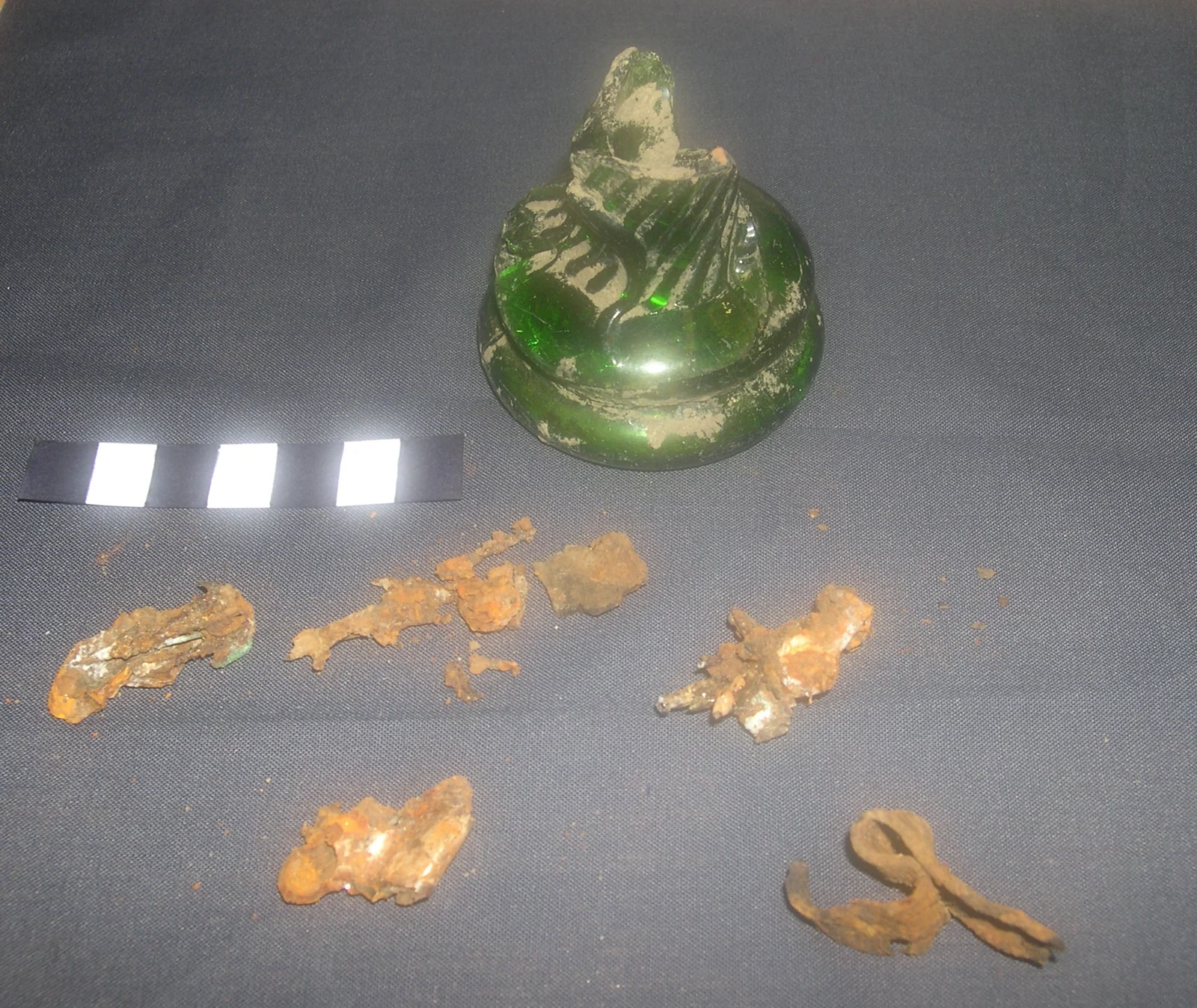
Later counter-magic evidence: a glass vessel and associated finds recorded by the Portable Antiquities Scheme as LIN1011, dating from approximately 1820 or later. The archaeological description notes corroded pins, copper-alloy fittings and leather. Its interpretation as a witch bottle is based on context and contents, not eyewitness proof of a ritual. Photo: Adam Daubney / Portable Antiquities Scheme / Trustees of the British Museum, via Wikimedia Commons, CC BY-SA 4.0. Resized and converted to WebP; this image adaptation is also licensed CC BY-SA 4.0.
How do archaeologists know a bottle was used for magic?
They do not always know. Archaeologists can document the material, measure the vessel, identify its contents, examine the layers in which it was found and compare that evidence with historical texts and similar objects. They then make an interpretation, sometimes with substantial uncertainty.
That difference between a find and a claim can be seen in MOLA’s discussion of glass containers. Some may be witch bottles, but others could be medicinal or homeopathic phials. The team explicitly cautions that certain examples need more research before they can confidently be placed in the category. MOLA, identification guide.
The Holywell find offers a second case with specific contents. A damaged bottle recovered during archaeological work contained approximately 60 small bent copper-alloy pins, corroded nail remains and a possible fragment of wood or bone. MOLA treats it as a potential charm or witch bottle, while distinguishing what was physically recovered from the intentions later ascribed to it. MOLA, The Holywell witch-bottle.
These are the right levels of certainty: the pins were present; the vessel was found in a documented context; researchers judge a counter-charm interpretation plausible. We cannot reconstruct a private conversation in which its owner explained precisely what they feared.
Were these bottles used by accused witches—or against them?
The surviving accounts more often frame them as defenses against suspected witchcraft, not possessions that identify their maker as a witch. A person who believed they had been harmed might seek a remedy from someone offering advice, or create a hidden household protection.
The historical context can be disturbing. Accusations of witchcraft had real consequences for real people. As London Museum’s history of witchcraft and medicine explains, early modern English laws criminalized witchcraft, and people accused of causing harm through spells could face prosecution. The private fears reflected in a bottle belonged to a society in which the charge of witchcraft could be dangerous.
That is also why a bottle is not evidence against an alleged witch. Even if a household believed someone had cursed them, the object can only demonstrate the maker’s belief or action. It cannot establish that the accused person had supernatural powers—or that an accusation was true.
For the documented history of accused people rather than charms, read the Pendle witch trials of 1612. Those prosecutions should not be imagined as the source of a specific witch bottle unless a source directly connects them.
Did the custom disappear after the witch trials?
No clean cutoff is visible. The seventeenth century dominates many museum examples and early texts, but archaeologists have also identified later bottles. The Portable Antiquities Scheme record behind the glass object pictured above describes a vessel dating from around 1820 or later, excavated beneath a floor. Its presence in a nineteenth-century setting shows why the history cannot be summarized as a single century of identical jugs.
This does not establish an unbroken, unchanged ritual from medieval times to the present. Some later practices may continue older ideas; others reinterpret them. Historical continuity is something to investigate, not assume.
Modern occult and popular-culture guides also use the phrase “witch bottle,” often for objects with quite different ingredients, designs or stated purposes. Those are contemporary practices and reinterpretations. They do not automatically tell us what a seventeenth-century person intended when a jug was hidden beneath a threshold.
Is a witch bottle the same as a Hand of Glory?
No, even though both appear in the history of English supernatural belief and both could be associated with hidden objects.
A witch bottle was typically imagined as a protective device or a counter-charm against alleged bewitchment. The Hand of Glory was a different motif: a preserved hand and light associated in collected stories with burglars magically keeping a household asleep. One tradition is about defending a home; the other commonly imagines disabling its occupants. Both survive through a mixture of material objects, recorded beliefs and later storytelling.
See the Hand of Glory and the Whitby Museum object for an example of why an object being real does not establish the powers claimed for it.
What should someone do if they find a sealed bottle in an old house?
Treat it as an archaeological find, not as a supernatural threat. MOLA advises people to leave a suspected historic witch bottle in place if possible, photograph its position, avoid cleaning it and not open a corked or sealed vessel. In England and Wales, a local Finds Liaison Officer through the Portable Antiquities Scheme can advise on reporting and preservation. MOLA’s find guidance.
This is important for practical as well as scholarly reasons: opening or disturbing an object may destroy evidence about its contents or original placement. Unknown contents should be handled by qualified specialists.
Frequently asked questions
What is inside a real witch bottle?
Recorded examples include bent pins, iron nails and, in some cases, urine, hair, nail clippings, leather or other materials. No single recipe fits every find. The combination of ingredients, container and archaeological setting matters more than one item alone.
Are witch bottles proof that witches existed?
They are evidence that people made and concealed objects connected with beliefs about witchcraft. They do not demonstrate that supernatural curses worked or that any person accused of bewitchment possessed supernatural abilities.
Were all witch bottles made from Bellarmine jugs?
No. Bartmann or Bellarmine stoneware jugs are prominent among earlier finds, but later glass and other containers have also been identified or investigated as possible witch bottles.
How old are the surviving examples?
Many of the best-documented English examples belong to the seventeenth century, while some likely or possible examples are later. A particular object’s date must come from its archaeological record rather than an assumed age attached to the name.
Why bury a bottle beneath a doorway or fireplace?
Those places were associated with protecting a household or using a concealed counter-charm. But deposits also occur in open ground and waterways. The findspot can guide an interpretation without always proving the maker’s intention.
Sources & further reading
- MOLA: Witch bottles concealed and revealed (research project)
- MOLA: What should you do if you find a 17th-century witch bottle?
- London Museum: Jug, witch bottle (object 25437)
- Wessex Museums: Witch Bottle, Salisbury Museum collection
- London Museum: Witches, medicine and magic through London's history
- MOLA: The Holywell witch-bottle
- Wikimedia Commons: Guildhall witch bottle (Ethan Doyle White, CC BY-SA 4.0)
- Wikimedia Commons: LIN1011 bottle and contents (Portable Antiquities Scheme, CC BY-SA 4.0)