Lore & Explained / Occult History
Aleister Crowley Explained: Thelema, Magick, the 'Great Beast,' and the Myths
Aleister Crowley was an influential and controversial occult writer. His actual work, organizations and self-mythology differ sharply from tabloid legend.
Topics: Aleister Crowley, Thelema, Occult History
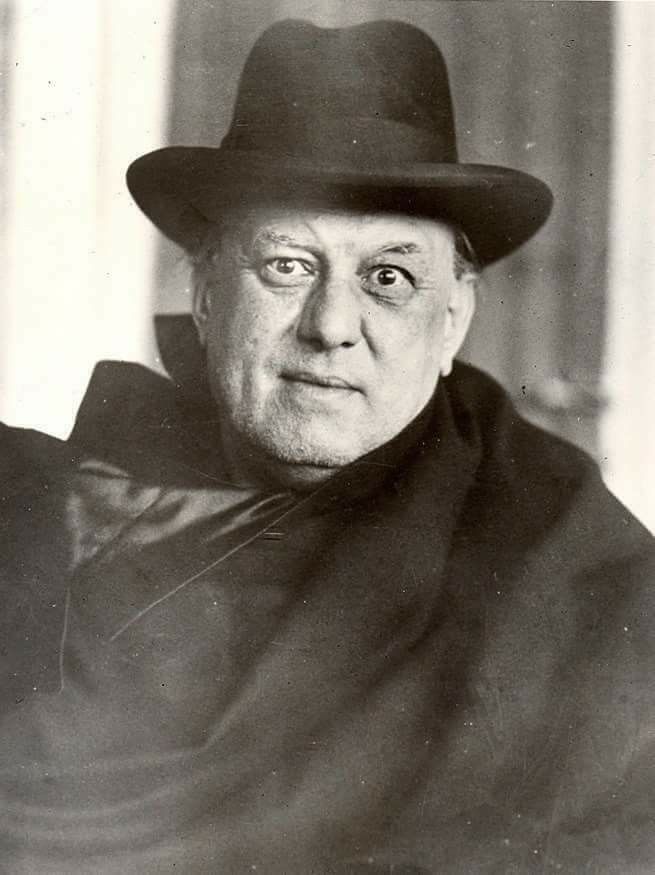
Unknown photographer / Wikimedia Commons (Public Domain)
Aleister Crowley was a British writer and occultist whose ideas helped shape Thelema and twentieth-century Western esotericism. He was not a Satanist in the ordinary Christian or modern-Satanist sense, though he deliberately used shocking religious imagery and called himself the “Great Beast 666.” His reputation was built from his own self-presentation as well as hostile tabloid coverage.
Crowley in 1929. Source. Unknown photographer / Wikimedia Commons, Public Domain.
Thelema and magick
Crowley grew up in a strict Plymouth Brethren environment and later joined the Hermetic Order of the Golden Dawn. In 1904 he said that The Book of the Law had been dictated in Cairo by a being he called Aiwass. That is Crowley’s religious claim; historians can document the text and its influence without treating its supernatural origin as established.
Thelema developed around the phrase “Do what thou wilt,” which Crowley understood as discovering and carrying out a person’s “True Will,” not as a simple permission to do anything. He used the spelling “magick” partly to distinguish his ritual and philosophical system from stage conjuring.
Crowley’s account of the Cairo reception is a religious claim made by Crowley and later accepted in different ways by Thelemites. Historians can establish the composition and publication history of The Book of the Law; they cannot independently establish Aiwass as a supernatural speaker. The same distinction applies to Crowley’s ritual work: its texts and communities are documented, while their claimed effects belong to belief and practice rather than verified fact.
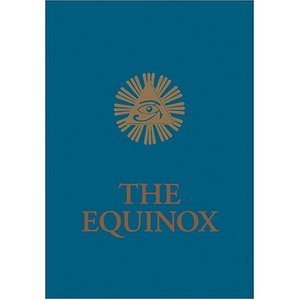
Cover of The Blue Equinox, a Crowley publication associated with Thelemic and O.T.O. material. Source. Unknown creator / Wikimedia Commons, Public Domain.
The man and the myth
Crowley worked with the Golden Dawn, founded or developed groups including A∴A∴, and became involved with Ordo Templi Orientis. His Abbey of Thelema at Cefalù, drug use, sexual practices and public feuds supplied material for a lasting sensational reputation. Claims that he was a British intelligence agent have been argued by writers but remain uncertain.
The Harry Ransom Center holds a substantial Crowley collection, including works, correspondence, personal papers and material on occult organizations. Such archives are a better starting point than repeating the “wickedest man” label as biography.
Crowley edited the 1904 Goetia with S. L. MacGregor Mathers, a fact sometimes used to connect him to every later demon story. It does not make him the author of the Necronomicon, which was invented by Lovecraft. For the distinct history of his magical name, see Baphomet.
A short historical timeline
Crowley was born in Leamington Spa in 1875 into a wealthy evangelical family associated with the Plymouth Brethren. He later described that upbringing as intensely restrictive, and his break with it became part of the persona he cultivated. At Cambridge he became absorbed in poetry, mountaineering and occult study. In 1898 he joined the Hermetic Order of the Golden Dawn, then one of Britain’s most visible ceremonial-magic organizations. The order’s internal disputes mattered: Crowley learned its ritual vocabulary and met collaborators and rivals there, but he did not simply inherit a settled system from it.
His best-known foundational text, Liber AL vel Legis (The Book of the Law), dates from April 1904. Crowley said it was received over three days in Cairo from Aiwass, a preternatural messenger. The manuscript, editions and later religious movement are historical evidence; the claimed dictation is a matter of Thelemic belief. That split is useful because it lets a reader take the text’s real cultural influence seriously without pretending a religious experience can be independently verified.
In the following decades Crowley wrote poems, essays, ritual manuals and periodicals; founded the A∴A∴; and became involved in the Ordo Templi Orientis (O.T.O.). His relationship with the O.T.O. changed over time, and present-day organizations have separate institutional histories. It is more accurate to say that Crowley reshaped a branch of the order around Thelema than to describe every group using the name as a single, unchanged institution.
What “Do what thou wilt” means in context
The line is often quoted as if it were an endorsement of impulse or cruelty. In Crowley’s writing, “will” is capitalized and tied to a person’s proper course or “True Will.” Readers can reasonably dispute that philosophy, but reducing it to “anything goes” misses the structure he claimed for it. The text is also not a legal or ethical authority outside its religious community. Its force is devotional and philosophical for adherents, not empirical proof of a hidden law of nature.
“Magick,” with the final k, was Crowley’s deliberately marked term for ceremonial and spiritual practice. He used it to distinguish ritual work from stage illusion, though the boundary was never as clean as the slogan suggests: performance, symbolism, literary provocation and religious practice all coexist in his writing. Ritual claims about spirits, astral travel and magical results should therefore be attributed to Crowley and his practitioners, rather than reported as established outcomes.
Abbey of Thelema and the tabloid reputation
Crowley established the Abbey of Thelema in Cefalù, Sicily, in 1920. It was a small communal experiment, not a secret worldwide headquarters. Reports of drug use, sexual ritual, financial instability and harsh living conditions helped make it notorious. After the death of a British visitor, Raoul Loveday, hostile press coverage intensified; Italian authorities expelled Crowley in 1923. The publicity fed the “wickedest man in the world” label, a tabloid construction that Crowley sometimes exploited rather than a neutral historical assessment.
That does not require turning him into either a harmless victim or a supernatural villain. His private life and public conduct have drawn serious criticism, and he could be cruel, manipulative and self-dramatizing. The careful approach is to separate documented conduct and contemporaneous reporting from recycled claims about human sacrifice, satanic conspiracies or secret state control. The recurring claim that he was an intelligence operative has attracted speculation because of his political contacts and wartime writing, but it remains contested rather than established.
Why Crowley still appears in horror culture
Crowley offers later fiction an unusually durable set of symbols: elaborate robes, coded books, demon names, the number 666, drug-fueled travel and a persona already shaped for scandal. Horror films, conspiracy narratives and occult paperbacks often borrow those details without preserving their sources. They are part of an afterlife in popular culture, not a reliable guide to Thelema. Readers interested in specific demon traditions should compare the historical Dictionnaire Infernal rather than treating every name in a grimoire as a confirmed entity.
Questions readers ask
Was Crowley a Satanist? No. He used provocative imagery, but his religious philosophy was Thelema.
What is Thelema? A modern religious and philosophical movement that developed from Crowley’s writings.
Did Crowley write the Necronomicon? No.
Was Aiwass real? Crowley presented Aiwass as the source of The Book of the Law. That is a religious claim and cannot be independently verified as a supernatural fact.
Did Crowley found Satanism? No. Thelema and modern Satanist movements have different histories, despite later media often collapsing them together.