The Index / Dark History
Dr Crippen Explained: The 1910 Cellar Murder, the Wireless Arrest and the DNA Dispute
What the 1910 trial record shows about Dr Crippen, Cora Crippen's disappearance, the remains at 39 Hilldrop Crescent, the wireless arrest, and why a 2007 DNA study is disputed.
Topics: Dr Crippen, Cora Crippen, Belle Elmore, Ethel Le Neve, Edwardian London, Old Bailey, Forensic science, DNA, Poisoning, 1910
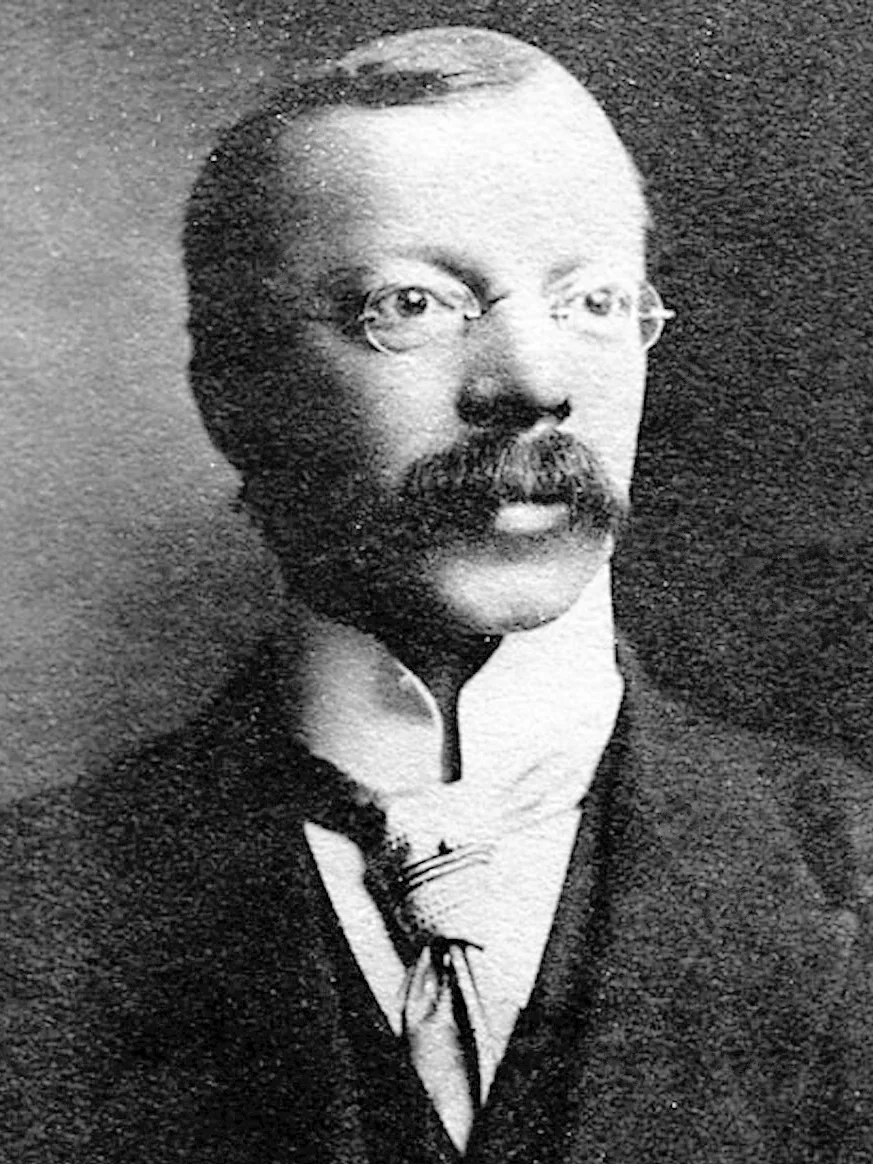
Hawley Harvey Crippen was an American-born patent-medicine salesman and dentist who was hanged at Pentonville Prison on November 23, 1910, for the murder of his wife, Cora Crippen, a music-hall performer known as Belle Elmore. She was last seen alive at a dinner party at their home, 39 Hilldrop Crescent in north London, on the night of January 31, 1910. On July 13 Chief Inspector Walter Dew lifted the bricks of the cellar floor and found human remains packed in lime. By then Crippen had fled with his lover, Ethel Le Neve, who was disguised as a boy, aboard the liner Montrose. The ship’s captain recognised them and sent a wireless message to England, the first time radio was used to catch a fugitive at sea. Crippen was tried at the Old Bailey in October 1910, convicted in 27 minutes of jury deliberation, and executed.
That much is documented in the trial record. What is argued over is whether the remains were Cora’s. In 2007 a team at Michigan State University announced that mitochondrial DNA from the trial exhibit did not match Cora’s maternal relatives, and that the tissue appeared to be male. The claim was published in a peer-reviewed journal in 2011. It has been challenged on the genealogy, and no court has reopened the case. This guide separates what the Old Bailey Proceedings and the 1920 trial volume establish from what the modern science claims and what remains unresolved.
The short version
| Date | Event | Status |
|---|---|---|
| September 1905 | The Crippens become tenants of 39 Hilldrop Crescent, Camden Road | Documented at trial |
| January 19, 1910 | Crippen signs for five grains of hyoscine hydrobromide at the chemists Lewis and Burrows | Documented; poisons-book entry read in court |
| January 31, 1910 | Dinner party with Paul and Clara Martinetti; Cora is never seen again | Documented |
| February to March 1910 | Crippen tells friends Cora has gone to America, then that she has died there | Documented by letters read at trial |
| June 30, 1910 | A friend of Cora’s reports her disappearance to Scotland Yard | Documented (Dew’s testimony) |
| July 8, 1910 | Dew interviews Crippen, who withdraws the death story; the house is searched | Documented |
| July 9, 1910 | Crippen and Le Neve leave London for the Continent | Documented (Crippen’s own evidence) |
| July 13, 1910 | Dew finds remains under the cellar floor | Documented |
| July 22, 1910 | Captain Kendall of the Montrose sends his wireless message | Documented |
| July 31, 1910 | Dew boards the Montrose off Father Point, Quebec, and arrests both | Documented |
| October 18 to 22, 1910 | Trial at the Old Bailey; guilty verdict | Documented |
| October 25, 1910 | Ethel Le Neve tried as an accessory and acquitted | Documented |
| November 5, 1910 | Court of Criminal Appeal dismisses Crippen’s appeal | Documented |
| November 23, 1910 | Crippen hanged at Pentonville | Documented |
| October 2007 | Michigan State University team announces DNA results | Documented announcement; disputed conclusion |
| December 2009 | Criminal Cases Review Commission refuses to refer the case | Documented |
| January 2011 | Foran et al. published in the Journal of Forensic Sciences | Documented |
Who the Crippens were
Most of what is known about the couple’s early life comes from Crippen’s own statement to the police, read out at his trial, and should be treated as his account. He said he had qualified as a doctor at the Hospital College in Cleveland, Ohio, that he first came to England in 1883, and that his first wife, a woman named Bell, had died in 1890 or 1891. He said he met Cora Turner in 1893, when she was 17, and married her in Jersey City that year. Standard biographies give his birthplace as Coldwater, Michigan, in 1862, and put the wedding in 1894; the trial record does not settle the year.
The couple settled in London around 1900. Crippen worked for the American patent-medicine firm Munyon’s and later for other remedy businesses, and by 1908 was a partner in a dental practice, the Yale Tooth Specialists, at Albion House on Oxford Street. Cora, who performed under the stage name Belle Elmore, had occasional music-hall engagements and was honorary treasurer of the Music Hall Ladies’ Guild, which met at Albion House. The couple’s doctor, John Burroughs, described her at trial as “a stoutish woman, about 30 years of age, vivacious, bright and cheerful,” fond of dress and jewellery, who appeared to be on good terms with her husband.
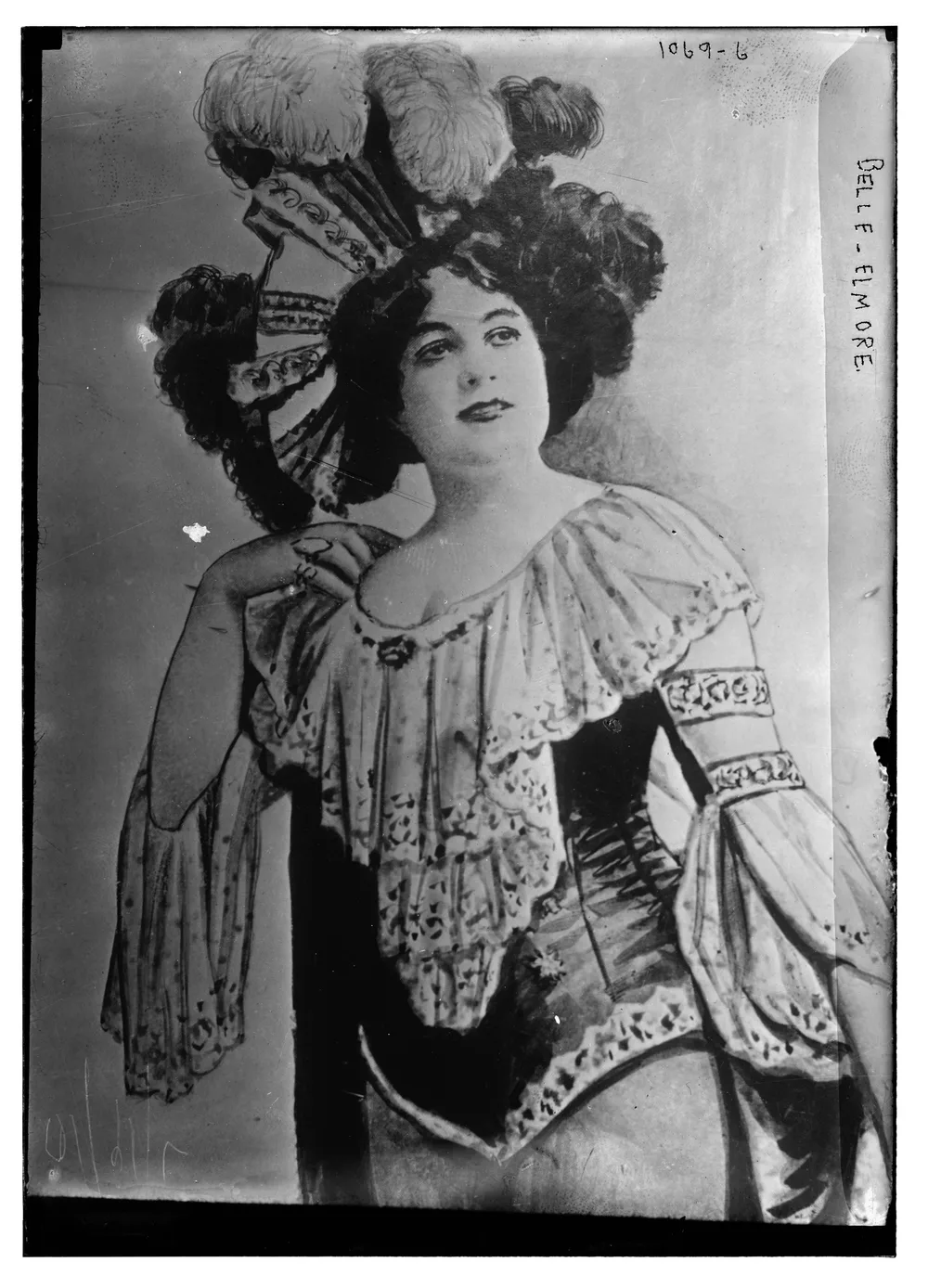
Cora Crippen in her stage persona as Belle Elmore. This is a Bain News Service press negative, labelled by hand and heavily retouched, as agency pictures of the period often were. Library of Congress, George Grantham Bain Collection, via Wikimedia Commons, no known copyright restrictions; resized and converted to WebP.
Ethel Le Neve was a typist who had worked for Crippen for years. In his statement to Dew, Crippen said he had been intimate with her for three years and that she was now living with him at Hilldrop Crescent as his wife; her former landlady testified that from February 1910 she stopped sleeping at her lodgings. Hallie Rubenhold’s 2025 book Story of a Murder reframes the case around the two women rather than the man, and argues, according to the Kirkus review, that Le Neve’s move into Crippen’s home and workplace owed as much to her own choices as to his. That is a historian’s interpretation, not a finding of the court.
What happened at 39 Hilldrop Crescent
The last people known to have seen Cora alive were Paul and Clara Martinetti, retired performers who dined at the house on January 31, 1910. The indictment charged the murder as having taken place on February 1. In his opening speech, the prosecutor Richard Muir said she was “left alone at half-past one in the morning of that day with the prisoner.”
Within days Crippen was explaining her absence. A letter of resignation from the Guild treasurership, in Belle Elmore’s name and citing a sudden call to America, was read at the trial. On February 2 and again on February 9, a pawnbroker in Oxford Street testified, Crippen pledged diamond rings, earrings and a brooch for a total of £195, signing the contract notes in his own name. Over the following weeks he told friends that Cora had fallen ill in California and died of pleuro-pneumonia. Burroughs testified that on April 5 he received a letter from Crippen on black-edged paper: “I have been nearly out of my mind with my poor Belle’s death so far away from me.” Le Neve, meanwhile, wore one of Cora’s brooches to the Guild’s ball.
Cora’s friends did not believe the story. On June 30 one of them, John Nash, went to Scotland Yard. Dew called at Hilldrop Crescent on July 8, found Le Neve there, and was taken to Crippen at Albion House. According to Dew, Crippen said: “I suppose I had better tell the truth. The stories I have told them about her death are untrue; as far as I know she is still alive.” He gave a long statement claiming that Cora had left him, probably to join a former music-hall performer named Bruce Miller in Chicago, and that he had invented the death to avoid scandal. Miller, called by the Crown, testified that he had last seen her in 1904 and that there had never been any arrangement for her to join him. Dew went through the house with Crippen that day and found nothing. Crippen, he said, “showed not the slightest trace of worry or anxiety, but was perfectly cool.”
The next morning Crippen and Le Neve were gone. Crippen later told the jury he had made up his mind to leave “the morning after Dew called on me, July 9,” because he feared being held in prison for months until his wife was found.
The remains in the cellar
Dew went back on July 12 and 13. On the 13th he decided to examine the cellar closely. In his words: “It had a brick floor: I probed about with a poker; at one place I found that the poker went rather easily in between the crevices, and I got a few bricks up. I then got a spade and dug the clay immediately beneath the bricks.” About nine inches down he found what appeared to be human remains, in a mass of lime about four feet long and twenty inches wide.
What was in that hole shaped everything that followed. Augustus Pepper, the consulting surgeon at St Mary’s Hospital who examined the remains, told the court that the head was missing, that “there was no bone or part of a bone,” and that the sexual organs were absent, but that otherwise all the internal organs were present, extracted in one connected piece by someone with “a practised hand and eye.” There were tufts of hair, some wound in a Hinde’s hair curler, bleached at the ends and dark brown at the roots. There were fragments of a woman’s cotton combinations, a handkerchief, and part of the collar of a man’s pyjama jacket bearing the label of Jones Brothers of Holloway. Pepper’s estimate was that the remains had been buried between four and eight months, and certainly not before September 1905, when the Crippens’ tenancy began.
The Crown’s case therefore rested on three expert pillars: the poison, the scar and the pyjamas.
The poison. William Willcox, the senior Home Office analyst, found hyoscine hydrobromide in the organs: “two-fifths of a grain,” which he said “would certainly correspond to more than half a grain in the whole body, which would be a fatal dose. A fatal dose is from a quarter to half a grain.” A chemist’s assistant produced the poisons-book entry showing that on January 19, 1910, Crippen had signed for five grains of the same drug, stated purpose “homeopathic preparations.” Crippen told the jury he had bought it for nerve remedies, but no residue was ever found.
The scar. Among the remains was a piece of skin, seven inches by six, from the lower abdomen. Pepper and the young pathologist Bernard Spilsbury testified that it carried an old surgical scar, consistent with an operation Cora was known to have had. Spilsbury told the court: “The mark is undoubtedly an old operation scar.” His reasoning was microscopic: the tissue was denser than the surrounding skin and contained no glands, while glands were present on either side.
The pyjamas. Dew had found two pyjama suits and one odd pair of pyjama trousers in a bedroom, all with the Jones Brothers label that matched the fragment in the grave. Crippen said the odd trousers belonged to an older suit bought years earlier, so the buried jacket could have predated the disappearance. The Crown then called the firm’s buyer, who testified that the material “never came into existence before November, 1908,” that the store sold it between December 29, 1908, and the end of January 1909, and that a sale duplicate dated January 5, 1909, recorded pyjamas bought for 17 shillings and ninepence. The jacket, in other words, could not have been buried by any earlier tenant.
The defence, and what it argued
Crippen’s counsel, Alfred Tobin, did not dispute that remains had been found. He argued that they could not be identified as Cora’s, that nothing proved they were even a woman’s, and that the “scar” was a fold of skin. The defence called Gilbert Turnbull, director of the Pathological Institute at the London Hospital, who told the court that “what has been called a scar cannot possibly be one,” because his sections showed hair follicles and part of a sebaceous gland within it, structures that a true scar does not contain. Spilsbury had already accepted the principle under cross-examination: if a sebaceous gland or a hair follicle were established within the scar, “it would be conclusive that it was not a scar.” He said he had searched the tissue carefully and found none. The jury was left to choose between two microscopes.
The defence also suggested that someone else could have buried the remains during the Crippens’ tenancy without their knowledge. Crippen himself conceded in cross-examination that this was “the possibility,” without being able to say how.
Crippen gave evidence in his own defence and, by the account of the editor of the 1920 trial volume, remained cool and unshaken throughout. Asked after the verdict whether he had anything to say, he replied: “I am innocent.” Sentenced to death, he said: “I still protest my innocence.”
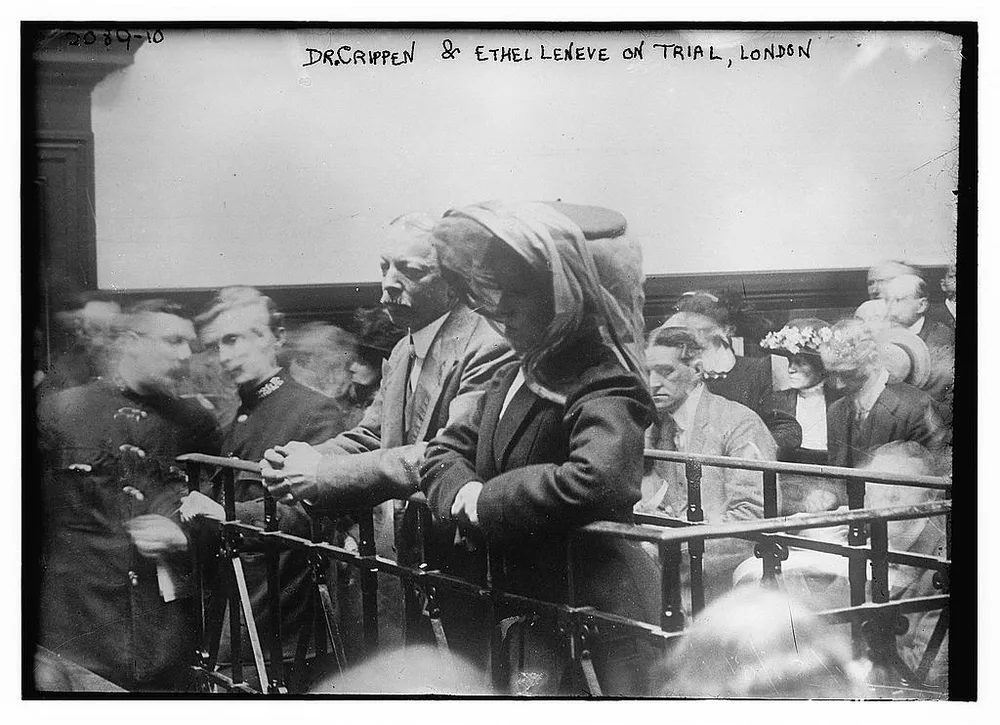
Crippen and Ethel Le Neve in the dock together. The two were tried separately at the Old Bailey, so a joint appearance like this one belongs to the Bow Street police-court hearings of August and September 1910. Bain News Service, Library of Congress, via Wikimedia Commons, no known copyright restrictions; resized and converted to WebP.
The Montrose and the wireless message
The flight is the part of the story most often retold, and the trial volume records it with unusual precision. Crippen and Le Neve went to Brussels, then Antwerp, and on July 20 boarded the Canadian Pacific liner Montrose as “Mr. John Robinson and Master Robinson,” father and son. The captain, Henry Kendall, had read the police descriptions and the Daily Mail’s offer of a £100 reward. Within hours he was suspicious. His message, printed in the Daily Mail on July 31 and reproduced in the 1920 volume, explains why: “My suspicion was aroused by seeing them on the deck beside a boat. Le Neve squeezed Crippen’s hand immoderately. It seemed to me unnatural for two males, so I suspected them at once.” He noted that “Master Robinson’s” trousers were split down the back and held with safety pins, and that the boy’s hat was packed with paper to make it fit.
Kendall sent his wireless message on July 22. Dew and Sergeant Mitchell sailed from Liverpool the next day on the faster Laurentic, reached Canada ahead of the Montrose, and on July 31 Dew came aboard off Father Point in the St Lawrence disguised as a pilot. Kendall’s report adds the detail that Crippen, unaware, had admired the ship’s wireless aerial and remarked, “What a wonderful invention it is!”
Dew’s own evidence of the arrest is short. He told Crippen he would be arrested for the murder and mutilation of his wife. Crippen said: “I am not sorry, the anxiety has been too much.” When handcuffed, because a card found on him said he intended to jump overboard, he added that he was “more than satisfied, because the anxiety has been too awful.” The card, addressed to Le Neve, read in part: “I cannot stand the horrors I go through every night any longer.”
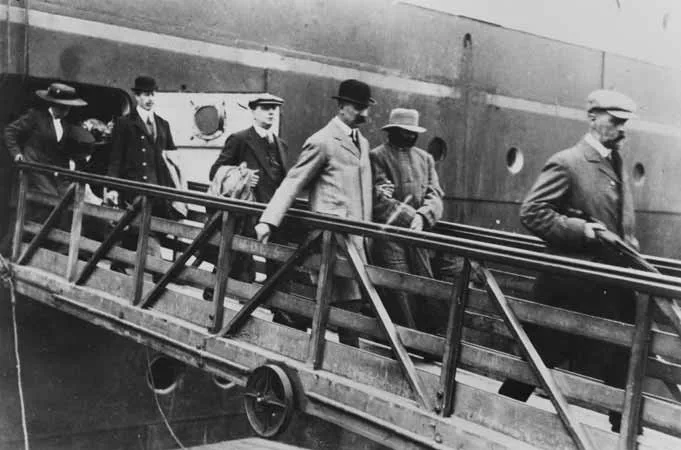
Crippen, face covered, is led down a gangway in custody in 1910. The Wikimedia Commons file is titled “Dewcrippen” but records neither the port nor the photographer. Via Wikimedia Commons, public domain; converted to WebP.
After extradition hearings in Quebec, the prisoners were landed at Liverpool on August 28 and committed for trial at Bow Street on September 2. A coroner’s jury returned a verdict of wilful murder against Crippen on September 26, and what the court took to be Cora’s remains were buried at Finchley cemetery on October 10.
The trial and the execution
The trial opened before the Lord Chief Justice, Lord Alverstone, on Tuesday, October 18, 1910, and ran five days. The Old Bailey Proceedings record the verdict in a single line: “Verdict, Guilty of wilful murder. Sentence, Death.” The fuller transcript in the 1920 volume gives the timing: the jury retired at 2.15 p.m. on October 22 and returned at 2.42.
Ethel Le Neve was tried separately on October 25 as an accessory after the fact, defended by F. E. Smith. The jury acquitted her and she was released at once. Later accounts say she lived for a time in North America, returned to England, and died in 1967; her later life is outside the trial record.
Crippen’s appeal was heard and dismissed by the Court of Criminal Appeal on November 5. He was hanged at Pentonville on November 23, 1910, and buried within the prison grounds, where his remains still lie.
The DNA study of 2007 and why it is disputed
The modern argument begins with a glass slide. The Royal London Hospital Archives and Museum held the microscope slide of the abdominal tissue that Spilsbury used at the trial. In 2007 the museum sent it to Michigan State University, where David Foran, director of the forensic science programme, led a two-year effort to recover DNA from tissue preserved in formaldehyde and sealed under pine resin. The work had been prompted by John Trestrail, a toxicologist who had long been troubled by one feature of the case: poisoners, he argued, want a death to look natural so that they can obtain a death certificate, and he knew of no other poisoning case in which the victim was dismembered.
A genealogist, Beth Wills, spent about seven years tracing Cora’s family forward from her mother and found three living grandnieces in the maternal line, who should share Cora’s mitochondrial DNA. According to the university’s announcement in October 2007, the mitochondrial profile from the slide did not match them. “This can’t be Cora Crippen,” Foran said. “We’re certain of that.” The team later reported a second result: a Y-chromosome signal in the nuclear DNA, which would mean the tissue came from a man. The findings were published in the Journal of Forensic Sciences in January 2011 under the title “The Conviction of Dr. Crippen: New Forensic Findings in a Century-Old Murder,” with Foran, Wills, Trestrail and two colleagues as authors.
The criticisms are of three kinds.
The genealogy. Jonathan Menges, a writer and genealogist, argued in the BBC’s 2010 report that the chain linking the three women to Cora is not secure, in part because no birth certificate for Cora exists, so a mismatch proves nothing about the slide. Foran replied that he was “fully satisfied by the genealogy,” and that the sex result stood on its own: “the remains are indisputably male.”
The sample. There is one slide, a century old, chemically treated, and handled since 1910. The team itself described the work of extracting DNA from it as demanding. Any result from a single degraded exhibit is only as good as the exhibit’s history, a problem familiar from the shawl in the Jack the Ripper DNA claim.
The inference. Even if the slide holds male tissue, that would show that the exhibit used to identify Cora was not from Cora. It would not explain who was in the cellar, why the burial contained bleached hair in a woman’s curler and women’s underclothes, why a fatal quantity of the drug Crippen had bought was in the organs, or why he fled. Foran himself drew the line carefully in 2010: “I don’t really care one way or the other whether the body was Cora Crippen’s, I have no interest in clearing Crippen’s name. What I care about is being right.” Trestrail’s formulation was: “I don’t say Hawley Crippen is innocent, but he is no longer proven guilty.”
The BBC also reported that researchers had asked to test the hair from the curlers, held in the Metropolitan Police’s Crime Museum, and had been refused, so the one sample that might settle the sex of the remains independently has not been tested.
The pardon application
James Patrick Crippen of Ohio, a second cousin three times removed, applied in 2009 for the case to be referred to the Court of Appeal, seeking a posthumous pardon and the return of the remains to a family plot in Michigan. In December 2009 the Criminal Cases Review Commission refused. It did not examine the DNA evidence. Its reason was procedural: the applicant was not a “properly interested person,” since the law allows a posthumous appeal only through a widow or widower, a personal representative, or a relative with a substantial interest approved by the court. No later application has succeeded, and the conviction stands.
The pattern is familiar from other cases on this site. In the Lindbergh kidnapping, a modern genetic test is proposed but blocked by custody of the exhibits; for the Somerton Man, a research identification exists without an official finding; for Kaspar Hauser, DNA removed one answer without supplying another. Crippen’s case has all three features: an exhibit that cannot be re-tested freely, a published result, and no court willing to hear it.
What is documented, disputed and unresolved
Documented
- Cora Crippen was last seen alive on the night of January 31 to February 1, 1910, and Crippen gave false accounts of her departure and death.
- Crippen bought five grains of hyoscine hydrobromide on January 19, 1910, and a fatal quantity of the drug was found in the remains.
- Headless, boneless human remains were buried under the cellar at 39 Hilldrop Crescent with lime, a woman’s hair in a curler, women’s underclothes and part of a Jones Brothers pyjama jacket whose cloth did not exist before late 1908.
- Crippen fled with Le Neve the day after Dew’s visit, was identified by wireless, arrested on July 31, convicted on October 22 and hanged on November 23, 1910.
Expert opinion at trial, contested then and now
- That the abdominal skin bore an operation scar matching Cora’s medical history. The Crown’s pathologists said yes; the defence pathologist said the tissue contained follicles and a gland that a scar would not.
Modern scientific claim, disputed
- That the slide tissue does not share Cora’s maternal DNA and carries a Y chromosome. Published in 2011; challenged on the reliability of the genealogy and the condition of the sample; not tested by any court.
Unresolved
- Who the remains belong to if they are not Cora’s, and where Cora went if she was not killed. No alternative account has any documentary support.
- Whether the hair in the curlers, which has never been tested, would confirm or contradict the slide result.
Later interpretation
- Arguments that Crippen was an abortionist whose patient died, that he dosed Cora as a sedative and miscalculated, or that the police planted evidence, all appear in later commentary. None is supported by the trial record, and the editor of the 1920 volume dismissed the miscalculated-dose theory on the ground that a medical man could not mistake five grains for half a grain.
Frequently asked questions
Was Dr Crippen a real doctor?
He held a diploma from the Hospital College in Cleveland, Ohio, which was found at Hilldrop Crescent, and he had worked for patent-medicine and remedy firms. He was not registered to practise medicine in Britain, and by 1910 his business was a dental practice at Albion House.
How was Crippen caught?
By wireless. Captain Henry Kendall of the Montrose recognised the fugitives from newspaper descriptions, sent a radio message on July 22, 1910, and Chief Inspector Dew crossed the Atlantic on a faster ship to meet the liner in the St Lawrence on July 31. It was the first arrest at sea made possible by radio.
What poison did Crippen use?
The Crown’s analyst found hyoscine hydrobromide, a powerful sedative, in the remains: two-fifths of a grain in the organs tested, which he said implied more than half a grain in the whole body, a fatal dose. Crippen had signed for five grains of the drug twelve days before his wife disappeared.
Did DNA prove Crippen was innocent?
No. A 2011 study reported that tissue from the trial slide did not match Cora’s maternal relatives and appeared to be male. That challenges the identification of the remains, not the rest of the evidence, and the genealogy behind the comparison has been disputed. The conviction has not been overturned.
What happened to Ethel Le Neve?
She was tried on October 25, 1910, as an accessory after the fact and acquitted. Later accounts say she lived for a time in North America, returned to England, and died in 1967.
Where is Crippen buried?
In the grounds of Pentonville Prison in London, where he was hanged on November 23, 1910. A 2009 request by a distant relative to have the remains released was tied to a pardon application that the Criminal Cases Review Commission declined to refer.
Does 39 Hilldrop Crescent still exist?
No. The BBC’s 2010 report notes that the house in north London has since been demolished.
Sources & further reading
- Old Bailey Proceedings Online, trial of Hawley Harvey Crippen, October 18 to 22, 1910 (reference t19101011-74); primary trial record (accessed November 5, 2026)
- Filson Young (ed.), 'The Trial of Hawley Harvey Crippen', Notable British Trials series, William Hodge, Edinburgh and London, 1920; full text via the Internet Archive, including the chronology, Captain Kendall's message (Appendix A), Ethel Le Neve's trial (Appendix D) and the Court of Criminal Appeal judgment (Appendix E) (accessed November 5, 2026)
- David R. Foran, Beth E. Wills, Brianne M. Kiley, Carrie B. Jackson and John H. Trestrail III, 'The Conviction of Dr. Crippen: New Forensic Findings in a Century-Old Murder', Journal of Forensic Sciences 56 (1), January 2011, pp. 233-240; published online August 23, 2010 (bibliographic record via Crossref; accessed November 5, 2026)
- Michigan State University, 'Crippen was innocent, say MSU forensic scientists', press release republished by ScienceDaily (October 18, 2007; accessed November 5, 2026)
- Stephen Tomkins, 'Was Dr Crippen innocent of his wife's murder?', BBC News Magazine (July 29, 2010; accessed November 5, 2026)
- BBC News, 'Crippen mystery remains despite DNA claim' (October 18, 2007; accessed November 5, 2026)
- BBC News, 'Dr Crippen's relative fails in bid to secure pardon' (December 7, 2009; accessed November 5, 2026)
- Kirkus Reviews, review of Hallie Rubenhold, 'Story of a Murder: The Wives, the Mistress and Doctor Crippen', Dutton, March 25, 2025 (accessed November 5, 2026)
- Wikipedia, 'Hawley Harvey Crippen', used only to trace where widely repeated claims and the later-commentary citations originate (accessed November 5, 2026)