The Index / Unidentified Persons
Who Was Kaspar Hauser? The Nuremberg Foundling, the Prince Theory and the DNA
Kaspar Hauser appeared in Nuremberg in 1828 and died of a stab wound in 1833. What the records, the dungeon story and the 2024 DNA study actually show.
Topics: Kaspar Hauser, Nuremberg, Ansbach, House of Baden, DNA analysis, Foundlings, 19th century
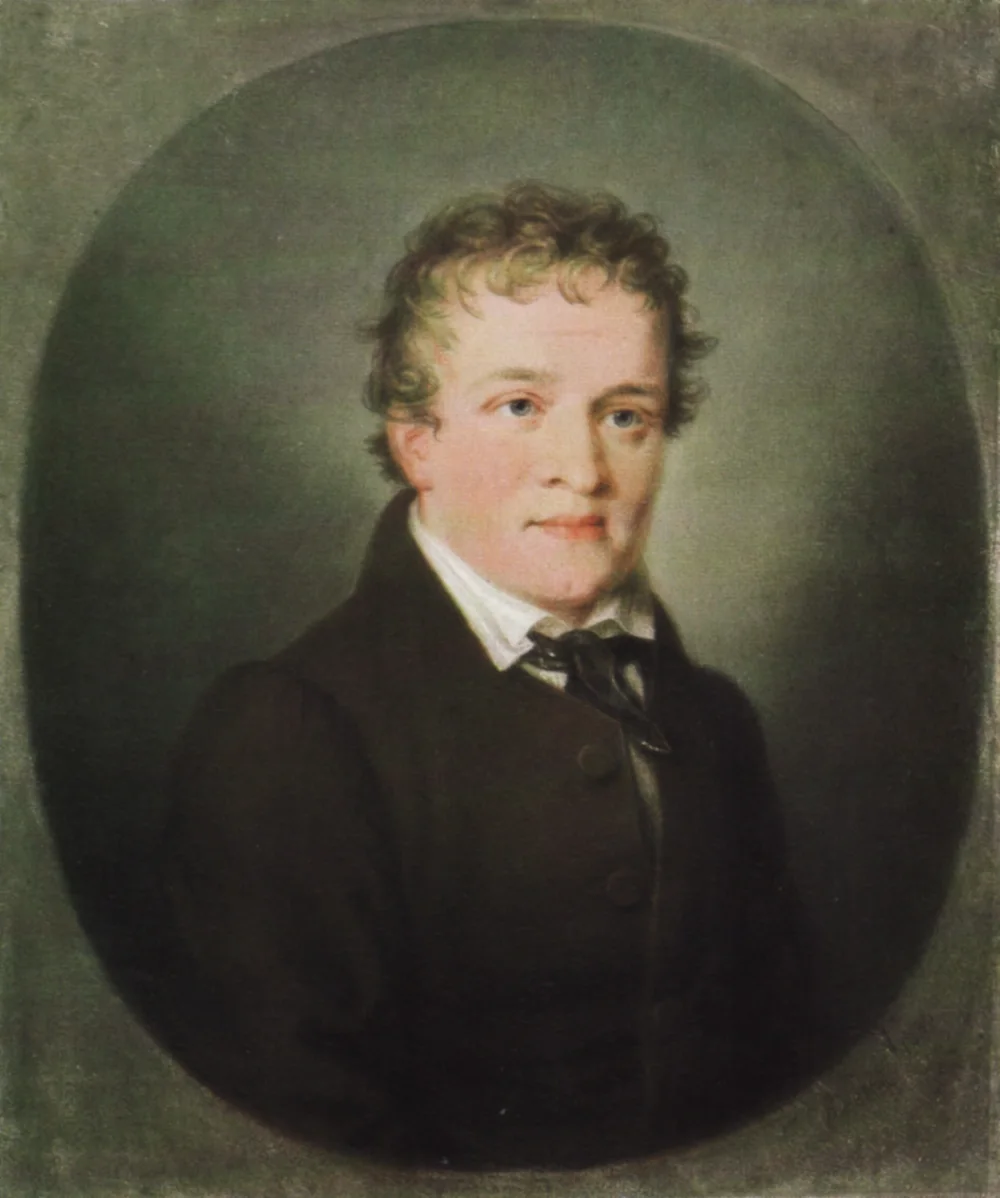
Nobody knows who Kaspar Hauser was. He appeared in Nuremberg on 26 May 1828, a teenager of about 16 who could barely speak, and he died in Ansbach on 17 December 1833 from a stab wound he said a stranger had given him. For almost two centuries the favourite explanation was that he was a stolen prince of Baden. A DNA study published in 2024 excludes that with very high probability. It does not tell us his name, and its authors warn that it does not prove he was a fraud either.
This guide separates what the record shows from what Hauser claimed and from what others built on top of it. It also compares the three rounds of DNA testing, because the middle round is the reason older articles still say the question is open.
What happened in Nuremberg on 26 May 1828?
The core events are not in dispute. Anselm von Feuerbach, the senior judge who studied the case and published a book on it in 1832, places the scene on Whit Monday between four and five in the afternoon, near the Haller gate. A citizen noticed a young man in peasant clothes who could hardly govern his legs. The youth held out a letter addressed to the captain of the 4th squadron of the 6th light cavalry regiment, and he was taken to the captain’s house.
There, according to Feuerbach’s summary of the depositions, he repeated a phrase in dialect meaning he wanted to be a cavalryman as his father had been, and otherwise said little beyond “don’t know”. He spat out meat and beer and accepted only bread and water. At the police station he could answer almost nothing, but when handed a pen he wrote a name in legible letters: Kaspar Hauser. Some of the officers already wondered whether a clever deceiver was hiding behind the helplessness, Feuerbach notes.
Feuerbach also issued a warning that is easy to overlook. He called the police documents from those first hours so irregular and contradictory that they could not be used “without much caution”. The earliest evidence in the case was poor from the start, and the man who complained about it believed Hauser.
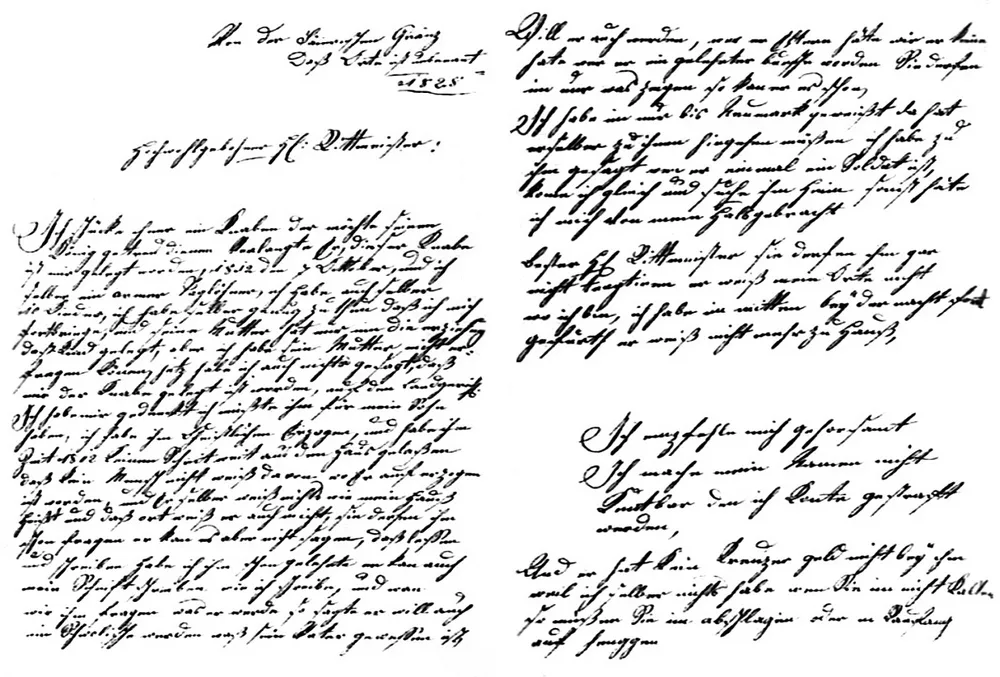
Facsimile of the anonymous letter Hauser carried in 1828. Authorship unknown; the Commons record lists “Kaspar Hauser (?)”. Public domain (PD-old) via Wikimedia Commons; resized and converted to WebP.
What did the two letters say?
The letter claimed to come from a poor day labourer with ten children, writing from a nameless place near the Bavarian border. It said the boy had been left at his house on 7 October 1812, that he had kept him indoors ever since, and that he had taught him to read and write. In Linberg’s 1832 translation, it adds that “he writes my handwriting exactly as I do”. It ended by telling the captain he could keep the boy or get rid of him.
A short enclosed note, supposedly from the mother, gave his birth date as 30 April 1812 and said his dead father had served in the same regiment. Feuerbach thought both papers were “evidently” by the same hand, despite the different scripts.
Two points follow, and the second is our own reading rather than a finding from the sources. First, the labourer’s claim that the boy shared his handwriting is one reason later critics suspected Hauser wrote the letter himself. That remains an inference. Second, taken at face value the letter does not fit the later prince story. A birthday in April is five months before the Baden prince’s birth on 29 September 1812, and the prince was officially alive until 16 October, nine days after the boy was supposedly handed over. An anonymous letter is weak evidence for anything, but anyone defending the prince theory has to dismiss its details as misdirection.
What was Hauser’s dungeon story?
This part is Hauser’s own claim, recorded after he had learned to talk. Feuerbach relays it in detail: for as long as he could remember he had lived in a small, low, dark space, sitting on the ground, hearing nothing. He woke to find bread and water beside him. Sometimes the water tasted bad and made him sleep, and then he would wake with a clean shirt and cut nails. He played with wooden horses. Shortly before his release a man appeared, taught him to walk and to write his name, then led him to Nuremberg.
No dungeon, keeper or route has ever been found. The Allgemeine Deutsche Biographie (ADB) notes that Hauser’s guardians themselves complained of his contradictions, and the 2024 DNA paper describes the “dubiety of his dungeon story” as a key argument for his critics. Psychiatrist Karl Leonhard argued in 1970, as quoted on Wikipedia, that nobody raised that way would have developed normally or even survived.
Some physical details do not sit comfortably with it. Doctors who examined him found him in good health, according to the 2024 paper’s historical summary. Feuerbach records soft soles covered in blisters and feet that showed no sign of ever having worn a shoe, which fits his view of the case. Wikipedia’s summary of the police description points the other way, saying observers found Hauser able to walk well and to climb more than ninety steps to his room.
The vaccination scars
Feuerbach also reports that “both his arms showed the scars of inoculation”. In 2023 Habicht and colleagues argued that this undermines the story of total isolation. Vaccination was compulsory in Bavaria from 1807 and was administered by physicians, often arm to arm, so a child could hardly have received it in secret.
The scars certainly contradict the letter, which says the boy never left the house after 1812. They are less decisive against a looser version of the story. The 2024 paper says Hauser’s abilities led contemporaries to think he was shut away at the age of three or four, and a child vaccinated before that point would still carry scars. So the scars point to contact with an ordinary medical system, which is useful, but they do not settle how the following years were spent.
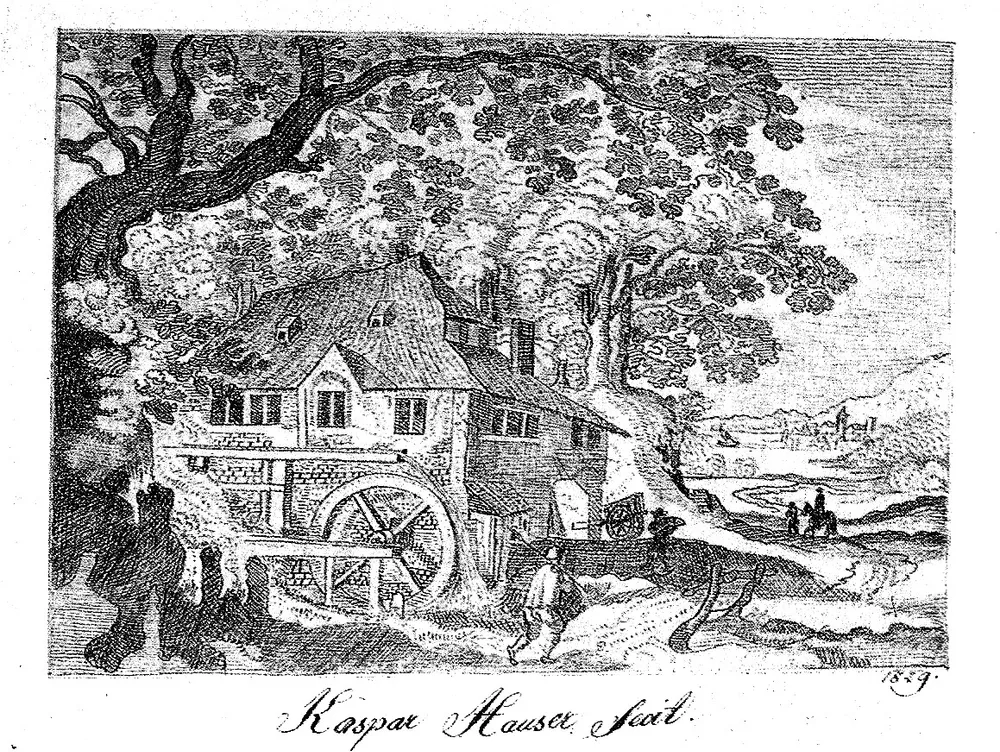
A drawing of a mill signed by Kaspar Hauser, 1829, from the Ansbach city archive according to its Commons record. Public domain (PD-Art, PD-old-auto-expired) via Wikimedia Commons; resized and converted to WebP. His talent for drawing emerged under Daumer, according to Wikipedia’s summary.
The wound of 1829 and the move to Ansbach
Nuremberg’s mayor publicised the case in July 1828, which brought national attention, and Hauser was placed with the teacher Georg Friedrich Daumer. On 17 October 1829 he was found in the cellar of Daumer’s house, bleeding from a cut on the forehead. Feuerbach, the 1911 Britannica and the 2024 paper all give the 17th; the ADB says the 16th, and Feuerbach’s detailed day-by-day account is the better guide.
Hauser said a man had attacked him. Descriptions of that man vary between sources: a figure Hauser’s first broken words compared to a chimney sweep in Feuerbach, a black beard in the ADB, a blackened face in the 1911 Britannica. No attacker or weapon was found. Supporters saw an assassination attempt. Critics saw a self-inflicted wound meant to regain attention, and Wikipedia’s summary of the historical literature adds that Hauser had recently quarrelled with Daumer over lying.
The British aristocrat Lord Stanhope then took up his cause. In December 1831 Hauser moved to Ansbach to live with a strict teacher, Johann Georg Meyer. Feuerbach, by then a patron, died in May 1833, and the ADB says public interest in Hauser had cooled considerably by that year.
What happened on 14 December 1833?
Hauser came home to Meyer’s house with a deep wound in his left side. He told people a stranger had lured him to the Hofgarten, the Court Garden, with a promise of news about his origins, handed him a bag and stabbed him. He died on 17 December. A bag was found in the garden, holding a pencilled note in mirror writing that said Hauser could describe the writer and where he came from, near the Bavarian border, and ending with three initials.
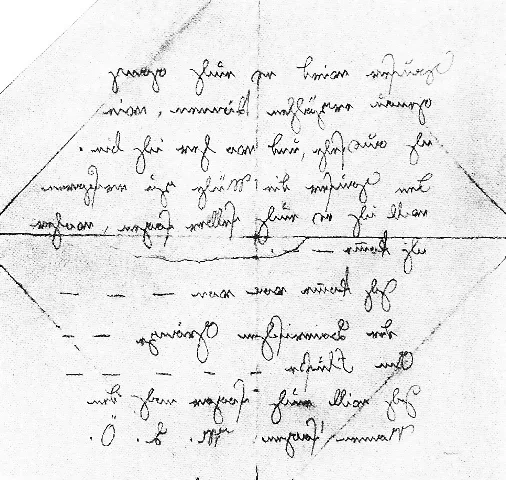
Photograph, c. 1925 according to Commons, of the mirror-writing note found in the bag in 1833. Commons tags it PD-old and names no photographer. Via Wikimedia Commons; resized and converted to WebP. Wikipedia reports the original has been missing since 1945.
The evidence that follows is often presented as stronger than it was, so it helps to see who supplied it. Most of it comes from Stanhope’s 1836 Tracts, written by a former patron who publicly decided he “had been deceived” and who was arguing a case.
| Point | What the sources say | Caution |
|---|---|---|
| Snow | Stanhope says only the footsteps of one person going back and forth were found. The ADB says one person’s footprints were found. | Andrew Lang, a sceptic, notes that nobody tells us whether the single track was Hauser’s. |
| The bag | Meyer remembered seeing a similar bag in Hauser’s possession, Stanhope reports. | One man’s memory after the event. |
| The note | Meyer’s wife said it was folded the way Hauser folded his letters, Stanhope reports. Wikipedia’s summary of later research adds spelling and grammatical errors typical of him. | Suggestive, not forensic. The initials are given as M. L. Ö. by Stanhope and M. T. Oe. in the ADB. |
| His behaviour | Stanhope lists Hauser’s concern for the bag but not its contents, and remarks about writing in pencil. | Interpreted by an accuser, and spoken by a dying man. |
| The blow | Lang reports a physician, Dr Horlacher, saying the wound must have come from a left-handed person, and that Hauser was left-handed. Stanhope suggests slow pressure through a wadded coat went deeper than intended. | Theories about a wound described in 1833. No knife was found, Lang says. |
The ADB, writing in 1880, treats the verdict of self-infliction as settled by the medical examination and the wider facts. Modern forensic opinion is more careful. A 2005 review by Risse and colleagues concluded that the question “cannot be answered with sufficient certainty” and that neither a suicidal stab nor a homicide can be definitely ruled out, while finding it unlikely that the stab was meant only as self-harm.
So the popular critics’ version, a staged wound that went wrong, is a serious hypothesis supported by real observations. It has not been proven. Neither has murder.
Where did the prince theory come from?
The claim is that Hauser was the son of Grand Duke Karl of Baden and Stéphanie de Beauharnais, the adopted daughter of Napoleon. Their boy was born on 29 September 1812 and officially died on 16 October, unnamed. In the story, Countess Hochberg swapped him for a dying infant so that her own sons could inherit. One of them, Leopold, did become Grand Duke in 1830.
This is a theory, and a later one than most retellings suggest. The ADB traces its printed form to March 1834, when a Baden exile, J. H. Garnier, published a pamphlet in Strasbourg, followed by Sebastian Seiler’s 1840 book. Rumours were circulating earlier, and Feuerbach himself wrote a secret memo to Queen Caroline of Bavaria in February 1832 calling the identification a strong supposition if not a moral certainty. It was published only in 1852, and the ADB says Feuerbach withdrew the idea shortly before he died.
The theory also had a political life. The ADB, itself hardly neutral, says newspapers hostile to the Baden dynasty pushed it in the 1860s and 1870s to stain the ruling house. In June 1875 the Baden government answered by publishing the records of the prince’s emergency baptism, autopsy and burial, and in 1876 Otto Mittelstädt published a detailed refutation. Neither ended the belief. The 2024 DNA paper still describes the prince story as “widely believed”, which is why a test independent of any court’s paperwork mattered.
What did the DNA tests show?
Mitochondrial DNA (mtDNA) passes from mother to child. A son of Stéphanie should therefore carry the same mtDNA type as her living maternal relatives. That makes it a clean test of this one claim. Three rounds of analysis give the question its confusing reputation.
| Round | Samples | Result | Status today |
|---|---|---|---|
| 1996, Munich and Birmingham (published 1998; reported in Der Spiegel) | Bloodstain on underwear said to be from the 1833 stabbing | Differed from two maternal relatives at seven positions. Prince excluded. | Confirmed by later work, but doubted for years because the stain’s authenticity was questioned. |
| 2001/2002, Münster with Munich and Freiburg | Pooled hair, swabs from trousers and a hat | Weak, inconsistent sequences, differing from the Baden line at only one position in the region tested. Treated as not excluding a relationship. | Not published in a journal until the 2024 paper set it out. Its authors explain it as probably extraneous DNA. |
| 2019 to 2022, Innsbruck and Potsdam (published 2024) | Single hair shafts from three separate collections, sequenced with modern methods | All match each other and the 1996 bloodstain: haplogroup W. The Baden line is H1bs. | Current best evidence. |
The Parson paper is unusually strong in design. Twelve individual hairs were tested rather than a pooled sample, and ten gave results. The Potsdam laboratory, which specialises in ancient DNA, received an anonymised hair and an unrelated control without being told whose they were. The team also tested a further maternal relative, and the Baden result stayed the same.
The paper also explains the 2002 confusion. The older sequencing method targeted longer DNA fragments than old hair is likely to preserve, so it may not have read Hauser’s DNA at all. Researchers from the Munich and Münster institutes are among the authors, so this is partly a correction from inside the field and not simply one camp defeating another.
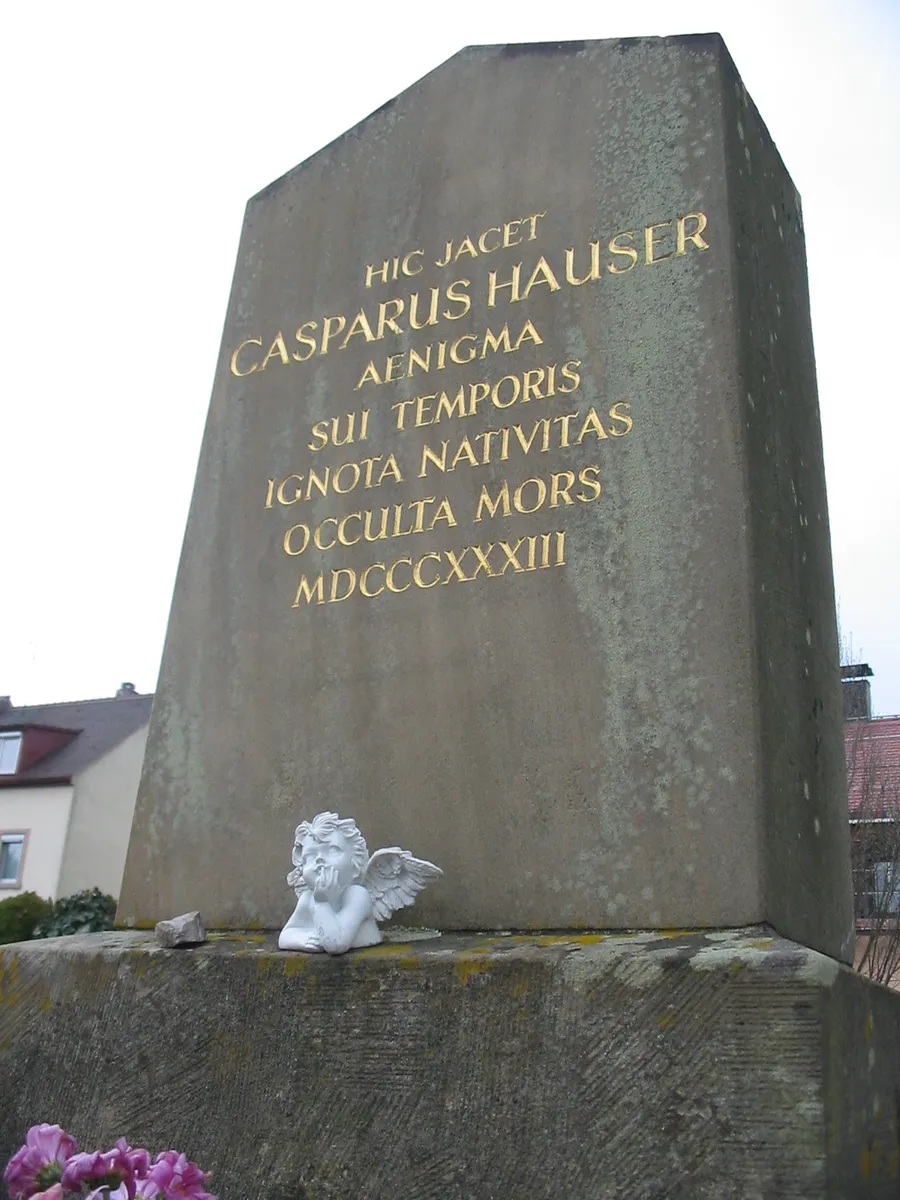
Hauser’s gravestone in Ansbach, photographed by Michael Zaschka on 22 April 2006. Public domain (PD-self) via Wikimedia Commons; resized and converted to WebP. The Latin calls him the riddle of his time, of unknown birth and mysterious death.
What the 99.9994 percent means
Headlines reduced the study to one number. The authors calculate a 99.9994 percent probability that the shared mtDNA type is really Hauser’s and, on that basis, that he was not Stéphanie’s son. It is worth reading that figure for what it is. The type occurs at most about 1 in 410 times in a West Eurasian database, using a conservative upper limit, and the calculation asks how likely it is that the three independent tests would produce that same type by error or contamination. It measures coincidence between tests. It is not a percentage for everything in the historical chain of custody, although the authors do consider that chain strong.
It also has limits the authors state themselves:
- No nuclear DNA. No further samples could be taken from items in the Ansbach museum, and the team had no access to his remains.
- No geography. The type is shared by many people across Europe. The authors explicitly reject an earlier claim that it points to Tyrol.
- No verdict on fraud. They caution readers not to take the result as evidence that Hauser was a liar, adding that he “may have been a crime victim even if he was not a prince”.
That last point matters, because the debate has often been framed as a choice between two options, prince or impostor. The DNA removes one. It does nothing to confirm the other.
What is documented, claimed and unresolved?
| Category | Items |
|---|---|
| Documented | Hauser’s appearance on 26 May 1828 with an anonymous letter. His care in Nuremberg and Ansbach. The forehead wound of 1829. The fatal wound of 14 December 1833 and his death on 17 December. A Baden prince’s recorded birth and death in 1812. |
| Hauser’s own claims | The dark cell, the drugged water, the man who taught him to walk. The attacker of 1829. The stranger in the Hofgarten. |
| Disputed interpretation | Whether the wounds were self-inflicted. Whether he wrote the letter and the mirror note. How much of his early helplessness was real. |
| Theory, now excluded with very high probability | That he was the son of Stéphanie de Beauharnais and the swapped prince of Baden. |
| Legend | Details added around the swap story, such as Countess Hochberg creeping into the nursery disguised as a ghostly White Lady, reported on Wikipedia as contemporary rumour. |
| Unresolved | His real name, parents and birthplace. Where he spent his youth. Who, if anyone, stabbed him. |
Why does the case still matter?
Hauser’s story outlived its evidence because it let people ask large questions through one person. What happens to a human being raised without other people? Could a court hide an heir? The name stuck to the ideas: the 2024 paper lists the “Kaspar Hauser experiment” in behavioural biology and a “Kaspar Hauser syndrome” in medicine and psychology, and he has been the subject of poems, plays and Werner Herzog’s 1974 film The Enigma of Kaspar Hauser.
It is also a useful warning about how a mystery ages. The Princes in the Tower show how a dynastic story fills a gap in the record, and the Green Children of Woolpit show how strange children attract explanations that say more about the people telling them. The Fox sisters are a neighbouring case of 19th-century audiences who wanted a young person’s extraordinary claim to be true. For a modern comparison, the Somerton Man and the Isdal Woman show what genetics can and cannot add when a person’s identity is the real question.
Mittelstädt’s answer, as quoted in the ADB in 1880, still stands for the central question: nobody knows, and nobody has ever found out.
Frequently asked questions
Who was Kaspar Hauser?
A German youth who appeared in Nuremberg in 1828, claiming to have grown up in a dark cell, and who died of a stab wound in Ansbach in 1833. His real identity is unknown.
Was Kaspar Hauser really a prince?
Almost certainly not. A study published in iScience in 2024 found that his mitochondrial DNA is clearly different from the maternal line of the House of Baden, which excludes him as the son of Stéphanie de Beauharnais.
How did Kaspar Hauser die?
He died on 17 December 1833 from a stab wound received three days earlier in the Hofgarten in Ansbach. He said a stranger stabbed him. Many authors suspect a self-inflicted wound that went too deep, while a 2005 forensic review said neither suicide nor homicide can be ruled out.
Was Kaspar Hauser a fraud?
That has not been proven. There is real evidence of contradictions and lies in his stories, and his dungeon account is widely doubted, but the authors of the 2024 DNA study explicitly warn against reading their result as proof of fraud.
Did anyone ever find the dungeon?
No dungeon has been identified, and no keeper has ever been traced in the sources used for this article.
Sources & further reading
- Parson et al., 'Kaspar Hauser's alleged noble origin: New molecular genetic analyses resolve the controversy', iScience 27(9), article 110539 (published 20 July 2024; open access, accessed 1 November 2026)
- Weichhold et al., 'DNA analysis in the case of Kaspar Hauser', International Journal of Legal Medicine 111(6), 1998 (abstract read; accessed 1 November 2026)
- Anselm von Feuerbach, 'Caspar Hauser: An Account of an Individual Kept in a Dungeon', translated by H. G. Linberg (Boston, 1832; primary text, accessed 1 November 2026)
- Philip Henry, Earl Stanhope, 'Tracts Relating to Caspar Hauser' (London, 1836; primary text, a partisan account by a former patron; accessed 1 November 2026)
- Wilhelm Höchstetter, 'Hauser, Kaspar', Allgemeine Deutsche Biographie, vol. 11 (1880), via Wikisource (accessed 1 November 2026)
- Risse, Bartsch, Dreyer and Weiler, 'The death of Kaspar Hauser (17 Dec 1833): assassination, suicide or self-inflicted injury?', Archiv für Kriminologie 216, 2005 (abstract read; accessed 1 November 2026)
- Habicht et al., 'Kaspar Hauser, the Child of Europe: are smallpox vaccination scars the clue to a two-century-old mystery?', Clinics in Dermatology 41(3), 2023 (accessed 1 November 2026)
- Andrew Lang, 'The Mystery of Kaspar Hauser', in Historical Mysteries (1905), Project Gutenberg (accessed 1 November 2026)
- Encyclopaedia Britannica, 11th edition (1911), 'Hauser, Kaspar', via Wikisource (accessed 1 November 2026)
- Wikipedia: Kaspar Hauser, used as a secondary overview and for its references to Mittelstädt, Striedinger and Schreibmüller, which were not read directly (accessed 1 November 2026)
- Wikimedia Commons file records for the five images used (accessed 1 November 2026)