The Index / Unsolved Cases
Who Was the Somerton Man? The Tamam Shud Inquest, the Letters and the DNA Claim
A man was found dead on Somerton Beach on 1 December 1948. The inquest named no one and no poison. A 2022 DNA claim points to Carl Webb. The coroner has not ruled.
Topics: Somerton Man, Tamam Shud, Carl Webb, Adelaide, Forensic genealogy, Rubaiyat
A man was found dead on Somerton Beach, Adelaide, on the morning of 1 December 1948. He had no name on him. In June 1949 the City Coroner adjourned the inquest without finding who he was, or how he died. In July 2022, University of Adelaide researcher Derek Abbott and the American genealogist Colleen Fitzpatrick announced that DNA from hair caught in a plaster cast of his face identified him as Carl “Charles” Webb, a Melbourne electrical engineer and instrument maker. South Australia Police did not adopt that announcement as a completed identification. On 6 July 2026 a police spokesperson told the ABC that the coronial investigation was still “complex and ongoing.”
The beach, the clothes, the slip of verse, the suitcase and the disagreement among the doctors are documented. The spy story, the dancer story and a single agreed reading of the pencilled letters are not.
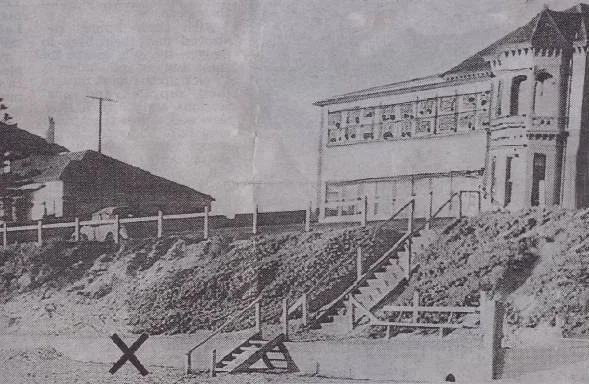
Hero image: a South Australian police photograph of the beach front, with an X marked on the print at the foot of the steps. Witnesses placed the man by those steps, opposite the Crippled Children’s Home. The photograph does not show the body. Wikimedia Commons. Public domain. Converted to WebP. Not enlarged.
Who was found on Somerton Beach?
A fully clothed man, on the sand against a sea wall. He had not been in the water.
The Adelaide News said so on 3 December 1948, while the body was still at the City Morgue. The paper put the discovery at 6.30 a.m. on the Wednesday, which was 1 December. All name tags had been cut from the clothing, and the paper said that cutting looked recent. There were no marks of violence. Fingerprints were not in police files. A post-mortem had been held the day before, and organs had gone to the Government Analyst. “At the moment it is thought death was not due to natural causes.”
The times in the inquest are a little later, and they are not one clock. Lyons, a jeweller who lived at Somerton, said he went down for a swim at about 6.35 a.m., and only afterwards saw men on horses looking at the body. Constable John Moss, of Brighton police, said he reached the beach at about 6.45 a.m. after a telephone message. The City Coroner, Thomas Erskine Cleland, summarised the discovery as about 7 a.m. The useful point is the one the News and the constable share: he was on the shore, not in the sea. Later retellings that have him washed up are contradicted by the first reports.
Moss found him on his back, feet toward the west, head against the sea wall and inclined to the right, opposite the Crippled Children’s Home. That is the institution’s historical name, and it is the name in the depositions. A partly smoked cigarette sat between his right cheek and the coat. The coat was not scorched, and the cheek was not blistered. Moss found no mark of violence and no undue disturbance of the sand. The body was cold, damp and stiff. He took it to the Royal Adelaide Hospital. Dr John Barkly Bennett, who examined it in the police ambulance outside the hospital at 9.40 a.m., pronounced life extinct.
Bennett’s note on the time of death is an estimate, and it is not a single minute. He thought death could have occurred up to eight hours before that examination, and not more than eight hours. He would put it at 2 o’clock at the earliest. He based that on rigor mortis, and he told the inquest he had not written down how far the rigor had gone. Eight hours before 9.40 a.m. is 1.40 a.m. “Not before 2 a.m.” is a slightly different bound. Both sentences are his. Neither is a witness who saw the man die.
What he was wearing, and what he was carrying, is listed in the coroner’s adjournment remarks and in the police depositions. The clothes were of fairly good quality. The tags that might have identified a maker or an owner had been removed. In the clothing were cigarettes and matches, two combs, chewing gum, an uncancelled second-class railway ticket from Adelaide to Henley Beach, a bus ticket, and, found later, the printed slip. The coroner’s list does not include a wallet. Professor John Burton Cleland, who is not the coroner, later remarked on the absence of money. The two Clelands were different men. State Records of South Australia notes that they were distant cousins. Thomas Erskine Cleland ran the inquest. John Burton Cleland was the pathologist who examined the clothes and found the slip.
Detective-Sergeant Raymond Lionel Leane, at the inquest, described a man of 5 feet 11 inches, about 45, well built, clean shaven, with grey eyes and hair he called gingery but mousy, greying at the sides. The teeth were his own. Leane thought about sixteen were missing. Dr John Matthew Dwyer, who did the post-mortem, had already made a chart of the missing teeth and said the gaps would show if the man laughed, and would not necessarily show if he were only speaking. There was no denture. A large number of people viewed the body. Leane said the particulars supplied by people who thought they recognised him did not tally. A Melbourne report of 25 January 1949, preserved on Trove, said five such identifications had already failed, and that the body was packed in ice at the mortuary while police asked Victorian readers to look at the photograph. That is the newspaper’s account of the display. It is not a claim that any of those five people was right.
What did witnesses see the night before?
Three people saw a man lying where the body was found on the evening of 30 November. None of them saw his face. They do not agree about his legs.
Lyons and his wife had walked to the Broadway and were on the way back. His wife told him to look at the way the man was slumped. Lyons put the spot within a yard of the steps in front of the Crippled Children’s Home, in the open, and put himself fifteen to twenty yards away on the sea side of the man. He could not see the face. While Lyons watched, the man’s right arm went fully up and fell. Lyons assumed he was drunk and sleeping it off. He said the remark he made about calling the police was a joke, and that he had no intention of calling them. He described the feet as crossed.
Gordon Kenneth Strapps and Constance Neill arrived at about 7.20 or 7.30 p.m. and left at about 8. They were on the landing above the beach. Strapps could see the man from about the waist down, and a left hand. He did not see him move. He did think a leg, which had been straight, was drawn up a little by the time they climbed the steps. Neill said she saw no change in position. She also said it occurred to her that the man might be dead, that the thought seemed silly, and that Strapps in effect told her to mind her own business. Strapps thought the mosquitoes should have woken a sleeping man. Neill said the place was public, and not the sort of place a man would choose if he wanted to die quietly.
The next morning Lyons told the men with the horses, and then Moss, that he had seen the body there the night before. In the same deposition he said he could not identify the man or the clothes from the previous evening, because he had not been close enough, and also that it was definitely the same person. The coroner did not treat that as proof. In the adjournment remarks he said he had been discussing the case on the footing that the morning body was the evening man, and that there was really no proof of it. None of the three witnesses could identify the face, or any part of the body they could swear to.
That is why the photograph at the top of this article is evidence of a place, not of a moment of death. It shows the steps, the slope, and the large building above them. An X is marked on the sand in the print. The witnesses’ steps and the building are the reason the photograph belongs here. The X is part of the print as it has circulated. It is not a measurement from a surveyor’s notebook reproduced in the inquest.
Why did the doctors and the chemist disagree?
Dwyer thought the death was unnatural. The government analyst found no common poison and thought a natural death more likely. The coroner said he was compelled to find poison, and then said the evidence would not support a finding.
Dwyer did the post-mortem at 7.30 a.m. on 2 December, at the City Mortuary. He described a tallish man of about 45, in good physical condition, with cared-for nails and no external marking he thought notable. The spleen was strikingly large, about three times normal. The stomach was deeply congested, with small haemorrhages under the lining and blood mixed with the food. He thought the food, probably a pie or a pasty, had been in the stomach for up to three or four hours, and he added that anxiety can suspend digestion, so the clock was not exact. Sand was in the hair and not in the nostrils or the mouth. The pupils were small and uneven. He said he would not stress the pupils in a dead man. A small patch of dried saliva lay at the right of the mouth.
The heart, he said, was normal, the muscle tough and firm, if anything contracted. It gave him the impression of “the heart of a man in good physical training.” He thought the immediate cause of death was heart failure. He could not find anything that would have caused the heart to fail, and from that conflict he concluded the death was not natural. He sent stomach and contents, blood, urine, liver and muscle for analysis. He had expected a barbiturate or another common poison. When the chemist found none, Dwyer said he was astounded, accepted the result, and thought a barbiturate unlikely, though not impossible. He saw no injection mark he regarded as significant. Two small recent abrasions on the back of the right hand did not, in his view, amount to much. The sunburn stopped at the crotch and spared the trunk, and he thought it was from a previous season, not from sunbathing in the weeks before he died.
Cowan, the deputy government analyst, received those specimens on 2 December. He tested for common poisons, naming cyanides, alkaloids, barbiturates and carbolic acid. He found none. His conclusion is the sentence later versions of the story tend to drop. He told the coroner he was quite satisfied that a common poison would have shown itself in his examination, and that if the man did die of poison it was a rare one. Then he said he thought death more likely to have been natural than poisoning, because he had failed to find a poison.
Sir Cedric Stanton Hicks, professor of physiology and pharmacology at the university, agreed with the doctors that the death was not natural, and he thought the post-mortem excluded barbiturates. He would have expected respiratory failure and an enlarged left ventricle, and he said that was not the picture. A dose of morphine large enough to kill inside the hours available would, he said, have been detectable. What the organs suggested to him was a group of drugs that stop the heart in systole, the contracted phase, so that blood backs up into the lungs, the liver, the spleen and the stomach wall. He had one member of that group particularly in mind. He said it would be extremely toxic even by mouth, missed by the ordinary tests, and very difficult to identify even if someone thought to look for it. He also said it could be obtained without special access, from a household where someone was already being treated with it, and that using it would imply intelligence more than a chemist’s training. He would have been more confident if there had been vomit. He expected convulsions, not necessarily the theatrical kind, and he was prepared to treat the arm that rose and fell at 7 p.m. as a possible last convulsive movement. The liver, in his reading, excluded insulin and excluded diabetic coma. Bennett had thought the man looked, at a glance, like a person who had had a coronary seizure. Hicks said that appearance fitted the drug-group he was describing.
Hicks was explicit about the assumption underneath the timing. He was proceeding on the basis that the dose was self-administered. If someone else had administered it, and the body had been brought to the beach, his difficulties about the clock, he said, would ease.
The coroner put the medical evidence more bluntly than a modern headline should. Three medical witnesses thought the death was not natural. He said the words on the slip put that conclusion beyond reasonable doubt, that there was no indication of violence, and that he was compelled to the finding that death resulted from poison. The next words, in his adjournment remarks, are “But what poison?” He then set out why he would not sign that finding. On the expert evidence, a dose of a common poison small enough to disappear from the body would not have killed so quickly, and a larger dose should have been found. Hicks’s group still had the missing vomit, and only some evidence of convulsion. The evening man and the morning body might not be the same man. If the body had been carried to the wall, the coroner wrote, the assumption that this was the person who left the suitcase, bought the tickets, removed the tags and put the slip in a pocket “would require revision.”
He finished in one paragraph that later accounts often cut in half:
The evidence is too inconclusive to warrant a finding. There is no evidence as to who the deceased was. Although he died during the night of the 30th November–1st December, I cannot say where he died. I would be prepared to find that he died from poison, that the poison was probably a glucoside and that it was not accidentally administered; but I cannot say whether it was administered by the deceased himself or by some other person.
He adjourned the inquest sine die. That Latin phrase means the hearing was put off without a day fixed for it to resume. It is not a verdict of murder, and it is not a verdict of suicide. The poison he said he was prepared to name is a conditional sentence inside a decision not to make a finding.
His opening remarks, on 17 June 1949, had already framed the same limit. Identity was unknown. The death, on the report in front of him, was not natural, was probably poison, and was almost certainly not an accident. The alternatives were the man’s own act or someone else’s. Until the evidence excluded another person, “the possibility of murder must remain under consideration.” He also warned the witnesses to separate what they knew from what they inferred. He ordered a cast of the face, because the photographs already published had not produced a reliable name, and because the man did not seem to have been missed.
What was the Tamam Shud slip?
The closing words of Edward FitzGerald’s English Rubaiyat of Omar Khayyam. Professor Cleland found them in a fob pocket. Constable Moss had not found them on the beach.
Moss was asked and said he did not find the paper. Cleland found it later, in a pocket just to the right of the fly, difficult enough that when he put the scrap back he had trouble finding the pocket again. Leane told the inquest that Professor Cleland had found the slip bearing the words. The coroner’s adjournment remarks call the words “Tamam Shud,” say he is satisfied the paper was torn from the second edition of FitzGerald’s translation, and say the words are the concluding words of the poem and mean “The End.”
State Records, describing the open inquest file, notes that the file often spells the phrase “Taman Shud.” The same page says Detective Leonard Brown was told the phrase came at the end of the Rubaiyat, identified an edition with the help of Beck’s Book Shop in Pulteney Street, and, with a librarian and a Persian-English dictionary, took the words to mean “to end or to finish.” The book itself was not then found at the public library, a lending library, a circulating library, or the university library. Brown was working from the scrap. The copy that later turned up had not yet been handed in.
The archives also quote three readings of the phrase from the inquest, and they do not match. Professor Cleland, in the archives’ quotation, said he already thought the death was almost certainly unnatural and was probably poison taken with suicidal intent, before he found the paper. The words, meaning “the end,” supported that view. He thought they had been put there deliberately and showed that the man “was fed up with things.” Leane’s deposition, which is readable in the inquest copy, says there is no fact he knows which points toward suicide and abolishes the possibility of murder. He believed the death unnatural, and he could not say how. The typed line has him saying a man in that physical condition would not just go to the beach and “tie.” State Records prints the same sentence and notes that the intended word is probably “die.” Leane’s point, either way, is that the slip could have been planted by whoever caused the death, so he would not treat it as proof of suicide. Brown, in the archives’ quotation, read the poem as an argument for enjoying life, and said it had no bearing on the cause of death.
FitzGerald revised the Rubaiyat several times, which is why “the second edition” is a narrower claim than “a copy of Omar Khayyam.” In the public-domain comparison text on Project Gutenberg, the first-edition sequence ends the famous last quatrain, “turn down an empty Glass,” and then prints “Tamám Shud.” The second-edition sequence in that same book ends the quatrain and then prints the single word “Tamám.” The fifth edition does the same. The coroner was looking at a scrap and at the edition he had been shown in 1949. This article cannot re-do that comparison from a later ebook. What the ebook does show is that the two-word line and the one-word line both exist in FitzGerald, and that a reader who says “every edition ends Tamam Shud” has not looked at the revisions.
When did the book, and the letters, appear?
After the inquest had adjourned. They are not in the coroner’s finding, because there was no finding, and they were not in the depositions.
The inquest sat on 17 June 1949 and resumed on 21 June, when the coroner adjourned it sine die. State Records says the police did not receive the book until 22 July 1949, when a man handed it in and said he had found it in the back of his car on 30 November 1948. The archives say that copy contained a handwritten note, believed to be a code, and a telephone number. The number was traced to a woman the archives refer to by the nickname Jestyn. Police interviewed the man who handed in the book, and they interviewed her. Neither interview is in the coroner’s file. The book had arrived too late.
A report in the News on 23 July is easy to merge with that story, and the details are not the same. Detective-Sergeant Leane had been asking for the Rubaiyat for months. L. F. Wytkins, a bus conductor of Partridge Street, Glenelg, told police he had found a book of the right sort and had handed it to the Tramways Trust lost-property office. He was not sure of the date. He thought it was about the time the body was found. The article does not say this book was thrown into a car, and it does not say the lost-property copy had the last lines torn out. It is a lead reported in the paper. The archives’ account is a book received by police the day before, from a man and a car. Treating them as one anecdote would invent a single scene the two sources do not share.
The letters are a separate object again. The photograph below is a police picture of pencilled capitals. One line is crossed out. Another stroke sits between the groups and is struck through. The top line is clear enough to read as W, then a gap, then R, G, O, A, B, A, B, D. The lines under the crossing-out are fainter, and several characters can be read more than one way. This article does not print a “solved” transcription. The inquest never adopted one, because the book was not yet in evidence. A short string of capitals can be made to fit a poem, a name, a horse, or a spy’s notebook. Fitting is not a solution. The same problem limits the two short unsolved ciphers in the Zodiac case, and it is the entire problem of the Voynich manuscript, at a much greater length.
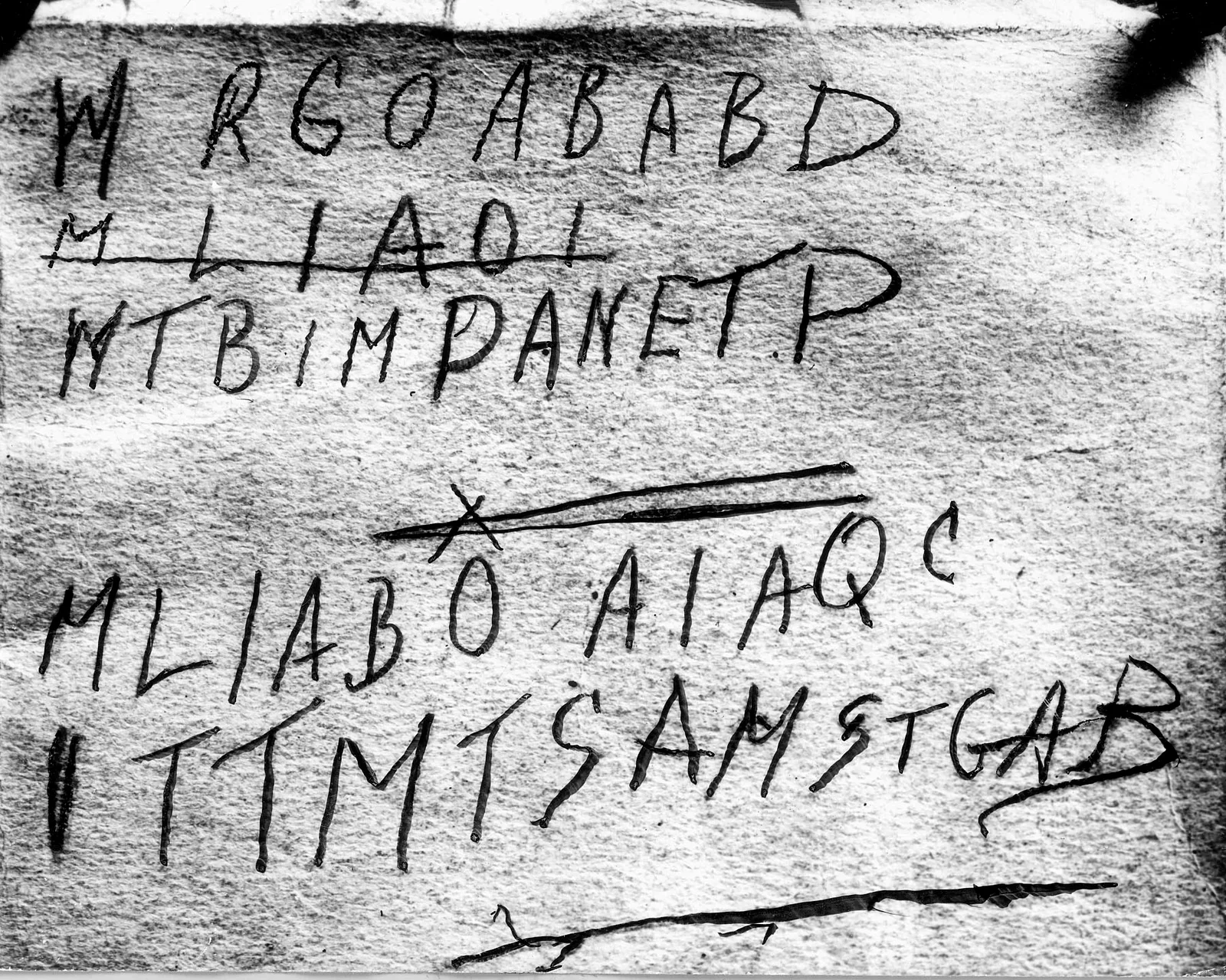
Police photograph of the pencilled letters associated with the Rubaiyat that was handed in after the inquest. The second line is crossed out. Individual letters in the lower lines are not all equally clear, which is why published transcriptions differ. Wikimedia Commons. Public domain. Resized to 1600 pixels wide and converted to WebP.
The spy story is a later reading of those letters and of the removed tags. It is not a finding in the 1949 file. Nobody at the inquest established a foreign service, a mission, or a handler. What the 2022 researchers later published was a trade: electrical engineer and instrument maker, living in Melbourne. That biography, if the coroner eventually adopts the name, makes a professional spy a story that would have to be proved on top of the name. It has not been.
Did the suitcase at the railway station belong to him?
Police and the pathologist thought it was connected, because of the clothes and a particular thread. His name was not in it.
The senior porter at the Adelaide Railway Station cloak room produced luggage ticket 52703. The clock stamp on the back meant it was issued on 30 November 1948, some time between 11 a.m. and noon. The suitcase was never claimed. Leane said he searched unclaimed luggage on 14 January 1949 and took possession of this case on 19 January. The Advertiser of 19 January was already describing the knife, the scissors and the stencil brush inside it. A report of 11 February, on Trove, said the case had stood unclaimed since 30 November and listed a dressing gown, red slippers, a sharpened table knife, scissors ground down short, and a stencil brush, along with the names “Kean” on a singlet and “T. Keane” on a necktie.
The connection argued at the inquest was physical. Tags were missing from clothing in the case, as from the clothing on the body. Shirts and underwear were of similar make. Sizes were close, and not identical: Leane said the coat in the case was a little smaller and the coat on the body a little large, and that both could still be one man’s. Cleland put the orange linen thread from the case under a microscope. It matched, in colour and fibre, thread used to repair a trouser pocket in the case, buttons on the trousers taken off the body, and the collar of the coat the man was wearing. He called the colour a warm sepia, and unusual. He also found beach sand in the turn-ups of the trousers in the case. He was less impressed by barley grass in a trouser leg and in a sock, because that grass was widespread. And he was not fully convinced the name tags had been removed in a hurry. They appeared to have been removed, he said, but he did not find threads showing that the removal was recent.
The Keane names were real marks. They were not, in 1949, an identity. The 25 January Melbourne report said detectives did not think “T. Keane” was the dead man’s name. Leane’s inventory matches the newspapers on the objects: a laundry bag printed “Keane,” a tie marked “T. Keane,” a singlet marked “Kean,” with the possibility that a final letter had worn away. What those marks mean depends on which century’s explanation you are reading. In 1949 they were a lead that did not become a name. In 2022 Abbott said Webb’s sister Freda was married to a Thomas Keane, who lived about twenty minutes from him in Victoria, and that the clothes might have been hand-me-downs. The Identifinders announcement of 26 July 2022 says the same. In July 2026 Abbott told the ABC a different family story: a nephew, John Keane, killed in the Second World War, whose clothes could have come back from Europe. Both versions are Abbott’s, four years apart. Neither was evidence in front of Coroner Cleland. The 1949 fact is the writing on the cloth.
The tools were given two jobs by two different readers. The Advertiser on 19 January said detectives thought the knife, scissors and brush might mean a station hand, someone who worked with sheep. At the inquest, Leane said he had shown them to Mr Gray, headmaster of the School of Arts and Crafts. Gray found a catalogue knife of the same shape, thought the knife and the shortened scissors were for cutting stencil letters out of zinc, and thought the brush had been used to ink those letters. A black substance came out of it when it was tested. A station hand and a man cutting stencils are both interpretations. The inquest did not turn either into a job the dead man was proved to have held.
The coat produced a third interpretation. Leane interviewed Hugh Pozza, a tailor in Gawler Place. Pozza thought the coat was an American type, with a gusset, and that a feather stitch in it could only be made on a machine then used in the United States. Leane drew the alternative Pozza’s opinion allows: the wearer had been in America, or he had bought the coat from someone who had. A tailor’s opinion about a stitch is not a passport.
The coroner’s travel story is labelled as a thought, not as a sighting. It was thought that the man arrived by train, left the case, bought a ticket to Henley Beach, missed that train, and went on by bus toward Somerton. The luggage-room attendant, the clerk who issued the rail ticket, and the bus conductor did not remember him. Nobody came forward to say they had seen him at Somerton between the bus and 7 p.m.
The tickets themselves are narrower than that story. Edmund Leslie Hall, of the Municipal Tramways Trust, identified the bus ticket as a 7d fare, serial CN 88708, sold by conductor Arthur Anzac Holdernesse on the St Leonards bus that left the railway station at 11.15 a.m. on 30 November. The 7d fare applied only between the station and the intersection of West Terrace and South Terrace. Farther out, the fare was 6d. Holdernesse had no memory of the trip beyond the journal. The coroner described the ticket as one that would have carried the holder from Adelaide to Somerton. What the punch proves is a 7d fare, sold early on that bus. It does not name the passenger, and it does not by itself prove he stayed on until Somerton.
The rail ticket was an uncancelled second-class ticket to Henley Beach. The clerk who sold it was on duty from 6.15 a.m. to about 2 p.m., and it was the first Henley Beach ticket out of his box that day. He did not remember the buyer. He said he might not even have looked up. Uncancelled means it was not given up for a journey. It does not say why.
Where did the story about a dancer’s legs come from?
From the man who made the plaster cast, and he called it his own assumption.
Paul Francis Lawson, a taxidermist working at the museum, told the inquest that on 7 June 1949 he went to the City Mortuary and made a mould of the face, then a cast from the mould. The coroner had asked for the cast so that new photographs might be published. Lawson said embalming and the time since death would have shrunk the flesh, so the cast was not a portrait from life. He also described the feet as wedge-shaped, and the calves as high and unusually developed. He said that development was his own assumption, drawn from women he had observed who wore high heels, and that low heels would not build the calf in the same way. He thought the man had been in the habit of wearing high-heeled, pointed shoes. He did not say the man was a dancer. He did not say the man was a woman. The comparison was his.
That assumption travelled. Decades later, Abbott’s own theory was that a ballet dancer, Robin Thomson, might be connected to the dead man, and that Thomson’s daughter, Rachel Egan, might be a descendant. Abbott told the ABC in July 2022 that DNA had eliminated it. “We can totally rule that out now, her DNA does not match at all.” He also said Thomson’s unusual teeth and ears, which resembled the dead man’s, were a coincidence. The calves did not identify a family. A laboratory comparison did, in the negative.
The cast matters for a second reason. The 26 July 2022 announcement from Identifinders International and the University of Adelaide says the DNA in the identification came from hair embedded in that plaster mask, held at the South Australia Police Museum. It says South Australian police allowed Abbott access to the mask and the hair in 2011. The hair is not the same specimen as the skeleton exhumed in 2021. The two examinations are easy to conflate, and they were not the same work.
Who do the researchers say he was?
Carl Webb, also called Charles, born in Footscray, Victoria, on 16 November 1905.
That is the identification in the 26 July 2022 announcement, and it is what Abbott told the ABC the same day. The parents named in the announcement are Richard August Webb (1866–1939) and Eliza Amelia Morris Grace (1871–1946). The announcement calls him a Melbourne resident, an electrical engineer and an instrument maker. Abbott said suspicions fell on Webb in March 2022, in part because researchers could not find a death record, and that the last DNA comparisons came together on the Saturday before the announcement.
The method, as the announcement and the ABC interview describe it, was forensic genetic genealogy, not a fingerprint match to a 1948 file. In 2018, the announcement says, the Australian Centre for Ancient DNA at the University of Adelaide extracted a whole mitochondrial genome from the hair and described the direct maternal line as European. In July 2022 Abbott and Fitzpatrick obtained an autosomal profile from the hair. Abbott told the ABC they used genealogical databases, including Ancestry.com, built a tree of more than 4,000 people, and matched a cousin on the father’s side and a cousin on the mother’s side. He treated those two lines, meeting at Webb, as the identification. He had spoken to living relatives of a younger generation. He said none of them had known Webb, and none had a photograph ready to hand.
He was careful, in that interview, about Adelaide. “We can’t say for sure, but we can speculate.” He said there was evidence Webb had separated from his wife and that she had moved to South Australia, so he might have come looking for her. Speculation was his own word.
The ABC’s 30 July 2022 report is the source for the marriage details used here. It says a marriage certificate records that Carl Webb and Dorothy Jean Robertson married on 4 October 1941 at St Matthew’s in Prahran, that he was 35 and she was 21, and that they lived in Domain Road, South Yarra. It also quotes a notice Dorothy Jean Webb placed in The Age on 5 October 1951, telling him she had begun divorce proceedings for desertion, and that if he did not enter an appearance at the Supreme Court of Melbourne the case might go ahead without him. A notice that proceedings have been started is not, by itself, the court’s final order. It is what the ABC could point to in the newspaper.
The same article is the source for the police response that week. South Australia Police said they were still actively investigating the coronial matter. “We are heartened of the recent development in that case, and are cautiously optimistic that this may provide a breakthrough. We look forward to the outcome of further DNA work to confirm the identification which will ultimately be determined by the coroner.” The exhumation the DNA work was waiting on had already happened. The ABC’s photograph caption dates it to May 2021: the remains were taken from West Terrace Cemetery to Forensic Science SA. Abbott’s hair work and the police work on the bones were running on different specimens.
Has any coroner confirmed the name?
No published coronial finding located for this article adopts the name Carl Webb, or closes the cause of death.
On 6 July 2026 the ABC reported that Abbott was “99.99 per cent sure,” and that he understood police had told him their report to the coroner would be finished very soon, with findings possible by the end of 2026. He added the limit himself. The match would fail, he said, if there were something as strange as an unknown twin separated at birth. Short of that, he called it beyond reasonable doubt. A researcher’s confidence, including a very high one, is not the coroner’s order. The ABC asked police whether the report was done. The spokesperson’s answer was: “A SAPOL coronial investigation in relation to the ‘Somerton Man’ is complex and ongoing.” And: “Once completed SAPOL will provide a report to the Coroner.” The coroner would then decide whether to hold an inquest, and would publish findings.
Abbott told the ABC he understood the bones were still at the Forensic Science Centre in the city. Police and Forensic Science SA would not say where they were. He also said that bones after more than seventy years were unlikely to show a cause of death unless there was an obvious injury, such as a crushed skull, which he said there was not. His own view, which he labelled as an opinion, was that why Webb came to Adelaide, and how he died, would probably remain unknown. That opinion lines up with the shape of the 1949 evidence. It does not replace the finding Cleland declined to make.
The exhumation sits inside a wider police program. The ABC reported in 2026 that it had been approved in 2019 as part of Operation Persevere, the effort to identify unknown human remains in South Australia. The same report said the grave at West Terrace, once marked as an unknown man, was empty, and that after a coroner’s finding the family could choose where to bury him again, at their own cost. Stuart Webb, whom Abbott believes to be the great-grandson of Charles Webb’s brother, told the ABC a move to Melbourne was unlikely. The relationship is Abbott’s account of the family tree. It is part of the genealogy claim, not a separate court finding.
A university audience is not that finding either. In August 2023 the University of Adelaide’s senior college reported a talk by Abbott and said the identity “has been revealed” as Carl Webb, a Melbourne electrical engineer born in 1905. The college was describing its speaker’s research, which had been widely reported. The Courts Administration Authority publishes coroners’ findings. While this article was being written, that public index did not show a finding under Webb’s name or under the Somerton case. An index can lag, and an internal file can exist before it is posted. The on-the-record police position, as of the ABC’s question in July 2026, was that the report had not yet gone to the coroner.
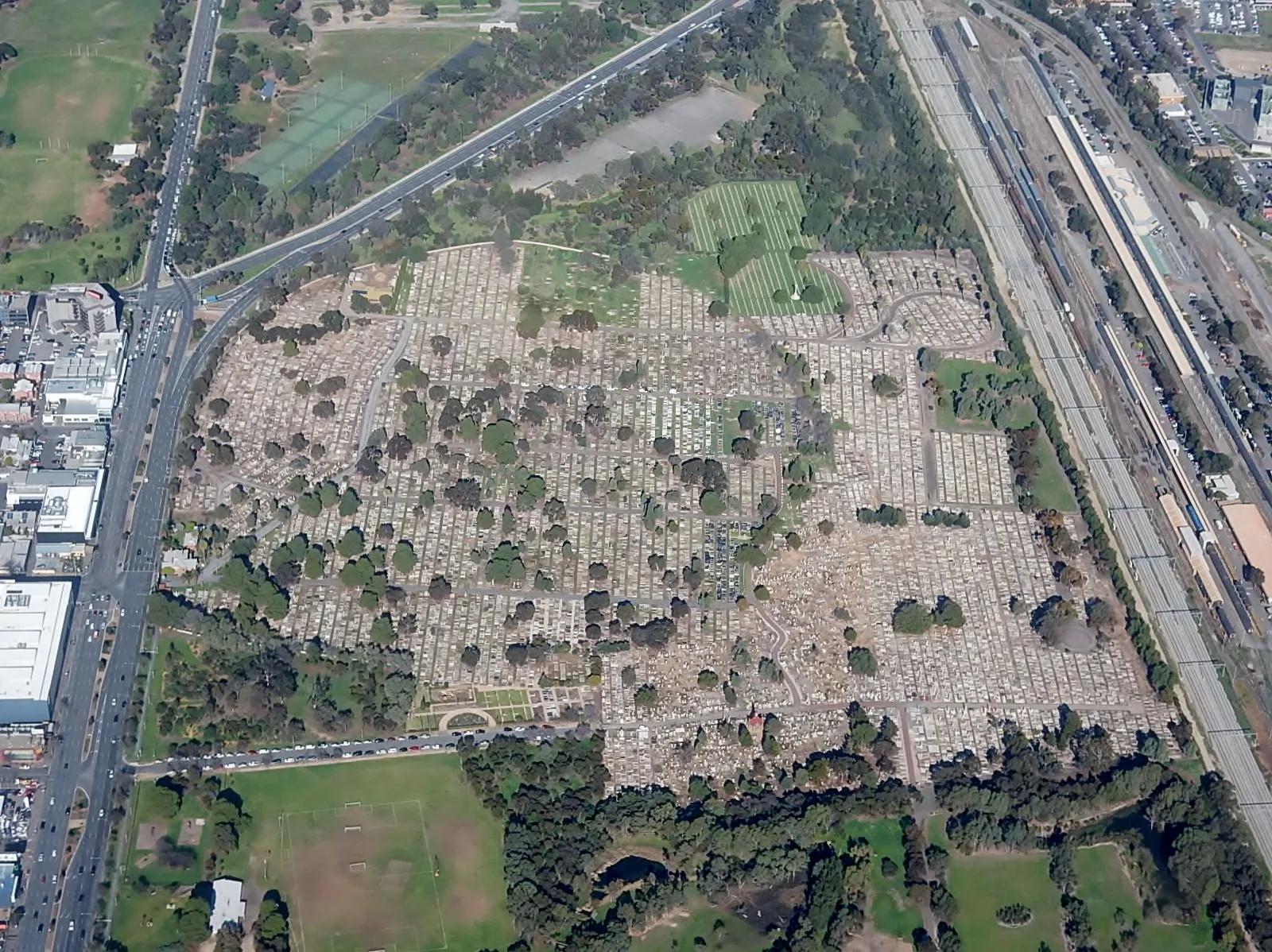
West Terrace Cemetery, Adelaide, photographed from the air on 26 June 2015 by mikecogh. The unidentified man was buried here. His remains were exhumed in May 2021. The photograph does not mark the grave. Wikimedia Commons and Flickr. CC BY-SA 2.0. Resized to 1600 pixels wide and converted to WebP.
What is still open, even if the name is right?
The cause of death, the place of death, whether anyone else was involved, and what the letters say.
A confirmed identity would retire one question the coroner could not answer. It would not choose between Cowan and Hicks. It would not decide whether the man against the wall at 7 p.m. was the man Moss found in the morning. It would not decode the capitals, and it would not turn Jestyn’s interview, which is outside the inquest file, into a motive. Abbott’s own 2026 comment was that those gaps were likely to stay.
That is a familiar shape on this site, and it is worth keeping the shapes distinct. D. B. Cooper is a proved crime with no identified person. The Somerton file is a death, possibly a crime, with a published research identification and no coronial confirmation. The Mary Celeste has a documented scene and no agreed reason the crew left. Somerton has a documented scene and no agreed cause of death. Dyatlov Pass shows the other half of the problem: later scientific work can be serious and still not be the same thing as the original official finding. Abbott’s genealogy is in that second category until a coroner says otherwise. The Beale ciphers show the opposite problem: an unread code whose surrounding story has no independent record. For another unidentified person whose belongings were stripped of labels and whose travel log was written in code, see the Isdal Woman. Kaspar Hauser shows a further limit: genetics ruled out the favourite identity in 2024 without supplying a new one. The Dr Crippen case shows the limit in reverse: a 2011 DNA result on a trial exhibit challenged the identification of a victim, yet no court has reopened the 1910 conviction.
What is documented, and what is not?
| Question | What the record supports | What it does not establish |
|---|---|---|
| When and where was he found? | On the shore at Somerton, morning of 1 December 1948, against the sea wall by the steps at the Crippled Children’s Home. Lyons about 6.35 a.m., Moss about 6.45, the coroner’s summary about 7. The News said 6.30, and said he had not been in the water | The minute of death. Bennett estimated not before about 2 a.m., from rigor, and had not graded the rigor in his notes |
| Who saw him alive? | Lyons, Strapps and Neill saw a man lying there on the evening of 30 November. Lyons saw an arm rise and fall. Neill wondered if he was dead | That the evening man was the morning body. None of them saw the face. The coroner said there was no proof |
| What killed him? | Dwyer: heart failure with no found cause, and an unnatural death. Hicks: not a natural death, and a group of hard-to-detect drugs that stop the heart contracted, consistent with the organs. Cowan: no common poison, and a natural death more likely | A named poison. The coroner said he would be prepared to find a glucoside, not given by accident, and then adjourned because the evidence would not support a finding |
| Suicide or murder? | Leane: nothing he knew pointed to suicide and ruled murder out. Cleland the pathologist, in the archives’ quotation, read the slip as suicide. The coroner left both open | A verdict. The inquest was adjourned sine die |
| What is Tamam Shud? | The coroner: the last words of the second edition of FitzGerald’s Rubaiyat, meaning “The End.” Brown, via a dictionary, in the archives’ account: “to end or to finish.” Cleland found the scrap in a fob pocket after Moss had searched the clothes | That every FitzGerald edition ends with both words. In the Project Gutenberg comparison text, the first-edition sequence ends “Tamám Shud” and the second ends “Tamám” |
| Where did the book come from? | State Records: handed to police on 22 July 1949 by a man who said he found it in the back of his car on 30 November 1948, with a code and a telephone number later tied to a woman nicknamed Jestyn. The News of 23 July separately reported a Glenelg bus conductor and a book at the tramways lost-property office | That those two reports are the same book, the same finder, or the same hour. The interviews are not in the inquest file |
| Was the suitcase his? | Unclaimed cloak-room case, ticket issued 30 November 1948 between 11 a.m. and noon. Similar clothes, removed tags, and a matching sepia thread on repairs. Sand in the trouser turn-ups | A name. “T. Keane,” “Keane” and “Kean” were marks. Detectives said in January 1949 that T. Keane was not being treated as his name |
| Who is Carl Webb? | Abbott and Fitzpatrick, 26 July 2022: DNA from hair in the plaster cast, genealogy through databases including Ancestry.com, triangulation on Carl Webb, born Footscray 16 November 1905. Police in July 2022: cautiously optimistic, and the coroner would have to confirm it. Police in July 2026: the investigation was still ongoing | A coronial finding. The hair work is not the DNA from the body exhumed in May 2021, which had not been publicly reported as a confirmation |
| What do the letters say? | A police photograph shows several lines of capitals, one of them crossed out. They were not before the June 1949 inquest | A decipherment. Short strings support many readings. None has been shown to be the one the writer intended |
Frequently asked questions
Has the Somerton Man been officially identified?
Researchers at the University of Adelaide and Identifinders announced on 26 July 2022 that he was Carl “Charles” Webb. South Australia Police said that week that any identification would be determined by the coroner. On 6 July 2026 police told the ABC the coronial investigation was still ongoing and that a report would go to the coroner when it was finished. No published coroner’s finding adopting the name was located for this article.
Did the 1949 coroner rule that he was poisoned?
He said he was compelled to think so, named the question “But what poison?”, and then adjourned without a finding. He wrote that he would be prepared to find a glucoside, not taken by accident, and that he could not say whether the man or another person gave it. The analyst, Cowan, had told him a natural death was more likely, because no common poison was found.
What does Tamam Shud mean?
In the coroner’s adjournment remarks, the words are the end of FitzGerald’s Rubaiyat and mean “The End.” State Records says a dictionary consulted for Detective Brown gave “to end or to finish,” and that the inquest file often spells the phrase “Taman.” The pathologist read the slip as evidence of suicide. The detective in charge of the investigation said it could have been put in the pocket by someone else.
Was he a Russian spy?
That is a later story. The 1949 inquest did not establish any intelligence service, and it did not establish a name. The 2022 research claim is that he was a Melbourne engineer and instrument maker. A spy theory would need evidence of its own. The removed clothing tags and the unread letters do not supply it.
Can the letters in the book be read?
The police photograph shows handwritten capitals, with one line crossed out. They were not part of the June 1949 evidence, because the book arrived in July. No reading of them has the status of a solved cipher. Several characters in the fainter lines can be taken more than one way.
Did the Keane labels identify him?
Not in 1949. Police said then that they did not think T. Keane was his name. Abbott has offered two family explanations since 2022: a brother-in-law, Thomas Keane, and, later, a nephew, John Keane, killed in the war. Those are the researcher’s accounts of the family. They were not testimony at the inquest.
Where are the remains?
He was buried at West Terrace Cemetery. ABC reporting places the exhumation in May 2021 and says the grave is now empty. In July 2026 neither police nor Forensic Science SA would tell the ABC where the remains were. Abbott said he understood they were still at the Forensic Science Centre in Adelaide. After a coroner’s finding, the family would be able to decide on a burial.
Sources & further reading
- City Coroner Thomas Erskine Cleland, inquest into the death of a body located at Somerton on 1 December 1948: remarks and depositions, June 1949. OCR of the inquest papers hosted by the University of Adelaide
- State Records of South Australia: 'But what poison?' Mystery of the Somerton Man, on coroner's inquest file 71/1949 in GRG 1/27
- News (Adelaide), 3 December 1948: 'Mystery of body on beach'
- The Advertiser (Adelaide), 19 January 1949: 'Somerton Body May Be That Of Station Hand'
- Melbourne newspaper report, 25 January 1949: 'Mystery of dead man on beach: Was he a Victorian?', via Trove
- Newspaper report, 11 February 1949, on the unclaimed suitcase, the names Keane and Kean, and the stencil tools, via Trove
- News (Adelaide), 23 July 1949: 'Possible Clue In Somerton Body Case'
- Edward FitzGerald, Rubaiyat of Omar Khayyam, comparison of the first, second and fifth editions, with Edmund Dulac's illustrations. Project Gutenberg eBook 35260. Public domain
- Identifinders International and the University of Adelaide, press announcement, 26 July 2022: 'The Somerton Man Identified'
- ABC News, 26 July 2022: Derek Abbott's announcement that the Somerton Man was Carl Webb
- ABC News, 30 July 2022: the ruled-out family theory, The Age notice of 5 October 1951, the May 2021 exhumation, and the South Australia Police statement
- ABC News, 6 July 2026: South Australia Police say the coronial investigation is still ongoing
- University of Adelaide, University Senior College, 17 August 2023: note of Derek Abbott's talk identifying Carl Webb
- Courts Administration Authority of South Australia: coroners' findings, the public index of published findings
- Wikimedia Commons: police photograph of the Somerton beach steps, December 1948 (public domain)
- Wikimedia Commons: police photograph of the pencilled letters associated with the Rubaiyat (public domain)
- Wikimedia Commons: aerial photograph of West Terrace Cemetery, Adelaide, 26 June 2015, by mikecogh. CC BY-SA 2.0