The Index / Dark History
The Centralia Mine Fire: Why a Pennsylvania Town Has Burned Since 1962, and Its Real Link to Silent Hill
How a 1962 dump fire reached the coal under Centralia, Pennsylvania, why it was never put out, how the town was emptied, and what Silent Hill really took from it.
Topics: Centralia, Pennsylvania, Mine Fires, 1962, Ghost Towns, Silent Hill, Environmental History
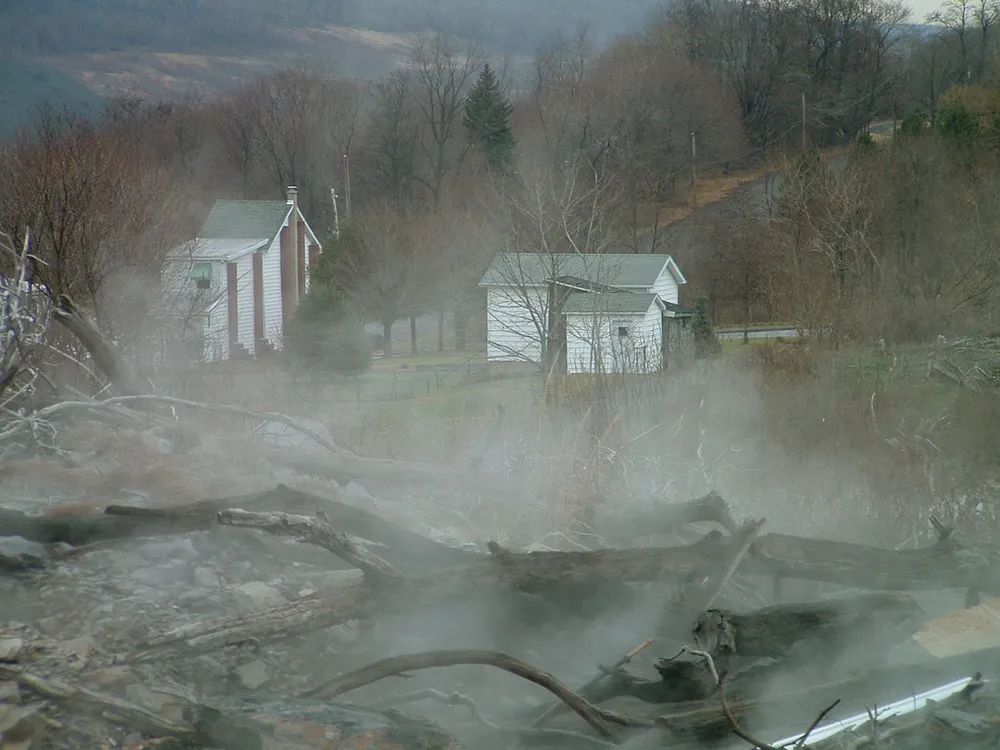
Scott Drzyzga, December 2006, via Wikimedia Commons, CC BY 2.0; resized and converted to WebP.
Since May 1962 a fire has been burning in the abandoned coal mines beneath Centralia, a borough in Columbia County, Pennsylvania. It began at the town dump, in an old strip-mine pit beside a cemetery, and spread through an unsealed opening into coal workings underneath. Years of excavation, trenching and flushing failed to stop it. Toxic gases and collapsing ground eventually led the federal and state governments to buy out and demolish almost the entire town. About 1,100 to 1,200 people lived there in 1962; by 2013 the Pennsylvania Department of Environmental Protection (DEP) counted five remaining property owners.
Centralia is also known as “the real Silent Hill”. That claim is half right. The 2006 film adaptation did use Centralia as its real-world model, according to its director. The art director of the original 1999 game has said repeatedly that the game’s town was not based on it.
This guide relies mainly on the DEP’s own published answers about the fire, its 1996 chronology, a university archive that holds the papers of a journalist who covered the fire, and contemporary news reports. Where those sources disagree on dates and numbers, we say so.
The short version
| Date | Event | Status |
|---|---|---|
| 1842 | Coal first mined in the Centralia area | Documented (DEP) |
| May 27, 1962 | Fire first reported in a dump pit near the Odd Fellows Cemetery | Documented (DEP); exact ignition disputed |
| August 1962 | Mines in the area closed because of fire gases | Documented (Bucknell archive; DEP gives 23 mines as a reported figure) |
| 1962 to 1978 | About $3.3 million spent on control projects, with limited results | Documented (DEP 1996 chronology) |
| February 14, 1981 | Todd Domboski, 12, sinks into a hole that opens in his grandmother’s yard | Documented; national attention follows |
| 1983 | Federal study puts the cost of extinguishing the fire at about $663 million | Documented (DEP 1996 chronology) |
| Late 1983 or 1984 | Congress provides $42 million for voluntary relocation | Documented; DEP sources differ on the year |
| January 1992 | Condemnation of remaining properties begins | Documented (DEP 1996 chronology) |
| 1993 | PennDOT closes a damaged stretch of Route 61 | Documented (DEP); some accounts say early 1994 |
| September 2003 | Centralia’s ZIP code stops being active | Documented (DEP); often misdated to 2002 |
| October 2013 | Remaining residents settle with the state and may stay for life | Documented (AP) |
| April 2020 | The abandoned “Graffiti Highway” is buried under dirt by its private owner | Documented (local press) |
A coal town built over its own mines
Centralia sat in the anthracite region of eastern Pennsylvania. According to the DEP, a settlement called Bull’s Head existed on the site by 1811, coal was first mined there in 1842 and the Centralia Colliery opened in 1862. The borough’s incorporation date is given as 1862 in the DEP’s FAQ and as February 1866 on the DEP’s own resources page and in Bucknell University’s archive description; the later date is the more widely cited.
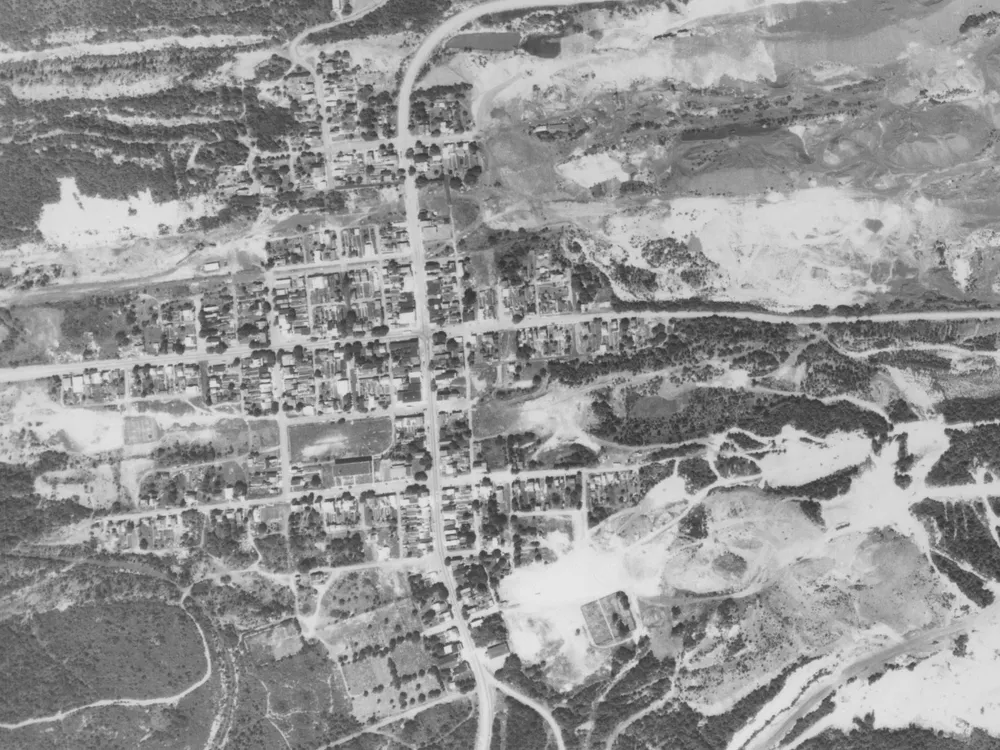
Centralia from the air on August 12, 1971, nine years into the fire and before the buyout. The pale scars around the town are areas of surface mining. US Department of Agriculture photograph via the Penn Pilot archive and Wikimedia Commons, public domain; cropped by a Commons contributor, resized and converted to WebP.
By 1962 most large-scale mining had ended. The DEP estimates that roughly 25 million tons of coal had been in place before mining began and that 50 to 70 percent of it had been removed from each mined bed. What remained was a maze of tunnels, rooms and coal pillars left to hold up the ground, connected through many beds and passageways. That network, and the oxygen it could carry, is what turned a local fire into a permanent one.
How the fire started
The DEP records that the fire was first reported on May 27, 1962, just before Memorial Day, in a surface mine pit just southeast of the borough near the Independent Order of Odd Fellows Cemetery. The pit, excavated around 1935 and left open, was about 75 feet wide and 50 feet deep, and the borough was using it as a dump.
The cause is where the record becomes less certain, and the DEP says so. Its FAQ calls the most widely accepted scenario a fire “intentionally set by Borough personnel”, probably to reduce the volume of rubbish, pests and smell before visitors arrived at the cemetery for the holiday. The DEP believes a missing barrier of non-combustible material allowed the fire to reach carbonaceous waste and then the coal workings below.
Other explanations exist. The DEP lists a 1930s mine explosion, spontaneous combustion of the rubbish and vandalism. The finding aid for the papers of David DeKok, the reporter whose book Unseen Danger is a detailed history of the fire, also mentions illegal dumping of hot furnace ash and a local legend of a curse, and notes that DeKok himself attributed the start to an accidental fire during a May 1962 dump clean-up. These positions overlap more than they first appear to: a deliberate rubbish burn could still have reached the coal by accident. What is not established is who lit what, and when.
The curse belongs in the folklore column. No source we reviewed offers it as anything more than a story people told about the fire.
Why nobody could put it out
The first attempts were simple. According to the DEP, crews tried dousing the fire with water and smothering it with a clay blanket. Later projects included digging out burning material, cutting isolation trenches, and flushing the mine workings with sand, fly ash or crushed rock pumped down boreholes. More than 2,000 boreholes have been drilled in the fire area since 1966. The DEP’s 1996 chronology puts spending between 1962 and 1978 at about $3.3 million, “with limited results”.
The Bucknell archive describes a pattern in the early years: the state repeatedly began work, ran out of money and stopped. In August 1962 deadly gases forced the closure of the remaining mines in the area.
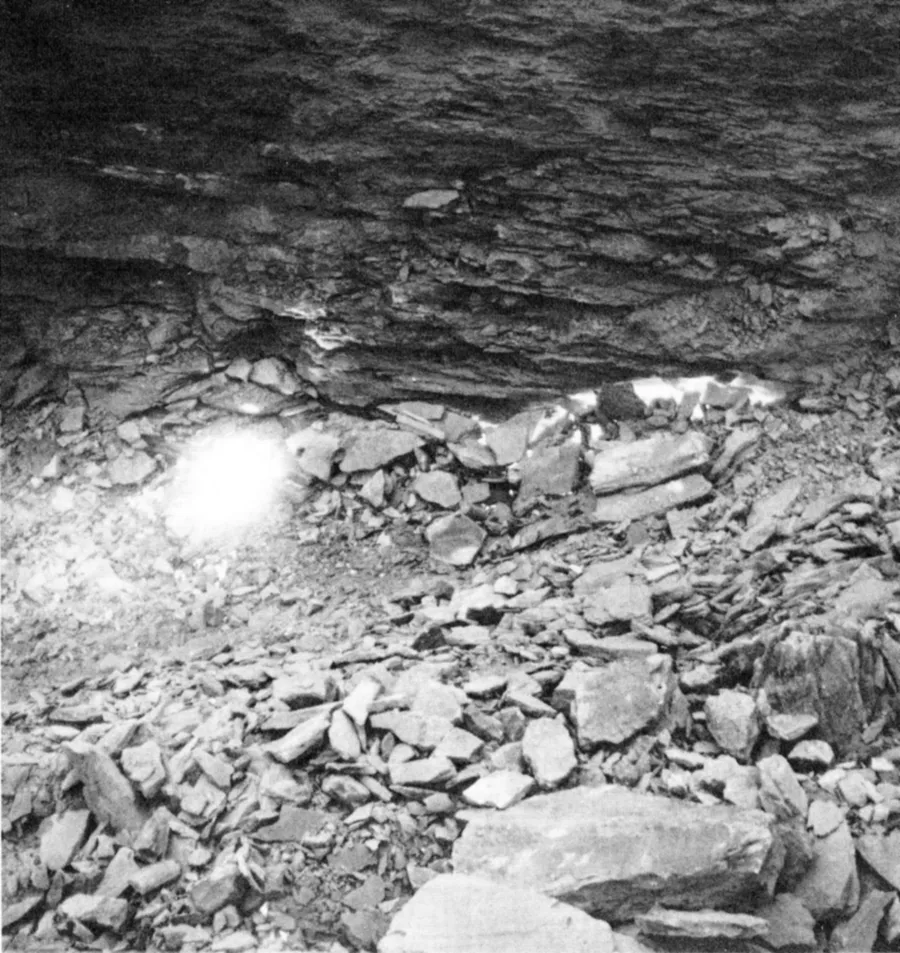
Part of the fire exposed during an excavation in 1969. US Bureau of Mines photograph, as reproduced in David DeKok’s Unseen Danger and uploaded to Wikimedia Commons as a public-domain federal work; retouched for contrast by a Commons contributor, resized and converted to WebP.
The DEP’s FAQ explains why the obvious solutions fail. Flooding is impractical: sealing the mine drainage tunnel would raise the water by about 230 feet, not enough to cover the upper half of the burning zone, and holding back more water risks a catastrophic blow-out through weakened coal barriers. Smothering would require an airtight seal around a huge area for decades, and a coal fire can smoulder with as little as 1 to 2 percent oxygen. Full excavation is possible in principle, but a 1983 federal study estimated the cost at about $663 million, and the DEP says a project of that size remains beyond the capacity of Pennsylvania’s abandoned mine programme.
Borehole readings from the 1970s and 1980s frequently exceeded 1,000 degrees Fahrenheit, with a highest recorded value of about 1,350 degrees; ground surface temperatures of more than 900 degrees were measured where the fire was close to the surface. The fire does not move steadily. The DEP describes bursts of advance followed by months of no movement, averaging roughly 50 to 75 feet a year along different fronts.
1981: the hole in the back yard
For almost two decades Centralia was a regional problem. That changed on February 14, 1981, when 12-year-old Todd Domboski sank into an opening that appeared under him in his grandmother’s yard as he went to look at smoke rising from the ground. The Bucknell archive calls it the critical turning point, the moment the fire drew national and international attention. Accounts based on DeKok’s history say his cousin pulled him out. Figures for the depth of the hole vary widely between retellings, and we have not found a measured value in an official source.
The government had already begun moving people. The DEP records that the federal Office of Surface Mining relocated seven families in 1980 and bought 27 more residences in 1981. Gas was the main concern: carbon monoxide, carbon dioxide, sulphur dioxide, hydrogen sulphide and methane were all detected in boreholes, surface vents and homes, and the routes by which gas could travel through fractures into basements could not be predicted.
The buyout that emptied a town
In 1983 the federal study put the cost of extinguishing the fire at about $663 million. Residents were instead offered relocation. The Bucknell archive records that most voted to relocate in August 1983; the Pennsylvania Highways history gives the count as 345 to 200.
Congress then provided $42 million. The DEP’s FAQ dates the appropriation to December 1983, with the relocation beginning in 1984; its 1996 chronology lists the appropriation itself under 1984. Either way, according to the 1996 chronology, 545 homes and businesses were acquired between 1985 and 1991. The Associated Press later summarised the result: by the end of the 1980s more than 1,000 people had moved and 500 structures had been demolished. The DEP’s FAQ says the state paid an average of roughly $52,000 per household, and that relocation spending after 1983 reached about $41.6 million by 2012. Residents of the nearby villages of Byrnesville and Germantown were moved as well.
Not everyone accepted. In January 1992 a state task force began condemnation proceedings against the remaining 53 properties, and Governor Robert P. Casey invoked eminent domain. Property owners and the borough fought it in court and lost: according to the 1996 chronology, the county court rejected the owners’ objections in 1994 and the state Supreme Court ruled against them in September 1995. Many holdouts nevertheless stayed in their homes for years.
The residents who stayed
The end of the legal fight came in October 2013. The AP reported that eight residents had settled their federal lawsuit against state officials. They could stay in their homes for as long as they lived, and would receive $349,500 in total: $218,000 for the value of their homes and $131,500 to settle other claims. After their deaths the properties pass to the state.
The numbers in different sources do not match, and the reason is mostly definitions. The AP counted eight residents; the Bucknell archive says seven; the DEP counted five remaining property owners as of January 2013. A property owner and a resident are not the same unit, and households changed over time. None of these sources supports the common claim that Centralia is completely empty.
The ZIP code is a smaller example of the same drift. Popular accounts say the Postal Service revoked it in 2002. The DEP’s FAQ states that it ceased to be active after September 18, 2003, with mail handled through Ashland.
Route 61 and the Graffiti Highway
The fire also broke a state highway. According to the DEP, the fire consumed or weakened the coal pillars beneath Route 61, causing subsidence; after repeated repairs, PennDOT closed about 4,000 feet of the damaged road in 1993 and diverted traffic onto a smaller local road. (The Pennsylvania Highways history dates the closure to early 1994.)
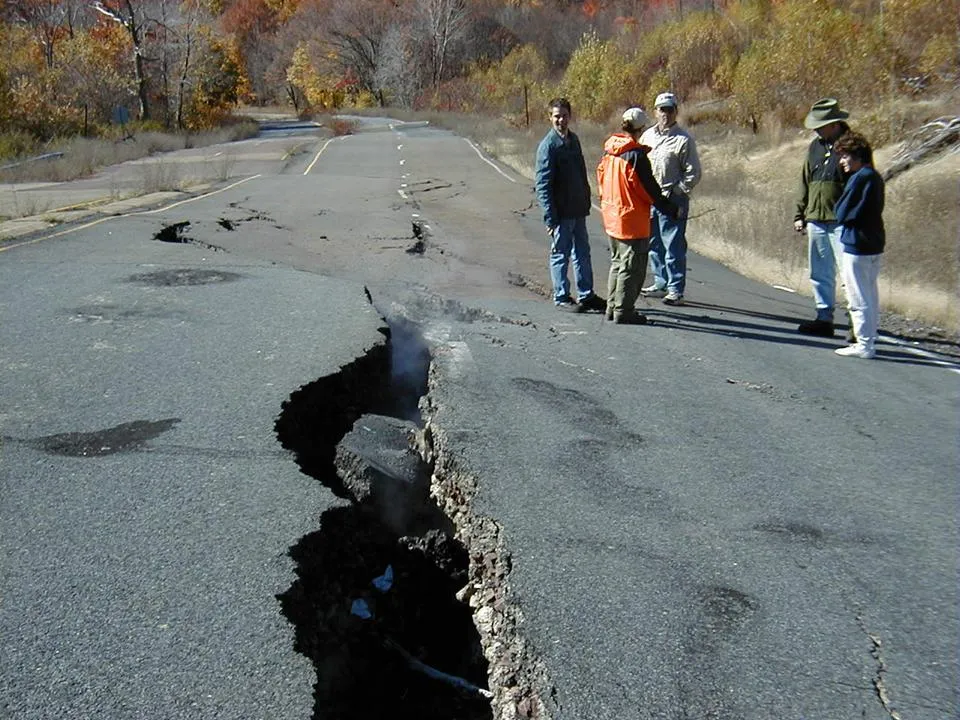
The closed section of Route 61 near Centralia in autumn 2000, photographed during a Kent State University geology field trip. Photograph by James St. John via Wikimedia Commons, CC BY 2.0; resized and converted to WebP.
The abandoned stretch became known as the Graffiti Highway, covered in paint by visitors. It drew large crowds, and on April 6, 2020, during the early months of the coronavirus pandemic, the landowner, Pagnotti Enterprises, closed the site, Skook News reported. Fox Mining crews began trucking in dirt to bury the road that morning, with state police keeping people away, and the owner planned to plant trees and grass on top. Local residents quoted in that report were divided between relief and regret.
Centralia today
The fire has spread beyond the borough. By January 2012, the DEP said, it involved about 400 surface acres, though not all of that area is burning at once. Left uncontrolled, the DEP estimates, it could burn for more than 100 years. According to the AP, a DEP geologist said in 2012 that the fire may have gone deeper but still posed a threat.
Two DEP findings cut against the more dramatic retellings. Air quality studies completed in 2008 found that outside air in the borough met clean air standards, and the DEP says the fire is not burning beneath the cemeteries, which lie mostly on barren ground or were isolated by excavation. At the same time the DEP strongly discourages visits: the ground can collapse without warning, and burnt-out areas can still vent toxic gas.
Centralia is not unique. The DEP lists about 38 actively burning coal mine fires in Pennsylvania and 241 in the federal abandoned mine inventory, some of them older or larger than Centralia’s. What made Centralia famous was a fire under a town, rather than under woodland, and the decision to move the town rather than the fire. For another case where ordinary coal burning turned into a public-health disaster, see London’s Great Smog of 1952.
Is Centralia the real Silent Hill?
For the 2006 film, yes, by the director’s own account. For the original game, no, according to its art director.
In answers on the film’s official production blog in March and April 2006, Christophe Gans wrote that screenwriter Roger Avary “discovered this town that had been destroyed by a coal fire”. Gans said “Centralia” was used as a working title, chiefly to keep the shoot secret, and that the town became the basis for the film’s real-world setting. He also explained that the story was moved from Pennsylvania to West Virginia for legal reasons.
The 1999 game is another matter. Masahiro Ito, art director on the first three Silent Hill games, has publicly rejected the idea that the original game’s town was inspired by Centralia, and said in 2019 that no real town inspired its design. As reported by Time Extension in 2022, he also pointed out that the white flakes falling in the first game are snow, unlike the coal ash of the film. The Centralia connection appears to have travelled from the film’s publicity backwards onto the whole franchise.
So the honest version is narrower than the meme: one adaptation borrowed a real disaster as texture for a fictional town. The series continues to invent its own places, as with the island setting of Silent Hill: Townfall.
Documented, claimed and disputed
| Claim | Status |
|---|---|
| An underground coal fire has burned beneath Centralia since 1962 | Documented (DEP) |
| It started in the borough dump in a strip-mine pit | Documented as the location; the DEP calls it the most commonly reported origin |
| Borough workers deliberately set the rubbish fire | The DEP’s “most widely accepted” scenario; not proven, and other causes have been proposed |
| A 1930s fire or explosion was never extinguished and caused it | Alternative theory listed by the DEP; not established |
| The town is cursed | Folklore; no evidence |
| The fire could be put out | Technically possible, according to the DEP, but estimated in 1983 at about $663 million and still unfunded |
| The town is completely abandoned | False as of the 2013 settlement; a handful of residents had the right to stay for life |
| Centralia’s ZIP code was revoked in 2002 | Misdated; the DEP gives September 2003 |
| The fire is burning under the cemeteries | Rejected by the DEP |
| Billions of dollars of coal remain beneath the town | The DEP calls press figures of 42 or 84 million tons “very unlikely” |
| Centralia inspired the 2006 Silent Hill film | Documented by the director |
| Centralia inspired the 1999 Silent Hill game | Rejected by the game’s art director |
Why Centralia still matters
It is easy to tell Centralia as a ghost story, with smoke rising from empty streets and a fire that will not die. The record supports a more ordinary and more troubling account. A small municipal decision about rubbish met a landscape already hollowed out by a century of mining. Then came twenty years of underfunded, interrupted firefighting, a near-fatal accident that finally made the danger visible, and a buyout that solved the safety problem by ending the town.
The people who lived there tend to disappear from the legend. Most of them did not abandon Centralia; they were relocated from it, by a vote, an appropriation and, for those who refused, a condemnation order. For another Appalachian community whose real disaster became tangled with later horror folklore, see the Mothman and the Silver Bridge collapse. For a “vanished village” story that turned out to have no documented basis at all, compare Lake Anjikuni. And for another Pennsylvania site where a haunted reputation sits on top of a well-documented history, see Eastern State Penitentiary.
Frequently asked questions
Is the Centralia mine fire still burning?
Yes, according to the Pennsylvania DEP, which still monitors it. The fire has spread beyond the borough to an area of about 400 surface acres, though not all of it burns at once. The DEP says it could burn for more than 100 years if left uncontrolled.
How did the Centralia fire start?
It was first reported on May 27, 1962, in the town dump, an old strip-mine pit near the Odd Fellows Cemetery. The DEP’s most widely accepted explanation is that borough workers set a rubbish fire before Memorial Day, which then reached the coal workings through an unsealed opening. Other causes have been proposed, and the exact ignition is not proven.
Does anyone still live in Centralia?
A few people did as of the most recent official counts. Under an October 2013 settlement, the remaining residents, reported by the AP as eight people, were allowed to stay in their homes for life. The DEP counted five remaining property owners in January 2013.
Why was the fire never put out?
Every method tried between 1962 and the 1980s, including trenches, excavation and flushing the mines with fill, failed or was abandoned when funding ran out. Flooding the mines is considered impractical and dangerous. A 1983 federal study estimated the cost of extinguishing the fire at about $663 million, and the DEP says that remains beyond the state’s abandoned mine budget.
Is it safe to visit Centralia?
The DEP does not recommend it. It warns that the ground can collapse suddenly and that toxic gases can vent from cracks, even in burnt-out areas. A 2008 study found that ordinary outdoor air in the borough met clean air standards, but that does not make the ground safe.
Was Silent Hill based on Centralia?
The 2006 film was. Director Christophe Gans wrote that screenwriter Roger Avary found Centralia and that it became the basis for the film’s real-world setting. The original 1999 game was not, according to its art director, Masahiro Ito.
What was the Graffiti Highway?
An abandoned section of Pennsylvania Route 61 near Centralia, closed after the fire damaged it in the 1990s and later covered in visitors’ graffiti. Its private owner had it buried under dirt in April 2020.
Sources & further reading
- Pennsylvania Department of Environmental Protection, Bureau of Abandoned Mine Reclamation, 'The Centralia Mine Fire: Frequently Asked Questions/Answers' (PDF, information current to 2012-2013; accessed November 4, 2026)
- Pennsylvania Department of Environmental Protection, 'Centralia Mine Fire Resources' (accessed November 4, 2026)
- Pennsylvania DEP, 'A Brief History of the Centralia Mine Fire' (February 1996), web transcription via Offroaders.com; not checked against the original print document (accessed November 4, 2026)
- Bucknell University Special Collections/University Archives, 'David DeKok Collection' (MS 30), finding aid and historical note (accessed November 4, 2026)
- Michael Rubinkam, Associated Press, 'Pa. residents living above mine fire free to stay', via KSL.com (October 31, 2013; accessed November 4, 2026)
- Skook News, 'Graffiti Highway to be covered with dirt' (April 6, 2020; accessed November 4, 2026)
- Pennsylvania Highways, 'Centralia' feature, used for the 1983 vote count and the 1981 rescue detail, which it attributes mainly to David DeKok's Unseen Danger (accessed November 4, 2026)
- Christophe Gans, answers from the official Silent Hill film production blog (March 15 and April 3, 2006), as archived by the fan site Silent Hill Memories (accessed November 4, 2026)
- Time Extension, 'Silent Hill art director tired of correcting fans over Centralia myth', on Masahiro Ito's statements (July 22, 2022; accessed November 4, 2026)