The Index / Dark History
The Lindbergh Kidnapping: What the Evidence Against Hauptmann Showed, and What Is Still Disputed
What happened to Charles Lindbergh Jr. in 1932, how ransom gold certificates led to Bruno Hauptmann, what the trial proved, and the DNA fight still unresolved.
Topics: Lindbergh Kidnapping, Bruno Richard Hauptmann, New Jersey, 1932, FBI, Trials, True Crime
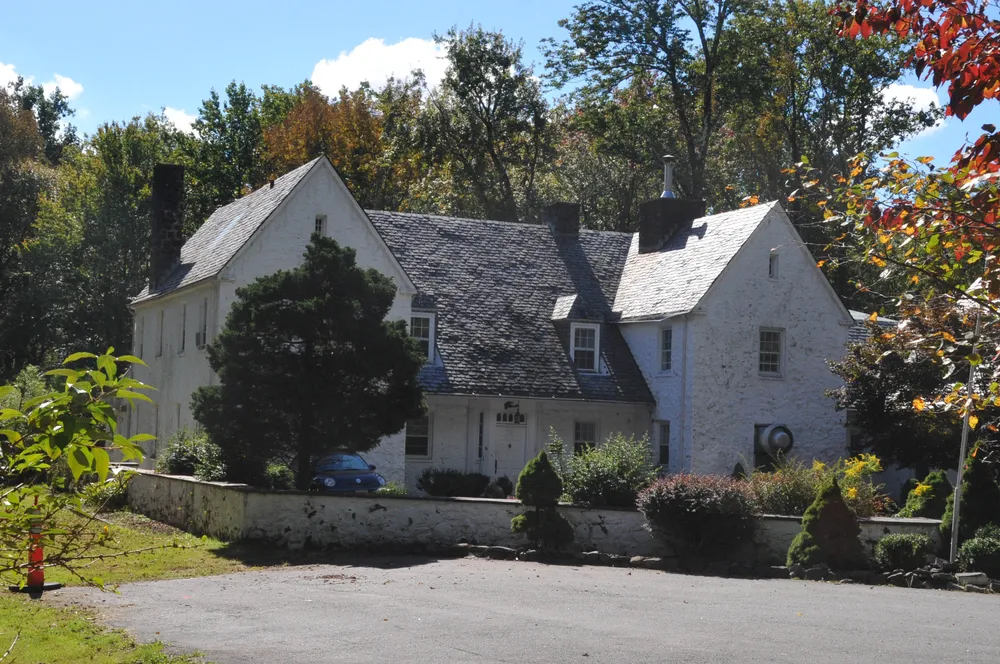
Jerrye & Roy Klotz, MD, via Wikimedia Commons, CC BY-SA 3.0; resized and converted to WebP.
On the evening of March 1, 1932, Charles Augustus Lindbergh Jr., the 20-month-old son of the aviator Charles Lindbergh and the writer Anne Morrow Lindbergh, was taken from his second-floor nursery in the family’s new house in rural New Jersey. A ransom of $50,000 was paid a month later, but the child was never returned. His body was found on May 12, 1932, a few miles from the house. In September 1934 investigators traced marked ransom money to Bruno Richard Hauptmann, a German-born carpenter living in the Bronx. He was convicted of murder in February 1935 and executed on April 3, 1936, still saying he was innocent.
The conviction is a documented legal fact, and the evidence linking Hauptmann to the ransom money is strong. What has been argued about for ninety years is how much more the evidence proves: whether Hauptmann was at the house that night, whether he acted alone, and whether the investigation and trial were fair. A lawsuit filed in 2025 to allow DNA testing of the ransom envelopes is the latest round of that argument.
This guide follows the record in order and marks, at each step, what is documented, what was claimed, and what remains disputed. It relies mainly on the FBI’s own case history and the 1935 appeal decision of New Jersey’s highest court, with later critics and current litigation attributed to the people who made those claims.
The short version
| Date | Event | Status |
|---|---|---|
| March 1, 1932, about 9 p.m. | Charles Jr. taken from the nursery; a ransom note left on the window sill | Documented (FBI; 1935 appeal decision) |
| March 1932 | Further notes received; John F. Condon of the Bronx becomes go-between (“Jafsie”) | Documented |
| April 2, 1932 | Condon pays $50,000 to a man calling himself “John” in the Bronx | Documented; the identity of “John” was the core trial question |
| May 12, 1932 | The child’s body is found near Mount Rose, New Jersey | Documented |
| June 22, 1932 | President Hoover signs the Federal Kidnapping Act | Documented |
| May 1, 1933 | $2,980 in ransom gold certificates deposited at the Federal Reserve Bank of New York under the name “J.J. Faulkner” | Documented; depositor never found |
| September 15, 1934 | A Manhattan gas station attendant writes a licence number on a $10 gold certificate | Documented |
| September 19, 1934 | Hauptmann arrested in the Bronx | Documented |
| January 2 to February 13, 1935 | Trial in Flemington, New Jersey; guilty of first-degree murder | Documented (sources differ on January 2 or 3 as the start) |
| October 9, 1935 | Conviction upheld by the Court of Errors and Appeals | Documented |
| April 3, 1936 | Hauptmann executed | Documented |
| April 2025 | Three plaintiffs sue the New Jersey State Police to permit DNA testing of the ransom envelopes | Reported; no published ruling found as of November 4, 2026 |
The night of March 1, 1932
The Lindberghs had built a house on a large estate in the countryside near Hopewell, New Jersey, partly to escape the press attention that followed Charles Lindbergh’s solo transatlantic flight in 1927. The address is usually given as Hopewell, but the 1935 appeal decision places the house in East Amwell, in Hunterdon County. That detail mattered legally: it is why the murder trial was held in the Hunterdon county seat of Flemington, and the defence argued on appeal that the indictment should not have been brought there.
According to the FBI’s account, the child was discovered missing at about 10 p.m. by his nurse, Betty Gow, and the kidnapping was placed at about 9 p.m. The appeal decision states that he had been put to bed at around eight. A note demanding $50,000 was found on the nursery window sill. Investigators found traces of mud on the nursery floor and footprints under the window that could not be measured. A homemade ladder in sections had been used to reach the window, and one section had split where it joined another, which suggested it broke during the climb or the descent. The FBI history records that there were no fingerprints in the nursery and no bloodstains.
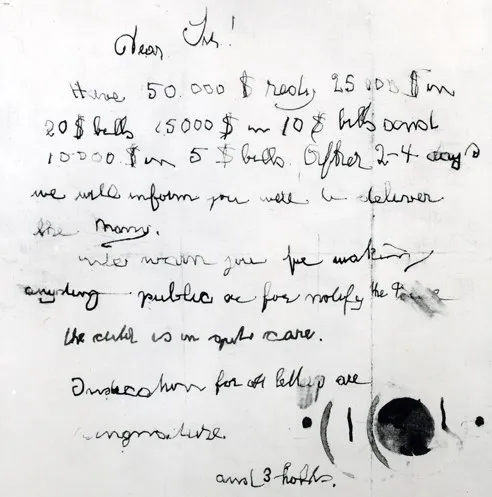
The note found on the nursery window sill. The interlocking circles at lower right were the “singnature” that later notes used to prove they came from the same writer. Image distributed by the FBI, via Wikimedia Commons, public domain; converted to WebP.
The New Jersey State Police took charge, under its superintendent, Colonel H. Norman Schwarzkopf. The FBI, then the Bureau of Investigation, offered help on March 2, but its role was initially auxiliary because kidnapping within a state was not a federal crime. That changed in stages. In May 1932 President Hoover made the Bureau the clearinghouse for federal work on the case, and on June 22 he signed the Federal Kidnapping Act, often called the Lindbergh Law, which made it a federal crime to carry a kidnapping victim across state lines.
The ransom notes and “John”
The FBI history counts thirteen ransom notes in all. The second, postmarked in Brooklyn, raised the demand to $70,000. On March 8, John F. Condon, a retired Bronx school principal, offered in the Bronx Home News to act as intermediary and to add $1,000 of his own. A note accepting him arrived the next day, and Lindbergh approved. Condon then communicated through newspaper advertisements under the name “Jafsie”.
On March 12, following instructions left under a stone, Condon met a man who called himself “John” at Woodlawn Cemetery in the Bronx. They talked about payment, and “John” promised proof that he had the child. On March 16 Condon received a child’s sleeping suit, which the parents identified. More notes followed, one claiming the kidnapping had been planned for a year.
On the night of April 2, 1932, Condon met “John” again, talked the demand down from $70,000 to $50,000, and handed over the money. In return he received a note saying the child could be found on a boat called the Nellie near Martha’s Vineyard. Searches found no such boat and no child. The ransom had been paid in bills whose serial numbers were recorded, and according to the FBI, $40,000 of it was in gold certificates. That choice would decide the case two and a half years later.
The discovery of the body
On May 12, 1932, William Allen, a truck driver’s assistant, found the child’s body partly buried in woods near Mount Rose, about four and a half miles from the house. The FBI history says the coroner found that he had been dead for about two months and that the cause of death was a blow to the head. The appeal decision records the state’s claim, which it found supported by evidence, that the autopsy showed fractures of the skull and that death was instantaneous. The date and manner of death were never directly established beyond that, and this gap is central to later arguments about whether the child died during the abduction itself.
False leads, a hoax and a death in the household
The investigation produced an enormous volume of tips, most of them useless and some fraudulent. Two episodes from that period are well documented and are often distorted in retellings.
The first is a swindle. The FBI history records that Gaston B. Means, a known confidence man, persuaded the Washington socialite Evalyn Walsh McLean that he could reach the kidnappers, and obtained $100,000 from her. His supposed contact, “The Fox”, turned out to be Norman T. Whitaker, a disbarred lawyer. Means was convicted of embezzlement and larceny and sentenced to 15 years. Neither man had any connection to the kidnapping.
The second is a tragedy. On June 10, 1932, Violet Sharpe, a maid in the household of Anne Lindbergh’s mother, took poison when she was about to be questioned again. The FBI history states plainly that her movements on March 1 had been checked and that she had no connection with the abduction. She is sometimes presented in modern retellings as a suspect; the official record does not support that.
How gold certificates led to Hauptmann
In 1933 President Roosevelt ordered gold and gold certificates returned to the Treasury. Ransom gold certificates now stood out every time one was spent. On May 1, 1933, someone deposited 296 ten-dollar and one twenty-dollar ransom gold certificates at the Federal Reserve Bank of New York, using the name “J.J. Faulkner” and an address on West 149th Street. The FBI says that depositor was never found. It remains one of the open threads in the case.
The FBI, the New Jersey State Police and the New York police distributed lists of serial numbers to banks, shops and filling stations and set up joint teams to trace each bill as it surfaced. From August 1934 new ransom certificates began appearing, mostly in Yorkville and Harlem, and witnesses described the man passing them in terms that matched Condon’s “John”.
On September 15, 1934, a gas station attendant at 127th Street and Lexington Avenue accepted a $10 gold certificate for five gallons of gasoline and, suspicious of it, wrote the car’s licence number on the bill. The bank flagged the note on September 18. The number was registered to Bruno Richard Hauptmann of 1279 East 222nd Street in the Bronx. He was arrested the next morning with a $20 ransom certificate on him.

A can from Hauptmann’s garage in which, according to the FBI, ransom gold certificates were hidden. The object belongs to the New Jersey State Police Museum. FBI photograph, 2017, via Wikimedia Commons, public domain; resized and converted to WebP.
The FBI history lists what followed. Ransom certificates totalling more than $13,000 were found hidden in Hauptmann’s garage. Joseph Perrone, the taxi driver who had delivered one note, identified him that night, and Condon later identified him as “John”. Condon’s telephone number and address were found written inside a closet door frame in Hauptmann’s home. The FBI Laboratory compared his handwriting with the ransom notes and reported a positive identification. Investigators also found that Hauptmann had stopped working as a carpenter soon after the kidnapping and had begun trading in stocks.
Hauptmann’s explanation, as summarised in later accounts of the trial, was that the money had been left with him by a former business partner, Isidor Fisch, who had returned to Germany and died there of tuberculosis in March 1934. Hauptmann said he found it later and kept it because Fisch owed him money. The prosecution answered with witnesses who said Fisch had been nearly penniless. Fisch was dead and could not be questioned. This is the defence’s claim, not an established fact, and the jury rejected it.
The ladder and the wood expert
The ladder is the evidence that connected Hauptmann not only to the money but to the house. Early in 1933 investigators had asked Arthur Koehler, a wood specialist with the US Forest Service, to examine it. According to the FBI, Koehler took it apart, identified the species of wood, studied tool marks and nail holes, and traced some of the lumber through mills and yards. After the arrest he testified that tool marks on the ladder matched Hauptmann’s tools and that one rail matched flooring in Hauptmann’s attic. Koehler later published his methods in the Journal of Criminal Law and Criminology in 1937.
The wood evidence is persuasive to many historians and was crucial at trial. It is also where critics have aimed most of their fire. They question the attic-board match and point to the lack of Hauptmann’s fingerprints on the ladder. Those are arguments made by later authors, discussed below, and they have not been tested in any court since 1935.
The trial and the appeal
The trial opened in Flemington in January 1935 and ended on February 13 with a verdict of guilty of first-degree murder, without a recommendation of mercy, which meant a death sentence. The 1935 appeal decision gives January 2 as the start date; the FBI history gives January 3. Judge Thomas W. Trenchard presided, the New Jersey Attorney General, David T. Wilentz, led the prosecution, and Edward J. Reilly led the defence.
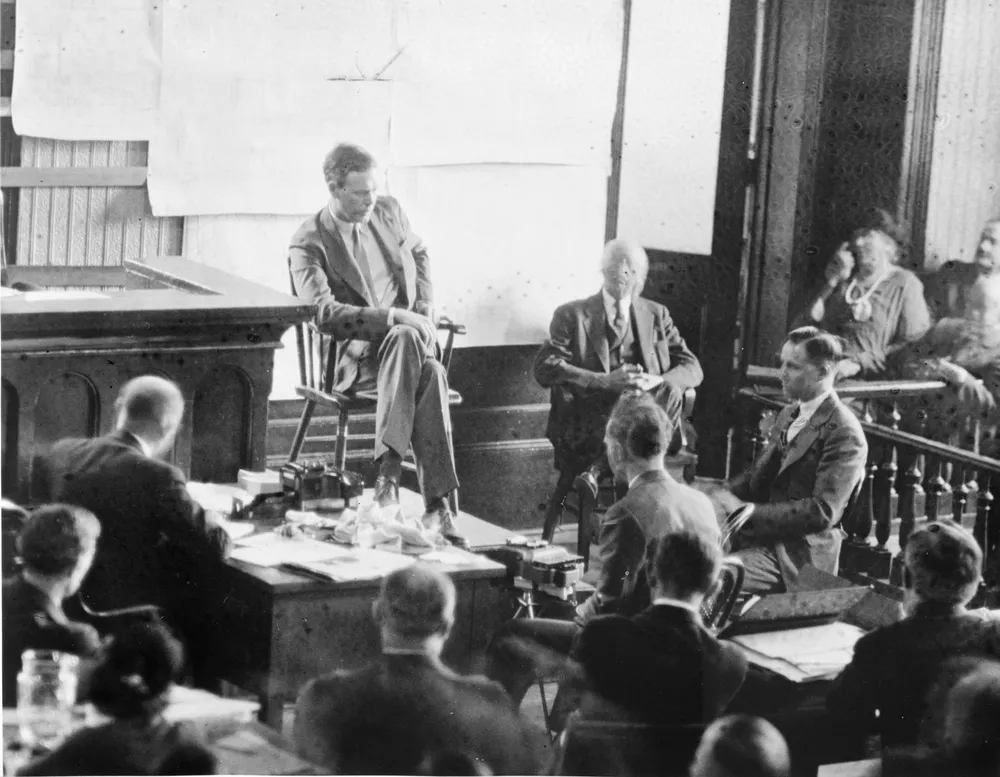
Charles Lindbergh on the witness stand at the Flemington trial in 1935. New York World-Telegram staff photograph, Library of Congress, via Wikimedia Commons, public domain; resized and converted to WebP.
The FBI’s summary is blunt: “The case against him was based on circumstantial evidence.” It names four planks: the tool marks, the attic wood, the writing inside the closet, and the handwriting. The ransom money in the garage sat alongside them.
The appeal went to the Court of Errors and Appeals, then New Jersey’s highest court. (The FBI history calls it the Supreme Court of New Jersey; the opinion itself shows the Court of Errors and Appeals.) Justice Parker’s opinion, delivered on October 9, 1935, noted the “great popular excitement before and throughout the trial” and a crowded courtroom, but rejected the defence’s sixteen points. On the prosecutor’s long and aggressive summation, the court held that the defence had objected only once and had not properly preserved most of its complaints. It found that the main contest at trial had been “whether defendant was the guilty man”, and it upheld the verdict.
The US Supreme Court declined to hear the case on December 9, 1935. Governor Harold G. Hoffman granted a 30-day reprieve in January 1936 and was publicly sceptical that the crime had been the work of one person, but the New Jersey Court of Pardons denied clemency on March 30. Hauptmann was electrocuted at 8:47 p.m. on April 3, 1936. Later accounts report that he refused offers, including one from a newspaper, in exchange for a confession.
What the case does and does not prove
| Claim | Status |
|---|---|
| Charles Lindbergh Jr. was abducted from the nursery on March 1, 1932, and found dead on May 12 | Documented |
| A homemade ladder was used and broke at the house | Documented by investigators at the scene |
| The ransom notes were written by one person | FBI handwriting finding; accepted at trial |
| $50,000 was paid to “John” on April 2, 1932 | Documented |
| Hauptmann possessed and spent ransom money | Documented; more than $13,000 found in his garage |
| Hauptmann was “John” | Jury finding based on Condon’s and other identifications; disputed by critics |
| Hauptmann wrote the notes | Expert testimony accepted by the jury; disputed by later critics |
| Ladder wood came from Hauptmann’s attic | Expert testimony by Arthur Koehler; disputed by critics |
| Hauptmann climbed the ladder and took the child | Inferred by the jury from circumstantial evidence; no eyewitness or fingerprint placed him at the house |
| Hauptmann acted alone | Not established; doubted publicly by Governor Hoffman in 1936 |
| The money came from Isidor Fisch | Hauptmann’s claim; rejected by the jury and unsupported by independent evidence |
| “J.J. Faulkner” deposited ransom money in 1933 | Documented deposit; identity unknown |
| Violet Sharpe was involved | Rejected by the FBI’s own record |
| Charles Lindbergh caused his son’s death and staged a kidnapping | Theory; no documentary evidence |
The doubters and the defenders
Questions about the verdict began before the execution, and they have produced a library of books. Three positions recur.
The innocence argument. The writer Ludovic Kennedy’s 1985 book The Airman and the Carpenter argued that Hauptmann was wrongly convicted, attacking the ladder evidence and the reliability of several witnesses. Hauptmann’s widow, Anna, twice sued the state of New Jersey in the 1980s over his execution; both suits were dismissed, on grounds including prosecutorial immunity and the statute of limitations, according to reporting summarised by Wikipedia. She continued to argue his innocence until her death in 1994.
The “not alone” or unfair-trial argument. Some historians accept that Hauptmann was involved with the money while doubting that the evidence proved murder or that he acted by himself. Lloyd Gardner’s 2004 book The Case That Never Dies is often cited for the account that a fingerprint examiner found no Hauptmann prints on the ladder. These are interpretations by named authors; we have not reviewed their underlying police files.
The case for the verdict. The former FBI agent and author Jim Fisher, in The Lindbergh Case (1987) and The Ghosts of Hopewell (1999), argued that the revisionist books misread the evidence and that Hauptmann was guilty. His view is close to the position of the FBI history and the 1935 court.
A fourth idea circulates widely online: that Charles Lindbergh himself caused his son’s death, perhaps in an accident or a prank, and staged a kidnapping. It has appeared in books and recent press features. It rests on inference about Lindbergh’s behaviour and character, not on any document or physical evidence. Even Jonathan Hagel, a historian now suing to allow DNA testing, told KU News in 2025 that he thought it unlikely Lindbergh did it, while saying a conspiracy of several people was more plausible to him. That too is his opinion, not a finding.
The DNA dispute: where things stand
The original ransom notes and envelopes are held by the New Jersey State Police. Several researchers believe saliva on the envelope flaps and stamps could contain DNA. A match to Hauptmann would strengthen the verdict; another person’s DNA would support the idea that he did not act alone.
According to The Jersey Vindicator, an earlier attempt by the Pennington lawyer Kurt Perhach to obtain the materials for genetic testing failed: a state appeals court ruled in 2024 that physical examination of artefacts is not guaranteed under the state’s public-records law. In April 2025 Perhach filed a 200-page lawsuit in Mercer County Superior Court on behalf of three plaintiffs, the University of Kansas historian Jonathan Hagel, the retired Hopewell teacher Michele Downie and the author and developmental psychologist Catherine Read, seeking access for DNA testing. The State Police have argued that testing for DNA is not covered by the records law and that the saliva-treated letters and stamps could be irreparably harmed. The Vindicator reported that the State Police archive in West Trenton had then been closed to researchers for about 13 months while research policies were revised.
We found no published ruling on the 2025 lawsuit as of November 4, 2026. Until testing happens, if it ever does, the genetic question is open, and claims that DNA has “solved” the case should be treated with caution. The Crippen case shows what happens when such a test is actually run on a century-old exhibit: a published result, a disputed genealogy, and a conviction that stands regardless.
Why the case still matters
The Lindbergh case is often called the crime of the century, but its documentary legacy is more specific. It changed federal law within months. It turned serial-number tracking of ransom money into a standard investigative tool, the same method that later matched the money found in the D.B. Cooper hijacking. It put forensic wood analysis in front of a jury. And its trial, held amid a public excitement the appeal court itself acknowledged, is still cited in arguments about publicity and fairness. For another American verdict that is still argued over, see the Lizzie Borden trial.
It is also, first, the story of a child who was killed. Charles Jr. was 20 months old. Much of the writing about the case concentrates on his famous father, the eccentric go-between and the man in the electric chair; the record of what happened to him is short because his life was.
For other cases where a famous name or a sensational press narrative overtook the evidence, see the Black Dahlia case and the Sodder children disappearance. For an older American case that was never solved at all, see the Villisca axe murders. For a mass death in which almost no one was left to prosecute, see the Jonestown massacre.
Frequently asked questions
Who kidnapped the Lindbergh baby?
Bruno Richard Hauptmann was convicted of the child’s murder in 1935 and executed in 1936. The evidence that he had and spent the ransom money is strong. Whether he took the child from the house himself, and whether he acted alone, is still disputed by some historians.
Was the Lindbergh baby ever found?
Yes. His body was found on May 12, 1932, partly buried in woods near Mount Rose, New Jersey, about four and a half miles from the family home. The coroner concluded that he had been dead for about two months.
How was Bruno Hauptmann caught?
Through the ransom money. Much of the $50,000 was paid in gold certificates with recorded serial numbers. In September 1934 a gas station attendant in Manhattan wrote a car’s licence number on one such certificate, and the number led to Hauptmann, who was arrested on September 19.
Did Hauptmann confess?
No. He maintained his innocence through his trial, appeals and execution. He said the ransom money had been left with him by Isidor Fisch, a former business partner who had died in Germany, a claim the jury rejected.
Is the Lindbergh kidnapping solved?
Legally, yes: Hauptmann was convicted and the conviction was upheld. Historically, parts of it remain open, including whether anyone else was involved and who deposited ransom money under the name “J.J. Faulkner” in 1933. A 2025 lawsuit seeks DNA testing of the ransom envelopes; we found no ruling as of November 2026.
What was the Lindbergh Law?
The Federal Kidnapping Act, signed by President Hoover on June 22, 1932, made it a federal crime to transport a kidnapping victim across state lines. It was passed in response to the Lindbergh case and is commonly called the Lindbergh Law.
Sources & further reading
- Federal Bureau of Investigation, 'Lindbergh Kidnapping', FBI History: Famous Cases and Criminals (accessed November 4, 2026)
- Court of Errors and Appeals of New Jersey, State v. Hauptmann, 115 N.J.L. 412, 180 A. 809, opinion by Parker, J., decided October 9, 1935; transcription via CrimeArchives (accessed November 4, 2026)
- FBI, 'September 2017: Lindbergh Kidnapping Gas Can', Artifact of the Month, FBI Flickr stream via Wikimedia Commons file record (September 14, 2017; accessed November 4, 2026)
- Arthur Koehler, 'Techniques Used in Tracing the Lindbergh Kidnaping Ladder', Journal of Criminal Law and Criminology, vol. 27, no. 5 (1937), journal record page (accessed November 4, 2026; full text not reviewed)
- Jon Niccum, 'Researchers sue New Jersey to obtain DNA evidence in Lindbergh baby kidnapping case', KU News, University of Kansas (June 2, 2025; accessed November 4, 2026)
- Jeff Pillets, 'Researchers sue New Jersey over access to Lindbergh kidnapping records', The Jersey Vindicator (April 28, 2025; accessed November 4, 2026)
- Wikipedia, 'Lindbergh kidnapping', used only to trace the trial personnel, Hauptmann's 'Fisch' explanation and the main revisionist books (accessed November 4, 2026)
- Wikipedia, 'Federal Kidnapping Act', used for the date the law was signed (accessed November 4, 2026)