The Index / Historical Folklore
The Green Children of Woolpit: What the Medieval Chronicles Actually Say
Two medieval chroniclers described green-skinned children in Suffolk. Compare the accounts, St Martin's Land, and the evidence behind the legend.
Topics: Green Children of Woolpit, Woolpit, Suffolk, Medieval Folklore, William of Newburgh, Ralph of Coggeshall
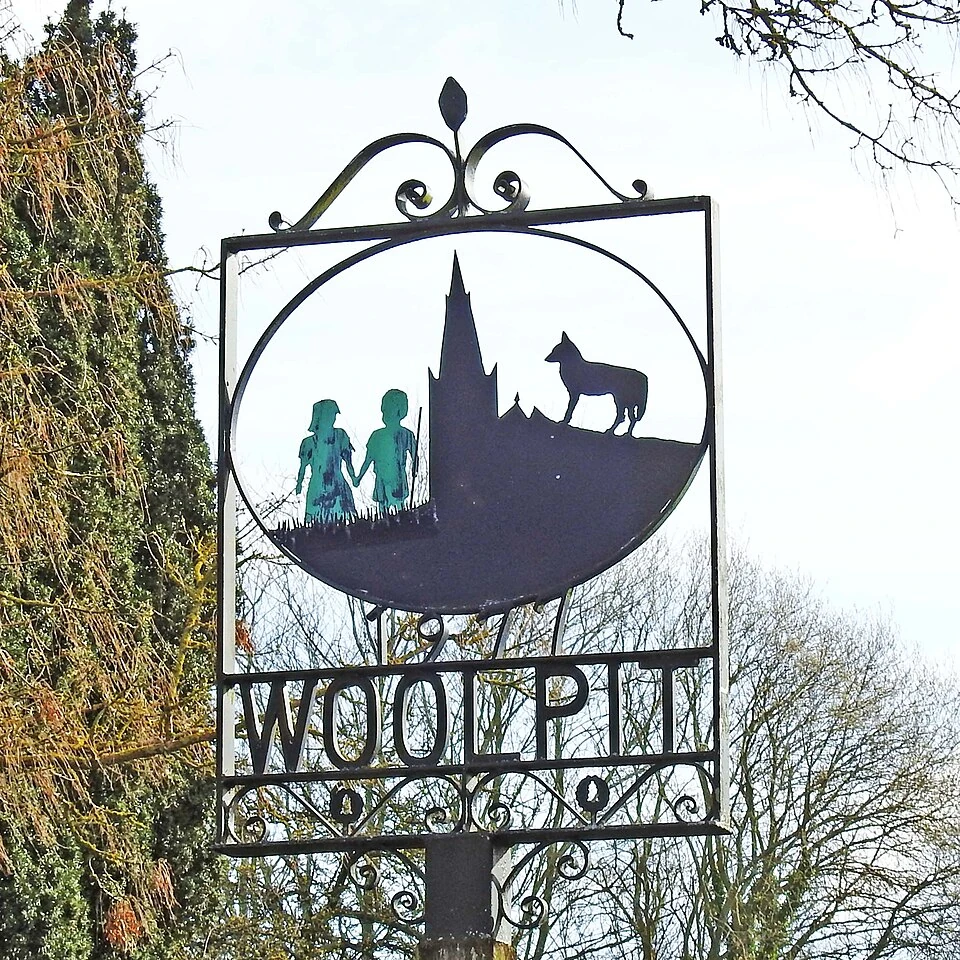
Adrian S Pye / Geograph via Wikimedia Commons, CC BY-SA 2.0 (modern village sign)
In a Suffolk village called Woolpit, two children supposedly appeared from the ground with green skin, unfamiliar clothing and a language nobody recognized. They would not eat the food offered to them, yet eagerly accepted beans. The younger child died. The girl survived long enough, the story says, to learn English and explain that she had come from a place where the sun never rose.
Those details sound like a modern supernatural mystery. They are actually drawn from two medieval chronicles. The manuscripts are evidence that the story was being told in medieval England; they are not independent proof that green-skinned children emerged from an underground world.
The distinction matters because the familiar version of the Green Children of Woolpit often merges the two accounts, adds details from much later speculation, and presents theories as if one must be the answer. Reading the original narratives separately produces a more interesting mystery: what did two educated medieval writers think was worth recording, and how much can their accounts tell us about a possible event?
Where did the story first appear?
The surviving written tradition is principally associated with William of Newburgh and Ralph of Coggeshall, English monastic chroniclers writing toward the end of the twelfth century and around the beginning of the thirteenth. Neither provides a dated eyewitness deposition, a surviving physical specimen or a contemporary record identifying the children.
William places the supposed incident in the reign of King Stephen, 1135–1154. Ralph tells a related story but does not explicitly give its year. This is a real chronological problem, not a minor detail: assigning the story to the early 1170s may make one popular explanation easier, but it conflicts with the reign named by William. Historian Michał Madej compares the accounts and their chronology in a 2020 study in Res Historica.
Woolpit itself is real. Its name is conventionally connected to pits or traps for wolves; William invokes the old cavities when introducing the story. But the existence of a village with a suggestive name does not establish that anyone climbed out of such a pit. Nor is the present-day village sign, which commemorates the legend, an image left by a medieval witness.
The sign is nevertheless an unusually direct expression of the story’s local afterlife: it makes the two green figures part of Woolpit’s public identity.
Hero: Woolpit’s modern village sign, photographed in 2021. Adrian S Pye / Geograph via Wikimedia Commons, CC BY-SA 2.0. Converted from a 960 × 960 source rendition to WebP, without cropping; derivative licensed CC BY-SA 2.0. This public artwork commemorates the legend; it is not a medieval witness image.
William of Newburgh: the children, the beans and St Martin’s Land
William devotes chapter 27 of the first book of his Historia rerum Anglicarum to the Green Children. His full account is available in English translation.
During harvest, he says, a boy and a girl emerged from old cavities near Woolpit. They were green in complexion, wore unusual clothes and were taken by the harvesters to the village. They initially rejected ordinary food. Presented with bean stalks, they searched inside the stalks rather than opening the pods. Once shown the beans, they ate them and gradually accepted other food.
Over time, according to William, both children lost their unusual coloring, learned the local language and received baptism. The boy died not long afterward. The girl, he reports, grew up and eventually married in Lynn. Even this apparently straightforward ending carries uncertainty: William introduces her marriage as something reported to him, rather than something he witnessed or documented.
When questioned, the children supposedly described St Martin’s Land. Its inhabitants were Christian, but the sun did not rise there. The landscape remained in a kind of twilight, while a brighter country lay across a great river. The children said they had been tending their father’s animals when they heard a sound like church bells and suddenly found themselves among the harvesters.
The account is supernatural in its imagery, but its inhabitants are not simply described as demons or pagan spirits. William gives the other land churches and reverence for St Martin. That detail complicates modern retellings that present the children as unquestioningly alien, infernal or nonhuman.
William’s own attitude is revealing. He says he initially thought the extraordinary tale too implausible to credit, but eventually accepted it because of people he regarded as competent witnesses. He does not identify those witnesses in the passage. His declaration of confidence tells us what he claimed to believe, not how a modern investigator could verify each assertion.
Ralph of Coggeshall: a knight, a cave and a different ending
Ralph’s Chronicon Anglicanum provides a second major version. Its Latin account and Thomas Keightley’s nineteenth-century English rendering can be read together in this source transcription. The hosting page also includes a modern storyteller’s adaptation; that creative introduction is not a medieval primary source.
Ralph places the children near the opening of a pit at St Mary’s of Woolpit. He says villagers brought them to the house of Sir Richard de Calne, a knight at Wikes. Unlike William, he identifies a purported route by which information reached him: Ralph says he often heard the story from Richard and his household. That is a reported informant, not a surviving sworn testimony by Richard or an eyewitness statement we can independently inspect.
The food episode is strikingly similar to William’s. The children were unable or unwilling to eat what they were given, then discovered beans and ate those. Ralph also reports that the boy soon died and the girl’s color faded as she grew accustomed to local food.
But Ralph places the girl’s baptism after his account of the boy’s death and specifically describes her as remaining for years in the knight’s service. His judgment of her behavior is unflattering, reflecting an adult male chronicler’s characterization rather than allowing us to hear her perspective. The detail should not be repeated as a factual diagnosis of the girl’s character.
Ralph’s explanation of their arrival also differs. In his version, the children followed animals into a cavern, heard bells, wandered through it, and eventually emerged into intolerably bright sunlight. When people approached, they tried to return to the cavern but could not find its entrance. He reports a green, sunless homeland; he does not supply William’s explicit name “St Martin’s Land” in the passage.
That last distinction is easily lost when modern articles combine the two narratives into one seamless interview with the children. No such interview survives.
The accounts agree on a core story—but not every detail
Both writers report two children, their green coloring, an unfamiliar language, beans, the boy’s death and the girl’s adaptation to local life. The shared elements show that a recognizable story circulated in the period. They do not prove that the chroniclers independently observed its subject.
Their differences are just as informative:
| Question | William of Newburgh | Ralph of Coggeshall |
|---|---|---|
| When did it happen? | Explicitly during King Stephen’s reign, 1135–1154. | Does not explicitly date the incident. |
| Who supplied the story? | Refers to numerous credible witnesses but does not name them. | Names Sir Richard de Calne and his household as reported informants. |
| Where did the children come from? | The Christian twilight country called St Martin’s Land, beyond a great river. | A green, sunless country reached through a cavern. |
| How did they enter Suffolk? | They heard bells and found themselves in the harvest fields. | They followed bells through a cavern and emerged into bright sunlight. |
| What happened to the girl? | Says she later married in Lynn, according to reports. | Says she lived for years in Richard’s service; no equivalent marriage account in this passage. |
Even where the two accounts match, there may have been a shared circulating story or overlapping chains of transmission. Two authors writing down similar material are not automatically two independent confirmations of the event. Madej’s comparison of the chronicles discusses their relationship and asks how each author’s wider work shaped his presentation.
Were the children Flemish refugees?
One influential naturalistic proposal identifies the children as Flemish-speaking youngsters displaced during twelfth-century conflict. In that reconstruction, language differences explain why the villagers could not understand them. Malnutrition or illness might have contributed to the appearance later remembered as green. Another step links “St Martin’s Land” to the Battle of Fornham St Martin in 1173.
The attraction is clear: this explanation replaces a hidden kingdom with historical displacement, language barriers and a medical possibility. But the hypothesis is not a documented identification.
For a start, the 1173 battle took place during Henry II’s reign. William explicitly assigns the children’s appearance to the reign of Stephen, which ended in 1154. Madej notes this tension when discussing a theory attributed to Paul Harris. One could suppose William misdated the event, but that is an extra assumption requiring evidence, not a solution established by the chronicles.
We also do not possess a medical examination of either child. “Green” in a Latin historical narrative is not a diagnostic chart, and a condition said to clear with changes in diet cannot be identified from a story alone. If there were two real children at the core of the tradition, malnutrition and linguistic isolation would be possibilities to investigate. Neither has been proved for these particular children.
Other tellings give the surviving girl a personal name or attach her to a precisely documented adult identity. The two principal chronicle passages do not establish such an identification. A name inserted by later writers should not be silently promoted to a medieval fact.
Does the story describe a fairyland—or another planet?
The twilight country and the passage underground closely resemble motifs familiar from medieval otherworld stories. A boundary separates ordinary life from a different realm. Bells draw a traveler across it. The traveler emerges into a place whose light, food or customs feel wrong. A survivor eventually learns the new community’s language and habits.
That resemblance is useful for understanding how the story works as a story. It does not prove that the chroniclers consciously invented it or that a specific older fairy tale supplied the plot. Medieval writers could report wonders in works that also contain recognizably historical events; the presence of a miracle narrative in a chronicle is not a modern certificate of empirical verification.
Madej reads the account in the context of medieval ideas about difference, color, incorporation and the disturbances of English society. His study also examines other strange narratives appearing close to William’s Green Children chapter, including creatures supposedly found in enclosed stone and a passage to a marvelous banquet. These juxtapositions make sense as literary and historical context even if no investigator can reconstruct what, if anything, happened in Woolpit’s fields.
The extraterrestrial explanation, familiar from later paranormal retellings, goes beyond either medieval source. Neither chronicler writes about spacecraft, planets or technology. Treating a perpetual twilight realm as proof of visitors from outer space merely replaces one unverified claim with another.
A responsible reading leaves room for more than one possibility: a distorted memory of real strangers, a legend rooted in unfamiliar language and customs, a story adapted from existing otherworld motifs, or some combination. The surviving material cannot rank those possibilities with the precision a detective story’s ending would require.
What can historians actually establish?
Certain: Two medieval chroniclers included substantially related accounts of green children found near Woolpit. Their narratives became part of a longer English folklore tradition. The village and its modern memorial imagery can be identified.
Reported, not independently established: The children’s green skin, their unusual diet, the boy’s death, the girl’s later life, her reported explanation of their homeland, and the route by which she or her brother arrived.
Unresolved: Whether a real encounter inspired the story; who the children were, if they existed; the condition of their skin; and whether medieval otherworld motifs shaped the narrative before or during its recording.
There is an important difference between saying no reliable physical corroboration has been presented and claiming a medieval event has been conclusively disproved. Neither the primary texts nor the later scholarship permits either certainty about the extraordinary claims or an artificially neat solution.
For another example of how an extraordinary local story grew through different witnesses and later retellings, see the Devil’s Footprints reported in Devon in 1855. The two cases are not related historically; their shared lesson is the need to keep documents, secondhand reports and later folklore separate. A twentieth-century counterpart, where photographs rather than chronicles carried the claim, is the Cottingley Fairies case. Another child who arrived from nowhere, with far better records and a modern DNA test, is Kaspar Hauser.
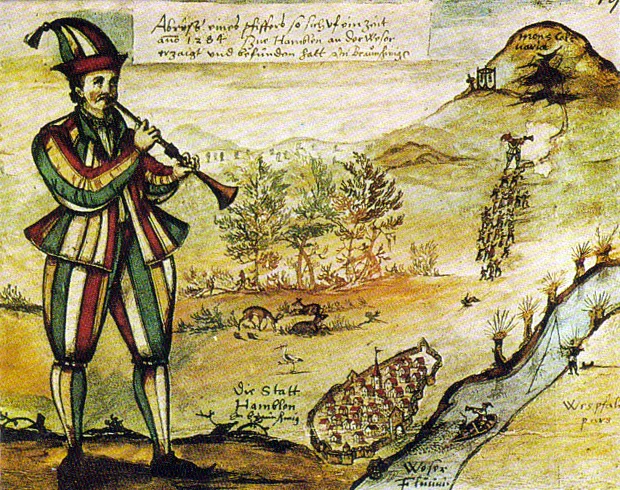
The Pied Piper of Hamelin raises a comparable question about lost children and late records, though the two stories are historically unrelated.
The Green Children of Woolpit remain compelling not because the chronicles solve the mystery, but because they preserve the way medieval writers tried to make sense of strangers, difference and the unfamiliar—and because enough details survive for us to see where their stories agree and where they do not.
Sources & further reading
- William of Newburgh, Historia rerum Anglicarum, book I, chapter 27 (English translation, Fordham University)
- Ralph of Coggeshall, Chronicon Anglicanum, Latin text and Thomas Keightley's 1850 translation
- Michał Madej, The Story About the Green Children of Woolpit According to the Medieval Chronicles (Res Historica 49, 2020)
- Michał Madej, full scholarly article (PDF, DOI 10.17951/rh.2020.49.117-132)
- Woolpit village sign, photographed by Adrian S Pye (CC BY-SA 2.0), Wikimedia Commons
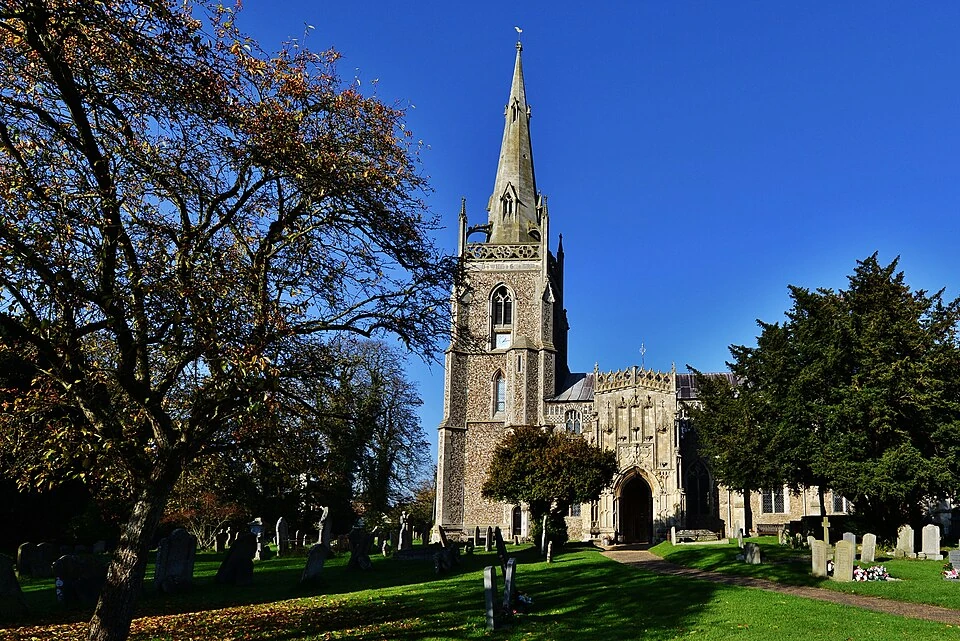
- St Mary's Church, Woolpit, photographed by Michael Garlick (CC BY-SA 2.0), Wikimedia Commons