The Index / Historical Folklore
Was the Pied Piper of Hamelin Real? What the Evidence Says About 1284
Hamelin's legend points to 130 children lost in 1284, but every surviving text is later. What the oldest records show and which theories hold up.
Topics: Pied Piper, Hamelin, Brothers Grimm, Robert Browning, Medieval legends, Disappearances, 13th century
The Pied Piper as a magical rat-catcher is folklore, but the legend may have a real event behind it. Hamelin has claimed since at least the 15th century that 130 of its children were lost on 26 June 1284. No record from 1284 survives, and no text we could trace names a single child or identifies the piper. The rats appear to be a later addition. The Hameln Museum itself says the historical core cannot be fully clarified, up to the question of whether anyone left the town at all that year.
So the honest answer has two parts. A very old local tradition of a collective loss is documented. The event behind it is not.
What does the oldest evidence say?
The story is usually told backwards, starting with Browning’s poem or the Grimms. Read forwards, it looks different. The table lists what we could trace, in date order, with how much weight each item can bear.
| Date | Source | What it says | Status |
|---|---|---|---|
| c. 1300? | Glass window, Marktkirche | Described around 1650 as a figure in colourful clothes among many children | Lost. The c. 1300 date is an inference, and the museum phrases it as a question |
| 1384? | Town record: “It is 100 years since our children left” | Repeated by the BBC and Wikipedia | We could not trace an edition or the document itself. Treat as unverified |
| Unknown | Verses in a missal, “zu Hameln im Kloster” | 130 children swallowed alive by Calvary | Original lost. Known from later copies (Meibom 1688, Herr 1761), as reported by Wikipedia |
| c. 1430-50 | Note in a Lüneburg copy of Heinrich of Herford’s chronicle | Young man with a silver pipe, 130 children, 1284, vanished at Calvary | Earliest datable narrative. No rats |
| 1556 | New Gate stone | Gate built 272 years after a “magus” led away 130 children | Survives, in the museum. Points to 1284 |
| 1556 | Hiob Fincelius, Wunderzeichen | The Devil piped children away about 180 years ago, on St Mary Magdalene’s Day | Points to about 1376, in July |
| c. 1559-65 | Zimmern Chronicle | Rat plague, cheated stranger, mountain closes | Earliest known version with rats |
| 1592 | Augustin von Mörsperg | Rats, unpaid fee, 130 children, Calvary. Commissioned a copy of the window | Oldest surviving picture |
| c. 1600-03 | House inscription, Osterstraße | 26 June 1284, 130 children, Calvary, the Koppen | Survives |
| 1605 | Richard Verstegan | Rats, 130 children, lame boy, 22 July 1376 | Browning’s source. Text read in the 1628 edition |
| 1610-17 | Hochzeitshaus (Wedding House) inscription | 1284, 130 children, the Koppen | Recorded by the museum |
| 1816 | Brothers Grimm | The full story, with variants and their sources | Collected legend |
| 1842 | Robert Browning | The English classic, set in July 1376 | Literature |
The consistency of the inscriptions is less impressive than it first appears. The museum points out that their words and pictures are strikingly alike, and suggests that a four-line rhyme may have been circulating since the Middle Ages. If so, several monuments may be repeating one verse rather than confirming each other independently.
The Lüneburg note
The closest thing to a narrative source is a passage added in a different hand to a copy of The Golden Chain, the Latin chronicle of the monk Heinrich of Herford. According to Wikipedia’s summary of the scholarship, the researcher Heinrich Spanuth found it in the Lüneburg city archives in 1936. It is usually dated between about 1430 and 1450. We read it in translation rather than in the manuscript, and the published translations disagree on small points such as whether the piper came in by the “West Gate” or the “Weser Gate”.
It describes a well-dressed young man of about 30 playing a silver pipe through the town. On the feast of Saints John and Paul in 1284, 130 children follow him out of the east gate to a place of execution or Calvary, and there they vanish. Their mothers search from town to town and find nothing.
Three things stand out. There is no rat, no fee and no revenge, so nothing explains why the man came or why the children followed. The writer says the report comes from “an old book”, which means the note is already a copy of something older that we cannot see. And its only witness is second-hand: the mother of a Hamelin dean, Johann von Lüde, is said to have watched the children go.
The note is therefore good evidence of what Hamelin’s clergy believed about 150 years later. It is not an eyewitness record of 1284. It also sits awkwardly with the museum’s exhibition text, which says the first concrete evidence appears in the early 16th century and does not mention the note. That is a real disagreement in the sources, and a useful reminder that “oldest” depends on how much you accept from lost or copied texts. The chronicles of the Green Children of Woolpit pose a similar problem of separating a written record from the second-hand report behind it.
The window that everyone cites and nobody has seen
Many accounts say a church window of about 1300 proves the event. The evidence is thinner than that sounds. The window was destroyed in 1660, according to the city. The museum says only that it “could be” the oldest source, and it openly asks whether the glass was installed soon after 1284. A witness around 1650 saw an old man in colourful clothes among many children, with a verse that had survived only in garbled form and the date 1572.
That date has also been read two ways. The Grimms wrote that the mayor had the story portrayed in the church windows in 1572. The museum says the picture was repaired that year by Mayor Poppendick. If the Grimms were right, the window would be a 16th-century creation rather than a medieval memorial.
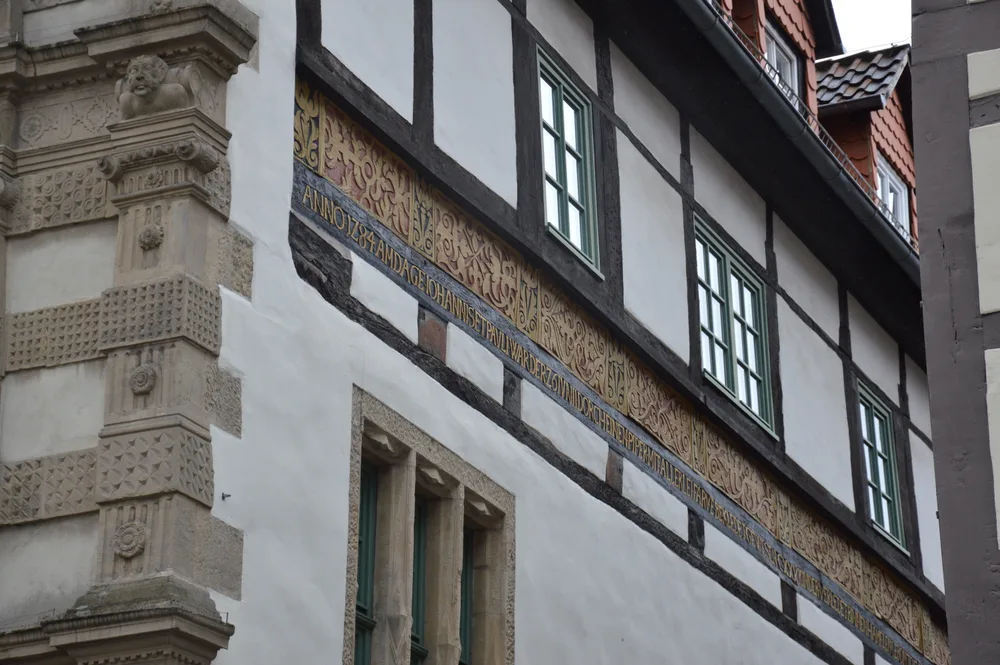
The inscription on the Bungelosenstraße side of the Pied Piper House, which gives 26 June 1284 and 130 children. Photo by Illustratedjc, 2015, CC BY-SA 4.0 via Wikimedia Commons; resized and converted to WebP.
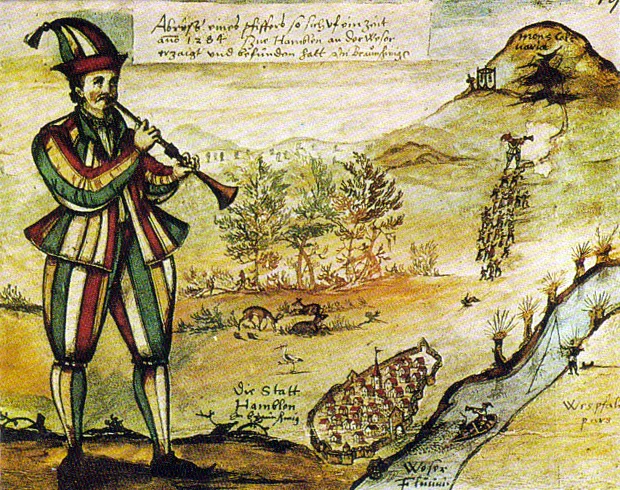
What we do have is the copy in this article’s main image, made for Augustin von Mörsperg, a travelling knight who came to Hamelin in 1592 to hear the story for himself. It is the only picture evidence for the window, and it should be read with care. Mörsperg’s own account, as translated by the museum, says the story was shown all over town, in the town hall, the church and even taverns, and that he had these windows copied. The watercolour shows a hill labelled “Mons Calvaria” with what looks like a gallows at its foot, and a figure with a pipe in a boat on the Weser. That boat belongs to the rat story, which he recounts in full. We cannot tell how much of the image reflects medieval glass and how much reflects what Hamelin was telling visitors in 1592.
Which date is right: 1284 or 1376?
Modern retellings treat 26 June 1284 as settled, and the BBC’s 2020 feature says all local documentation agrees on it. That holds for the inscriptions, but not for the wider record.
In 1556 alone, two texts disagree. The New Gate stone counts 272 years back to the piper, which gives 1284. The same year, Hiob Fincelius wrote that the Devil had led the children away about 180 years earlier on St Mary Magdalene’s Day, which falls on 22 July. That gives about 1376, and he claimed it was written in the town-book. Verstegan then printed the exact date of 22 July 1376, and Browning took it into English verse, so readers of the poem have a different year from visitors to the town.
There are smaller variants too. The Grimms note that one writer, Seyfried, put the entry on 22 June, and that some said the event took place at seven in the morning and others at noon. A Bamberg chronicle of 1553, according to Medievalists.net, gives 1283. In the 18th century, Christoph Friedrich Fein read 1259 from the gate stone and tied the story to the Battle of Sedemünder, an error the museum points out, since that battle took place on 28 July 1260.
Our reading is that 1284 has the better claim because it is carried by the local monuments and the earliest narrative. That is still a judgement about which tradition is older, not proof of when anything happened.
Where did the rats come from?
The rats are absent from the Lüneburg note, the missal verses, the gate stone and the house inscription. The earliest version we know that includes them is the Zimmern Chronicle of about 1559-65. Wikipedia gives the range, while the museum simply says 1565. It tells of a stranger cheated out of his payment, and adds a moral about the townspeople’s greed. The museum says the two stories had merged by the late Middle Ages, but it cites no earlier text for that.
The city of Hamelin’s own explanation is that a legend of a children’s departure was later joined to a separate rat-expulsion legend. That fits the evidence well. Ratcatcher stories without any missing children were told about other places, and Ashliman’s collection includes examples from Germany, Austria, Denmark, Ireland and Iceland. The rat plot supplies what the older story lacks: a motive. It turns an unexplained loss into a tale about a broken promise, and it moves the blame onto the parents.
The rats brought other folklore with them: a later verse epic pictured the devil in Hamelin as a giant knot of rats, an image borrowed from the real and much-mythologized rat king.
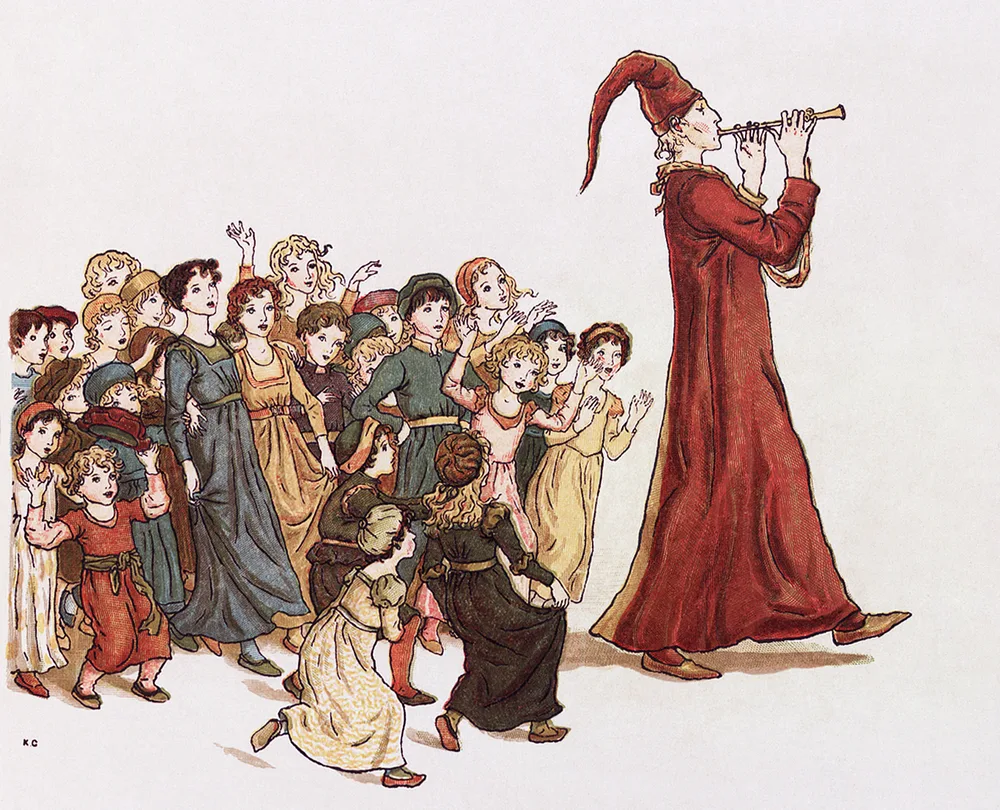
The image most readers know: Kate Greenaway’s illustration for Browning’s poem, engraved by Edmund Evans, 1888. Fiction, not evidence. Public domain (PD-Scan, PD-old-100-1923) via Wikimedia Commons; resized and converted to WebP.
Were they really children?
The accounts disagree here, and the disagreement matters for every theory.
- The Grimms report boys and girls “from their fourth year on”, plus the mayor’s grown daughter.
- Zimmern says most were under eight or nine.
- Verstegan speaks of “boyes”.
- The Latin texts use pueri and puelli, ordinary words for boys or children that do not fix an age by themselves.
The city of Hamelin favours another reading: “children of the town” could mean citizens of any age. It is an attractive argument, because it would turn the loss of small children into a departure of adults. But it is an interpretation, and none of the early texts we read says so.
What are the main theories?
None of these is proven. The museum states that counter-arguments have been raised against all of them.
Migration to the east: the strongest candidate
The museum and the city both call this the most plausible explanation. In the 13th century, German settlers moved into eastern lands, recruited by agents known as locators. In this view the piper was a recruiter in eye-catching clothes, and the “children” were young people who left for good.
The linguist Jürgen Udolph of Göttingen gave the theory its best-known modern support. According to the Independent’s 1998 report, he found place names echoing Hameln in the Prignitz and Uckermark north of Berlin and around Stargard in present-day Poland. Wibke Reimer of the Hameln Museum told the BBC in 2020 that his work points to the regions around Berlin.
The idea is older than it looks, though. Verstegan was already reporting around 1605 that Transylvanian Saxons shared surnames with Hamelin burghers, and he dismissed the conclusion. His objection is still worth asking: if 130 strange children had arrived, the people receiving them would surely remember. Later folk tradition still placed them in Transylvania, as the Grimms and Emily Gerard recorded.
We see two limits here. Name matches can show that settlers from this part of Germany moved east in general. They cannot show that a particular group left Hamelin on a particular day. And Reimer raises a further problem herself: such explanations struggle with the precise date and the sense of local trauma. Voluntary emigration is an odd thing to mourn for centuries. It is odder still as a starting point for dating public documents, if the claim that Hamelin did so is true. Asked who the piper was, Udolph told the Independent he had “no idea”, though he suggested a locator.
Disaster
Landslides, sinkholes and similar accidents are often proposed, since “Calvary” and “the Koppen” suggest a hill. The museum notes that this idea always leans on another theory to explain why the children went there at all. The Grimms named the hill as the Poppenberg, also called Koppenberg. Which hill the older texts meant is uncertain.
Disease
Richard Salinger suggested that the 130 died in an epidemic and were buried outside the gates. The trouble is chronology. The Black Death reached Europe in the 14th century, decades after 1284. This theory works better with the rival date of 1376, a connection the sources we read do not make, and which remains speculation. Leprosy has also been proposed, without direct evidence.
Dancing mania
The feast of St John on 24 June, with its music and dancing, falls close to the legend’s date, and some researchers imagine a trance-like procession. There is a striking parallel in a legend from Erfurt, where a crowd of children danced out of town to Arnstadt. Grässe dates that to 1257, while Wikipedia gives 1237. The best-documented outbreak, the Strasbourg dancing plague of 1518, came more than two centuries later, so it can show that such things happened but not that they happened in Hamelin.
Weaker ideas
- Children’s Crusade: the movement belongs to the early 13th century, some 70 years before 1284.
- Battle of Sedemünder: rests on Fein’s misreading of the gate stone, although it was the standard solution in the 18th and 19th centuries.
- A midsummer massacre by Christians: raised as a possibility in the BBC feature. No document supports it.
Is Bungelosenstraße really a street without music?
The street beside the Pied Piper House is real, and it is the legend’s most concrete survival. Verstegan reported in the early 17th century that no music could be played in the street leading to the gate. The Grimms wrote that it was called the bunge-lose, or drumless, street into the mid-18th century, and that musicians in a bridal procession had to stop playing while crossing it.
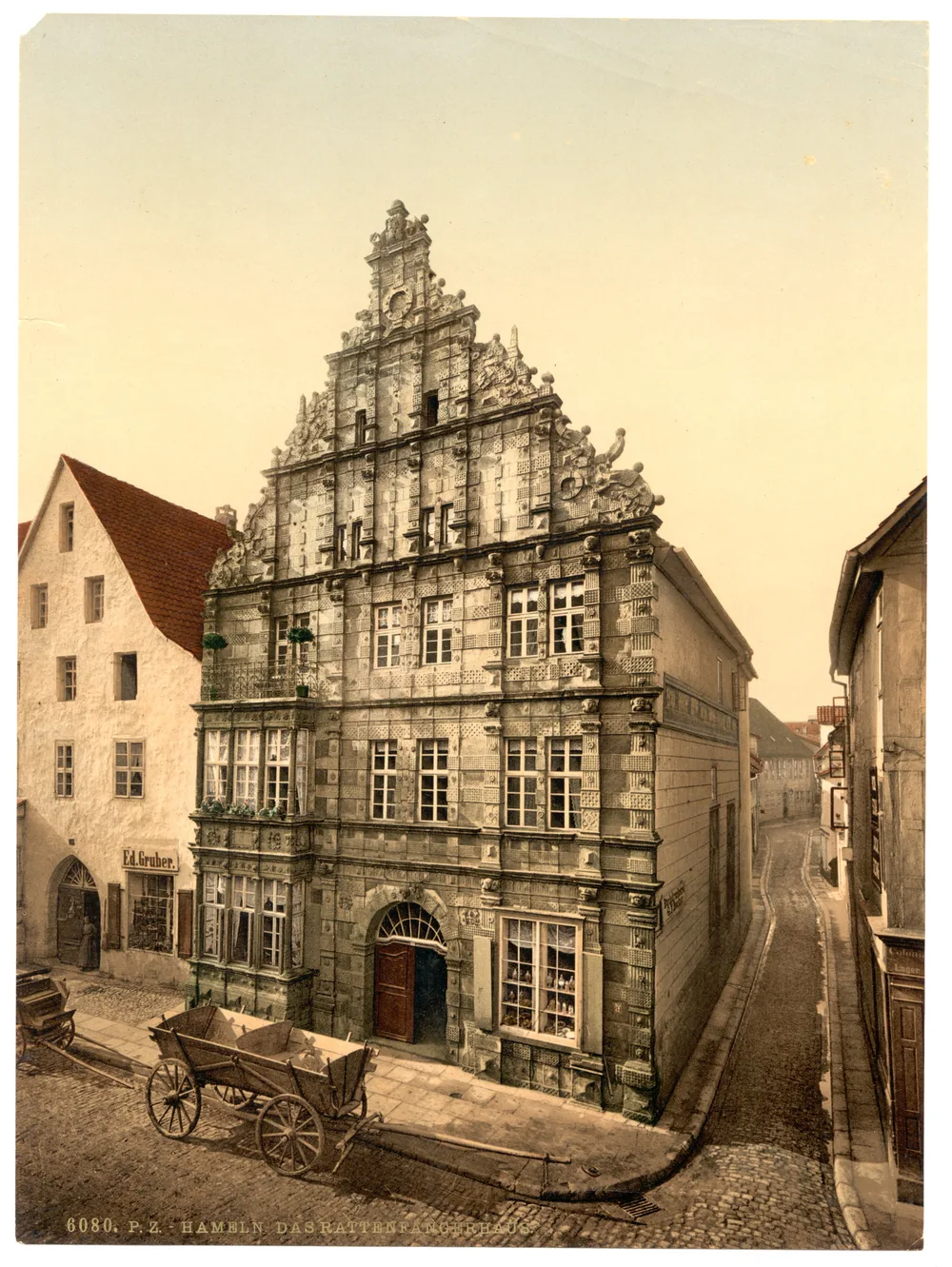
The Rattenfängerhaus and, on the right, the lane called Bungelosenstraße, in a photochrom print of about 1890-1900. The house was built in 1602/03 and has carried the Pied Piper name only since about 1900. Library of Congress, public domain (PD-old-70-1923) via Wikimedia Commons; resized and converted to WebP.
A custom like this shows what the town believed and acted on. It does not show that the event happened, and we found no record of when the custom began.
The same is true of the house. The building is sometimes treated as a witness to 1284, but it is more than three centuries too late. The museum even asks whether the side inscription existed before the 1600s rebuilding or was added by its owner, Hermann Arendes.
How Hamelin has used the legend
Hamelin’s relationship with the story changed long before modern tourism. In 1654 the former school rector Samuel Erich published Exodus Hamelensis, arguing that the story was literally true and that the piper was a manifestation of the Devil. Sebastian Spilcker, a town councillor, wrote a critical reply, and the Dutch professor Martin Schoock called the story a fable in 1659. Serious doubt about the legend is therefore more than 350 years old.
The town began celebrating the legend publicly in the 19th century, with a jubilee in 1884. The museum records that the 1934 festival was largely organised by the local Nazi party administration and used for propaganda, with SA torch processions and military parades. A story about a town losing its young people to an outsider was being staged in a very different spirit from the one in which it was first recorded. Today the city’s version is gentler: rat markers set into the pavement, an open-air play, and a new window in the Marktkirche, installed in 1984 to recall the lost one.
Disappearance stories often work this way. As with Roanoke or the invented vanished village of Lake Anjikuni, the absence of evidence leaves room for later generations to supply a cause. Unlike Anjikuni, however, Hamelin has an old tradition behind it.
What is documented, claimed and unresolved?
Documented:
- By about 1430-50, a written note records the loss of 130 children in Hamelin in 1284.
- By 1556, the town had carved that memory into a gate, and by the early 1600s into house fronts.
- A church window related to the story existed by 1592 and was lost by about 1660.
- Mörsperg’s 1592 watercolour, Erich’s 1654 book and the street name all survive.
Claimed, not verified:
- A town record of 1384 marking 100 years since the children left.
- A window made soon after 1284.
- A lost missal verse from the 14th century.
- That the dean’s mother saw the children leave.
Legend or fiction:
- The magic pipe, the rats drowning in the Weser, and the unpaid fee.
- The mountain that opens and closes.
- The returning blind, mute or lame children.
- The tunnel to Transylvania.
Theory:
- Emigration to the east, the most widely favoured.
- Disaster, disease, dancing mania, crusade or battle.
Disputed or unresolved:
- Whether the year was 1284, 1376 or another date.
- Whether the “children” were young children at all.
- Whether any group left the town in 1284.
Frequently asked questions
Is the Pied Piper of Hamelin a true story?
Partly, at most. The magical piper and the rats are legend. Hamelin’s old tradition that 130 children were lost in 1284 may reflect a real event, but no record from that time survives to confirm it.
What really happened to the children of Hamelin?
Nobody knows. The most favoured explanation is that young people left to settle in eastern lands, recruited by an agent, but this remains an unproven theory, and the museum in Hamelin says even the basic event cannot be confirmed.
When did the Pied Piper take the children?
Local inscriptions and the earliest narrative say 26 June 1284. Fincelius in 1556 implies about 1376, and Verstegan and Browning give 22 July 1376.
How many children disappeared?
The number 130 is remarkably consistent across the inscriptions and texts from about 1450 onward. No list of names exists, so it cannot be checked, and its consistency may only show that the texts share one rhyme.
Were there really rats in the original story?
No. The rats do not appear in the earliest texts. They first appear in the Zimmern Chronicle of about 1559-65, and the city of Hamelin treats them as a separate legend joined on later.
Where did Browning get the story?
From Verstegan’s English account, first printed in 1605. That is why his poem uses 1376 and has a lame boy left behind. It appeared in Dramatic Lyrics in 1842, and according to the museum he wrote it to entertain a sick child.
Can you visit the places in the story?
Yes. The Pied Piper House stands at Osterstraße 28 on the corner of Bungelosenstraße, and the Hameln Museum holds material including the gate stone. The hill itself cannot be securely identified.
Sources & further reading
- Museum Hameln, 'The Pied Piper: The Origin of the Legend' (permanent exhibition text, including its translation of Mörsperg's 1592 account; accessed 1 November 2026)
- Museum Hameln, 'Pied Piper: Interpretations' (permanent exhibition text; accessed 1 November 2026)
- Museum Hameln, 'The Pied Piper Literature: Early Sources' (accessed 1 November 2026)
- Museum Hameln, 'The Pied Piper in Literature, Part 2' on Goethe, the Grimms and Browning (accessed 1 November 2026)
- Museum Hameln, 'The Pied Piper Jubilee Celebrations' (accessed 1 November 2026)
- Stadt Hameln, 'Deutungsansätze zur Sage' (city portal, last updated 14 August 2025; accessed 1 November 2026)
- Stadt Hameln, 'Spuren der Kindesentführung' (city portal, on the house, the window and the 1984 replacement; accessed 1 November 2026)
- D. L. Ashliman (ed. and trans.), 'The Pied Piper of Hameln and Related Legends', University of Pittsburgh: texts of the Grimms (1816), Browning, Zimmern, Verstegan (1628 edition), Fincelius (1556, via Gutch 1892) and Grässe (1868; accessed 1 November 2026)
- Jacob and Wilhelm Grimm, 'Die Kinder zu Hameln', Deutsche Sagen, vol. 1 (Berlin, 1816), no. 244, via Wikisource (primary text; accessed 1 November 2026)
- Imre Karacs, 'Twist in the tale of Pied Piper's kidnapping', The Independent, 27 January 1998 (report on Jürgen Udolph's research; accessed 1 November 2026)
- Raphael Kadushin, 'The grim truth behind the Pied Piper', BBC Travel, September 2020 (includes comments by Wibke Reimer of the Hameln Museum; accessed 1 November 2026)
- Medievalists.net, 'The Medieval Mystery Behind the Pied Piper' (secondary overview drawing on Wolfgang Mieder's handbook; accessed 1 November 2026)
- Encyclopaedia Britannica, 11th edition (1911), 'Hameln', via Wikisource (accessed 1 November 2026)
- Deutsche Märchenstraße, 'Pied Piper House' (accessed 1 November 2026)
- Wikipedia: Pied Piper of Hamelin, used for the translation of the Lüneburg note and for references to Spanuth, O'Donnell, Wieder, Rostek-Lühmann, Krogmann, Meibom and Herr, which were not read directly (accessed 1 November 2026)
- Wikimedia Commons file records for the four images used (accessed 1 November 2026)