The Index / Curses
The Curse of Tutankhamun: How Lord Carnarvon's Death Became a Legend
No curse inscription was found in Tutankhamun's tomb. See how Carnarvon's 1923 death, a press rivalry and a 2002 BMJ study shaped and tested the legend.
Topics: Tutankhamun, Curses, Ancient Egypt, Howard Carter, Lord Carnarvon, Conan Doyle, Spiritualism
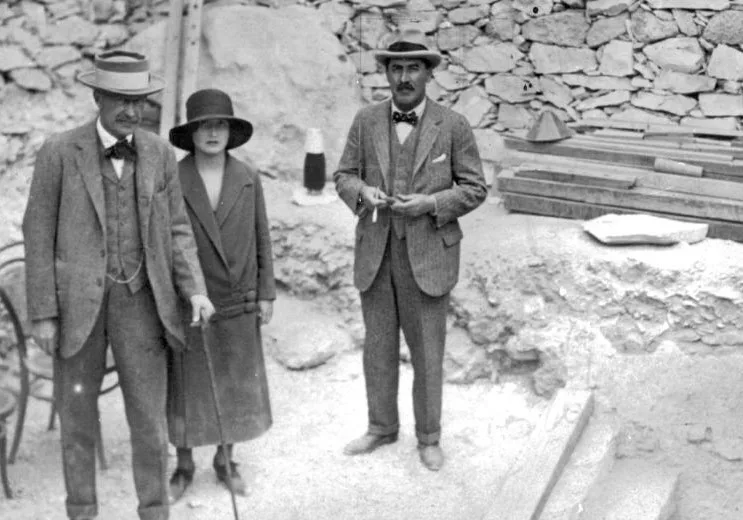
Harry Burton / Griffith Institute via Wikimedia Commons, public domain; converted to WebP.
The curse of Tutankhamun is the claim that opening the boy king’s tomb in 1922 and 1923 brought death to the people involved. Its anchor is a real event: Lord Carnarvon, who financed the excavation, died in Cairo in April 1923, weeks after the burial chamber was opened. The rest of the legend does not hold up. No curse inscription has been found in the tomb, the most famous omens around Carnarvon’s death come from newspaper reports, and a 2002 study in the BMJ found no survival difference between people present at the key openings and other Westerners in Egypt at the time.
What remains interesting is how the story was built. The record lets us watch it happen almost day by day, from Howard Carter’s excavation journal to a novelist’s warning in the press, and then to the coincidences that were added afterwards.
The short answer
| Claim | Status | What the record shows |
|---|---|---|
| Carnarvon died soon after the tomb was opened | Documented | He died in Cairo in April 1923 after an infected bite and illness, about seven weeks after the burial chamber was opened. |
| A curse was inscribed in or on the tomb | Not supported | No such inscription has been found. The well-known wording is traced to a 1923 press statement, not to the tomb. |
| Cairo’s lights went out as he died | Reported, not significant | Reported at the time. An Egyptologist notes that power cuts in Cairo were common. |
| His dog in England died at the same moment | Reported, timing disputed | Repeated in the press; the time difference means the dog died hours after Carnarvon, not at the same instant. |
| People who entered the tomb died early | Tested and not supported | Nelson’s 2002 cohort study found no significant association between exposure and survival. |
| Carter believed in the curse | Contradicted | Carter publicly dismissed such stories with contempt in 1927. |
What happened at the tomb?
Howard Carter’s own journal, published online by the Griffith Institute at Oxford, gives the sequence. On November 4, 1922, he uncovered the first traces of the entrance below the tomb of Ramesses VI. Carnarvon, who was in England, arrived in Luxor on November 23. On November 26, Carter made a small breach and looked through by candlelight.
In the published version, Carter’s first volume (1923) gives the familiar exchange. Carnarvon asked whether he could see anything, and Carter recalled answering, “Yes, wonderful things.” His journal entry for that day records the reply as “Yes, it is wonderful.”
The official opening of the antechamber followed on November 29, 1922. The sealed doorway to the burial chamber was opened on February 16, 1923, in front of officials and invited guests, according to the journal. That date matters, because the curse story counts its victims from these openings.
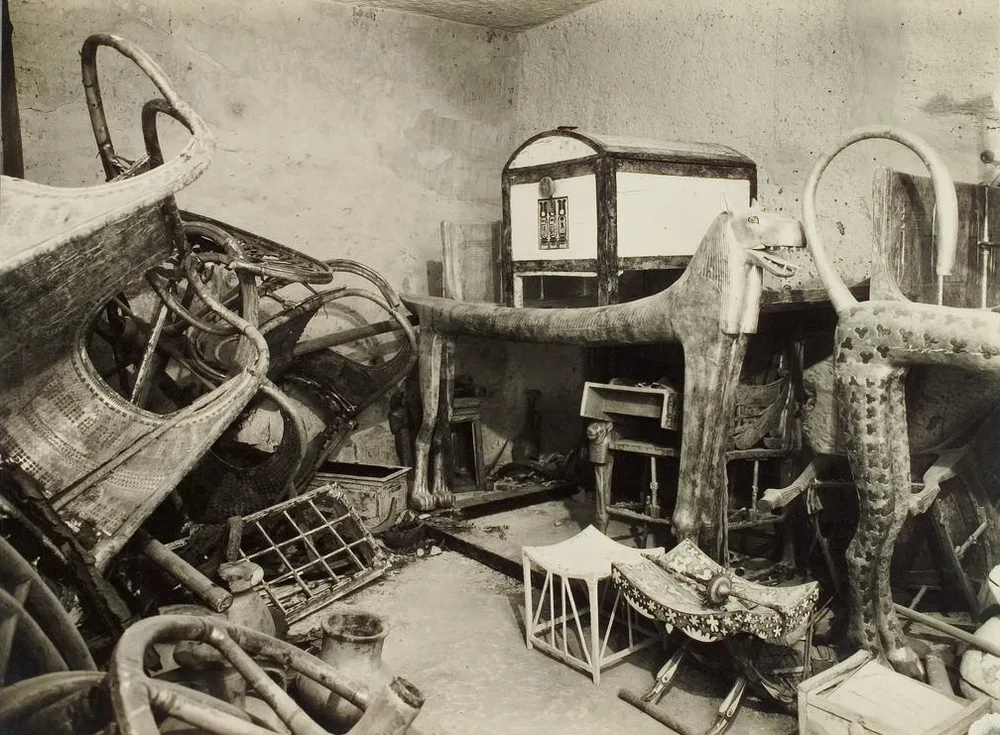
Harry Burton’s photograph of tomb contents as they were found, published in his album of Tutankhamun tomb photographs (vol. 2, 1922). Public domain via Wikimedia Commons; resized and converted to WebP.
How did Lord Carnarvon die?
George Herbert, 5th Earl of Carnarvon, was 57. The University of Manchester’s 2013 account, drawing on Egyptologist Joyce Tyldesley, notes that a serious car crash in Germany in 1901 had left him in fragile health. The widely accepted chain of events is a mosquito bite on his cheek, cut while shaving, followed by blood poisoning and illness.
His sister, Lady Burghclere, wrote the biographical sketch printed in Carter’s 1923 volume. She describes him as very tired at the end of the season and says a mosquito bit him, “the wound got poisoned”, and he declined over three weeks. The Mark Nelson study in the BMJ summarizes the cause as an infected bite leading to septicaemia and pneumonia.
There is a small disagreement over the date. Lady Burghclere’s sketch gives April 6, 1923. The University of Manchester and Princeton Alumni Weekly give April 5, which is the date most references use; Manchester marked the 90th anniversary on April 5, 2013. The difference does not change anything about the cause of death, but it is a useful reminder that even a family account written months later can carry slips.
Where did the curse story come from?
The story did not begin at the tomb. It began in the newspapers, and the reason is partly commercial. Carnarvon gave The Times an exclusive arrangement for news of the excavation. The Manchester account describes the result as other journalists left waiting outside, looking for stories they could publish without The Times’ cooperation.
One answer was to ask outside commentators. On March 24, 1923, while Carnarvon was ill, the Daily Express carried a statement by the bestselling novelist Marie Corelli. Manchester quotes her as asking whether it was “a mosquito bite that has so seriously infected” him. When he died days later, she was treated as having foreseen it. The phrase often presented as a tomb inscription, about death coming “on wings” to anyone who enters a pharaoh’s tomb, is attributed by Manchester to Corelli. It was widely accepted as carved in the tomb. No such inscription has been found.
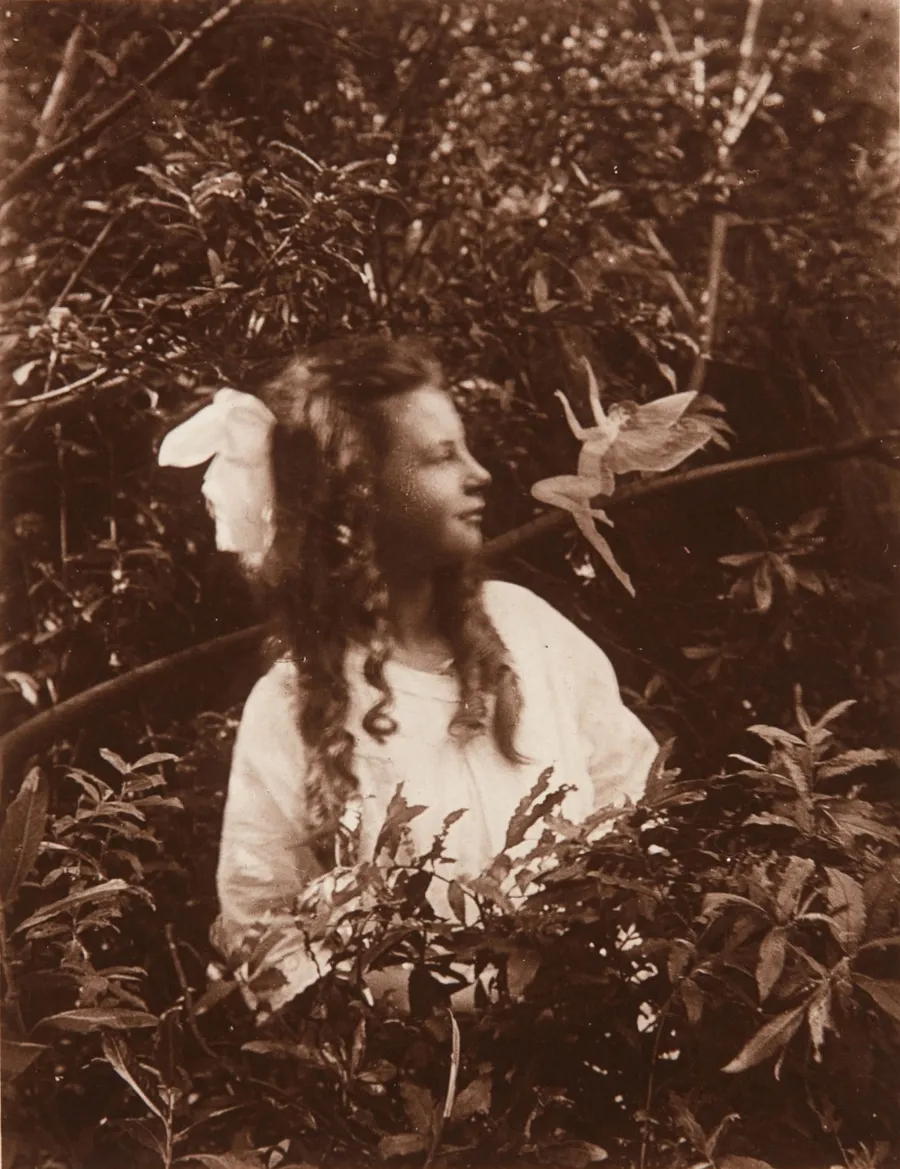
Arthur Conan Doyle supplied a supernatural explanation. A New York report printed in the Glasgow Herald on April 6, 1923, and transcribed by the Arthur Conan Doyle Encyclopedia, quotes him suggesting that “an evil elemental” might have caused the illness. Doyle was a committed spiritualist by then, the same conviction that led him to back the Cottingley fairy photographs and later to fall out with Harry Houdini. His remarks are evidence of what a famous man believed. They are not evidence about the tomb.
The idea of a mummy’s revenge was also already familiar from fiction. Nelson points to Louisa May Alcott’s 1869 story “Lost in a Pyramid; or, The Mummy’s Curse” as an example of the theme decades before Carnarvon’s death.
The omens, checked one by one
Two details carried the legend: the lights of Cairo failing at the moment of death, and Carnarvon’s dog dying at home in England at the same moment.
- The lights. Princeton Alumni Weekly, writing about an autograph album from the tomb’s public opening, notes that Cairo’s power failed as Carnarvon died, a coincidence recorded at the time as “curious”. Tyldesley’s point, reported by Manchester, is that power cuts in Cairo were common. A blackout in a city with an unreliable supply is weak evidence of anything.
- The dog. The story of Susie, Carnarvon’s dog, howling and dying at the same moment, appeared in the press. Manchester reports Tyldesley’s correction: allowing for the time difference between Cairo and England, Susie died about four hours after her master.
Neither detail is evidence of a curse. Both show how a coincidence grows sharper with each retelling.
Did the people who opened the tomb die early?
The curse required a body count, and the press supplied one. Manchester lists later deaths that were attached to the tomb, including Prince Ali Kemal Fahmy Bey, who was shot by his wife in 1923, Georges Bénédite of the Louvre in 1926 and Albert Lythgoe of the Metropolitan Museum in 1934. These people had very different lives and causes of death. Listing them together creates a pattern without testing one.
Mark Nelson, an epidemiologist at Monash University, did test it. His study, published in the BMJ on December 21, 2002, identified 44 Westerners whom Carter recorded as being in Egypt at the relevant times. Twenty-five were present at one or more of four key events: the breaking of the seals and opening of the burial chamber in February 1923, the sarcophagus opening, the coffin opening and the examination of the mummy, all in 1926. The others formed the comparison group. (Nelson dates the burial chamber opening to February 17; Carter’s journal records the sealed doorway being opened on February 16, with the official visit the next day.)
| Measure (Nelson, 2002) | Present at key events | Not present |
|---|---|---|
| Mean age at death | 70.0 years | 75.0 years |
| Mean survival after the events | 20.8 years | 28.9 years |
| Statistical significance | No significant difference (P=0.87 for age at death, P=0.95 for survival) |
Nelson concluded that there was no evidence for a mummy’s curse. He was also candid about the limits. The numbers were small, dates of death could be found for only 11 of the comparison group, almost all of the exposed group were men, and people present at famous events are more likely to have left a record. A study of 44 people cannot rule out every possible effect, but it does remove the main claim the legend makes: that those who entered the tomb died unusually young.
The point had been made long before. Nelson cites Herbert Winlock of the Metropolitan Museum of Art, who observed in 1934 that only six of the original 24 people present when the tomb was opened had died. The Manchester account adds that, of those who first entered the burial chamber, only Carnarvon died prematurely. Carter, the person most exposed of all, went on to publish two further volumes on the tomb.
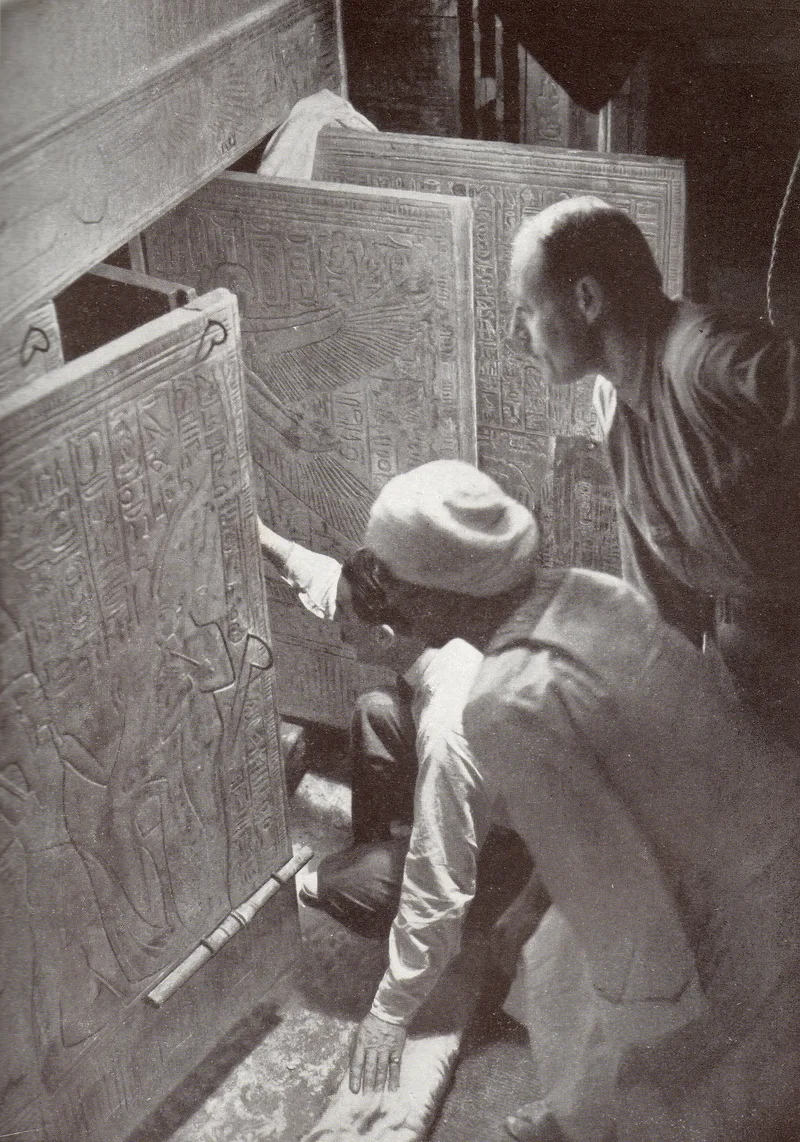
Howard Carter, an Egyptian workman and Arthur Callender at the doors of the burial shrines, photographed by Harry Burton in January 1924. The Commons file record notes the scene may have been re-enacted for the camera. Public domain via Wikimedia Commons; resized and converted to WebP.
What Carter said about it
Carter’s answer is in the preface to his second volume, published in 1927 and available in full at the Internet Archive. He separates two things. Ghost stories about tombs, he writes, are a legitimate form of literary amusement. But claims of real physical danger in the tomb he calls mendacious and close to libellous, adding that “all sane people should dismiss such inventions with contempt.”
He also states that scientific examination found the tomb sterile when it was opened, and that any germs inside afterwards were brought in from outside. That is Carter’s statement about tests made at the time; he does not give the details in the preface, so it should be read as his account rather than an independent laboratory report. Later suggestions about mould, bacteria or toxic dust are theories proposed long after the event. None of the sources reviewed here links any of them to Carnarvon’s illness, which is consistently described as an infected bite.
Documented, claimed and disputed
Documented:
- The tomb was found in November 1922 and the burial chamber opened in February 1923 (Carter’s journal).
- Carnarvon died in Cairo in April 1923 after an infected bite and illness (Lady Burghclere, Nelson, Manchester).
- Marie Corelli’s warning appeared in the Daily Express on March 24, 1923, before his death (Manchester).
- Carter publicly rejected the curse in 1927.
- A 2002 cohort study found no survival difference linked to exposure.
Claimed or reported, without support as evidence of a curse:
- A curse inscription in the tomb.
- Cairo’s lights failing as a sign.
- Carnarvon’s dog dying at the same moment.
- Doyle’s “evil elemental”.
Disputed or minor uncertainties:
- Carnarvon’s date of death (April 5 in most sources, April 6 in Lady Burghclere’s 1923 sketch).
- The exact source of the “death on wings” wording, which is attributed to press commentary rather than to any ancient text.
Theory:
- Fungal spores or other tomb hazards as a cause of death. These are later hypotheses, not findings about Carnarvon’s case.
The pattern is similar to other cursed-object legends on Morbid Index, from the Dybbuk Box to Robert the Doll: a real object and real people, followed by a selective list of misfortunes that is rarely compared with what would have happened anyway.
Frequently asked questions
Is there a curse written in Tutankhamun’s tomb?
No such inscription has been found. The famous wording about death coming “on wings” circulated in the 1923 press and was then presented as if it came from the tomb.
What really killed Lord Carnarvon?
The sources agree on an infected mosquito bite on his cheek, cut while shaving, followed by blood poisoning and pneumonia. He was 57 and had been in poor health since a 1901 car accident.
Did Howard Carter die because of the curse?
No. Carter continued working on the tomb for years after Carnarvon’s death, published further volumes about it in 1927 and 1933, and publicly dismissed curse stories.
Has anyone studied the curse scientifically?
Yes. Mark Nelson’s 2002 study in the BMJ compared 25 Westerners present at key openings with others in Egypt at the time and found no significant difference in survival.
Why did the curse story spread so fast?
Carnarvon’s exclusive deal with The Times left rival newspapers short of material. Commentary from Marie Corelli and Arthur Conan Doyle, and coincidences such as the Cairo blackout, filled the gap.
Sources & further reading
- Griffith Institute, University of Oxford: Tutankhamun: Anatomy of an Excavation, Howard Carter's 1922-23 excavation journal (accessed November 3, 2026)
- Howard Carter and A. C. Mace, The Tomb of Tut-ankh-Amen, vol. 1 (1923), with Lady Burghclere's biographical sketch of Lord Carnarvon, full text at the Internet Archive (accessed November 3, 2026)
- Howard Carter, The Tomb of Tut-ankh-Amen, vol. 2 (1927), preface, full text at the Internet Archive (accessed November 3, 2026)
- Mark R. Nelson, The mummy's curse: historical cohort study, BMJ 325:1482 (December 21, 2002), PubMed Central
- University of Manchester: 90th anniversary of the curse of Tutankhamen: how a modern myth was born (April 4, 2013)
- W. Barksdale Maynard, Princeton Alumni Weekly: From Princeton's attic: A scrapbook and a pharaoh's curse (October 13, 2010)
- An Evil Elemental, The Glasgow Herald, April 6, 1923, p. 10, transcription at the Arthur Conan Doyle Encyclopedia (accessed November 3, 2026)