The Index / Unidentified Persons
The Isdal Woman: What Is Known About the Unidentified Woman Found in Bergen in 1970
A burned woman was found in Isdalen near Bergen on 29 November 1970. Her name is still unknown. What the police, NRK and the tooth analysis show, and what is only theory.
Topics: Isdal Woman, Isdalen, Bergen, Norway, Unidentified remains, Cold case, 1970
On 29 November 1970 a family out walking found the burned body of a woman on a scree slope in Isdalen, a valley near Bergen, Norway. She has never been identified. Police at the time concluded that she most likely took her own life, but the identification papers she carried were false, every label had been removed from her belongings, and later forensic work has narrowed where she may have grown up without giving her a name.
This guide goes through what was found, what the 1970 investigation concluded, what NRK and the police added from 2016 onward, and which parts of the popular story are theory. Because she is an unidentified person, the aim here is to describe the record without guessing at who she was or why she died.
What happened in Isdalen on 29 November 1970?
According to NRK, a 12-year-old girl who was out walking with her father and younger sister spotted the body between large rocks on the slope above Isdalen. There were no mobile phones, so the family had to walk around the lake Svartediket to report it. The woman was lying on her back and was severely burned.
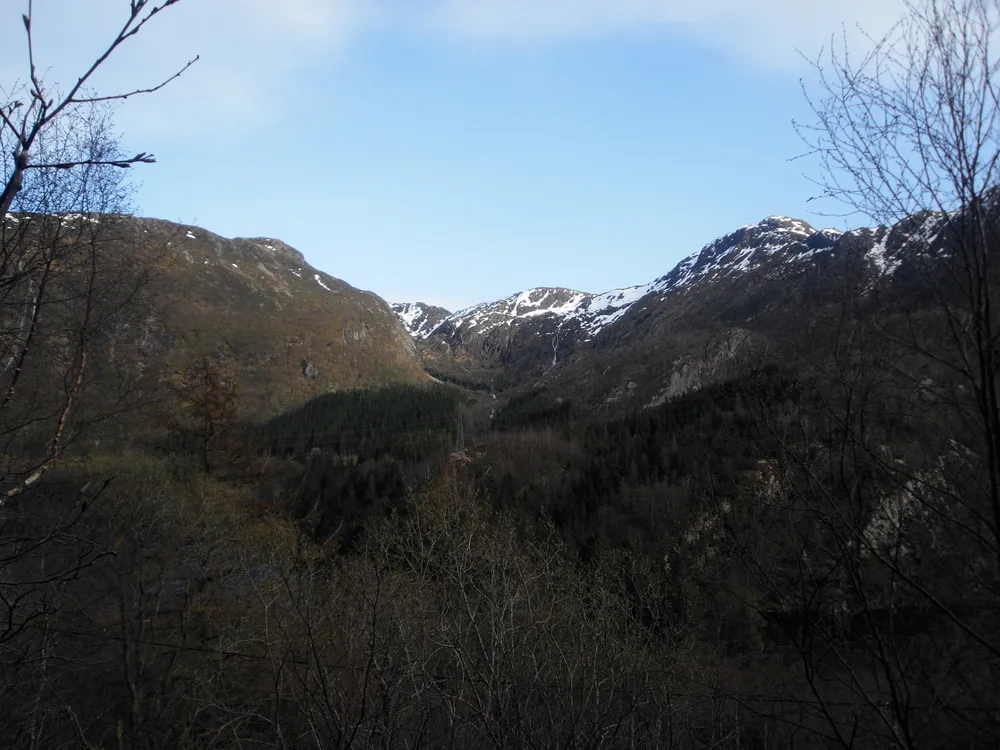
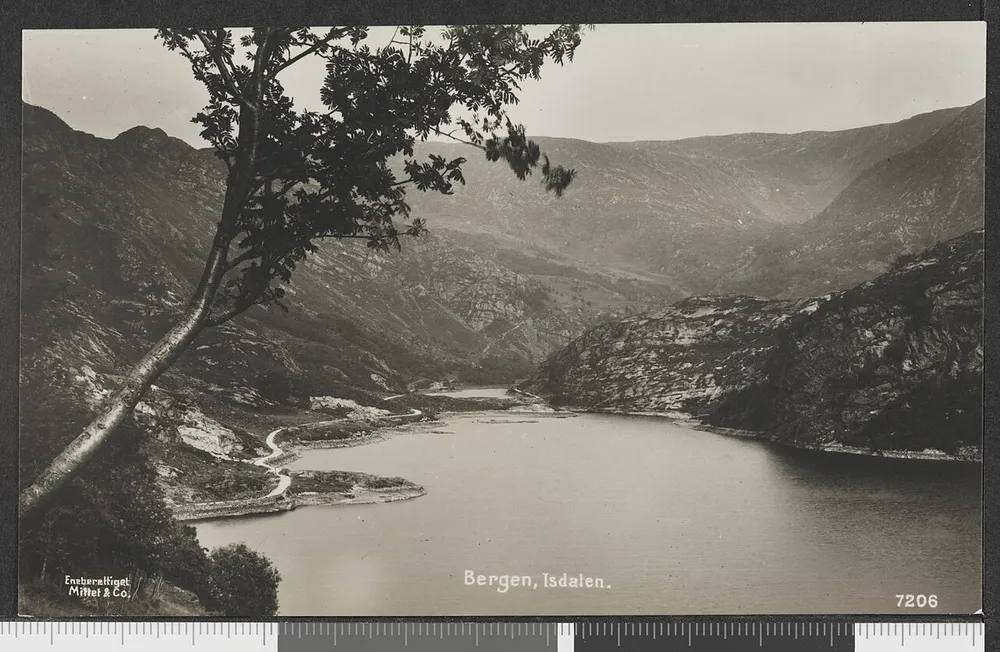
Isdalen near Bergen, photographed in April 2009 by Reinhardheydt. Public domain (PD-self) via Wikimedia Commons; resized and converted to WebP. The photograph shows the landscape only and has no connection to the 1970 scene.
NRK’s account lists what lay around her: charred clothing, an umbrella, carrying equipment, two melted plastic bottles, a half-empty bottle of a state liquor monopoly liqueur and the remains of what may have been a passport cover. The manufacturer labels had been cut out of the clothing and scraped from the bottles. The case was registered as 134/70, the number still used for her.
What was in the suitcases?
Three days later, police found two suitcases in the left-luggage office at Bergen railway station. NRK reports that a fingerprint on a pair of sunglasses matched the dead woman, which tied the luggage to her. The cases held several wigs, spectacles with plain glass, and everyday items such as a comb and hairbrush, again with labels removed. A shopping bag from a shoe shop in Stavanger led police to a pair of rubber boots she had bought there, according to the shop owner’s son as quoted by NRK.
The most useful item was a writing pad filled with coded entries. Police decoded it as a log of her travel. NRK gives her final route as Paris, Stavanger, Bergen, Trondheim, Stavanger and Bergen again. She stayed in hotels under different names. NRK says police linked her to at least eight identities, all false, including Finella Lorck, Claudia Tielt, Vera Jarle, Alexia Zarna-Merchez, Claudia Nielsen, Genevieve Lancier and Elisabeth Leenhouwfr, with Belgian nationality given at least at one Bergen hotel. Belgian police told the investigators that all the identities were false.
NRK’s own pages count the identities differently (seven or more in one place, at least eight in another), and the spelling of some names varies between accounts. Treat the exact number and spellings as approximate.
Johan Christian Dahl, ‘Isdalen at Svartediket near Bergen’, 1842. National Museum of Art, Architecture and Design, Oslo; public domain via Wikimedia Commons; resized and converted to WebP. A 19th-century landscape, shown for the place only.
What did the autopsy and the police conclude?
The 1970 findings, as summarised by NRK, were:
- Sedatives. The autopsy found a large amount of the sleeping medicine sold as Fenemal, taken in several doses in the hours before death. Many tablets had not dissolved.
- Cause of death. The medical conclusion was a combination of the sedative poisoning and carbon monoxide, with the burns possibly contributing. NRK says the sedative alone was not judged to be the sole cause.
- Petrol. Kripos chemist Tormod Bønes isolated a small amount of petrol from the soil beneath the body. NRK says he supported the 1970 report but held that homicide or an accident could not be ruled out.
- Verdict. Bergen’s police chief, Asbjørn Bryhn, concluded: “Suicide.” Active police work largely stopped afterward. Crime reporter Knut Haavik rejected that view and regarded the case as a killing, NRK reports.
So the official 1970 position was suicide, but the authors of the record themselves left room for other explanations, and the position was never tested against an identity.
The teeth: what did dental work show?
Her dental work was unusual. NRK says ten teeth carried gold crests, most of them preformed crests, and that Professor Gisle Bang judged this uncommon in Scandinavia, without being able to say where it was done. The police description sent to Interpol and other forces in 1970 gave an age of about 25 to 30, a height of 164 cm, slim, long brownish-black hair, brown eyes, and dental work “of a kind practised in the Far East, Central or Southern Europe, and South America”.
That age estimate has since been revised. NRK reports that in 2017 experts at the Karolinska Institute in Sweden found she may have been between 36 and 44 when she died, born around 1930 plus or minus four years. This is an estimate, not a documented date.
What changed from 2016 onward?
In November 2016 NRK, working with Kripos and Police District West, reported that previously unexamined material from 1970 had been found and that a DNA profile had been obtained from preserved tissue samples. NRK states that the DNA shows European genetic characteristics. An updated Interpol “black notice”, dated 10 May 2017, carried the profile.
The tooth enamel work followed. According to NRK’s report of 19 May 2017, isotope analysis of strontium and oxygen in three teeth was interpreted by Professor Jurian Hoogewerff of the University of Canberra, with Kripos staff Knut-Endre Sjåstad and Per Angel. Enamel takes up these elements from food and water while it forms, so teeth formed at different ages record different places. The report says:
- France and Germany stood out on the probability maps for both her childhood (about age 4) and her teenage years (about age 14);
- the pattern suggested a move from eastern or central Europe toward western Europe, possibly immediately before or during the Second World War;
- NRK adds that handwriting analysis and the dental examinations make areas such as the United Kingdom less likely, and that Kripos saw the UK and Spain as less likely than France and Germany because of other leads; the handwriting suggests she may have learned to write in France.
NRK’s November 2016 page, as updated in 2018, also puts her childhood at the Franco-German border, and mentions possible origins near Nuremberg. Wikipedia repeats a Nuremberg-area birth as “most likely”. Those details are best read as probabilities from a method that had never been used in a Norwegian criminal case before, not as an identification. No source I could open reports that a relative has come forward.
What is documented, claimed and unresolved?
| Category | Items |
|---|---|
| Documented | A woman’s body was found in Isdalen on 29 November 1970. Labels had been removed from her belongings. Two suitcases at Bergen station were linked to her by a fingerprint. She used multiple false identities. The autopsy found sedatives and carbon monoxide. Police concluded suicide in 1970. A DNA profile and an Interpol notice followed in 2017. |
| Reported findings, interpretation required | The isotope-based origin (France and Germany), the revised age (born about 1930), the handwriting indication of French schooling. |
| Disputed | Suicide versus homicide. Whether the removal of labels and use of wigs shows concealment of identity for crime, for espionage, or for personal reasons. |
| Theory without public proof | Intelligence work, a claim that her travel matched missile tests, a link to a named banker. Wikipedia reports these as claims made in books and newspaper pieces, some from anonymous informants. None has been confirmed by police. |
| Unresolved | Her name, her nationality, why she was in Bergen, and whether anyone was with her. |
Why do the espionage stories persist?
Everything about the case invites a larger story. The false names, the code, the wigs and the removed labels look deliberate. Wikipedia reports that some writers have tied her movements to missile tests near Stavanger, and a 2023 newspaper article has linked her to a named banker. These are claims, and the public record contains no evidence that settles them.
A source-critical reading separates two points. The concealment is documented. The reason for it is not. A person might remove labels and use false names for many reasons, from work to a personal secret to an intention that nobody should be able to trace her afterward. A 1970 suicide ruling did not need that question answered, and nobody later has been able to answer it with evidence.
It is worth noting how stories like this grow around gaps. The same habit of treating an unexplained detail as a sign of a hidden plot shows in other unidentified-person cases such as the Somerton Man, and in cipher stories like the Beale ciphers. In the Isdal case the code was real and was cracked, and what it gave police was a travel log, not a confession or a name.
How was she buried?
NRK says she was buried in a Catholic ceremony in Bergen in a zinc coffin, with no tombstone, and that the funeral was conducted by the Catholic parish priest. Wikipedia says the Catholic rite was chosen because of saints’ names on her papers; I could not confirm that detail in NRK’s account. The dates differ in NRK’s own pages: the main 2016 article places the burial in February 1971, while the updated 2018 page says March 1971. Wikipedia gives 5 February 1971. The sources agree that no relatives were present.
Where does the case stand now?
The case remains open. The latest dated reporting I could open is NRK’s from 2016 to 2018 and Life in Norway’s 2024 update, which still describes it as unsolved. Wikipedia describes later podcast work and tips, including a 2019 mention of genetic genealogy, but I could not open the BBC pieces it cites and so do not rely on them here. If you believe you have information, NRK’s page for the case directs people to contact local police, who can collect samples and run them against police databases.
For a different case, with an identified victim but a similar pile of online speculation, see the Cecil Hotel and Elisa Lam case, which shows how to separate the record from rumour.
Frequently asked questions
Who was the Isdal Woman?
Nobody knows. She was never identified, and every name she used in 1970 was false, according to Belgian police as reported by NRK.
Was the Isdal Woman murdered?
Not established. Police concluded suicide in 1970, and the chemist who found petrol traces said homicide or an accident could not be ruled out. No suspect has ever been named by police.
Was she a spy?
That is a theory, not a finding. The claims come from books, articles and informants, and no police statement supports them.
Where was the Isdal Woman from?
Isotope analysis of her teeth, interpreted for Kripos in 2017, suggests France and Germany, with a move during her youth. Her DNA shows European heritage. The result narrows the search but names no one.
Where is Isdalen?
Isdalen is a valley near Bergen in western Norway. The family who found her walked around the lake Svartediket to report it, according to NRK.
Sources & further reading
- NRK, 'The Isdalen mystery' (Ståle Ellingsgard Hansen et al., published 29 November 2016; accessed 31 October 2026)
- NRK, 'Do you remember this woman?' (published 29 November 2016, updated 9 March 2018; contains the police description sent to Interpol and a link to the Interpol notice dated 10 May 2017; accessed 31 October 2026)
- NRK, 'Chemical analyses of the Isdal woman point to Germany and France' (19 May 2017; accessed 31 October 2026)
- Wikipedia: Isdal Woman, used as a secondary overview and for its reference list, including BBC News coverage of 2017 and 2019 (accessed 31 October 2026)
- Life in Norway, 'The Unsolved Mystery of the Isdal Woman' (last updated 1 September 2024; accessed 31 October 2026)
- Wikimedia Commons file records for the three images used (accessed 31 October 2026)