The Index / Hoaxes
The Beale Ciphers: A Buried Treasure Story That Rests on One Pamphlet
The Beale ciphers promise gold buried in Virginia. See what the 1885 pamphlet says, how one cipher was 'solved', and why the story has no independent proof.
Topics: Beale Ciphers, Buried Treasure, Cryptography, Virginia, Hoaxes, Unsolved Mysteries
The Beale ciphers are three sheets of numbers said to reveal where a man named Thomas J. Beale buried a fortune in gold, silver and jewels in Bedford County, Virginia, in 1819 and 1821. Everything we know about them comes from a single 1885 pamphlet. One cipher appears to have been solved, the other two have not, and no independent record has been found that the story the pamphlet tells ever happened.
That last point is the key to reading the case. A genuinely unsolved cipher and an unverified story are separate problems. The first can be studied in numbers. The second needs documents, and the documents are missing.
What does The Beale Papers say?
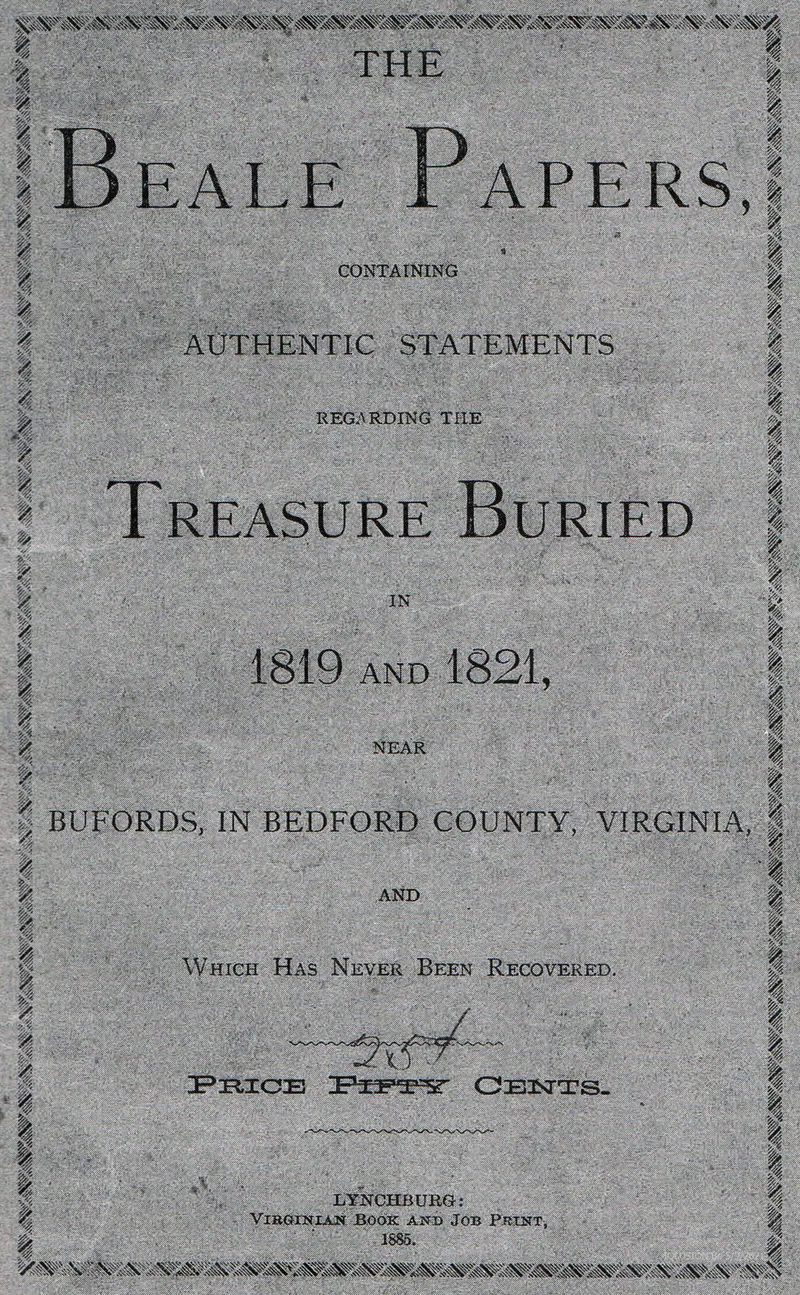
The Beale Papers was printed in Lynchburg, Virginia, in 1885 by the Virginian Book and Job Print and sold for fifty cents, according to its cover. The copyright notice names J. B. Ward. The narrator never gives his own name: he says he is withdrawing it and has left publication to an unnamed agent who had known Robert Morriss, a Lynchburg innkeeper. The pamphlet does not say that Ward is that agent, and it does not say Ward is the narrator.
The cover of the 1885 pamphlet. Public-domain scan via Wikimedia Commons; resized and converted to WebP.
The pamphlet’s own account runs as follows:
- In January 1820, a man calling himself Beale stayed at Morriss’s Washington Hotel in Lynchburg for the winter, then left.
- He returned in January 1822, and that spring left a locked iron box with Morriss. A letter from St. Louis dated May 9, 1822 said he would be gone for at least two years.
- Beale never came back. The pamphlet says he had promised, under certain circumstances, to send a key to the papers, and that it never arrived. Morriss, it says, broke the lock in 1845 and found papers covered in numbers.
- In 1862, Morriss told the narrator, who spent years trying to read them.
According to Beale’s own letters as printed, he and a party found gold and silver north of Santa Fe, and buried it in Virginia in two deposits. The first, in November 1819, was 1,014 pounds of gold and 3,812 pounds of silver. The second, in December 1821, was 1,907 pounds of gold, 1,288 pounds of silver and jewels valued at $13,000. Together that is 2,921 pounds of gold and 5,100 pounds of silver. The vault is described as about four miles from Buford’s tavern in Bedford County, six feet down, lined with stone and packed in iron pots. The pamphlet puts the total at more than three-quarters of a million dollars in 1885 money.
Everything in this list is what the pamphlet states. It is not an independently documented sequence of events.
What are the three ciphers?
Each is a list of numbers. According to the pamphlet, they contain:
| Cipher | Said to contain | Status |
|---|---|---|
| No. 1 | The exact location of the vault | Unsolved |
| No. 2 | A description of the treasure and the vault | Presented as solved in the pamphlet |
| No. 3 | Names of Beale’s partners and their next of kin | Unsolved |
The narrator says he tried the numbers against every book he could obtain until the Declaration of Independence gave him the clue to one of the papers. Each number points to a word in the Declaration, and the first letter of that word gives one letter of the message. The pamphlet prints the Declaration with every tenth word numbered, so readers can check.
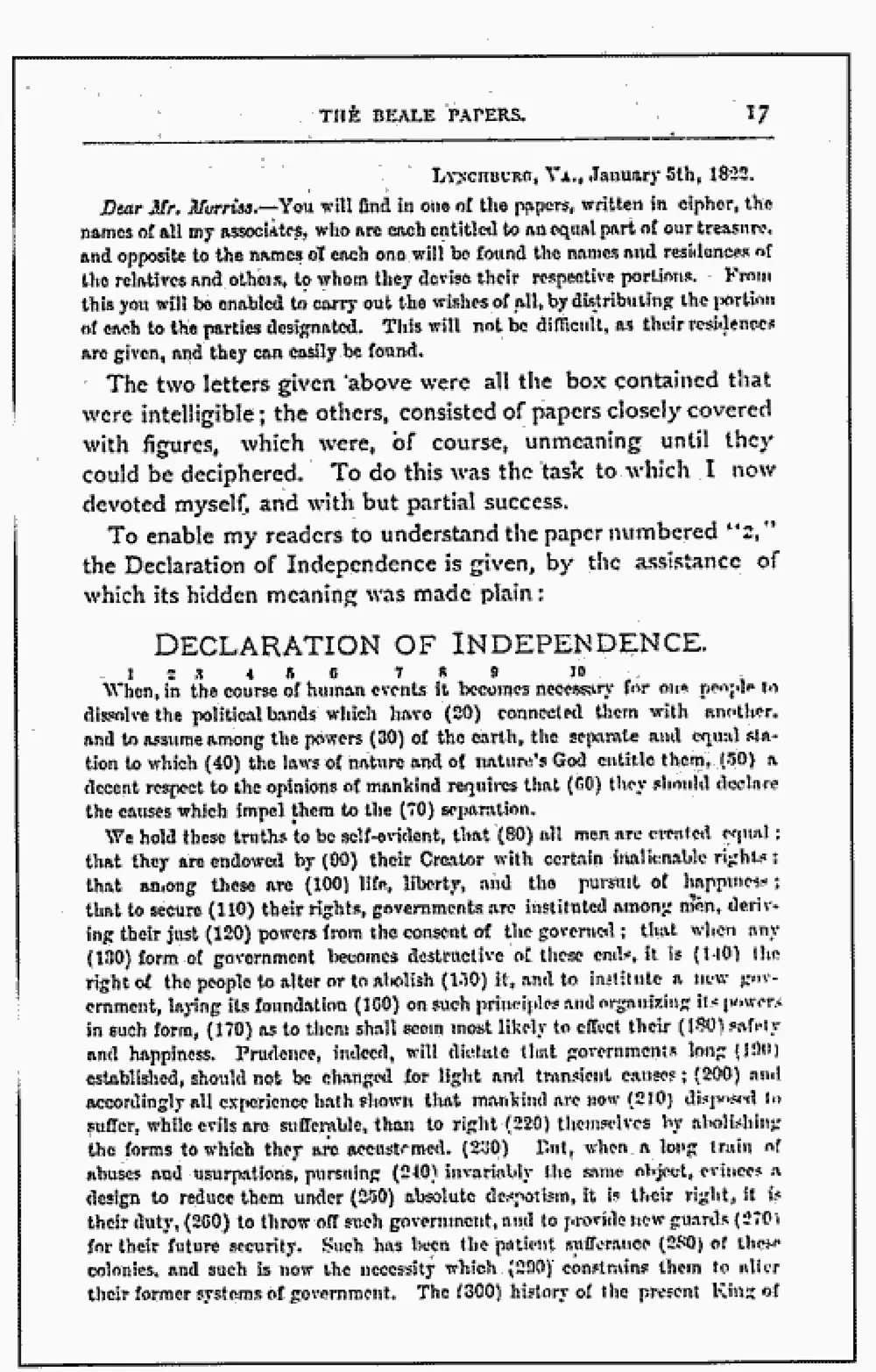
Page 17 of the 1885 pamphlet, introducing the Declaration of Independence as the key to cipher No. 2. Public-domain scan via Wikimedia Commons; resized and converted to WebP.
The message that results is the description of the deposit quoted above. The narrator says that at first he thought he had the key to all three, but the Declaration did not work for the others. He says he devoted most of his time to No. 1, which gives the location, without success.
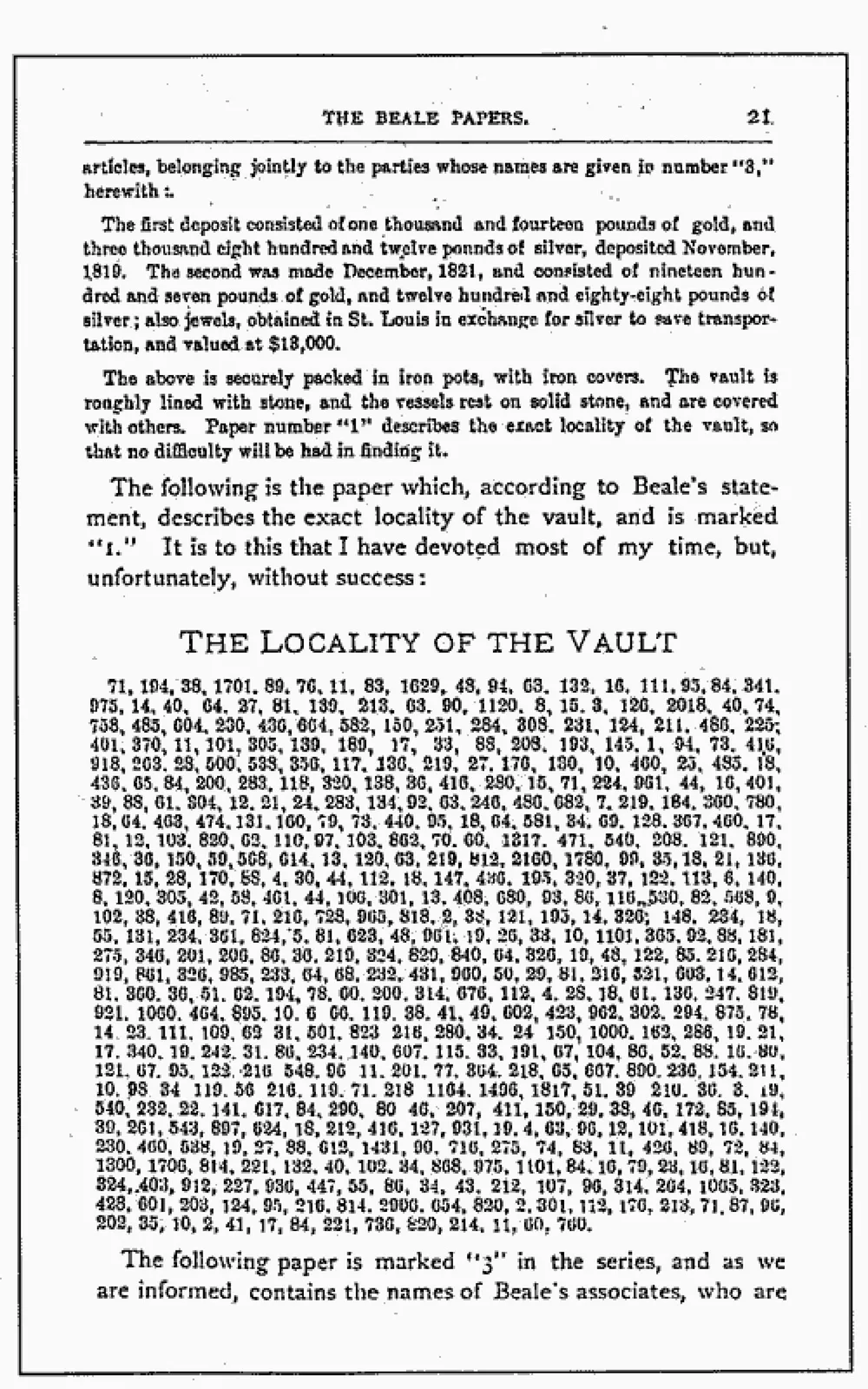
Page 21 of the 1885 pamphlet, showing cipher No. 1, “The Locality of the Vault”. Public-domain scan via Wikimedia Commons; resized and converted to WebP.
How well does the “solved” cipher hold up?
Critics have pointed out that applying the Declaration key exactly as printed does not cleanly reproduce the message. The summary of later analyses on Wikipedia reports that the key text needs several modifications before it yields the pamphlet’s decipherment, and that the decipherment contains probable errors. In an editorial check for this article, we applied the pamphlet’s stated rule to the Declaration text printed in the pamphlet. The result matched parts of the described message and then drifted into noise. That is consistent with those reports, but it is a limited test, not a published cryptanalysis.
Cipher No. 1 has been tested too. Wikipedia attributes to the American Cryptogram Association the observation that decoding it with the Declaration produces alphabetical runs, such as “abcdefghiijklmmnohpp”, which are very unlikely to arise by chance. Whether that means a failed attempt at a hoax or something else is a matter of interpretation. The cipher itself has not been broken by anyone.
Is there evidence that Thomas Beale existed?
No independent evidence for the story has been found. Skeptoid summarises the research of Joe Nickell (1982), who found no record of a Thomas Jefferson Beale of the right age, and reports that the pamphlet places Beale at Morriss’s hotel before Morriss became its proprietor. Wikipedia’s summary of Nickell and of William Poundstone’s work likewise says contemporary records place Morriss at the hotel only from around 1823.
Two further points are disputed and should be handled with care:
- Anachronisms. The pamphlet’s text includes the words “stampeding” and “improvised” in Beale’s letter. Critics, as summarised by Skeptoid, say these words were not yet in use in the 1820s. Simon Singh, writing in The Guardian in 1999, notes that “stampede” may have been used orally before it appeared in print.
- Authorship. Nickell, with the cryptologist Louis Kruh, argued from stylometric comparison that the pamphlet and Beale’s letters share an author, according to the Skeptoid summary. If so, Beale’s letters would be part of the pamphlet’s composition, not independent documents.
Singh also reports that some historical research has identified Virginians named Thomas Beale who fit the broad facts, and mentions a journal from 1821 to 1822 that describes a group of roughly the same size as Beale’s party. Those claims are described secondhand here and have not been checked against the originals. They do not amount to documentation of the party, the mine or the vault.
Was the pamphlet written as a puzzle?
Several researchers argue that it was. Nickell, per Wikipedia, saw the story as a Masonic allegory of a secret vault, and noted that Ward was a Freemason. This is an interpretation, not a proven origin. What can be said without speculation is that the pamphlet is anonymous in its narration, names Ward only in the copyright entry, and offers no confirmation by anyone other than the narrator.
Skeptoid reports that Ward later claimed remaining copies were destroyed in a fire at a print shop, and that no newspaper record of such a fire has been found. That is a single source and should be treated as such.
Has anyone searched for the treasure?
Yes. Treasure hunters have dug in Bedford County for generations. According to Wikipedia’s summary, some have been arrested for trespass, and digs on Porter’s Mountain in the late 1980s found only Civil War artifacts. Skeptoid says that no dig has found treasure. The absence of a find does not disprove the story, but combined with the absence of any outside record it leaves the claim unsupported.
For anyone tempted to search, two points are worth stating plainly. The location in the pamphlet is only given in the unsolved cipher, so no one knows where the vault is supposed to be. And digging on private land without permission is trespass.
What is documented, claimed and uncertain?
| Category | Statement |
|---|---|
| Documented | A pamphlet titled The Beale Papers was printed in Lynchburg in 1885 and registered under J. B. Ward’s name. |
| Documented | It prints three number ciphers and a text of the Declaration of Independence. |
| Claim (by the pamphlet) | Thomas J. Beale deposited gold, silver and jewels in Bedford County in 1819 and 1821. |
| Claim (by the pamphlet) | Robert Morriss kept an iron box from 1822, opened it in 1845 and passed the story on in 1862. |
| Disputed | Whether the Declaration key legitimately decodes cipher No. 2. |
| Unsolved | Ciphers No. 1 and No. 3. |
| Not found | Any independent record of Beale, his party, the shipment or the vault. |
| Interpretation | That the pamphlet is a literary hoax or allegory; argued by critics, not proven. |
Why does it endure?
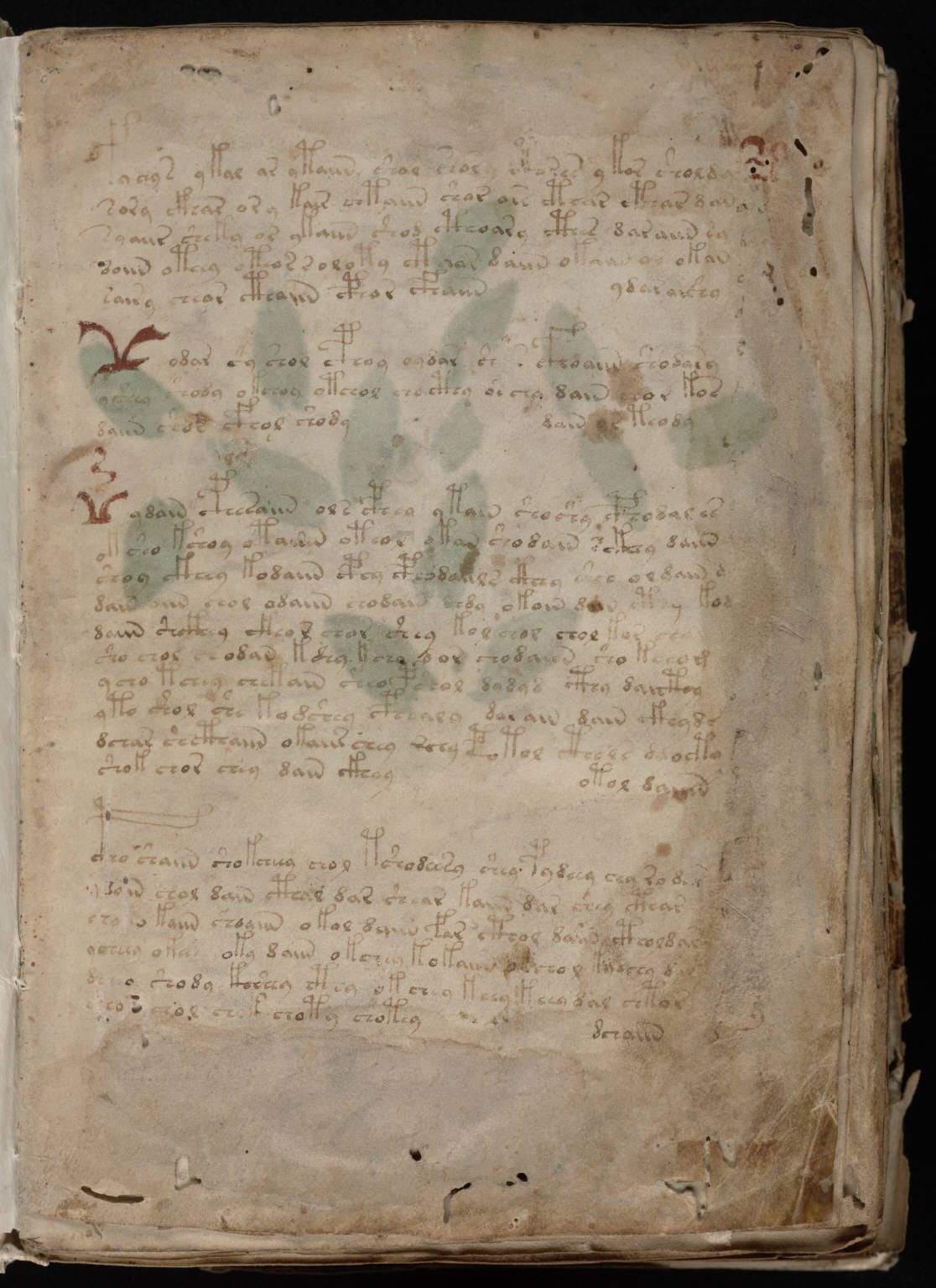
The story offers a satisfying promise: a solution is worth a fortune, and it may be one clever idea away. Cryptographers also keep returning to it because two of the three ciphers do remain unbroken. Still, a cipher that cannot be read does not prove that it contains a message. The same problem confronts readers of the Voynich manuscript and the unsolved short ciphers of the Zodiac case.
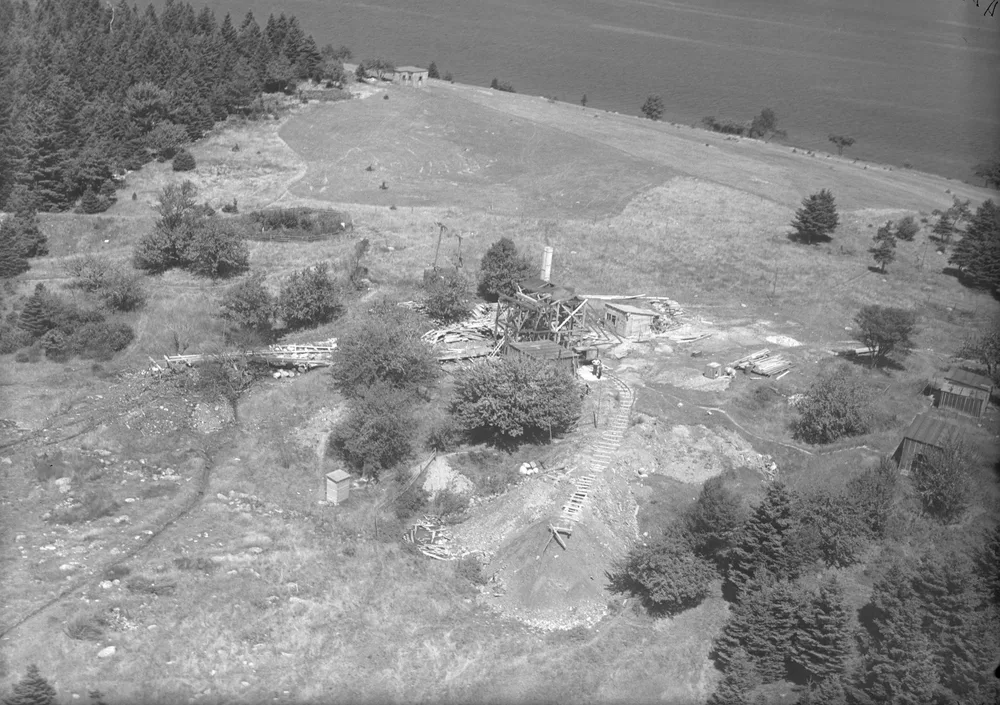
The Beale story shares another feature with lost-loot cases like D. B. Cooper’s hijacking: an appealing narrative can persist for a long time without the physical evidence that would anchor it. A more recent case where a coded clue sat at the centre of an identification dispute is the Somerton Man and the Tamam Shud code. A coded notebook also sits at the centre of the Isdal Woman case, where the cipher turned out to be a travel log rather than a name. Nova Scotia’s Oak Island Money Pit shows the same problem from the other direction, with a treasure story resting on letters written by the people digging for it.
Frequently asked questions
Is the Beale treasure real?
There is no independent evidence that it is. The only source is the 1885 pamphlet, and attempts to verify its characters and dates have not succeeded.
Has any Beale cipher been solved?
The pamphlet presents cipher No. 2 as solved using the Declaration of Independence. Critics dispute how cleanly that works. Ciphers No. 1 and No. 3 are unsolved.
Who wrote The Beale Papers?
The pamphlet names J. B. Ward in its copyright entry; its narrator is anonymous. Some researchers believe Ward wrote it himself, which is an argument, not a documented fact.
Where is the Beale treasure supposed to be buried?
The pamphlet says it is in Bedford County, Virginia, about four miles from Buford’s tavern. Cipher No. 1, which is said to give the exact spot, has not been read.
Has anyone found the treasure?
No. Searches in Bedford County have not produced a confirmed find.
Sources & further reading
- The Beale Papers (Lynchburg: Virginian Book and Job Print, 1885), transcription on Wikisource from the Commons scan (accessed October 31, 2026)
- The Beale Papers, 1885 pamphlet, page scans on Wikimedia Commons (accessed October 31, 2026)
- Brian Dunning, Skeptoid #301: The Beale Ciphers (March 13, 2012)
- Simon Singh, The Beale Treasure Ciphers (The Guardian, 1999; republished on simonsingh.net)
- Beale ciphers, Wikipedia: summary of later analyses by Nickell, Kruh, Gillogly and others (accessed October 31, 2026)