The Index / Dark History
Malleus Maleficarum Explained: The Witch-Hunting Manual and Its Real Influence
The Malleus Maleficarum is real, and its author really did fail as a witch-hunter first. What's exaggerated is how influential this one condemned, controversial book actually was.
Topics: Malleus Maleficarum, Witch Trials, Dark History, Heinrich Kramer, Medieval History
Public Domain, via University of Sydney Rare Books / Wikimedia Commons
The Malleus Maleficarum is a real book, written by a real Catholic inquisitor whose own church condemned it within a few years of publication. It’s often described online as the Church’s official witch-hunting manual, the theological foundation for centuries of European witch trials. That version overstates the book’s actual, documented influence. The real story is stranger and more specific: a failed witch-hunter, publicly humiliated in his own trial, went home and wrote a book to vindicate himself — and the church he served rejected it almost immediately.
Who Wrote It
The Malleus Maleficarum was published in 1486 in Speyer, in what is now Germany, under the authorship of Heinrich Kramer, a Dominican friar and inquisitor also known by the Latinized name Henricus Institor. For centuries the book was credited to two authors, Kramer and fellow inquisitor Jacob Sprenger, but that co-authorship claim is now disputed by historians. Sprenger’s name wasn’t added to the work until 1519, thirty-three years after its original publication and twenty-four years after Sprenger’s death. Historian Wolfgang Behringer has argued this was a fabrication on Kramer’s part, and there’s evidence Sprenger actually opposed Kramer during his lifetime, reportedly barring him from preaching and from staying at convents in his province.
The Trial That Led to the Book
The Malleus wasn’t written from a position of institutional authority and confidence. It was written after a public failure. In 1485, Kramer organized a witch trial in Innsbruck, drawing on a papal bull he’d obtained the previous year that gave him some authorization to investigate witchcraft. Around fifty people, most of them women, were denounced and investigated; seven, including a woman named Helena Scheuberin, were formally charged and faced potential death sentences.
The trial collapsed. The local bishop, Georg Golser, grew concerned about Kramer’s conduct — including his fixation on Scheuberin’s sexual history, which Kramer had introduced at length into the proceedings — and the defendants were ultimately acquitted. Golser reportedly dismissed Kramer as senile and effectively expelled him from the diocese. Kramer, professionally humiliated, left for Cologne and wrote the Malleus Maleficarum in the aftermath, presenting it as both an instructional manual for identifying and prosecuting witches and as a defense of the very approach that had just failed him publicly.
What the Book Actually Argued
The Malleus laid out a theological and legal case that witchcraft was real, constituted heresy, and demanded aggressive prosecution, including torture to extract confessions and execution as the standard remedy. It also built its argument on explicitly misogynistic claims, asserting that women were inherently weaker in faith and therefore more susceptible to demonic influence than men — a framing that shaped much of the document’s reasoning about who was likely to be a witch in the first place.
How the Church Actually Responded
This is the part most retellings skip entirely. In 1490, just a few years after publication, the Faculty of Theology at the University of Cologne formally condemned the Malleus, criticizing both its theological inconsistencies and its recommended legal procedures as improper. The papal bull Kramer had obtained in 1484, Summis desiderantes affectibus, is often cited as if it were the Church’s endorsement of the finished book, but it predates the Malleus entirely — it authorized Kramer’s earlier investigative activity, not the specific contents of a text he hadn’t written yet. The institutional Church’s actual documented response to the finished Malleus was rejection, not endorsement.
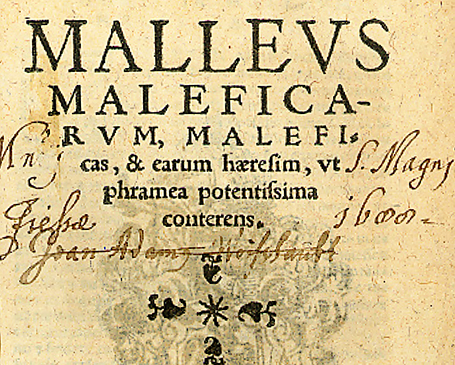
Title page from a 1520 Cologne printing of the Malleus Maleficarum — printed in the same city whose theology faculty had formally condemned the work three decades earlier. Source. Public domain.
Real Influence, Not Official Doctrine
None of this means the Malleus was harmless or irrelevant. It went through roughly 28 editions between 1486 and 1600, and the printing press let it circulate more widely and more quickly than a handwritten manuscript ever could have. It was genuinely read and genuinely used, primarily by secular courts rather than ecclesiastical ones — the actual Inquisition largely disregarded the legal procedures Kramer recommended. Its influence on the witch trials that followed across the next two centuries was real but regional and uneven, not the singular, church-authorized rulebook it’s often described as today. Historians studying the broader witch-hunting period generally point to a combination of factors — Reformation-era religious conflict, local political pressures, economic stress, and existing folk belief — as bigger drivers of specific witch panics than any one printed text, the Malleus included.
Modern Misrepresentation
Popular culture, and a lot of casual internet history, still treats the Malleus Maleficarum as the Catholic Church’s official witch-hunting manual: sanctioned from the top, uniformly applied, directly responsible for the era’s worst excesses. The documented record doesn’t support that framing. It was a controversial, formally condemned text written by a discredited inquisitor trying to salvage his reputation, later picked up unevenly by secular authorities who found its arguments useful for prosecutions they were already inclined to pursue. That’s a less tidy story than “the Church’s witch-hunting handbook,” but it’s the one the actual sources support.
The gap between a text’s outsized modern reputation and its actual documented history and influence shows up elsewhere on this site too — in how the Salem Witch Trials get flattened into a single clean narrative despite a much messier documented record, and in how Baphomet went from a disputed medieval accusation to a completely different symbol invented centuries later. Kramer’s book itself also echoes forward into cases like the Skinwalker coverage on this site, in the way both involve outside observers translating a specific cultural or religious framework about “witches” into their own agenda.
Frequently Asked Questions
Did the Catholic Church endorse the Malleus Maleficarum? No, not the finished text. The Faculty of Theology at Cologne formally condemned it in 1490. An earlier papal bull is sometimes cited as an endorsement, but it predates the book and authorized different, earlier activity by its author.
Who wrote the Malleus Maleficarum? Heinrich Kramer, a Dominican inquisitor, published it in 1486. Jacob Sprenger’s traditional co-authorship credit is disputed by modern historians and appears to have been added decades after publication, after Sprenger’s death.
Was the Malleus Maleficarum used in most European witch trials? Its actual influence was regional and uneven rather than universal. It was used mainly by secular courts, not church tribunals, and historians consider factors like Reformation-era conflict and local politics more significant drivers of most witch panics than the book itself.
Why did Heinrich Kramer write the Malleus Maleficarum? He wrote it after a 1485 witch trial he organized in Innsbruck collapsed and the accused were acquitted. The local bishop dismissed Kramer’s conduct and effectively expelled him. The book followed shortly after, defending the approach that had just failed him.
Is the Malleus Maleficarum still in print? Yes, modern translations and reprints of the text are widely available, most commonly the Montague Summers translation from the 1920s, which is itself sometimes criticized by historians for its own editorial framing.