The Index / Unsolved Cases
The Oak Island Money Pit: What the 1860s Records Actually Say About the Treasure
Is there treasure in Oak Island's Money Pit? No find has proved it. Here is what the 1860s records say, how the legend grew, and what the geology suggests.
Topics: Oak Island, Money Pit, Nova Scotia, Buried treasure, Captain Kidd, Franklin D. Roosevelt, Hoaxes, 19th century
No treasure has ever been shown to exist in Oak Island’s Money Pit. What is documented is well over 150 years of expensive, sometimes fatal digging on a small island in Nova Scotia’s Mahone Bay, and a story that changed as it was retold. No known document from the time records the famous discovery of 1795. Nova Scotia’s own tourism site says no definitive treasure has been found.
The most useful thing a reader can do with this legend is go back to what the diggers themselves wrote in the 1860s. Those letters are shorter, odder and less impressive than the modern version. They were also written, in part, to sell shares.
The short version
| Date | Event | Status |
|---|---|---|
| 1795 | Daniel McGinnis (or McInnis) and two others find a sunken spot and start digging | Tradition, no record from the time |
| c. 1803-04 | The Onslow Company digs to about 90 feet; the shaft floods | Tradition, first written up decades later |
| 1849 | A note gives a syndicate permission to dig | Documented, according to Joltes |
| 1849-51 | The Truro Company bores into the pit and reports wood and “metal in pieces” | Participant claims |
| 1857 | First known printed mention of the diggings | Documented |
| 1861 | The Money Pit collapses during a bailing operation | Documented by participants |
| 1867 | John Brown reports to the company’s directors that the water course is natural | Documented; transcript of manuscript |
| 1909 | Henry Bowdoin’s expedition, with Franklin D. Roosevelt in the group, finds nothing | Documented |
| 17 August 1965 | Four men die in a shaft | Documented |
| 2010 | Nova Scotia announces a dedicated Oak Island Treasure Act | Documented |
The gap before 1849
The usual telling starts in 1795 and moves briskly through a parade of companies. The paper trail starts much later.
According to researcher Richard Joltes, who has spent years collecting early material for his Critical Enquiry site, the only pre-1857 fragment is a note from 1849 granting members of a syndicate permission to dig. The first printed mention came in 1857, when a traveller described abandoned debris at the site. Wikipedia cites this as J. P. Forks in the Liverpool Transcript of 20 August 1857. We did not see that item ourselves.
Fuller accounts appear only from 1861, when the digging had become a public argument:
- “The Oak Island Folly”, Liverpool Transcript, 29 August 1861, a mocking piece. Joltes calls its author unknown, while Wikipedia describes a justice of the peace from Chester.
- The “Patrick” letter, dated 16 September 1861, an angry reply from someone who says he was one of the diggers.
- J. B. McCully’s letter, dated 2 June 1862, reprinted in the Liverpool Transcript that autumn.
- An 1863 account, which Wikipedia cites to the Yarmouth Herald as the source for the summer 1795 date. We did not read this one directly.
That leaves roughly 60 years between the supposed discovery and the first detailed description. Everything said about 1795 and 1804 reached print as memory, passed through people who were digging at the time they told it.
What McCully’s letter actually says
McCully’s letter is the best single test of the legend, because he says plainly which parts he witnessed: “This part of the work I can speak of with more certainty than any previous, as I took part in it personally, and worked on the auger.” Set beside the version most people know, it looks like this.
| Modern legend | McCully, 1862 |
|---|---|
| Three boys on an adventure find the pit in 1795 | “a Mr. McGinnis went to Oak Island to make a farm”. The letter gives no calendar year |
| The boys stumble on a mystery | Settlers already carried a story of a dying sailor from “Captain Kidd’s crew” and about “two millions pound value of treasure” |
| Oak platforms every ten feet | Oak timber at 10, 20 and 30 feet, then only “a mark every ten feet”: charcoal, putty and a stone |
| A coded stone reads “forty feet below, two million pounds are buried” | At 80 feet, “a stone cut square, two feet long and about a foot thick, with several characters on it”. No translation is offered |
| Links of a gold chain | “three small links which had apparently been forced from an epulette. They were gold” |
| A proven flood tunnel | A drain and tunnel inferred from water bursting into pits and from flagstones and fibre on the beach |
The second row matters most. In the earliest detailed account we read, the treasure comes first. A story about Kidd is already in circulation, and the sunken spot is read in its light: McGinnis “was induced from the appearance to suppose that it might be the place referred to by the sailor.” That is an interpretation, not a discovery of treasure.
Joltes adds a point the legend usually loses. Citing land grants and deeds, he says McInnis was born in 1758, so he would have been about 37 in 1795, and that he already owned land on the island. Joltes traces the “boys” to James De Mille’s 1873 adventure novel, The Treasure of the Seas. That link is his inference, but it is a familiar pattern. A warm breakfast on the Mary Celeste took a similar route from fiction into supposed history.
These letters were sales documents
Both 1860s letters come from interested parties, and neither hides it. McCully opens by complaining that the press has ridiculed the “Oak Island Diggins” and near its end explains that the company is “endeavouring to raise the required amount of stock”. Patrick ends with a boast: “Over one hundred shares of £5 each are issued, and the money is coming in again.”
That does not make every detail false. It does mean the key evidence, the boring log, reaches us from people with money riding on how it was read. The two accounts agree closely on the layers: spruce, a gap, oak, about 20 inches of something, oak, the same again, oak, spruce. But nobody saw what the 20 inches were. McCully says the auger suggested “metal in small pieces” from “the sound”. Patrick offers “coin, if you will”, then has to answer the obvious question of what came up from those layers: “Answer – nothing.” The tool that could have held coins had broken.
Patrick’s letter does not mention the gold links at all. They appear in McCully the following year, and Bowdoin, writing in 1911, dismissed them outright on the grounds that such things do not stick to a chisel or auger through 120 feet of water.
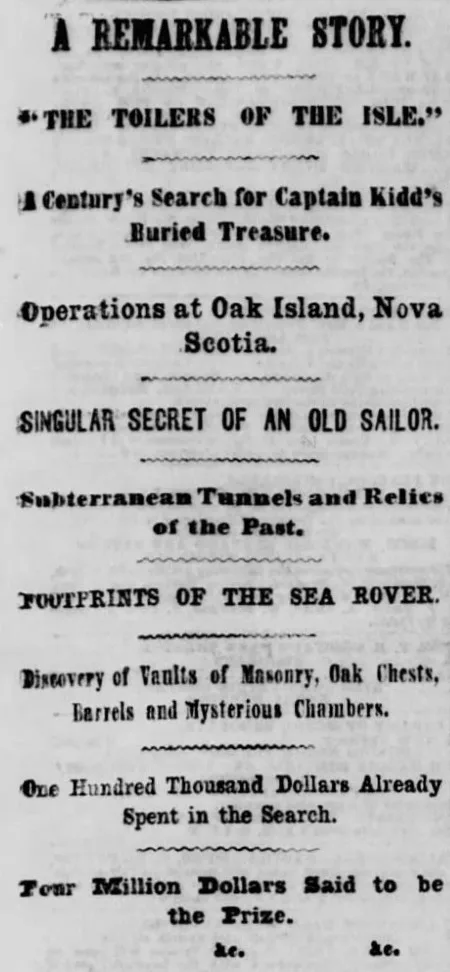
The New York Herald’s headline of 2 September 1866. Within a few years of McCully’s letter, “marks” and borings had become “Vaults of Masonry” and a four-million-dollar prize. We read the headline only, not the article beneath it. Public domain (PD-US-expired) via Wikimedia Commons; converted to WebP.
How the inscribed stone grew
The stone shows the legend’s mechanics most clearly, and the sequence below is the part we find most telling.
- 1862: McCully reports “several characters”. He does not describe them.
- 1893: According to Wikipedia, the Oak Island Treasure Company’s prospectus claims a decipherment about two million pounds.
- 1911: Bowdoin examines a stone in Creighton’s bookbindery in Halifax, reports the reading as “Ten feet below two million pounds lie buried”, and rejects it: “There are a few scratches, etc., made by Creighton’s employees, as they acknowledged, but there is not, and never was, a system of characters carved on the stone.”
- Around 1949: Joltes finds no drawing of the symbols until Edward Rowe Snow prints a set supplied by a Rev. A. T. Kempton. Joltes suspects Kempton invented them, while acknowledging he cannot yet prove it.
Notice two things. The phrase changes from “ten feet” to the now-standard “forty feet”, and the symbols printed in most books post-date McCully’s letter by almost 90 years. Joe Nickell reports that the popular text does decipher as a simple substitution cipher, but a solved modern drawing tells us nothing about a lost stone. Compare the single-document problem in the Beale ciphers, another treasure story built around a code nobody can check against an original.
The insiders who said no
The sceptical case is often presented as modern debunking. In fact, two of its strongest statements came from men hired or leading the digs.
John Brown, 1867. Brought in by the company to bore for the bottom of the disturbed ground, Brown told his directors that “the water course is a natural one”, and that this could account for the original sinkage at the surface and the wood in the disturbed ground. He also made a small experiment worth remembering. To test whether coins would come up, he says, he “often at a depth of 150 feet threw money into the hole, of course it came up in the augur”. If chests had really been bored through, he reasoned, some of the contents should have surfaced. He noted that layers of gravel sounded so much like coin “that it was difficult to undeceive myself until the augur was withdrawn”.
He also left the most useful sentence in the whole file: “it is the easiest thing in the world for the most honest man to be deceived, especially in connection with borings having for their purpose the discovery of immense amounts of treasure.”
The transcript of this report was made from a difficult handwritten original, and we have not seen the manuscript. Joltes also quotes the Halifax Sun and Advertiser of 11 January 1867 calling the whole affair “a freak of nature”, which fits Brown’s report in date and substance.
Henry Bowdoin, 1911. Bowdoin’s company landed on 27 August 1909, and left on 4 November. In Collier’s he wrote: “there was not, and never was, a buried treasure on Oak Island.” He reported that the “cement” found at depth was judged by Columbia University specialists to be natural limestone, and noted of the parchment fragment that it was found only on a second examination at the company’s office, adding that he understood “more stock was then sold”. Bowdoin was himself a disappointed promoter, so his verdict is testimony, not a laboratory finding. But his objections are concrete and can be tested against the record.
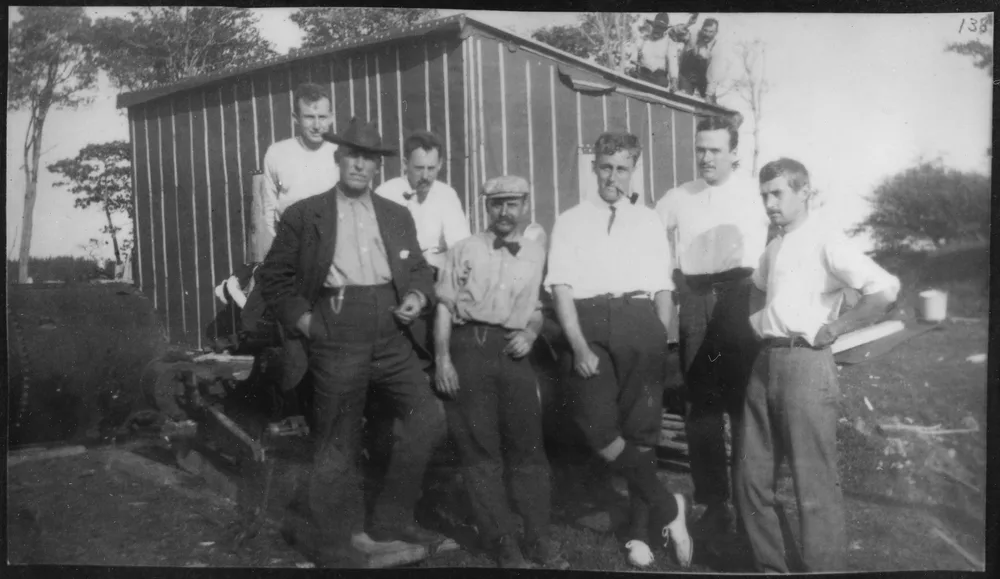
The Franklin D. Roosevelt Library’s “Photograph of Franklin D. Roosevelt and Others at Oak Island”. The catalog dates it 1910, while the expedition usually linked to Roosevelt ran in 1909, and the record we read does not say which man is which. U.S. National Archives, NAID 196803, use listed as unrestricted (PD-USGov tag on Commons) via Wikimedia Commons; resized and converted to WebP.
Roosevelt’s involvement is real but tends to be oversold. Nickell states that he took part in the work in summer and autumn 1909. Bowdoin’s article does not mention him. His presence shows the story could attract a young man from a prominent New York family. It does not show that he knew anything others did not.
Why the pit floods: tunnel or geology?
The booby-trap flood tunnel is what lifts Oak Island above an ordinary treasure yarn, so it deserves the closest look. It was never seen as a continuous structure.
- The 1860s searchers could not find it. Dennis King’s commentary on the David Smith workbook points out entries from March 1863 reporting “no drain” after hard digging in the shore pit.
- The later “discoveries” have an awkward explanation. King and John Bartram each argue that later crews who struck a tunnel near the 110-foot level had probably found one of the earlier diggers’ own tunnels. McCully’s letter does describe such a tunnel, 17 feet long, running into the old pit. This is a reasonable inference, not a proven identification.
- Brown and Bowdoin both objected on engineering grounds. Bowdoin noted that Smith’s Cove lies over 600 feet away, while the nearest shore is about 150 feet, and thought salt water simply percolated through coarse gravel.
- The geology offers a mechanism. Civil engineer Graham Harris, quoted by Bartram, describes dense glacial till over anhydrite, a very soluble rock. On that account pumping enlarges seepage paths and makes the problem worse. Nickell cites limestone and anhydrite strata, and an 1878 cave-in, reported by D’Arcy O’Connor, in which the ground sank beneath Sophia Sellers’s oxen as she ploughed.
- A dye test reportedly found no link to the sea. Joltes, after interviewing Woods Hole scientists in 2002, reports that dye placed in Borehole 10-X never emerged along the coast, that the water was brackish, and that the coconut fibre from the beach dated to around 1100 CE. The fibres were handed to the team by the treasure hunters. This is one critic’s account of interviews, not a published study that we could read, so we treat it as a lead.
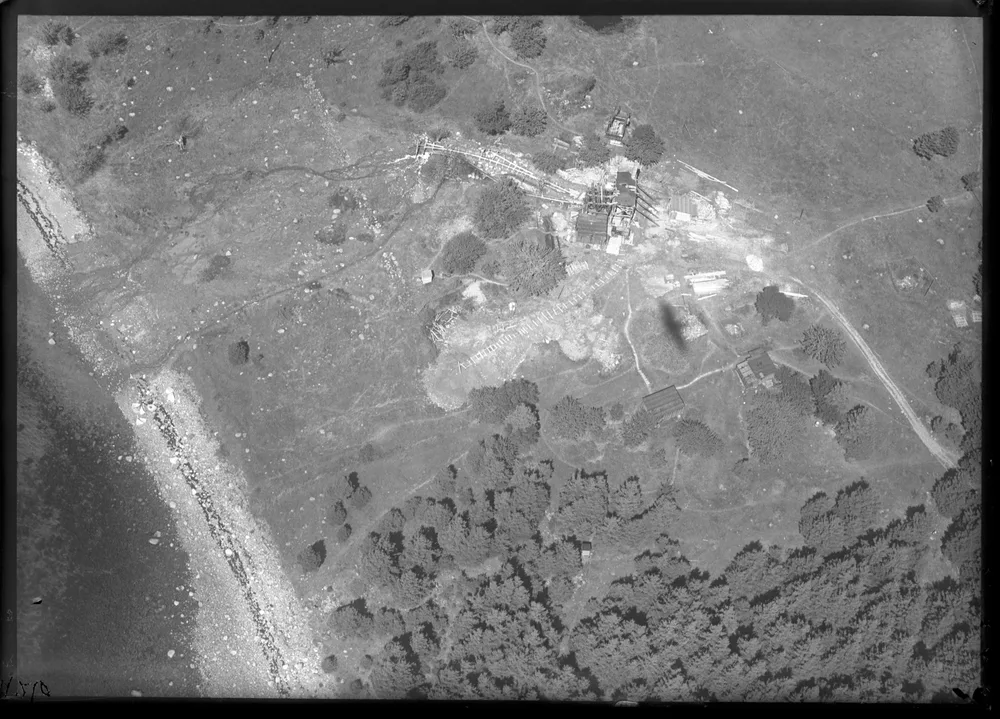
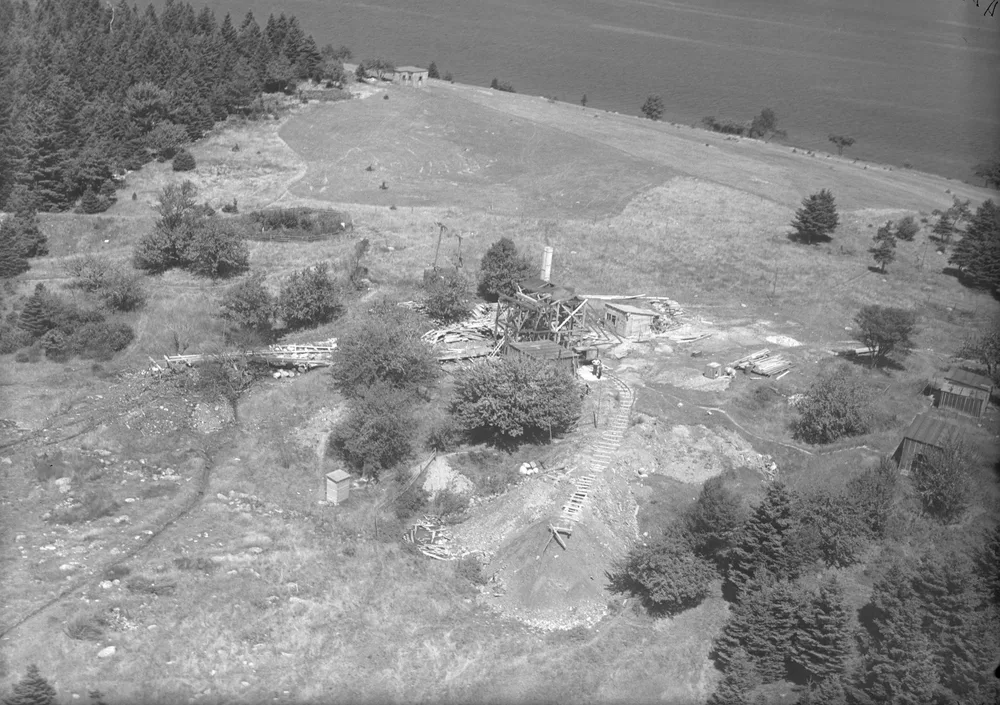
The same workings seen from almost directly above in August 1931, with the shore at lower left. By then the ground had been dug over for generations, which is why neither side can now read the original surface. Richard McCully, Nova Scotia Archives accession 2012-010/004 no. 36, public domain (PD-Canada) via Wikimedia Commons; resized and converted to WebP.
The critics do not fully agree either
Here the honest answer gets less tidy. Nickell argues the pit and “tunnels” are natural: a sinkhole, with fallen or washed-in logs later taken for platforms. He points to a similar soft spot found while digging a well on the shore of Mahone Bay in 1949, again via O’Connor. Joltes is less committed. He thinks something man-made may have existed, perhaps only 20 to 30 feet deep, and that later crews mistook their predecessors’ debris for ancient work. He speculates about military storage or ship-fitting, which is itself unproven.
Nickell’s second argument is bolder. He reads the saga through the Royal Arch “Secret Vault” allegory of Freemasonry, noting that several prominent searchers were Masons. Those memberships are a checkable matter, and the parallels are interesting. But the claim that the story may be a Masonic creation is a theory, built on resemblance, and Nickell himself says he cannot tell whether those elements were added later or present from the start. Treat it as one reading of the legend, not as the solution he declares it to be.
So the realistic position is narrow. The treasure has no reliable evidence behind it. The flood tunnel has very little. What McGinnis originally saw, if he saw anything, cannot now be established, because the ground has been destroyed.
The deaths are the documented cost
Whatever is in the ground, people died looking. Nickell, following O’Connor, records a workman scalded by a ruptured boiler during operations between 1858 and 1862, and a worker killed in a fall in 1897. Wikipedia names that man as Maynard Kaiser, citing a television programme, so we hold the name loosely.
On 17 August 1965, four men died in a shaft. Lee Lamb’s family history of the Restalls, published by Dundurn, dates the tragedy. Wikipedia names them as Robert Restall, his son, Karl (also spelled Karle) Graeser and Cyril Hiltz, though it gives no specific source for that passage. The cause is reported differently: Nickell gives swamp gas or engine fumes, and Wikipedia says hydrogen sulfide.
Those six deaths feed the modern talk of a curse, that seven must die before the treasure is found. Wikipedia sources that line to a 2020 magazine piece. It does not appear in any of the 19th-century documents we read, and it deserves to be labelled folklore, not fate. These were men and families, not plot points.
Oak Island today
The island is privately owned and, according to Nova Scotia’s tourism site, not open for self-guided visits, with the Money Pit under restricted access. Guided tours run on a schedule that varies through the year.
Nova Scotia announced in November 2010 that it was repealing its 1954 Treasure Trove Act, which it says was first created to govern Oak Island hunting, and replacing it for the island with a dedicated Oak Island Treasure Act. The provincial licence page says holders may search for and recover precious stones or metals on Oak Island that are not in their natural state, and keep them on payment of a royalty.
Interest today comes mostly from History’s The Curse of Oak Island, on air since January 2014, with brothers Rick and Marty Lagina as its lead treasure hunters. A 14th season is listed to begin on 10 November 2026. The series has shown coins and other artefacts from the island, and those need independent archaeological publication before they can say anything about a hoard. Items from an island with centuries of settlement, shipping and digging on it would be expected in any case.
What is documented, claimed and unresolved
| Claim | Status |
|---|---|
| Companies dug repeatedly on Oak Island from at least the mid-19th century | Documented |
| The pit flooded and collapsed in 1861 | Documented by participants |
| Four men died there in 1965 | Documented; cause reported variously |
| McGinnis found the site in 1795 | Tradition; no record from the time |
| Kidd or any pirate buried treasure there | Legend, present from the earliest accounts |
| Boring passed through chests of metal | Participant claim; nothing recovered from those layers |
| Gold links and parchment | Reported; provenance disputed, and Bowdoin rejected them |
| An inscribed stone existed | Disputed; the popular symbols appear only around 1949 |
| A man-made flood tunnel | Theory; rejected by Brown and Bowdoin, never traced |
| Natural sinkhole origin | Leading sceptical theory; not proven |
| Masonic origin of the story | Theory |
| Templars, Holy Grail and similar treasures | Speculation with no supporting evidence in these sources |
| What, if anything, was first dug there | Unresolved |
As with Lake Anjikuni’s vanished village, the valuable step is reading the earliest text before the retellings. And as with the D. B. Cooper ransom, a small number of real objects can carry an enormous story, but here the objects themselves are mostly gone.
A note on our sources: much of the early material survives online in transcriptions hosted by Critical Enquiry, a site openly sceptical of the treasure. We checked the quotations against those transcriptions and a web reprint of Bowdoin’s article, not the original newspapers or manuscripts. Joltes’s commentary is his own, and we have separated it from the documents wherever we could.
Frequently asked questions
Has any treasure been found on Oak Island?
No treasure hoard has been demonstrated. Nova Scotia’s tourism site says no definitive treasure has been found, and the items reported over the years are small, of disputed provenance or both.
Who found the Money Pit?
Tradition credits Daniel McGinnis (also McInnis), with Smith and Vaughn, in 1795. No record from that year survives. The first detailed account in our sources, from 1862, gives no year and describes McGinnis as a man going there to farm, not a boy on an adventure.
Is the flood tunnel real?
It has never been traced as a continuous structure. Searchers in 1863 reported finding “no drain”, and Brown in 1867 and Bowdoin in 1911 both argued that the water arrived naturally.
Did Franklin D. Roosevelt really dig on Oak Island?
Nickell says he took part in 1909, and the Roosevelt Library holds a photograph of him there, which it dates 1910. His involvement adds fame to the story but no evidence to it.
How many people have died on Oak Island?
The sources we read describe six deaths: one between 1858 and 1862, one in 1897 and four in 1965. They do not support the claim of a curse, which we did not find in any 19th-century document.
Can you visit Oak Island?
Only on organized visits. Nova Scotia’s tourism site says the island is privately owned and closed to self-guided visits, and that access to the Money Pit is restricted. Check current tour dates before travelling.
Sources & further reading
- J. B. McCully, letter dated Truro, 2 June 1862, reprinted as 'The Oak Island Diggings', Liverpool Transcript, 1862 (primary; read in the transcription at Critical Enquiry; accessed 2 November 2026)
- 'Patrick', letter dated Truro, 16 September 1861, in the Nova Scotian (primary; read in the transcription at Critical Enquiry, whose pages disagree on whether it ran on 16 or 30 September; accessed 2 November 2026)
- John Brown, report to the directors of the Oak Island Company, Walton, 17 January 1867 (primary; read in Dennis King's transcription of the handwritten original at Critical Enquiry; accessed 2 November 2026)
- David Smith workbook of the Oak Island Association, 1862-63 (primary; read through Dennis King's 2014 transcription and commentary; accessed 2 November 2026)
- H. L. Bowdoin, 'Solving the Mystery of Oak Island', Collier's, 19 August 1911, pp. 19-20 (primary; read in the reprint at JasonColavito.com; accessed 2 November 2026)
- Joe Nickell, 'The Secrets of Oak Island', Skeptical Inquirer 24:2, March/April 2000, used for the sinkhole and Masonic arguments and for details he credits to O'Connor (1988) and Faribault (1911), which we did not read directly (accessed 2 November 2026)
- Richard E. Joltes, 'Early History, to 1865', History, Hoax, and Hype: The Oak Island Legend, Critical Enquiry, on the 1849 note, the 1857 traveller's note and 'The Oak Island Folly' (accessed 2 November 2026)
- Richard E. Joltes, 'Evolution of the Legend: 1865-Present', Critical Enquiry, on De Mille, Des Brisay, Snow and Kempton; the source for the Halifax Sun and Advertiser of 11 January 1867, which we did not read directly (chapter marked as unfinished; accessed 2 November 2026)
- Richard E. Joltes, 'A Critical Analysis of the Oak Island Legend', Critical Enquiry, 1996, updated to 2004 (accessed 2 November 2026)
- Richard E. Joltes, 'The Woods Hole Oceanographic Institute Report', Critical Enquiry, a secondhand account based on 2002 interviews; we did not locate a published Woods Hole report (accessed 2 November 2026)
- John A. Bartram, 'On the claim for a flood tunnel', Critical Enquiry, 19 June 2005, also quoting civil engineer Graham Harris on the island's anhydrite (accessed 2 November 2026)
- Government of Nova Scotia, news release on changes to treasure-hunting regulations, 2 November 2010 (accessed 2 November 2026)
- Service Nova Scotia, Treasure Trove Licence page, Department of Natural Resources, citing the Oak Island Treasure Act. The legislature's own statute page refused our connection on the day of writing, so we did not read the Act itself (accessed 2 November 2026)
- Nova Scotia Tourism, 'Oak Island', official visitor page, on private ownership and restricted access (accessed 2 November 2026)
- U.S. National Archives catalog, 'Photograph of Franklin D. Roosevelt and Others at Oak Island in Nova Scotia', NAID 196803, Franklin D. Roosevelt Library Public Domain Photographs (accessed 2 November 2026)
- Dundurn Press, publisher's page for Lee Lamb, Oak Island Obsession: The Restall Story (2006), on the deaths of 17 August 1965; book not read (accessed 2 November 2026)
- Wikipedia: Oak Island mystery, used only for the citations it gives to the 1857 Liverpool Transcript note, the 1863 Yarmouth Herald, the 1893 prospectus and the 1965 names; each such claim is flagged in the text (accessed 2 November 2026)
- Wikipedia: The Curse of Oak Island, for broadcast dates and the listed premiere of season 14 (accessed 2 November 2026)