The Index / Unsolved Cases
What Happened to Amelia Earhart? The Itasca Log, the Nikumaroro Bones and the 2026 Search
Earhart vanished near Howland Island on July 2, 1937. What the Itasca radio log, the 1940 Nikumaroro bones, the declassified files and the October 2026 search show.
Topics: Amelia Earhart, Fred Noonan, Nikumaroro, Howland Island, Lockheed Electra, Aviation mysteries, Disappearances
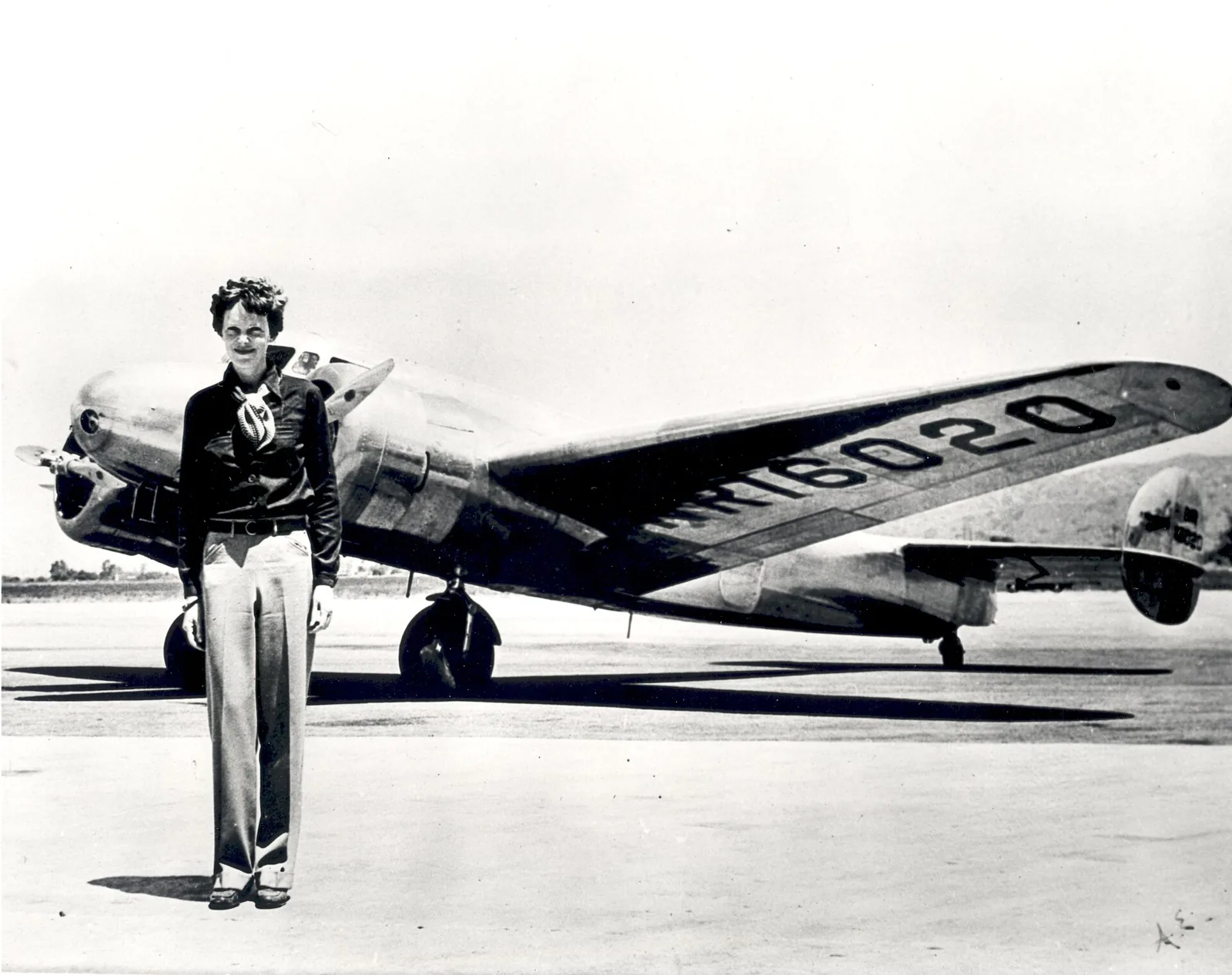
Nobody knows. Amelia Earhart and her navigator, Fred Noonan, were last heard from at 8:43 a.m. on July 2, 1937, by the Coast Guard cutter Itasca, which was waiting for them at Howland Island in the central Pacific. No wreckage, no body and no later message has ever been confirmed as theirs. The United States government concluded that the Lockheed Electra ran out of fuel and went into the sea near Howland. A rival hypothesis, that the pair landed on the reef of Gardner Island, now Nikumaroro, and died there as castaways, has been investigated since the 1980s and was tested again in October 2026, when a Purdue-led expedition dug for a lagoon object that turned out to be trees. A third story, capture by Japanese forces, rests on claims that have not survived checking.
Those are three different kinds of statement. The radio log, the search reports, the 1940 bone find and the 2026 field results are documents. The three endings are interpretations of them. This article keeps the two apart.
Hero image: Earhart with the Electra 10-E, registration NR16020. The photograph is undated and comes from NASA’s Great Images in NASA collection via Wikimedia Commons. Public domain. Resized and converted to WebP.
Who was flying, and why Howland Island?
A 39-year-old record-setting pilot, her navigator, and a twin-engine aircraft paid for by a university research foundation.
Earhart was born in Atchison, Kansas, on July 24, 1897. In May 1932 she became the first woman to fly solo across the Atlantic, and in 1935 the first person to fly solo from Hawaii to the American mainland. That autumn she joined Purdue University as a career counselor for women and an adviser on aeronautics. In July 1936 she acquired a Lockheed Electra 10-E, bought with Purdue Research Foundation money and promoted as a “Flying Laboratory.” Purdue’s own newsroom still describes the fund that paid for it, the Amelia Earhart Fund for Aeronautical Research, and says she intended to return the aircraft to the university after the world flight. Purdue biographical sketch.
The first attempt, in March 1937, went westward from Oakland to Hawaii and ended on the ground: a ground loop at Luke Field damaged the Electra badly enough to send it back to California for repair. The National Archives holds the 56 pages of proceedings of the board that investigated that March 20 accident. The second attempt started from Miami on June 1, 1937, flying east, with Fred Noonan navigating. By the time they reached Lae, New Guinea, they had covered about 22,000 miles.
Howland was the hard leg. It is a coral island roughly 3 kilometers long and 1.6 kilometers wide, about 2,556 miles from Lae across open ocean. The Coast Guard cutter Itasca was stationed off the island to send radio signals, make smoke, and supply fuel for the next long over-water leg. The Purdue finding aid for the family papers adds a detail that matters for every later argument about navigation: the position of Howland on the charts in use was about five nautical miles off. Purdue Archives, Disappearance and Search, 1937–1938.
What does the Itasca radio log actually say?
That the aircraft was close, that Earhart could not hear the ship, and that the last message put the plane on a navigational line, not at a place.
The log kept aboard the Itasca by radio operator Leo G. Bellarts survives in his donated papers at the National Archives in College Park. Earhart and Noonan left Lae at 10:00 a.m. local time on July 2, which was midnight Greenwich time. Through the night the cutter heard Earhart’s voice intermittently, but never managed a two-way exchange. The National Air and Space Museum notes the simplest reason: neither Earhart nor Noonan could work Morse code, and it appears she may never have heard any of the ship’s transmissions. National Air and Space Museum.
The entries that matter, in the Archives’ own summary of the log, run like this. At 6:14 a.m. ship’s time the aircraft reported itself about 200 miles out. At 7:42 Earhart said, “We must be on you, but we cannot see you,” and that fuel was running low; the crew had also reported flying low, at 1,000 feet. Just before 8:00 she said they were circling and asked for bearings, adding that they had received the cutter’s signals but could not get a bearing from them. The museum records that this 7:58 transmission was the strongest the ship received, strength 5 plus. At 8:43 came the last message the Itasca logged, at strength 5, still good reception: “we are on the line 157 337 wl rept msg we wl rept…” Then nothing. DocsTeach summary of the log and the Archives’ highlight page with the final entry.
A line of position is a line, not a point. The message says the aircraft believed itself to be somewhere along a bearing of 157–337 degrees, roughly north-north-west to south-south-east, and the Archives’ summary notes that it gave no reference point. It does not say where on that line the Electra was, or how far north or south the crew then flew. That single ambiguity is the hinge of the whole case. Howland lies on such a line. So, roughly 400 miles away on much the same bearing to the south-south-east, does Gardner Island.
| Time (Itasca, July 2, 1937) | What the record shows | What it does not settle |
|---|---|---|
| 10:00 a.m. July 2, Lae time (00:00 GMT) | Takeoff from Lae for Howland, about 2,556 miles | Actual wind and ground speed over the full flight |
| 6:14 a.m. | Aircraft reports about 200 miles out | Whether that estimate was correct |
| 7:42 a.m. | “We must be on you, but we cannot see you”; fuel running low; flying at 1,000 feet | How much fuel “low” meant |
| About 7:58 a.m. | Circling, asking for a bearing; strongest signal received | The aircraft’s direction from the ship |
| 8:43 a.m. | “We are on the line 157 337…” Last message logged | Where on that line, and which way they flew next |
| Noon onward | Itasca begins searching; Navy and Coast Guard search runs July 2–18 | Any sighting of the aircraft or crew |
How big was the 1937 search, and did it look at Gardner Island?
It covered more than 250,000 square miles and ended on July 18. Navy floatplanes did fly over Gardner on July 9 and reported “signs of recent habitation.” No one landed.
The National Archives holds the “Report of Earhart Search by U.S. Navy and U.S. Coast Guard, July 2–18, 1937,” the Itasca’s cruise report, its radio and communications logs, and the deck logs of the Colorado, Ontario and Swan, along with charts tracking the Lexington, Colorado, Swan, Itasca, Lamson, Drayton and Cushing. The museum calls it the United States government’s largest search for a lost aircraft up to that point. National Archives, Records Relating to Amelia Earhart.
The battleship Colorado left Pearl Harbor on July 3. On July 9 three of its floatplanes flew over Gardner Island from no lower than about 400 feet. The flight leader, Lieutenant John Lambrecht, reported “signs of recent habitation,” and that repeated circling and zooming drew no response from anyone on the island. The planes went on to the other islands of the Phoenix group over the next two days, and no search party went ashore anywhere. The carrier Lexington and four destroyers took over on July 12, searched open ocean to the north-west of Howland, and stopped on July 18. That sequence is set out, with the officers’ names, in a 1993 Proceedings article by Richard Gillespie, who founded the group that argues for Gardner; the Purdue finding aid independently notes the “signs of recent habitation” report and the fact that the island had been uninhabited since 1892. Gillespie, Proceedings, February 1993; Purdue Archives.
Two readings of that overflight exist, and both are honest about what the pilots saw. Advocates of the island hypothesis read “signs of recent habitation” as evidence someone had just been there. Skeptics point out that the planes saw no aircraft, no people and no signal. The report records what it records: a remark and a silence.
The government search ended on July 18. George Putnam, Earhart’s husband, paid for private searching into October 1937. On January 5, 1939, the Superior Court in Los Angeles declared her legally dead.
Where did the three theories come from?
One from the official conclusion, one from a 1940 telegram and forty years of fieldwork, and one from stories collected in the Marshall Islands and Saipan.
Crash and sink
This was the government’s conclusion in 1937, and it remains the view of the Smithsonian’s aviation curator who has spoken on the case. Dorothy Cochrane of the National Air and Space Museum put the argument in 2019 in two sentences. On the radio: “Her radio strength is close by… They all think that she’s close by, possibly within view.” On the fuel: “And if she’s so worried, she’s so low on fuel, how is she going to fly another 350 or 400 miles to another island?” She also noted that many people claimed to hear Earhart’s voice in the days afterwards and that none of those claims was “ever confirmed or authenticated.” Smithsonian Magazine, July 31, 2019.
The weakness of crash-and-sink is not logic but depth. Nothing has been recovered from the sea floor around Howland. In January 2024 the South Carolina firm Deep Sea Vision announced a sonar image about 100 miles from the island, at a depth of about 15,000 feet, that its chief executive, Tony Romeo, thought matched the Electra’s size and tail. The firm went back in early November 2024 with an autonomous vehicle and a high-resolution camera, and announced the result itself: “our target was not Amelia’s Electra 10E (just a natural rock formation).” NPR, November 25, 2024. A theory that nothing has been found is hard to disprove, which is also why it cannot be called proven.
The Nikumaroro castaway hypothesis
Gardner Island was renamed Nikumaroro and is today part of the Republic of Kiribati, in the Phoenix Islands. The hypothesis holds that Earhart, having reached the 157–337 line but not Howland, flew south-east along it, landed the Electra on the island’s reef flat, transmitted from the aircraft for several days, and that the two then died as castaways while the aircraft was broken up by surf. The International Group for Historic Aircraft Recovery, TIGHAR, has pursued it since the late 1980s, with a dozen expeditions by 2018.
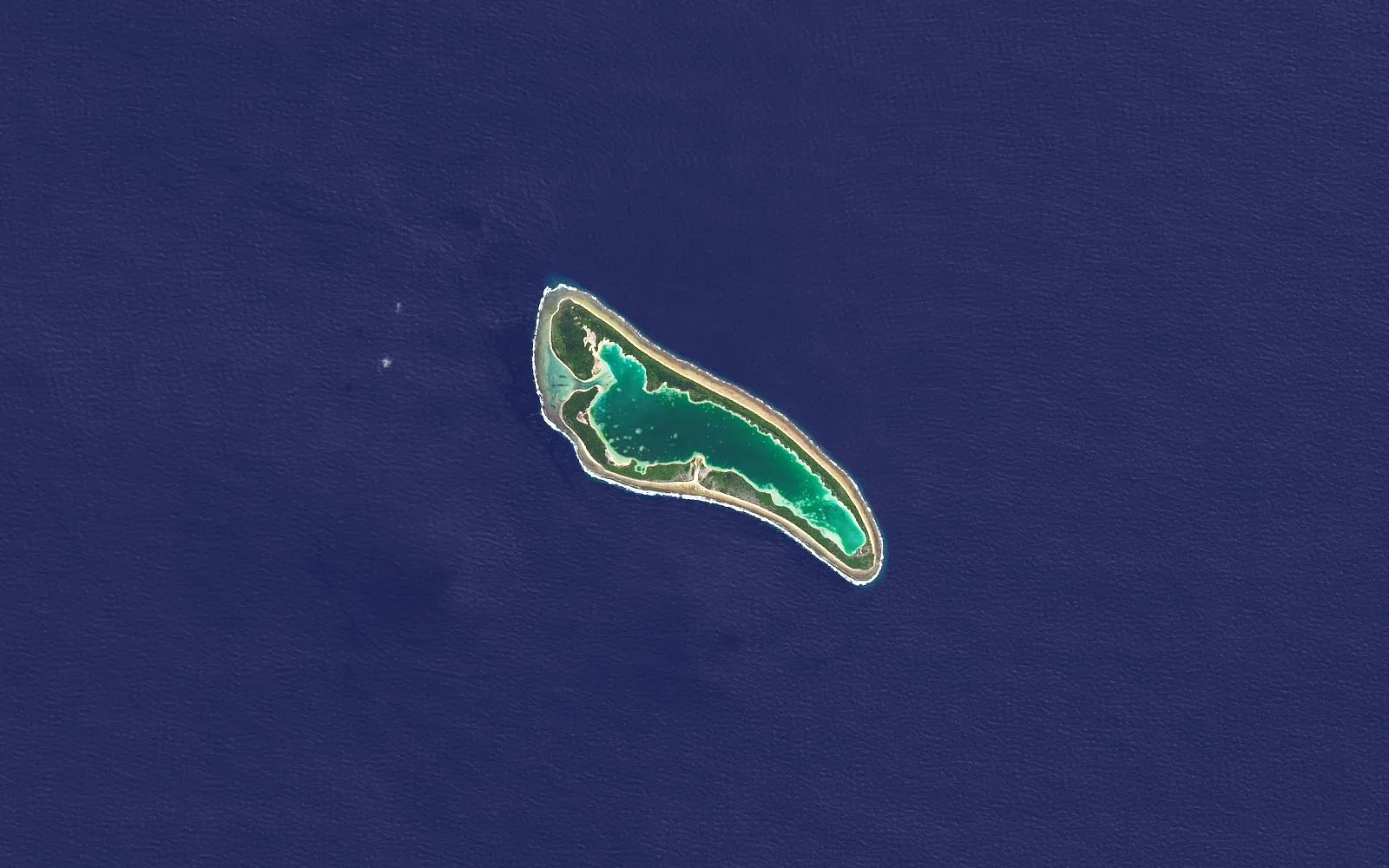
Nikumaroro, formerly Gardner Island, in a Landsat 8 image acquired July 28, 2014. The atoll is about 7.5 kilometers long. The lagoon in the center is where the 2026 Taraia Object expedition dug. NASA Earth Observatory image by Joshua Stevens, using U.S. Geological Survey Landsat data, via Wikimedia Commons. Public domain. Cropped from the full-frame NASA image and converted to WebP.
The oldest piece of evidence is a set of colonial telegrams. In 1940 the island was being settled under a British scheme, and the officer in charge, Gerald Gallagher, cabled his superiors on September 23 that a working party had found a human skull some months earlier and buried it, and that more bones, part of the sole of what he took to be a woman’s shoe, and a box for a sextant had since been found. His own guess was that the skeleton was “possibly that of a woman,” and a later telegram spoke of signs that the person had been alive when cast ashore. Those messages are reproduced from the Western Pacific High Commission files on TIGHAR’s site; the group’s role as advocate should be kept in mind, but the telegrams are archival documents, not its own claims. TIGHAR, The Bones Files.
Thirteen bones went to Fiji. The doctor who examined them there, D. W. Hoodless, concluded they belonged to a European male, and that finding closed the matter for decades. The bones themselves were then lost. What survives is Hoodless’s seven measurements: four of the skull and the lengths of a humerus, a radius and a tibia. National Geographic, March 8, 2018.
In 2018 Richard Jantz, a forensic anthropologist at the University of Tennessee, re-ran those seven numbers in the journal Forensic Anthropology. He argued that the sexing methods available in 1941 were inadequate and that Hoodless’s male verdict cannot be assumed correct. Comparing the bone lengths with estimates of Earhart’s dimensions taken from photographs and her clothing, he found that Earhart was more similar to the Nikumaroro bones than 99 percent of individuals in a large reference sample, and called that strong support for the conclusion that the bones were hers. Jantz, Forensic Anthropology 1, no. 2 (2018).
That is a real result, and its limits should be stated as plainly as its number. The analysis works on seven measurements written down by someone else, of bones nobody can re-examine, compared with a body whose dimensions were themselves estimated. “More similar than 99 percent of a reference sample” is a statement about resemblance, not an identification. It says the bones fit a woman of Earhart’s build well; it cannot say they were not some other woman of similar build. A sextant box and a shoe sole are consistent with a castaway from a wrecked ship as well as from an aircraft.
The other pieces TIGHAR and Purdue cite are of the same character. A photograph taken about three months after the disappearance by a British colonial officer named Bevington, who was surveying the island for settlement, shows the reef with a blurred object near the 1929 wreck of the steamer Norwich City; proponents read it as a landing-gear assembly, which is why Purdue calls it the “Bevington Object.” Radio bearings taken in July 1937 by Navy, Coast Guard and Pan American stations are said to converge on the island. Artifacts of 1930s type, a woman’s shoe, a compact, a freckle-cream jar and a medicine vial, have been dug up at a site on the island. None of these has been tied to Earhart by a serial number, an inscription or DNA. Purdue News, October 18, 2026.
The most thorough underwater test came in August 2019, when Robert Ballard took the research vessel Nautilus to Nikumaroro. His remotely operated vehicles found the propellers and boilers of the Norwich City. Of the aircraft he said: “We visually examined 100 percent of the island down to 750 meters [2,400 feet] and did not see evidence of the plane.” National Geographic, August 26, 2019.
Capture by Japanese forces
The claim that Earhart and Noonan came down in the Japanese-mandated Marshall Islands and were taken to Saipan was already reaching Washington by 1939. The National Archives lists a January 7, 1939 Office of Naval Intelligence report “on information that Earhart was a prisoner in the Marshall Islands,” and a 1960 San Mateo newspaper front page in the recent releases carries a former serviceman’s account of being shown an unmarked grave on Saipan. A report that information was received is not a confirmation that it was true, and the Archives does not say it was. National Archives.
The best-known exhibit collapsed within days. In July 2017 a History Channel program presented a photograph from Office of Naval Intelligence files, captioned Jaluit Atoll, as showing Earhart seated on a dock and Noonan standing nearby. A Japanese military-history blogger found the same photograph in a photo book held by Japan’s National Diet Library and published in 1935, two years before the flight. The network said it was investigating. NPR, July 11, 2017. The stories that she survived and lived on under another name sit a further step out again, and no reputable investigation has produced evidence for them.
What did the declassified files add in 2025 and 2026?
Thousands of pages, almost all of them previously available to researchers, and no new answer.
On September 26, 2025, President Trump directed that government records “related to Amelia Earhart, her final trip, and everything else about her” be released. The National Archives posted 4,624 pages on November 14, 2025, 3,715 pages on November 25, 1,810 on December 17, and two small batches totaling 47 pages on January 9, 2026, with some privacy redactions. The files are Navy, Coast Guard and State Department correspondence, the Itasca logs, National Security Agency oral histories, presidential-library material and decades of press clippings on the Saipan and spy stories. National Archives, Research Our Records.
CBS News and Agence France-Presse, reviewing the first batch, reported that the phrase “Earhart Unheard” recurs through the Itasca log, that the 8:43 a.m. message is there as quoted above, that much of the material had been released before, and that aviation experts considered it unlikely to shed new light. CBS News, November 17, 2025. The release is useful because the primary documents are now easy to read. It did not change what they say.
What happened on Nikumaroro in October 2026?
The expedition went to dig up a lagoon anomaly called the Taraia Object. It was trees.
The target was a shape in satellite imagery of the lagoon, first noticed in 2020 and, according to Purdue, visible in aerial photographs as far back as 1938. The Archaeological Legacy Institute of Eugene, Oregon, the Purdue Research Foundation and Purdue University announced an expedition in July 2025. Not every Nikumaroro advocate was persuaded: Ric Gillespie of TIGHAR, which had worked the island for decades, told NBC News that month, “We’ve looked there in that spot, and there’s nothing there,” a remark CBS News repeated when the archives opened in November. The expedition was postponed on October 27, 2025, citing the Kiribati research-permit process and the cyclone season. WFYI, October 29, 2025. The plan published on September 28, 2026 was to photograph the site undisturbed, survey it with magnetometers and sonar, expose the object with a hydraulic dredge, and walk the nearby shore for debris. Purdue News, September 28, 2026.
The team flew out of Purdue on October 2, assembled in Tarawa on October 6, and spent five days at sea reaching the atoll. Weather kept them off the shore for part of the week; in all they spent seven days at Nikumaroro, four of them working on land. On October 18, 2026 Purdue announced the result. What was left of the anomaly was a single Y-shaped segment of a much larger mass of trees that had been deposited along the sandspit of the Taraia Peninsula and had mostly broken up and washed away. The bright, metallic-looking surface was a carbonate veneer; other objects nearby were coated in the same concretized coral sand. The expedition’s project director, Rick Pettigrew, said: “We accomplished our goal to determine what the Taraia Object was.” Steve Schultz, Purdue’s general counsel and a member of the field team, said: “We set out to test a hypothesis, not to guarantee a particular result, and we followed the evidence to the end.” Purdue News, October 18, 2026.
The divers did recover other things from the lagoon, including a steel tube about 30 inches long, which will be studied. The team’s own reading is that these finds support the mechanism behind the hypothesis, that debris can enter the lagoon through the Tatiman Passage and collect on the peninsula opposite, even though the specific object did not. Purdue says it will keep searching. Purdue Research Foundation expedition site.
It is worth being exact about what was and was not ruled out. The expedition eliminated one candidate object in one lagoon. It did not test the reef flat, the deep slope Ballard surveyed in 2019, or the bones. The castaway hypothesis is in the same position it was in before the trip: supported by circumstantial material, contradicted by nothing decisive, and still without the “smoking gun” its own advocates say they need.
What is documented, and what is not?
| Question | What the record supports | What it does not establish |
|---|---|---|
| When and where was the last contact? | 8:43 a.m. Itasca time, July 2, 1937, by voice, at strength 5: “we are on the line 157 337…” | Where on that line the aircraft was, or how much fuel remained |
| Was the aircraft near Howland? | The 7:58 signal was the strongest the ship received. Earhart said she could not see the island and could not get a bearing | A distance. Signal strength is not a position fix |
| Did the 1937 search cover Gardner Island? | Three Colorado floatplanes overflew it on July 9 and reported “signs of recent habitation” and no response | What those signs were. No one landed |
| Were human remains found on Nikumaroro? | Yes. A 1940 colonial telegram reports a skull found months earlier, more bones, part of a shoe sole and a sextant box. Hoodless in Fiji recorded them as a European male. The bones are lost | Whose they were. Jantz’s 2018 re-analysis finds them more similar to Earhart than 99 percent of a reference sample, which is a resemblance, not an identification |
| Was the Electra photographed on the reef? | A 1937 Bevington photograph shows an object near the Norwich City wreck | That the object is landing gear. The image is blurred and has not been corroborated by a recovered part |
| Was she captured by the Japanese? | A 1939 ONI report records information to that effect; later Saipan testimony exists in clippings | Any confirmation. The 2017 photograph was published in 1935 |
| Did the 2025–26 declassification solve it? | About 10,000 pages were posted, including the Itasca log and search report | New evidence of her fate. Most material was already available |
| What was the Taraia Object? | Trees with a carbonate crust, per the October 2026 expedition that dug it | Anything about the aircraft. One object was excluded; the island was not |
How this case compares
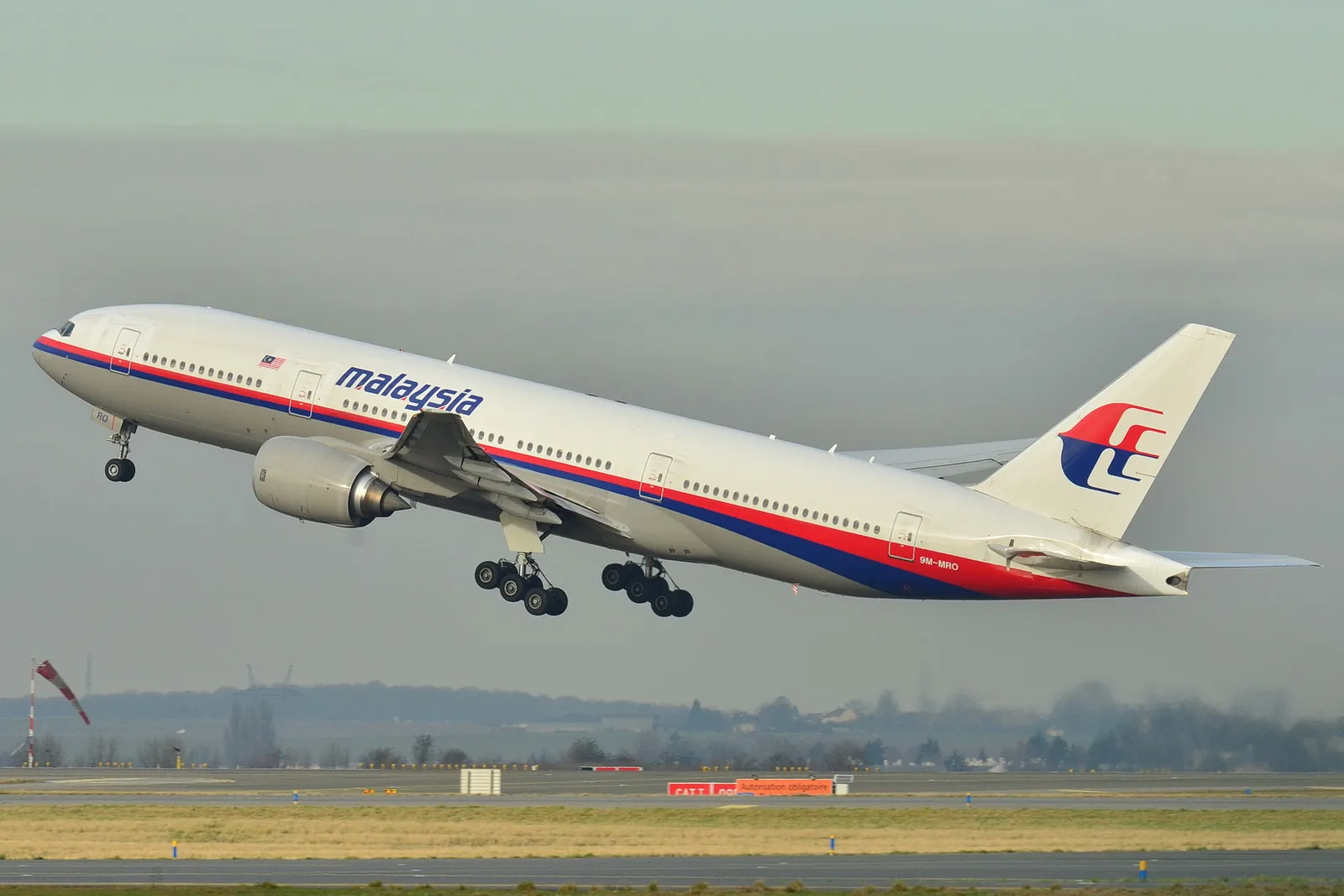
The shape of the Earhart file is familiar on this site. The Flannan Isles lighthouse also has an official record that is quiet at the decisive moment and a century of invented detail laid over it. The Mary Celeste has a documented scene and no agreed reason the people left it. The Somerton Man shows how a modern scientific claim about identity can be serious and still fall short of an official finding, which is exactly where Jantz’s bone analysis sits. The Franklin expedition is the hopeful precedent: a lost party whose ships were finally found in 2014 and 2016, by searchers who used Inuit knowledge and kept going. And because Earhart’s loss is sometimes folded into the general lore of vanished aircraft, it bears repeating that it happened in the central Pacific, on the far side of the world from the Bermuda Triangle. The closest modern parallel is Malaysia Airlines Flight 370, which vanished in 2014 with far better data, satellite handshakes and serial-numbered debris, and is still being searched for in 2026.
Frequently asked questions
Has Amelia Earhart’s plane been found?
No. A sonar target near Howland in 2024 and a lagoon object on Nikumaroro in 2026 were both investigated and turned out to be a rock formation and a mass of trees. No part of the Electra has been recovered and identified.
What was Earhart’s last message?
The last transmission the Itasca logged, at 8:43 a.m. on July 2, 1937, was “we are on the line 157 337 wl rept msg we wl rept…” Earlier that morning she had said, “We must be on you, but we cannot see you,” and that fuel was running low. The original log is in the Leo G. Bellarts Papers at the National Archives.
Were the bones found on Nikumaroro hers?
Unknown. Thirteen bones found in 1940 were measured in Fiji, judged to be a European male’s, and then lost. A 2018 re-analysis of the seven surviving measurements found Earhart more similar to the bones than 99 percent of a reference sample. That is strong resemblance, not an identification, and no DNA identification has been published.
Was Amelia Earhart captured by the Japanese?
There is no verified evidence that she was. A 1939 naval intelligence report recorded that such information had been received, and stories of a grave on Saipan circulated for decades. The photograph shown in 2017 as proof was found in a book printed in 1935.
What did the 2026 Purdue expedition find?
That the Taraia Object, an anomaly seen in satellite images of the Nikumaroro lagoon, was a mass of trees coated in a carbonate crust, not aircraft wreckage. The team recovered other lagoon debris for study, said it still believes the castaway hypothesis, and Purdue has said it will continue the search.
Did the declassified files reveal what happened to her?
No. The National Archives released roughly 10,000 pages between November 2025 and January 2026 under a September 26, 2025 directive. They include the Itasca radio log and the Navy and Coast Guard search report. Reporters and researchers who reviewed them found that most of the material had been available before and that none of it establishes her fate.
Sources & further reading
- National Archives: Radio log of the last communications of Amelia Earhart, USCGC Itasca, July 1–2, 1937, Leo G. Bellarts Papers (NAID 6210268), with the final 8:43 a.m. entry
- National Archives DocsTeach: Radio Log of the Last Communications of Amelia Earhart, summary of the 6:14, 7:42 and 8:43 a.m. entries
- National Archives: Records Relating to Amelia Earhart, Itasca logs, the Navy and Coast Guard search report (NAID 305240), the 1939 ONI Marshall Islands report and the Jaluit photograph
- National Archives: Research Our Records, Amelia Earhart, the September 26, 2025 directive and the release schedule from November 14, 2025 to January 9, 2026
- CBS News / AFP, November 17, 2025: Amelia Earhart records released, including her last known communications
- National Air and Space Museum, June 29, 2017: Amelia Earhart, missing for 80 years but not forgotten (departure from Lae, signal strengths, the July 2–18 search)
- Purdue University Archives: George Palmer Putnam Collection of Amelia Earhart Papers, series Disappearance and Search, 1937–1938
- Purdue University Libraries: Amelia Earhart biographical sketch (Purdue appointment, the Electra, the two 1937 attempts, the 1939 declaration of death)
- Richard E. Gillespie, "Why the Navy Didn't Find Amelia," U.S. Naval Institute Proceedings, February 1993 (the Colorado's July 9 overflight of Gardner Island; the author directs TIGHAR)
- TIGHAR research archive: The Bones Files, telegrams of Gerald Gallagher and the Western Pacific High Commission, September–October 1940 (documents reproduced by the group that advocates the Nikumaroro hypothesis)
- Richard L. Jantz, "Amelia Earhart and the Nikumaroro Bones: A 1941 Analysis versus Modern Quantitative Techniques," Forensic Anthropology 1, no. 2 (2018): 83–98
- National Geographic, March 8, 2018: Bones discovered in 1940 could have been Amelia Earhart's (the 13 bones, Hoodless, the lost remains)
- Smithsonian Magazine, July 31, 2019: curator Dorothy Cochrane on why the crash-and-sink explanation fits the fuel and radio evidence
- National Geographic, August 26, 2019: Robert Ballard's Nautilus expedition to Nikumaroro ends without evidence of the aircraft
- NPR, July 11, 2017: a Japanese blogger finds the 'Earhart' Jaluit photograph in a book published in 1935
- NPR, November 25, 2024: Deep Sea Vision's sonar target near Howland Island turns out to be a rock formation
- WFYI / Indiana Public Media, October 29, 2025: the Purdue-led search for Amelia Earhart's plane has been delayed
- Purdue University News, September 28, 2026: one week out, countdown to the search for Amelia Earhart's plane (the Taraia Object, the methods, the Purdue funding of the Electra)
- Purdue University News, October 18, 2026: search for Amelia Earhart's plane continues after Taraia Object expedition on Nikumaroro rules out latest hypothesis
- Purdue Research Foundation: Amelia Earhart expedition site, with the October 2–18, 2026 field timeline
- Newsweek, October 2026: Amelia Earhart search hits setback as expedition rules out Taraia Object theory
- Wikimedia Commons: Amelia Earhart with her Lockheed Electra, NASA GPN-2002-000211 (public domain)
- Wikimedia Commons: Nikumaroro atoll, NASA Earth Observatory image by Joshua Stevens using Landsat 8 data, July 28, 2014 (public domain)