The Index / Unsolved Cases
The Bloody Benders: What Is Documented About the 1873 Kansas Murders and the Family That Vanished
A Kansas inn, a missing doctor and graves found in May 1873. What the records show about the Benders, their flight, the 1889 arrests and the claims never proven.
Topics: Bloody Benders, Kansas, Labette County, 1873, Unsolved Murder, Frontier Crime
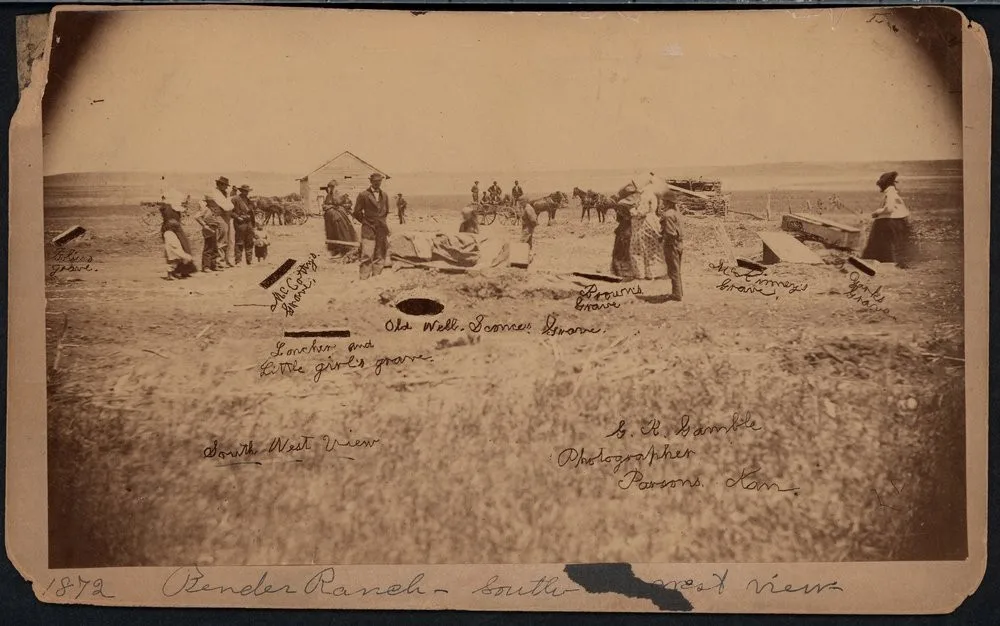
The Bloody Benders were a family who ran a small inn and store beside a trail in Labette County, Kansas, in the early 1870s. In May 1873 neighbours searching the abandoned property found human remains buried on the farm. Investigators concluded that travellers had been robbed and killed there. The Benders had already left, and no member of the family was ever convicted. What happened to them is not documented, and every later claim about it rests on rumour, a deathbed story or a disputed identification.
This guide separates what the 1873 reports and later accounts agree on from what is contested. The victims were real people, and their numbers and names are still not fully settled.
Who were the Benders?
The family held a 160-acre claim in Labette County from about 1870, according to HistoryNet. Harper’s Weekly captioned the site as near Cherryvale. They kept a small inn and store, and the Library of Congress calls it a semi-regular stop for travellers. The household is usually listed as John Bender (about 60), his wife (in her 50s), John Jr. (about 25) and Kate (a couple of years younger).
Almost nothing about them is solidly established. The Library of Congress notes that the family’s nationality was inconsistently reported: most papers called them German, while one Oregon newspaper described them as “Hollanders”. It also says the relationships between them were only surmised. Whether the older pair were married, and whether the younger two were really siblings, is unknown. The names in circulation are the ones the family used in Kansas, not proven identities.
HistoryNet and James both report that Kate Bender presented herself as able to contact spirits, which became part of the case. Spiritualism, discussed in the guide to the Fox sisters and their rappings, had made such claims familiar by the 1870s.
How did the disappearances come to attention?
Two cases moved the story from rumour to inquiry.
- George Longcor (spelled “Loncher” in some accounts) and his young daughter. HistoryNet dates their disappearance to winter 1872, after Longcor bought a wagon and team from Dr. William York. The team was later found abandoned.
- Dr. William York. He went looking for the team and was last seen on March 9, 1873. His brothers, Ed York and the Kansas state senator Colonel Alexander M. York, retraced his route and learned that he had mentioned visiting the Benders’ inn.
HistoryNet and James both say the Yorks visited the inn in late March or early April. By these accounts Kate offered to consult the spirits about the doctor’s whereabouts, and the family suggested he might have been attacked by highwaymen. James writes that the party left with suspicion eased and returned eleven days later with a larger group.
What was found in May 1873?
The accounts agree on the outline, though not on every date. James says York’s party reached the cabin on Monday, May 6, 1873, where neighbours were already searching the house, and elsewhere in the book gives May 5; HistoryNet has a township trustee entering the cellar on May 5 and a large crowd digging the next day. The Library of Congress blog gives May 6 for the discovery of Dr. York’s body, citing the Emporia News of May 9. Some online summaries place these events in April. The sources read here put them in early May.
The cabin was empty, the animals had been left unfed, and the family had gone. The searchers found a trapdoor in the floor and, according to HistoryNet, items in the cellar, including hammers. Dr. York’s body was found in the orchard, and further graves were opened that day and afterwards. James says three hammers and a clock were kept as evidence.
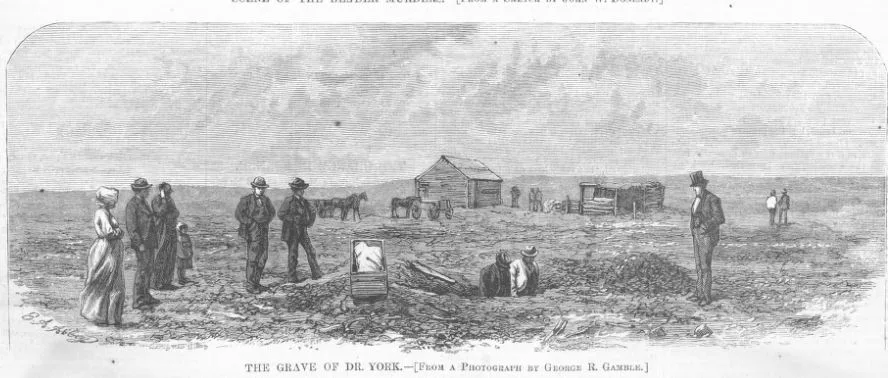
“The Grave of Dr. York,” a woodcut in Harper’s Weekly, June 7, 1873, made from a photograph by George R. Gamble. Public domain via Wikimedia Commons; resized and converted to WebP.
How many victims were there?
There is no agreed number, and sources that give one often differ in what they count.
| Source | What it says |
|---|---|
| James (1913) | Eleven bodies from the garden and orchard: nine men, a young woman and a girl. Others were found later along the creek, in the timber and at a distance from the house. |
| Library of Congress (citing Emporia News, May 23, 1873) | Up to eight graves reported and up to fourteen deaths attributed to the family; the reporter admitted he could only give an outline. |
| HistoryNet | At least nine other bodies besides Dr. York; the total is unknown and some estimates exceed twenty. |
The identified dead are usually given as Dr. William York, Ben Brown, W. F. McCrotty, John Greary, Henry McKenzie, Johnny Boyle, and George Longcor with his daughter, though spellings differ between James and HistoryNet. James states that a young woman among the dead was never identified, and that the cause of death for the child is uncertain: he believed she had been smothered, while HistoryNet describes burial alive as suspected. The fair summary is that about eight named victims are documented in these sources and the true total cannot be fixed.
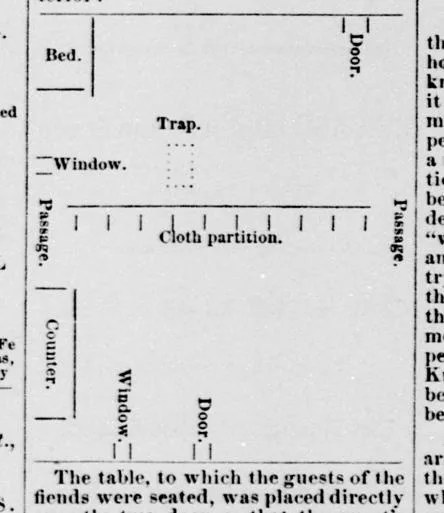
Excerpt of the Wichita City Eagle’s May 22, 1873 diagram of the cabin: a cloth partition, a trap in the floor, a counter and the door. Public domain via Wikimedia Commons; resized and converted to WebP.
The method usually described, in which a guest seated at a table beside a canvas partition was struck from behind and dropped through the trap, comes from this physical layout and from the retrospective chapter James titled “How the Benders Did It.” Nobody who survived such an attack has been identified, so treat it as a reconstruction, not as testimony. The motive most sources give is robbery. HistoryNet estimates the proceeds at about $5,000 and notes that some victims carried very little.
What happened to the Benders?
After the discovery, crowds came to the farm. HistoryNet reports that relic hunters dismantled the buildings. A mob also targeted Rudolph Brockman, who had courted Kate, and hanged him repeatedly to force answers; other neighbours were held on suspicion.
Rewards were announced, but the figures vary by source. James reproduces part of a proclamation dated May 17, 1873, issued by Governor Thomas A. Osborn, which describes the four suspects. Secondary accounts give $1,000 from Colonel York plus $2,000 from the governor, while the Library of Congress says the Wichita City Eagle of May 22 carried a $5,000 reward notice. Treat the totals as unsettled.
HistoryNet says trails led by train from Humboldt toward Texas and toward St. Louis, and that one detective’s search ended in the Chihuahua desert. The Library of Congress notes the family may have had a head start of almost a month.
Which claims about their fate are unproven?
Several stories have circulated. None is verified.
- A lynching. James includes an account of a Vigilance Committee member, George Evans Downer, who, according to the book, stated on his deathbed that he and others had shot the family. James also prints a second deathbed statement dated to 1876 in New Mexico. Both are secondhand and uncorroborated, and James himself writes that none of the Benders located in later years was satisfactorily identified.
- A Nebraska arrest, 1880. The Library of Congress says two people claimed to be the elder Benders were arrested and “confessed,” then were widely judged impostors and released.
- Scattered sightings. HistoryNet lists reports from Iowa (1873), Arizona (1875) and elsewhere, all unconfirmed.
- Kate Bender. Rumours that she lived out her life under another name were repeatedly disputed in later decades, according to the Library of Congress.
The 1889 arrests in Michigan
The best-known identification attempt came in 1889. Two women in Niles, Michigan, Sarah Eliza Davis and Mrs. Monroe, who is described as her mother, were arrested after a campaign by Frances McCann, whom the Library of Congress calls a victim’s daughter. They were held as the “Bender women” and taken to Oswego, Kansas.
The case collapsed. According to the Library of Congress, evidence later placed the women in Michigan at the time of the 1873 murders. James, who defended them, says the prosecutor became convinced they were not the Benders and dismissed the case. HistoryNet says a judge freed them for insufficient evidence, while the Osage Township trustee who escorted them to Kansas continued to believe in the identification.
This is a case where the source matters. James was the defence lawyer, so his book is not a neutral witness, but his account matches the Library of Congress summary on the result, and his objections are specific. No court ever found that these women were Benders.
What is documented, claimed, and unresolved?
| Category | Statement |
|---|---|
| Documented | A search in early May 1873 found Dr. William York and other human remains on the Bender claim in Labette County, Kansas. |
| Documented | Governor Osborn issued a proclamation on May 17, 1873, naming the family as suspects. |
| Documented | No member of the family was convicted. The 1889 prosecution of two Michigan women ended without a finding. |
| Disputed | The total number of victims, the identity of the young woman, and the cause of the child’s death. |
| Reconstruction | The trapdoor-and-curtain method, drawn from the cabin layout and later accounts, not from a witness. |
| Unverified claims | Lynching accounts, deathbed statements and the many “Bender” sightings after 1873. |
| Unknown | The family’s real names and relationships, and what became of them. |
Why the case is still told
The Benders fit an image of the frontier as a place where a stranger could vanish without notice, and that image has often been stretched beyond the evidence. The record supports a narrower, sadder story: a small number of identified travellers, several more unidentified, a community that took weeks to act, and a family that disappeared before anyone could ask them questions.
For other cases in which a building or a reputation outgrew the evidence, compare H. H. Holmes and the “Murder Castle”. For an unsolved Midwestern family murder from 1912, see the Villisca axe murders. Another trial in which a verdict and the popular verdict diverged is Lizzie Borden’s, and the Burke and Hare killings are another case of murder for profit, though one where the perpetrators were identified.
Frequently asked questions
Were the Bloody Benders real?
Yes. A family of four lived on a claim in Labette County, Kansas, in the early 1870s, and human remains were found on the property in May 1873. The names, relationships and origins of the family are not fully established.
How many people did the Benders kill?
Nobody knows. Contemporary and later sources give figures from around nine or ten named victims to estimates above twenty. Be cautious with any single number.
What happened to the Bender family?
It is unknown. The family left before the graves were found and was never captured. Lynching, escape and later sightings have all been claimed, and none is proven.
Were the Benders ever caught?
No. Two Michigan women were arrested in 1889 as the Bender women, but the case against them was dismissed and no court identified them as Benders.
Were the Benders spiritualists?
Reports say Kate Bender told visitors she could contact spirits. Both James and HistoryNet describe her offering to contact spirits on behalf of the Yorks. That is a report about one person, not evidence about spiritualism generally.
Sources & further reading
- John T. James, The Benders in Kansas (Wichita: Kan-Okla Publishing Co., 1913), full text at the Internet Archive (accessed October 31, 2026). James was the defence attorney for the women tried in 1889-1890.
- Joanna Colclough, The Bloody Benders: Homestead of Horrors, Library of Congress Headlines & Heroes blog (October 8, 2024; accessed October 31, 2026)
- HistoryNet: The Bloody Benders' Grim Harvest (accessed October 31, 2026)
- Harper's Weekly, June 7, 1873, p. 484, 'The Grave of Dr. York' (woodcut after a photograph by George R. Gamble; Wikimedia Commons file record, accessed October 31, 2026)
- Wichita City Eagle, May 22, 1873: diagram of the Bender cabin (Wikimedia Commons file record, accessed October 31, 2026)
- Wikipedia: Bloody Benders, read only to cross-check the outline of events and the list of cited works; not relied on for any figure (accessed October 31, 2026)