The Index / Disappearances
The Lake Anjikuni Vanished Village: What the 1930 Story, the RCMP and Skeptics Actually Show
Did an Inuit village vanish near Lake Anjikuni in 1930? What the Danville Bee article, the RCMP and Skeptoid show, and how the story grew from 25 people to 2,000.
Topics: Lake Anjikuni, Angikuni Lake, Nunavut, Disappearances, Urban Legend, 1930
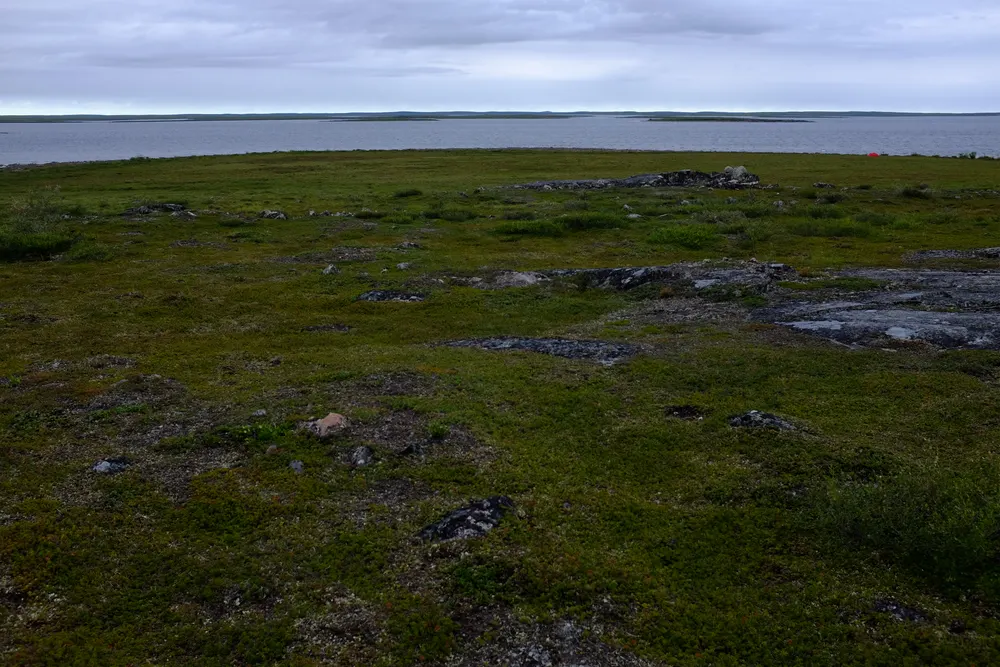
The story goes that in November 1930 a trapper walked into an Inuit village by Lake Anjikuni in northern Canada and found it empty: food still on the fire, rifles left behind, and the villagers gone. The Royal Canadian Mounted Police say the story is not true. A newspaper article about it did appear in 1930, but nothing in the police record, the geography or the sources supports a mass disappearance, and the details people repeat today were added decades later.
This guide follows the story from the 1930 article to the online versions, and separates what can be checked from what was added along the way. The real people of that region have a documented history of their own, and it is not the one the legend tells.
What is the Lake Anjikuni story?
The popular version runs like this. A trapper named Joe Labelle reached a village he knew on the shore of the lake and got no answer when he called out. Everything seemed in place, but the people were missing. Later versions add kayaks drawn up on the beach, meals hanging over cold fires, dead sled dogs, emptied graves and sometimes strange lights in the sky.
Two things are worth keeping apart from the start. The lake itself is real, and the event is not documented. The name is also written two ways: Angikuni is the spelling used for the lake in Nunavut, while Anjikuni is the form that spread with the legend. This article uses both because people search for both.
Where is the lake, and who lived there?
Angikuni Lake lies in the Kivalliq Region of Nunavut, about 510 km² of water along the Kazan River, with many islands and no permanent settlements, according to Wikipedia’s entry on the lake. In 1930 the area was part of the Northwest Territories.
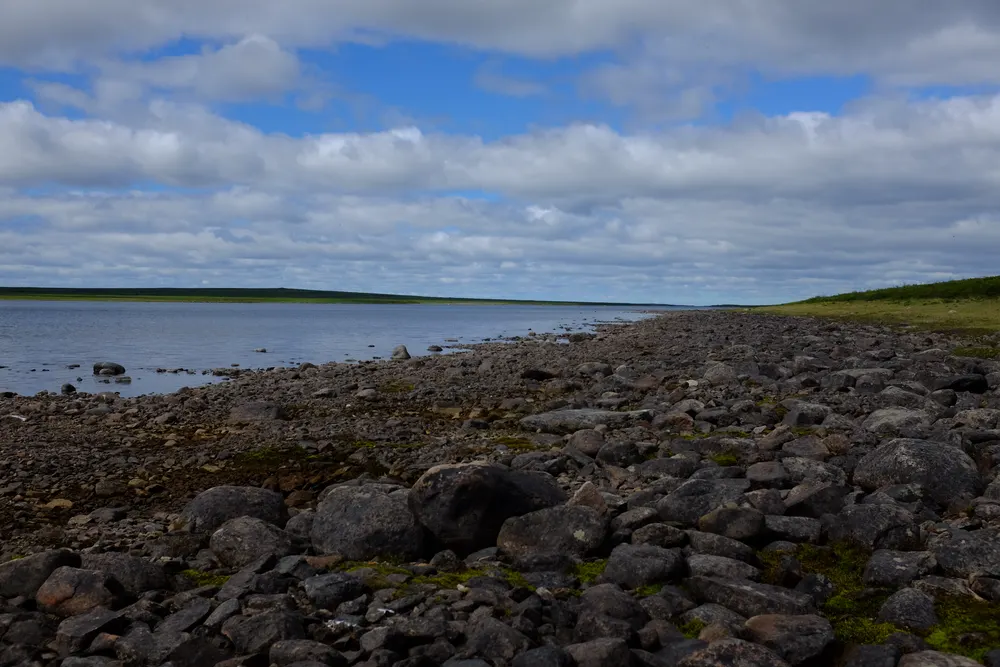
A stony shore of Angikuni Lake, photographed in July 2014 by N. Perrault. CC0 via Wikimedia Commons; resized and converted to WebP. The photograph shows the landscape only and says nothing about 1930.
The inland Inuit of this region are known as the Ahiarmiut or Ihalmiut, and they lived by hunting barren-ground caribou. The Wikipedia article on them reports that Joseph Tyrrell’s 1893-94 expeditions counted about 2,000 Caribou Inuit across the wider region, and that by 1934 the Ahiarmiut numbered 80, with 11 heads of families. These are secondary figures and should be treated as approximate, but they show that a settled village of hundreds, let alone 2,000, near this lake in 1930 does not fit the region’s recorded population.
What did the 1930 article actually say?
The story’s trail starts with a newspaper piece. According to the reference list of Wikipedia’s article and Brian Dunning’s Skeptoid episode, the article was written by Emmett E. Kelleher and appeared in The Bee of Danville, Virginia, on November 27, 1930, under the headline “Vanished Eskimo Tribe Gives North Mystery Stranger Than Fiction”. Dunning says Kelleher’s version had 25 villagers, one rusty rifle, a few dog carcasses and a generic photograph of an Inuit village.
The sources disagree about where it was first printed. Dunning reports that Dwight Whalen’s November 1976 article in FATE magazine was the first to cite a 1930 article and a 1931 police report, and that Whalen named the Halifax Herald of November 29, 1930. Researcher Patrick Derksen found no trace of either in Manitoba papers in 2013. Dunning’s later update says the article was in fact located in The Bee. I could not open the original page, which sits behind a bot-check wall, so the quotation of the headline and date rests on those two secondary sources.
Dunning confirms the article exists but still calls it “dubious”. That matters: the legend is not a pure invention of the 1950s, but a 1930 piece of newspaper writing that was never backed by anything else.
What did the police find?
The RCMP’s own page on fun facts and urban legends says the story of a village disappearing near Lake Anjikuni in the 1930s “is not true”. Dunning quotes the force as adding that a village with such a large population would not have existed in such a remote area of the Northwest Territories.
Dunning also describes a January 1931 report by Sergeant J. Nelson, released by Commissioner Cortland Starnes, which found that:
- Joe Labelle was a real person but worked only in northern Manitoba;
- the photograph with the article came from the RCMP’s own archives;
- nobody in the region knew of the village or its disappearance;
- the story was “a sensationalized hoax made up by Kelleher”.
Wikipedia attributes its account of Nelson’s report to John Robert Colombo’s Ghost Stories of Canada (2000), and a former RCMP historian is quoted by Dunning as writing in 1988 that no Labelle had come to the police and no search parties had been sent. These are reports of the report, not the report itself, so the Nelson findings are best read as well-attributed but second-hand.
How did the story grow?
The most useful way to see the legend is to compare versions. Dunning’s comparison, which I have kept to what he reports, shows the numbers inflating over time.
| Version | Date | What it adds |
|---|---|---|
| Kelleher, The Bee | 1930 | 25 villagers, one rusty rifle, a few dog carcasses, a stock photograph |
| Frank Edwards, Stranger Than Science | 1959 | A “friendly little Eskimo village” of about thirty people, kayaks on the beach, meals over dead fires, frozen dogs; no sources given |
| Blundell and Boar | 1983 | 1,200 people, three trappers who saw UFOs, a telegraph report |
| Rense.com | 2001 | 2,000 people, dog bodies under twelve feet of snow |
| Rutkowski and Dittman | 2006 | Ancestral graves emptied |
Nothing in this sequence adds evidence. Each version adds colour and scale, and in Dunning’s list the UFO element first appears in the 1983 version. The same pattern of a plain account becoming a sensation shows up in stories like the Flatwoods monster and the Men in Black, where the later retellings carry most of the drama.
Do the details hold up?
Dunning raises practical objections to the details added after 1930, and they are reasonable to weigh, with the caveat that they are one writer’s reasoning rather than archival findings:
- Kayaks on a November beach make little sense on a lake that would be freezing over.
- Sealskin kayaks and clothing would be odd inland; the region’s resource was caribou hide, and a trapper would likely notice the difference.
- A village of 1,200 or 2,000 people has no match in the recorded population of the region.
None of this proves that no one at all ever left a camp near the lake, which is a normal event in seasonal hunting life. It shows that the dramatic specifics are not supported.
What is documented, claimed and unresolved?
| Category | Items |
|---|---|
| Documented | Angikuni Lake exists in Nunavut. A 1930 article by Emmett E. Kelleher appeared in The Bee in Danville, Virginia. The RCMP states the story is not true. |
| Reported by secondary sources | Sergeant Nelson’s 1931 findings that Labelle only worked in Manitoba, that the photograph was an archive picture, and that Kelleher invented the story. |
| Legend and embellishment | Kayaks on the beach, meals on the fire, frozen dogs, empty graves, villages of 1,200 or 2,000, UFOs. |
| Unresolved | Whether Kelleher based his article on any rumour at all, and why Whalen cited a Halifax Herald date for it. |
What is the real history of the region?
The legend’s emptiness hides something real. The same Wikipedia article on the Ahiarmiut records that between 1949 and 1959 the federal government relocated the group several times, including a May 1957 airlift to Henik Lake, after which many starved. In 2018 a settlement of $5 million was agreed, and in January 2019 the government apologised to 21 survivors in Arviat. The author Farley Mowat wrote about the Ahiarmiut, though that article notes his books are described as creative non-fiction.
That is a documented case of people being moved off their land and suffering for it. It deserves more attention than an invented village that never existed, and it is one reason to be careful about telling the Anjikuni story as though real Inuit communities were props.
Why does the legend persist?
Part of it is the format. The story is short, it has a sympathetic witness, an unexplained absence and a remote setting that few readers can check. It sits comfortably beside other vanishing stories such as the Roanoke colony, the Mary Celeste and the Flannan Isles lighthouse keepers. Unlike those, there is no record of an actual missing group. Readers interested in the wider pattern of places where disappearances cluster in popular writing can also see the Bermuda Triangle.
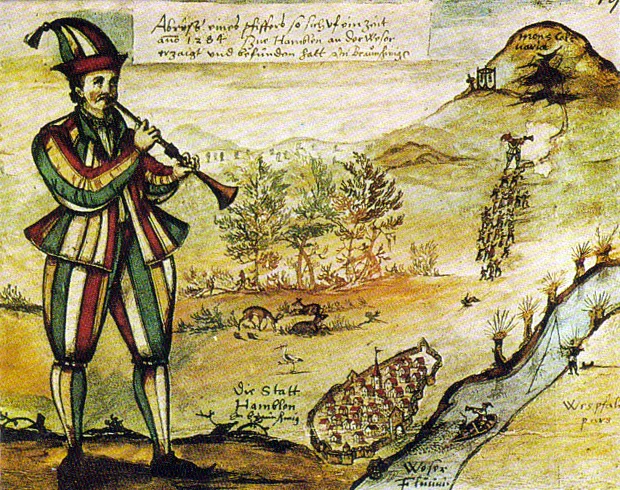
The Pied Piper of Hamelin is a useful contrast: its event cannot be confirmed either, but the tradition behind it goes back centuries rather than to a single newspaper story. For another legend that looks very different once the first printed accounts are read, see the Oak Island Money Pit.
Frequently asked questions
Did an Inuit village really disappear at Lake Anjikuni?
No evidence says so. The RCMP states the story is not true, and the first known printing was a 1930 newspaper article that police reportedly judged a hoax.
Who was Joe Labelle?
A real trapper, according to Dunning’s account of the 1931 police report, but one who only worked in northern Manitoba. The meeting with an empty village is not documented.
Where did the story come from?
A 1930 article by Emmett E. Kelleher in The Bee of Danville, Virginia, according to Wikipedia and Dunning. Frank Edwards’s 1959 book Stranger Than Science made it famous without citing any source.
Is it Anjikuni or Angikuni?
Angikuni is the spelling used for the lake in Nunavut. Anjikuni is the spelling attached to the legend. Both refer to the same place.
Were UFOs involved?
Only in later retellings. In Dunning’s comparison the UFOs first appear in a 1983 retelling, not in the 1930 article.
Sources & further reading
- Royal Canadian Mounted Police, Fun facts and urban legends (page last modified March 10, 2025; accessed October 31, 2026)
- Brian Dunning, Skeptoid #371: The Vanishing Village of Angikuni (2013, with later update; accessed October 31, 2026)
- Wikipedia: Angikuni Lake, used for the lake's geography and for the reference list (including the Kelleher article in The Bee, Danville, Virginia, November 27, 1930); accessed October 31, 2026
- Wikipedia: Ahiarmiut (Ihalmiut), used for the people of the Ennadai Lake and Kazan River region and the 1949-1959 relocations; accessed October 31, 2026
- Wikimedia Commons file records for the two lake photographs by N. Perrault, both CC0 (accessed October 31, 2026)