The Index / Dark History
The Princes in the Tower: What the Evidence Can Prove
Edward V and Richard disappeared in 1483. Separate the recorded succession crisis, later murder stories and disputed bones from claims that the case is solved.
Topics: Princes in the Tower, Missing Children, Tower of London, Richard III, Medieval History
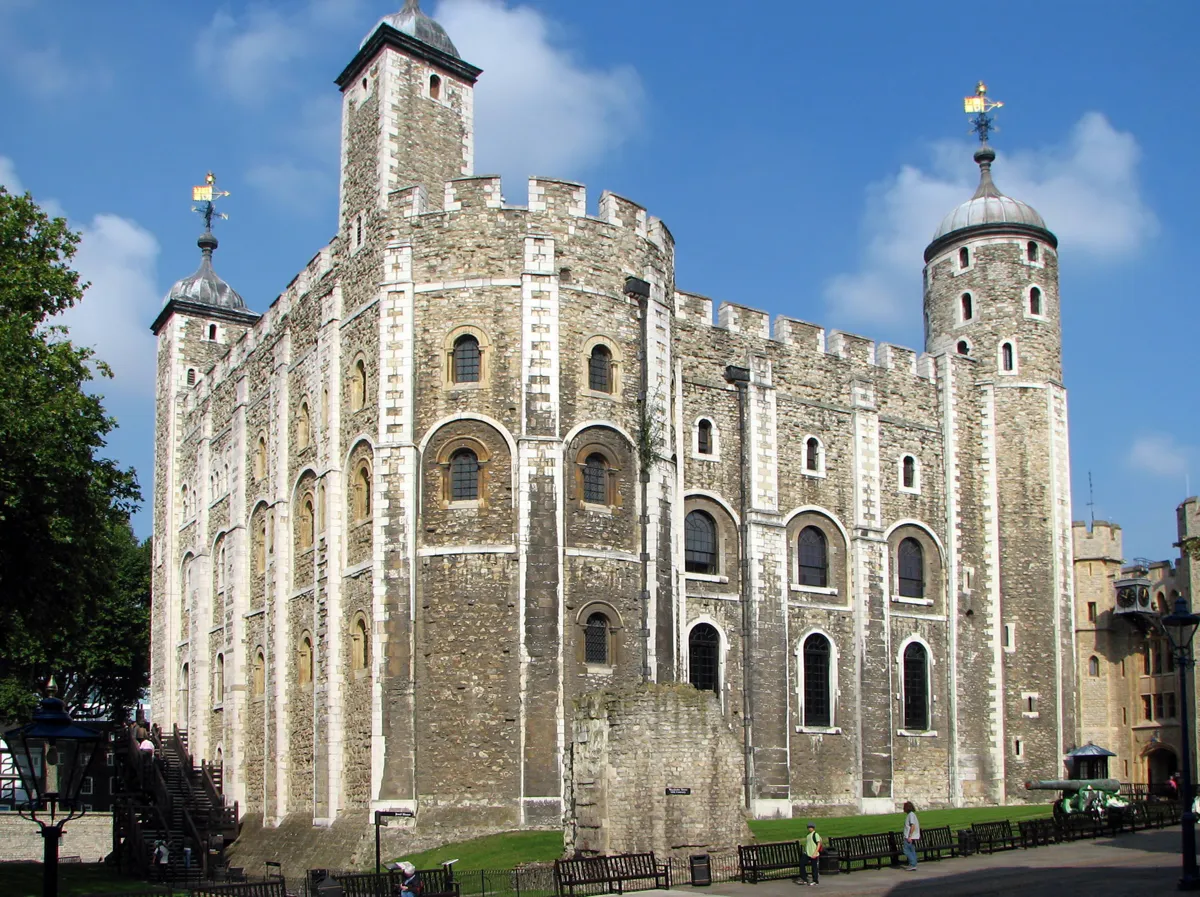
Bernard Gagnon / Wikimedia Commons, CC BY-SA 3.0; resized and converted to WebP.
The Princes in the Tower were Edward V and his younger brother Richard, Duke of York, who disappeared from public view in 1483. Their uncle became Richard III. Murder is the familiar explanation, but the surviving evidence does not establish precisely when the boys died or who was responsible.
Three separate questions are often collapsed into one: what happened politically, what later writers alleged, and whose bones were discovered nearly two centuries afterward. Keeping them apart makes the case more understandable.
Who were the princes?
Edward and Richard were sons of Edward IV and Elizabeth Woodville. After their father died on April 9, 1483, Edward succeeded as Edward V, but was never crowned. His uncle Richard, Duke of Gloucester, escorted him to London and placed him in the Tower.
Their mother sought sanctuary at Westminster Abbey. The younger Richard subsequently joined Edward at the Tower. Following an allegation that their parents’ marriage was invalid, Edward was deposed and Gloucester became king.
These events are summarized in Westminster Abbey’s account of the brothers. They establish a succession crisis. By themselves, they do not establish a murder.
What does the disappearance record tell us?
Historic Royal Palaces’ historical account distinguishes reports from later storytelling. It discusses Dominic Mancini, who wrote about the boys becoming less visible and suspicions that they had been killed. His report included information and rumors circulating at court.
A report that people feared a killing is evidence that the fear existed. It is not an eyewitness description of the killing itself.
Richard III has long been the principal suspect. He controlled the situation and benefited from his nephews losing their claim. That makes the question legitimate, but political advantage is not proof of a particular act. The case still needs evidence connecting a named person to what happened.
Why later accounts require caution
Thomas More’s account, written decades later, accused Richard of arranging the murders. The distinction between the date of an alleged event and the date of its detailed retelling matters.
Curator Charles Farris’s examination of the bones’ discovery notes that More was not an eyewitness. Later readers associated the discovery near stairs with his narrative. The resemblance helped make the identification persuasive; it did not independently authenticate the story.
That is a recurring problem in historical mysteries: an earlier story can shape how a later find is interpreted. Agreement between the two must be examined, not simply counted as a solution.
What was found in 1674?
On July 17, 1674, workmen discovered skeletal remains during building works at the Tower. Charles II supported identifying them as the princes. An urn was installed at Westminster Abbey in 1678.
Farris cautions that even the precise discovery location is debated. The familiar plaque and the phrase “under the staircase” should not be mistaken for a complete archaeological record.
The remains’ identification, their subsequent commemoration and their original discovery are different historical events. A royal decision to bury bones under particular names records what authorities accepted at that time. It does not create a modern forensic identification.
Did the 1933 examination settle their identity?
No definitive identification follows from the Abbey’s published description. It records that the urn was opened in July 1933 and that the surviving bones were those of two young children. Some material had already been lost or given away following the original discovery.
The urn’s inscription blames Richard III in much stronger language. The Abbey reproduces that inscription, allowing readers to distinguish the memorial’s assertion from the examination it also describes.
“Children’s remains were examined” and “these particular children were identified” are different claims. Even an identification would leave the separate questions of cause of death and responsibility to resolve.
Paintings are evidence of the story’s afterlife
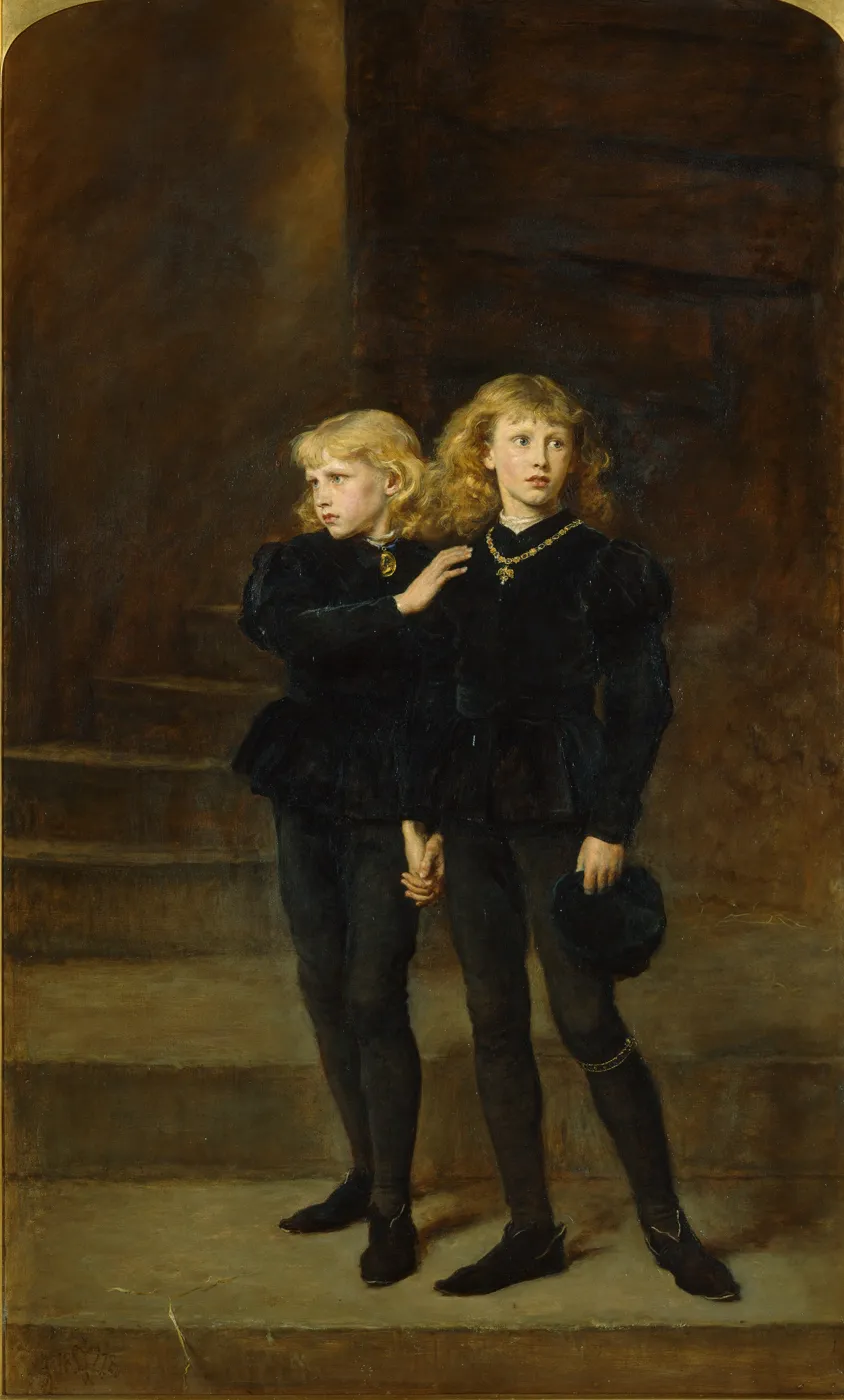
John Everett Millais’s 1878 interpretation of the princes, not a contemporary portrait or a record of their final moments. Public-domain reproduction via Wikimedia Commons; resized and converted to WebP.
The emotional certainty of a painting can outstrip the certainty of a document. The Royal Collection’s catalogue entry for a photograph of Paul Delaroche’s 1830 painting explicitly connects that work to Shakespeare’s Richard III. It stages the boys awaiting an approaching figure.
That is useful evidence about nineteenth-century interpretations. It cannot tell us what someone entering their room in 1483 actually did. The same caution applies to the Millais painting reproduced here.
Reading the evidence without inventing an ending
An unresolved death or disappearance should not be filled with invented dialogue, a precise final scene or an unverified survival story. This is also important when reading about the Sodder children’s disappearance and Roanoke Colony: uncertainty does not independently prove rescue, escape or murder. The story of a hidden heir also attached itself to Kaspar Hauser in Germany, where DNA testing could finally be applied.
For the separate problem of accusations accumulating later dramatic details, see Elizabeth Báthory and the Blood Countess legend. These cases have different records, not a shared solution.
Frequently asked questions
Were the princes murdered?
Murder is a longstanding explanation. The precise circumstances and perpetrator are not established by the surviving evidence discussed here.
Did Richard III kill them?
He remains a major suspect. Suspicion and a later account accusing him should not be presented as a proven verdict.
Were their bodies found?
Bones discovered in 1674 were accepted as theirs and commemorated at Westminster Abbey. Their identification remains disputed.
Were both boys kings?
No. Edward became Edward V without being crowned. Richard was Duke of York.
Sources & further reading
- Historic Royal Palaces: The Princes in the Tower: murdered or survived? (accessed October 30, 2026)
- Charles Farris, Historic Royal Palaces: Charles II and the discovery of the Princes in 1674 (July 17, 2024)
- Westminster Abbey: Edward V & Richard Duke of York (accessed October 30, 2026)
- Royal Collection Trust: Les enfants d'Édouard, RCIN 2160759 (accessed October 30, 2026)