Lore & Explained / Folklore
Robert Johnson and the Crossroads: The Real Story Behind the Devil Legend
Robert Johnson really did disappear and come back a far better guitarist. The deal-with-the-devil story wasn't originally his -- it belonged to a different bluesman first.
Topics: Robert Johnson, Crossroads Legend, Blues, Folklore, Mississippi Delta
Firecruise, Wikimedia Commons (CC BY-SA 4.0)
Robert Johnson recorded 29 songs across two sessions in 1936 and 1937, died in Mississippi in 1938 at 27, and is now considered one of the most influential blues musicians in American history. None of that required a deal with the devil. The story that he sold his soul at a rural crossroads to become a great guitarist is one of the most durable legends in American music — and it wasn’t even originally about him.
Who Robert Johnson Actually Was
Johnson was born in Hazlehurst, Mississippi, around May 1911 (some records conflict on the exact date), and spent his short life moving through the Mississippi Delta as a working musician. His entire surviving recorded output comes from two sessions: one in San Antonio, Texas, at the Gunter Hotel in November 1936, and another in Dallas the following June. Together they produced the 29 songs, with several alternate takes, that make up his complete discography — released at the time as 78 rpm singles, with more surfacing posthumously. He died on August 16, 1938, near Greenwood, Mississippi. No official cause of death was recorded at the time; later researchers have proposed poisoning by a jealous husband, complications from undiagnosed medical conditions, or a combination of factors, and the exact cause remains genuinely unresolved.
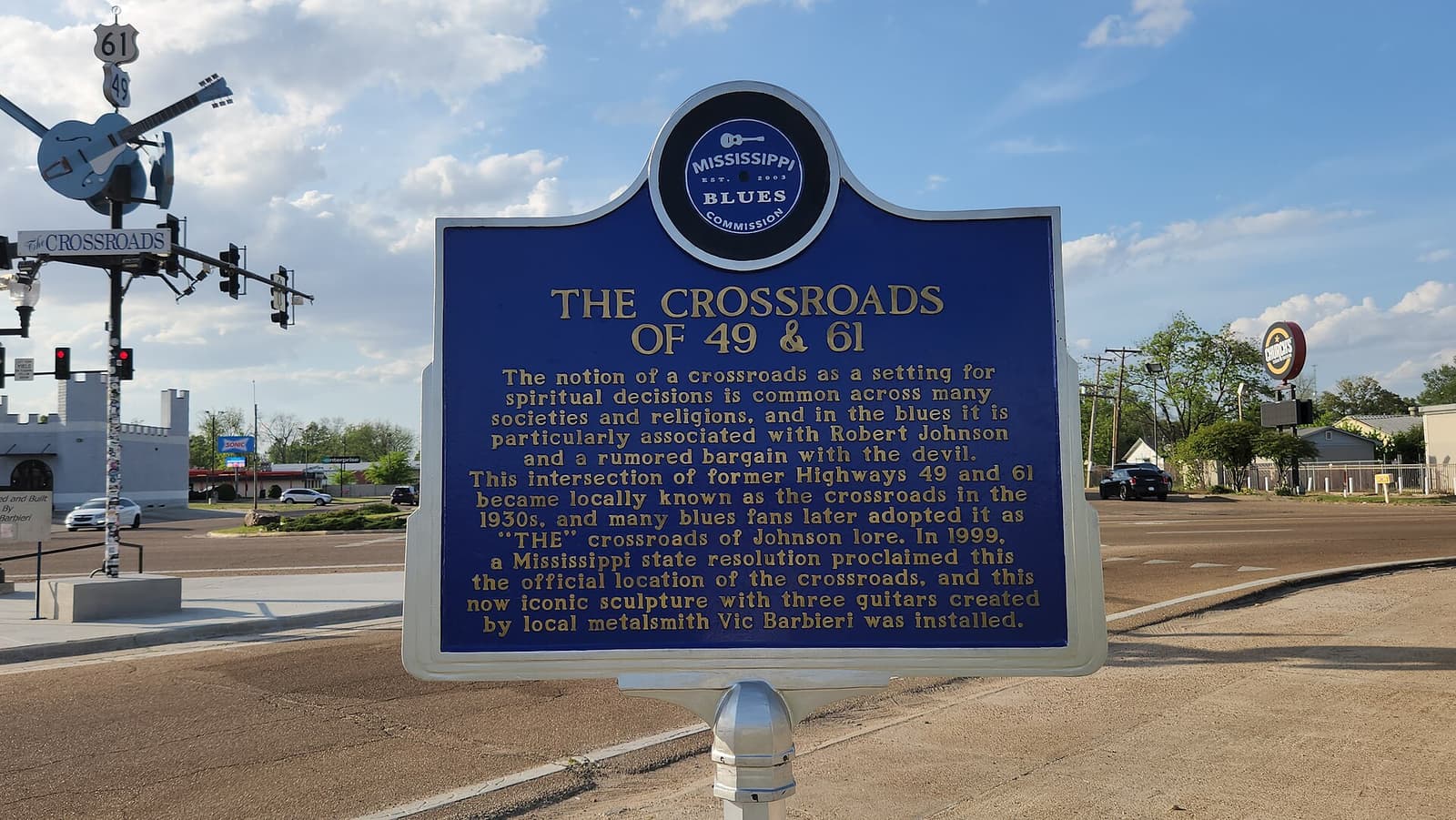
A Mississippi Blues Trail marker at the crossroads of Highways 61 and 49 in Clarksdale — a modern tourist site built around the legend, not a documented historical location tied to Johnson’s actual life. Source. Firecruise, Wikimedia Commons, CC BY-SA 4.0.
The Legend Wasn’t Originally His
This is the detail most retellings leave out entirely. The crossroads deal-with-the-devil story predates Robert Johnson’s fame and originally belonged to a different, unrelated blues musician: Tommy Johnson, no relation, who was himself said to have claimed he sold his soul to the devil at a crossroads near Dockery Plantation to gain his musical ability. That story was documented in the 1960s through interviews with Tommy Johnson’s brother Ledell and his associate Ishman Bracey. Sometime after Robert Johnson’s death — and well after his own lifetime, when he couldn’t confirm or deny anything himself — the story migrated from Tommy Johnson to Robert Johnson, likely helped along by the two men sharing a last name and by the specific circumstances of Robert Johnson’s own rediscovery decades later.
How the Story Attached to Robert Johnson
Robert Johnson was largely unknown outside blues circles until a wave of “rediscovery” by white American and British audiences and critics in the 1960s, well over two decades after his death. Blues scholar Elijah Wald, who has written the most detailed modern account of Johnson’s actual career, has noted that the crossroads legend as commonly told largely dates from this rediscovery period rather than from Johnson’s own lifetime or immediate reputation. Music writers including Greil Marcus and Robert Palmer helped popularize and elaborate the story in the decades that followed, folding in details that strengthened the narrative without strong documentary support behind them.
One piece of “evidence” often cited is blues musician Son House’s account of Johnson’s musical development — but House’s actual answers, when pressed by interviewers about how Johnson improved so dramatically, were reportedly vague and equivocal rather than a clear supernatural claim. Later writers and audiences interpreted that vagueness as confirmation of something House never consistently asserted.
What Actually Happened, As Best As It’s Documented
Son House himself provided the more mundane, better-supported half of the story: he remembered a young Robert Johnson as a competent harmonica player but, in his own description, an embarrassingly poor guitarist. Johnson then disappeared from the area for roughly a year to eighteen months. When he reappeared, House and others were struck by how dramatically his guitar playing had improved.
Modern researchers have identified a far more grounded explanation than a supernatural bargain: Johnson is believed to have spent that missing period living with and studying under a musician named Isaiah “Ike” Zimmerman, near Martinsville, Mississippi, not far from Johnson’s birthplace. Zimmerman is described in later accounts as a significant influence on Johnson’s technique, and the two reportedly practiced at night in rural graveyards — not for any occult reason, but for the practical reason that cemeteries were quiet and unlikely to be disturbed by anyone late at night. A year or more of intensive, focused practice under a skilled mentor is a documented, unremarkable way for a musician to improve dramatically. It’s just a much less cinematic story than the one that actually became famous.
The African Folklore Question
Some writers have proposed that the “devil at the crossroads” motif reflects surviving African spiritual tradition brought to the American South, specifically pointing to Legba, a trickster and crossroads-associated deity in West African and Afro-Caribbean religious traditions. Blues scholar David Evans has pushed back on this interpretation directly, arguing that the devil imagery found throughout blues lyrics and folklore traces more clearly to Western Christian folk tradition, and noting that blues performers of the era did not typically reference African deities by name in their own material. This is a genuinely contested point among folklorists and music historians, not a settled question either way, and it’s worth treating it as an open scholarly debate rather than picking whichever version sounds more atmospheric.
About Robert Johnson’s Photographs
It’s worth flagging directly: the handful of known authenticated photographs of Robert Johnson — including the so-called “dime-store” photo and a 1930s studio portrait — are not in the public domain. They remain under copyright, controlled through the Johnson estate following a 1998 Mississippi court ruling on his heirs, and have been licensed commercially since the 1980s. Several other images that have circulated online claiming to show Johnson, including ones published in national magazines, have been disputed by blues historians on grounds ranging from anachronistic clothing to facial-recognition analysis. Readers should be skeptical of any Robert Johnson photo circulating without clear sourcing.
A Story That Outgrew the Man
The crossroads legend has become so dominant that it now overshadows Johnson’s actual, well-documented body of work and his real, specific, traceable influences. That’s a familiar pattern in American folklore — a compelling supernatural explanation crowding out a more human, harder-to-dramatize one. It’s the same dynamic behind cases like the Highgate Vampire, where a real sequence of events got reshaped into legend through retelling, and it echoes the way Krampus gets marketed as ancient pagan tradition despite a much later, more traceable documented history.
Frequently Asked Questions
Did Robert Johnson really sell his soul to the devil? There’s no evidence he did, and the story wasn’t originally told about him at all. It’s documented as originally belonging to a different blues musician, Tommy Johnson, and migrated to Robert Johnson’s reputation decades after his death.
How did Robert Johnson actually get so good at guitar? Researchers believe he spent roughly a year studying intensively under a musician named Isaiah “Ike” Zimmerman, likely practicing at night in rural cemeteries simply because they were quiet, not for any supernatural reason.
How did Robert Johnson die? Near Greenwood, Mississippi, in August 1938, at age 27. No official cause was determined at the time, and the exact cause remains disputed among researchers, with poisoning and underlying medical conditions both proposed as explanations.
Are there real photographs of Robert Johnson? A small number of authenticated photos exist, but they remain under copyright and are not freely licensed or public domain. Several other widely circulated images claiming to show Johnson have been disputed by historians.
Where does the crossroads legend actually come from? It originated with a different, unrelated blues musician, Tommy Johnson, who was documented in the 1960s as having made a similar claim about a crossroads near Dockery Plantation. It attached to Robert Johnson’s reputation after his death, mainly during his rediscovery by wider audiences in the 1960s.