The Index / Paranormal
The Marfa Lights: What the Records and Field Studies Actually Show
What are the Marfa lights? Field studies tie most sightings to headlights on US 67. Where the 1883 story comes from, and what remains unexplained.
Topics: Marfa Lights, Texas, Ghost lights, Mirages, Unexplained phenomena, Skepticism
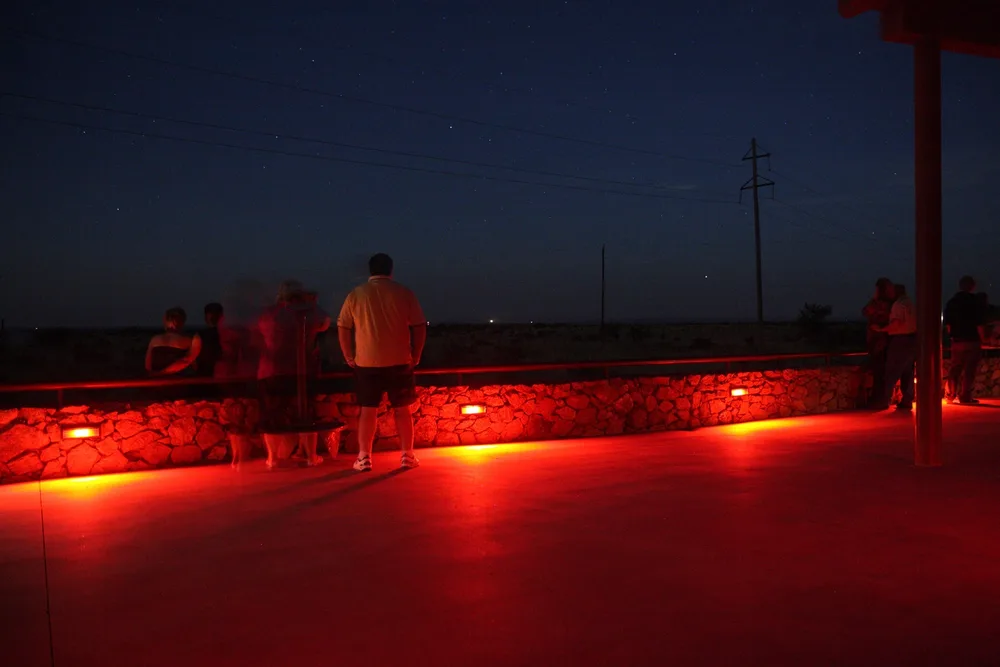
Jon Hanson / Wikimedia Commons, CC BY 2.0; resized and converted to WebP.
The Marfa lights are points of light seen at night on the horizon near Marfa, in far West Texas, usually from a roadside viewing area on U.S. Highway 90. The two best-known field studies found that most of the lights people watch from that platform are explainable: chiefly vehicle headlights on U.S. Highway 67, many miles away, distorted by layers of air over the desert, with others traced to streetlamps and small fires. A short list of sightings, recorded mainly by one long-term researcher, has not been matched to a known source. Those sightings are unexplained. That is not the same as evidence of anything supernatural.
The history is shakier than the lights. The famous 1883 sighting by a cowhand named Robert Reed Ellison rests on family tradition, and the earliest published account usually cited dates from 1957.
The short version
| Date | Event | Status |
|---|---|---|
| 1883 | Cowhand Robert Reed Ellison sees a flickering light near Paisano Pass and takes it for an Apache campfire | Family tradition; no written record from the time has been found |
| 1885 | Joe and Sally Humphreys report their first sighting | Reported in the Handbook of Texas; no contemporary document cited |
| 1919 | Cowboys ride into the mountains looking for the source and find nothing | Local account in the Handbook of Texas |
| 1940s | Pilots training in the area search for the lights from the air | Local account in the Handbook of Texas |
| July 1957 | Paul Moran’s “The Mystery of the Texas Ghost Light” appears in Coronet | Earliest published account usually cited |
| 1960s | Syndicated features and newspaper columns spread the story | Documented in newspaper archives |
| 2003 | The Marfa Mystery Lights Viewing Center opens on U.S. 90 | Documented |
| May 2004 (or 2005) | University of Texas at Dallas physics students link the lights they film to U.S. 67 traffic | Documented study; the date differs between sources |
| 2008 | Texas State University team runs 20 nights of spectroscopy | Documented study, published 2009; month per Wikipedia |
| 2011 | Paper measuring one “intense long-duration luminous object” near Marfa | Documented publication |
Where and what people see
Marfa is a small town in the high desert of Presidio County. The Handbook of Texas, the reference work of the Texas State Historical Association, describes the lights as usually visible on clear nights between Marfa and Paisano Pass, looking toward the Chinati Mountains. Witnesses report lights that twinkle, change colour, drift, split apart, merge and vanish, then reappear somewhere else.
Most visitors watch from a single place. According to the Handbook, the Texas Department of Transportation first built a roadside parking area about nine miles east of Marfa on U.S. 90, and the Marfa Mystery Lights Viewing Center opened there in 2003. Nautilus, writing in 2014, put the first viewing area in 1986. The two accounts can both be true if they refer to the parking area and the later building, but neither source says so directly.
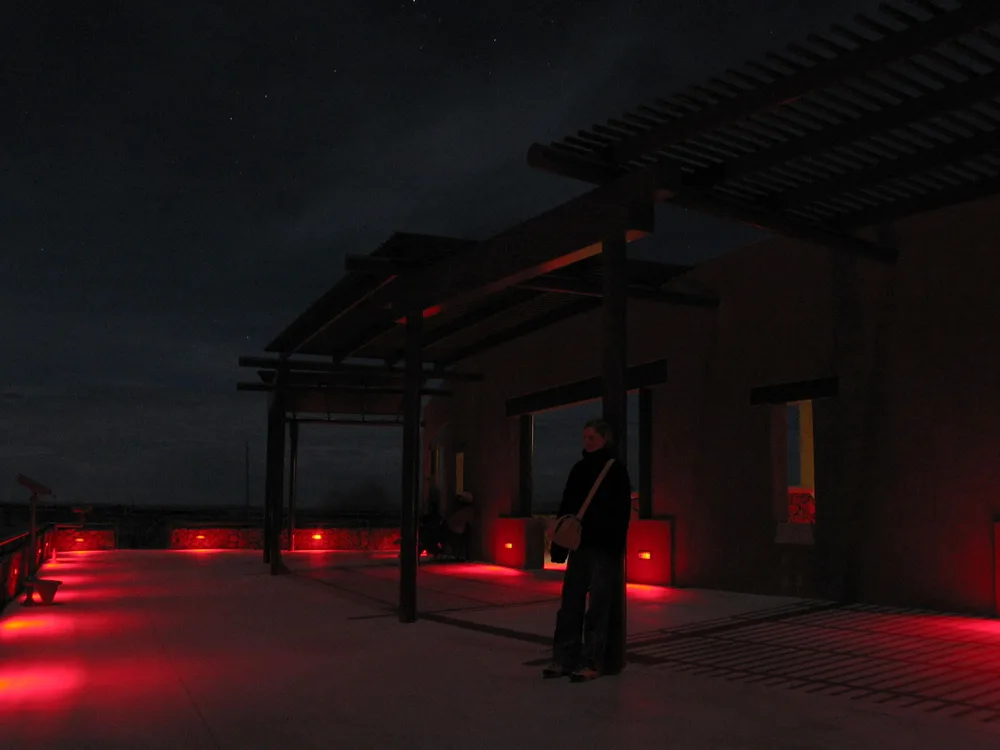
The viewing platform east of Marfa in April 2004, the year after the visitor centre opened. Photo by Daniel Schwen via Wikimedia Commons, CC BY-SA 2.5; resized and converted to WebP.
The location matters for every explanation that follows. The platform looks out across a broad open plain, which Dunning identifies as Mitchell Flat, toward distant mountains. Several roads, ranches and a highway lie in that direction. A light on the horizon there can be ten or twenty miles away, and nothing in the darkness gives the eye a sense of distance.
The 1883 story and the paper trail
The Handbook of Texas tells the origin story in its standard form: in 1883 a young cowhand, Robert Reed Ellison, was moving cattle through Paisano Pass when he saw a flickering light and wondered whether it was an Apache campfire. Other settlers said they saw the lights often, but no ashes or campsite were ever found.
That is the story. The documentation for it is thin. Brian Dunning’s Skeptoid episode on Marfa points out that there is no written record of Ellison describing the lights. His descendants said he talked about them, but his own memoirs, published in 1937 and covering his life in the region, do not mention them. Dunning concludes that the evidence from before the highways existed is anecdotal.
The first published account usually cited is Paul Moran’s article “The Mystery of the Texas Ghost Light” in the July 1957 issue of Coronet, a popular general-interest magazine. We have not seen the original. It is listed in the bibliography of the Wikipedia article and in the newspaper citations compiled by the lexicographer Barry Popik.
Popik’s compilation shows how the story then travelled. A 1960 feature by H. N. Ferguson, printed as far away as Cumberland, Maryland, described the light shining from a peak in the Chinati Mountains, visible from U.S. 90 between Alpine and Marfa, and already offered the familiar menu of explanations: an Apache ghost legend, light reflected from mica, swamp gas and mirages. In 1967, the Texas columnist Ed Syers asked readers for the latest on what one reader called the “Old Ghost Light” marked on a road map, and printed their replies. One woman, raised in the Chinatis, said the lights had never done harm beyond frightening people and seemed curious about people and livestock. The Handbook later quotes a Mrs. W. T. Giddings in almost the same terms; Popik’s citation spells the name Giddens.
That chain is typical of how a local legend becomes a fixed history. The story of a cattle drive in 1883 appears in print 74 years later, and each retelling cites the one before it. The same pattern shows up with the Lake Anjikuni vanished village, where the documented story begins with a single newspaper article rather than the event it describes.
What the field studies found
The student study: headlights on U.S. 67
The best-known test was carried out by members of the Society of Physics Students at the University of Texas at Dallas. Wikipedia, citing the students’ report, says they spent four nights in May 2004 recording lights southwest of the viewing area. Nautilus dates the same study to 2005. We could not retrieve the archived report, so the summary here comes from Skeptoid and Wikipedia.
According to those summaries, the students found that the lights they filmed rose and fell with traffic on U.S. 67, the road that runs south from Marfa to Presidio on the Mexican border. They had a car parked on the highway flash its headlights, and observers at the viewing area saw a “Marfa light” flash at the same moment. Dunning adds that daytime photographs from the same camera position show U.S. 67 in the far distance, exactly where the lights appear at night. Wikipedia reports that the students themselves said more work was needed on lights that headlights cannot explain.
Spectroscopy in 2008
A more rigorous approach came from Karl Stephan of Texas State University’s engineering school, with two Texas State colleagues and the independent researcher James Bunnell. Their paper in the American Journal of Physics in August 2009 describes 20 nights of observation, which Wikipedia dates to May 2008, with a telescope and a spectrometer, which splits a light into its component colours. Different sources leave different fingerprints: sodium streetlamps, halogen or LED headlights and open flames do not look alike to the instrument.
The abstract says the combination of logged direction, video and continuous spectroscopy “reliably identifies” false positives such as distant streetlamps, car headlights and fires. It also describes a method for estimating how far away a light is by measuring how much atmospheric oxygen has absorbed part of its spectrum, accurate to about 6% for sources at least 4 kilometres away. That matters at Marfa, because the central problem is that a light 15 miles away and one 2 miles away look the same to the eye.
The mirage
Headlights explain where most of the lights come from. A mirage explains why they misbehave. On calm nights in the desert, the ground cools quickly and leaves a layer of cold air under warmer air. Light passing through that boundary bends, which can lift a source that is below the horizon into view and make it waver, stretch, split or jump. Dunning identifies this as a superior mirage and corrected an earlier version of his episode that had suggested the rarer Fata Morgana. The Handbook of Texas, written for a general reader, also names a mirage caused by cold and warm air layers as the most plausible explanation.
Stephan described the effect to Vice in 2017 as similar to looking through wavy glass: warm air rising in bubbles after dark distorts the light of vehicles on a highway roughly 15 to 20 miles from the platform.
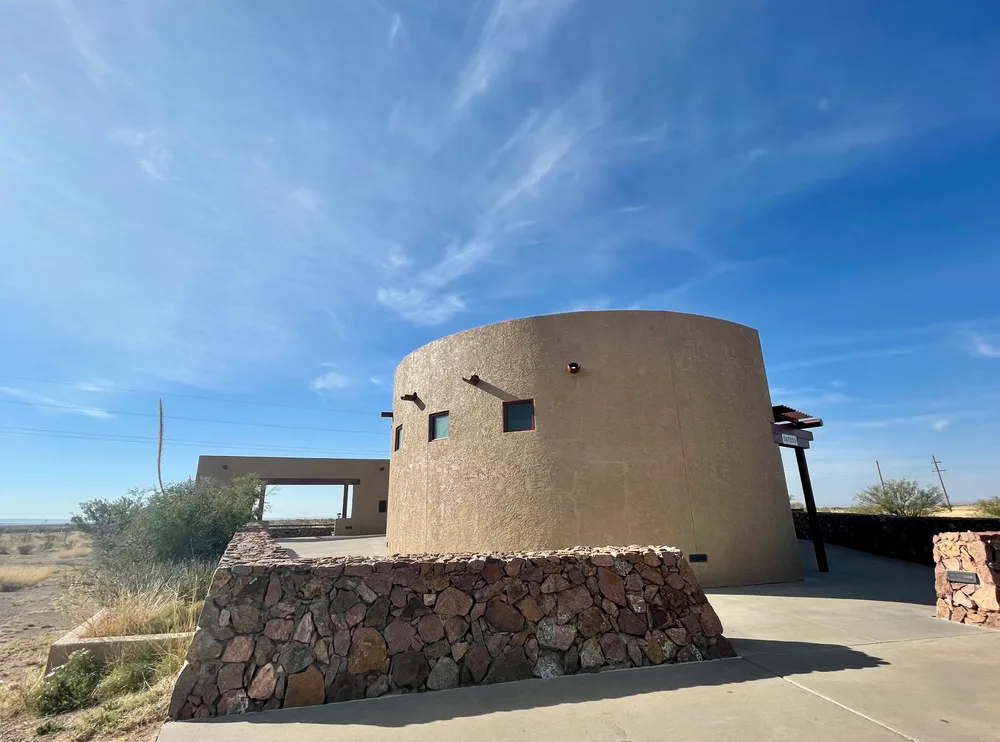
The Marfa Lights viewing area by day in November 2021. The platform faces open desert, which makes distant light sources impossible to judge by eye. Photo by Allison Meier via Wikimedia Commons, CC BY 2.0; resized and converted to WebP.
What is still unexplained
The headlight explanation is solid for what tourists usually see. It does not cover everything that has been reported, and the researchers who did the most fieldwork say so themselves. A similar gap between a likely explanation and an unconfirmed remainder runs through the story of Overtoun Bridge in Scotland, where a scent theory fits most of the dog incidents but has not been proven.
James Bunnell, a retired aerospace engineer, set up automated camera stations outside Marfa in the early 2000s. Nautilus reported in 2014 that between 2000 and 2009 he had logged 60 lights he considered genuine over 31 nights, after discarding anything he could match to a known source. Wikipedia, citing his 2009 book, gives different figures from a different counting method. Either way, the important point is rarity: by his own account, the lights he cannot explain appear on only a handful of nights a year, and most visitors will never see one.
The 2011 paper by Stephan, Bunnell and two co-authors is titled as a set of “quantitative intensity and location measurements” of an “intense long-duration luminous object near Marfa.” We have read only its bibliographic record, not the full text, so we do not summarize its findings here.
Stephan told Vice that some reports describe lights moving backward, dancing or vanishing suddenly in ways that distorted headlights do not account for, and that Bunnell’s photographs show internal structure inconsistent with a car. He also gave a 2006 conference talk titled “What Marfa Lights Probably Aren’t”, which captures the method well: rule out the known causes first.
Speculation about the residue has gone in several directions:
- Bunnell’s hypothesis, as Nautilus reported, involves hydrogen plasma rising through fault zones.
- Stephan has suggested a possible link to earthquake lights, glows reported around some earthquakes. Nautilus notes that he acknowledged Marfa is seismically quiet and the data set is small.
- Older folk explanations include swamp gas, moonlight on mica, static electricity and the ghosts of Spanish conquistadors. The Handbook of Texas lists these alongside the mirage without endorsing them.
None of these has been demonstrated. The honest position is that a small number of recorded events lack a confirmed source, and the published work so far does not show what they are.
Lights, legends and a tourist economy
The lights became part of how Marfa presents itself. Nautilus reported that the viewing area was renovated with public money, and Vice put the cost of expanding the visitor centre at $720,000 in federal and state funds. Nautilus also repeats a rumour that James Dean watched for the lights while Giant (1956) was being filmed in the area. We found no documentation for it, and it should be read as local lore.
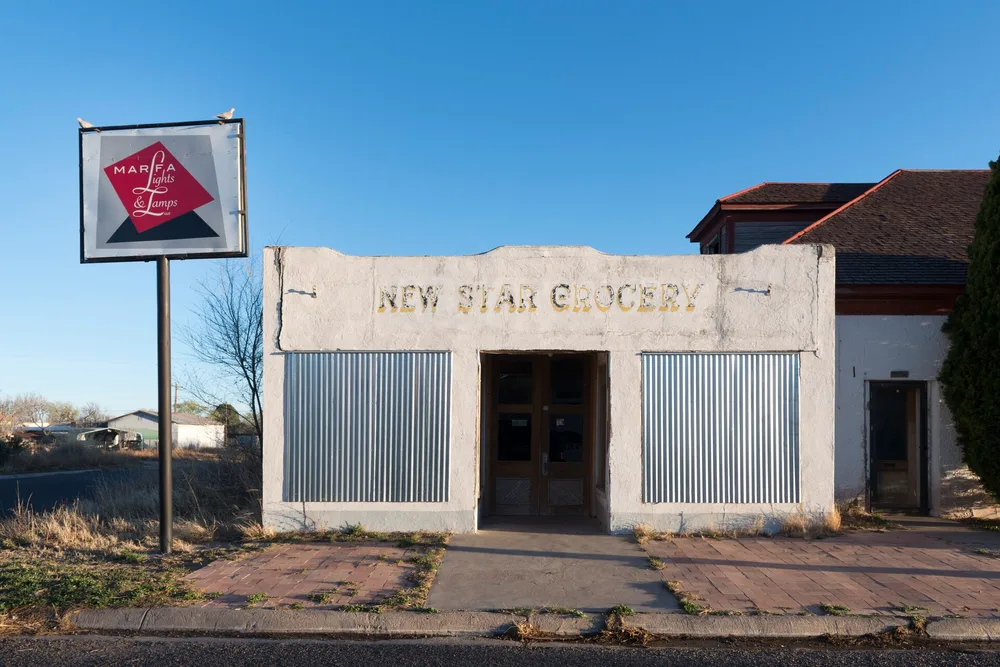
A former grocery in Marfa converted into a “Marfa Lights and Lamps” shop, photographed in March 2014 by Carol M. Highsmith. Lyda Hill Texas Collection, Library of Congress via Wikimedia Commons, public domain; resized and converted to WebP.
The same thing happened in Point Pleasant, West Virginia, where a statue, a museum and an annual festival keep the Mothman legend alive. Tourism and festivals are evidence of a story’s cultural strength. They are not evidence about its cause.
Strange lights in the sky have a long record of being read through whatever the culture expects. During the 1952 UFO wave, lights on radar and in the sky over Washington were taken for spacecraft. At Flatwoods the same year, what was probably a meteor became the opening scene of a monster encounter. At Marfa, the older vocabulary was campfires, invasion signals and ghosts.
What is documented, claimed and unresolved
| Claim | Status |
|---|---|
| Lights are regularly seen on the horizon from the viewing area east of Marfa | Documented |
| Most of those lights are vehicle headlights on U.S. 67 | Supported by two independent field studies |
| Atmospheric layering makes distant lights flicker, split and move | Well-supported explanation; consistent with the observations |
| Some sightings are streetlamps or small fires | Reported by the spectroscopy study |
| Robert Reed Ellison saw the lights in 1883 | Family tradition; absent from his 1937 memoirs |
| The lights were seen throughout the 19th century | Claimed in later retellings; no contemporary record cited |
| Pilots searched for the lights during the Second World War | Local account; no official record cited |
| A small number of recorded lights have no identified source | Reported by researchers; unresolved |
| Plasma, earthquake-light or other physical mechanisms | Hypotheses; not demonstrated |
| Ghosts, spirits or alien craft | Folklore and paranormal claims; no supporting evidence |
Frequently asked questions
What causes the Marfa lights?
Most of the lights seen from the viewing area are vehicle headlights on U.S. Highway 67, distorted by layers of warm and cool air over the desert. Student researchers in 2004 and a Texas State University team in 2008 reached that conclusion independently. Others have been traced to streetlamps or small fires.
Has anyone explained every Marfa light?
No. A few recorded sightings, mainly from James Bunnell’s camera stations, have not been matched to a known source. The researchers involved describe them as unexplained, not supernatural.
Did people really see the lights in 1883?
That is the traditional date, linked to cowhand Robert Reed Ellison. No written account from Ellison has been found, and his 1937 memoirs do not mention the lights. The earliest published article usually cited dates from 1957.
Where can you see the Marfa lights?
At the Marfa Mystery Lights Viewing Center on U.S. 90, about nine miles east of Marfa toward Alpine. Clear, calm nights are best, but sightings are not guaranteed.
Are the Marfa lights dangerous?
No harm from the lights has been documented. The main practical risk at night is the highway itself, so stay on the platform rather than walking along the road.
Sources & further reading
- Julia Cauble Smith, 'Marfa Lights', Handbook of Texas Online, Texas State Historical Association (published April 1, 1995; revised September 7, 2017; accessed November 3, 2026)
- Karl D. Stephan, Sagar Ghimire, William A. Stapleton and James Bunnell, 'Spectroscopy applied to observations of terrestrial light sources of uncertain origin', American Journal of Physics 77(8), 697-703 (August 2009), abstract (accessed November 3, 2026)
- Karl D. Stephan, James Bunnell, John Klier and Laurence Komala-Noor, 'Quantitative intensity and location measurements of an intense long-duration luminous object near Marfa, Texas', Journal of Atmospheric and Solar-Terrestrial Physics 73(13), 1953-1958 (2011); bibliographic record only
- Karl Stephan, 'What Marfa Lights Probably Aren't', 2006 Texas Section APS/AAPT/SPS Joint Spring Meeting, March 24, 2006 (meeting listing; accessed November 3, 2026)
- Brian Dunning, 'The Marfa Lights: A Real American Mystery', Skeptoid #38 (April 11, 2007; accessed November 3, 2026)
- Barry Popik, 'Marfa Lights', newspaper citations compiled at The Big Apple (June 19, 2008; accessed November 3, 2026)
- Azeen Ghorayshi, 'What Makes Mysterious Orbs Shine Over a West Texan Desert?', Nautilus (March 10, 2014; accessed November 3, 2026)
- Kaleigh Rogers, 'Scientists Can't Fully Explain These Strange Floating Lights in Texas', Vice (May 9, 2017; accessed November 3, 2026)
- Wikipedia, 'Marfa lights', used only for its citation of the 2004 student report (accessed November 3, 2026)