The Index / Haunted Places
Overtoun Bridge: What the Records Say About Scotland's 'Dog Suicide Bridge'
Why do dogs jump from Overtoun Bridge near Dumbarton? What the 1895 records, 2005 reports and the mink-scent theory show, and which claims are unverified.
Topics: Overtoun Bridge, Scotland, Dogs, Haunted places, Unexplained phenomena, Skepticism
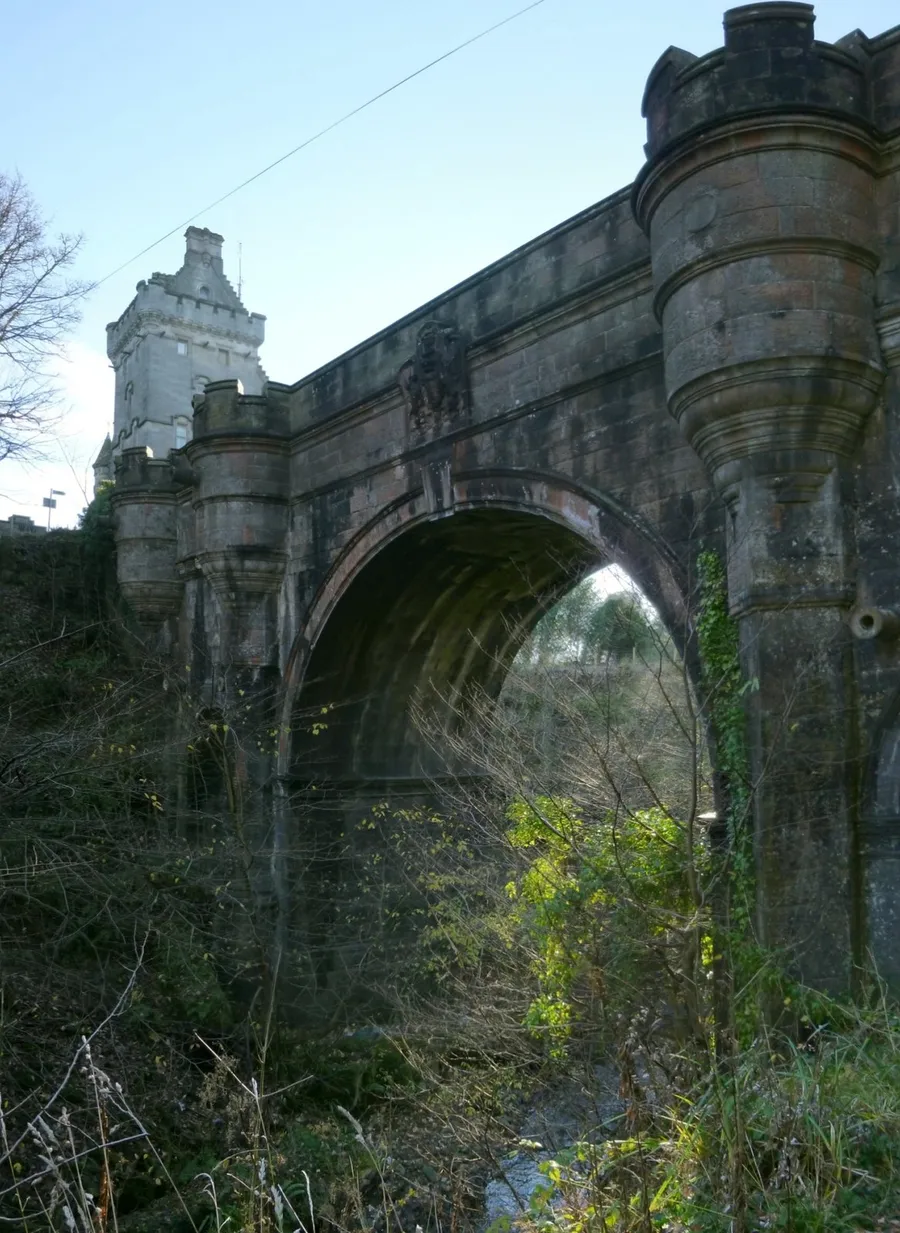
Lairich Rig / Geograph via Wikimedia Commons, CC BY-SA 2.0; resized and converted to WebP.
Overtoun Bridge is a Victorian stone bridge near Dumbarton, in West Dunbartonshire, Scotland, from which a number of dogs have jumped or fallen into the gorge below. The incidents are real: they were reported by animal-welfare officers in 2005 and by dog owners in later interviews. The famous totals are not. Figures of 50 dead dogs and 300 or 600 jumps come from local researchers and tabloid estimates, not from any published count. The best-supported explanation is ordinary: long-nosed dogs catch the scent of wild animals in the gorge, cannot see the drop behind a solid parapet and dense foliage, and go over the wall. Nobody has proved that explanation either. The ghost stories attached to the bridge are local belief and have no supporting evidence.
The short version
| Date | Event | Status |
|---|---|---|
| June 1893 | Lord Overtoun buys the Garshake estate and work on a new drive begins | Documented in the Historic Environment Scotland listing |
| June 1895 | Last stone of the bridge laid; the bridge is inscribed with a slightly different date | Documented; the listing cites the Lennox Herald of June 15, 1895 |
| 1908 | Lord Overtoun dies at Overtoun House | Documented |
| 1950s | Locals begin to notice dogs jumping from the bridge | Claimed in later press accounts; no contemporary record cited |
| January 1984 | Bridge listed as Category B | Documented |
| 1994 | A father throws his infant son from the bridge | Reported tragedy; see below |
| 2004 to 2005 | At least five dogs jump within six months; Scottish SPCA comments publicly | Reported by The Independent, March 2005 |
| 2005 or 2010 | Animal behaviourist David Sands investigates | Reported; sources give different years |
| 2019 | The New York Times interviews the tenant of Overtoun House and dog owners | Documented reporting |
The bridge and the man who built it
The structure is better documented than its reputation. Historic Environment Scotland’s listing record, reference LB24908, describes a bridge dated 1895 and designed by H. E. Milner of Westminster. It carries the drive to Overtoun House over the Overtoun Burn, with a large round central arch flanked by lower pedestrian arches. The stone is rough-faced ashlar. Triangular buttresses rise to round, corbelled refuges at parapet level, the turret-like features visible in most photographs. The bridge was listed as Category B on January 31, 1984.
The listing adds a small detail from the local paper. Citing the Lennox Herald of June 15, 1895, it says the last stone was laid on June 7, 1895, although the stone is inscribed June 5. Lord Overtoun had bought the neighbouring Garshake estate in June 1893, and work on the new drive started almost at once.
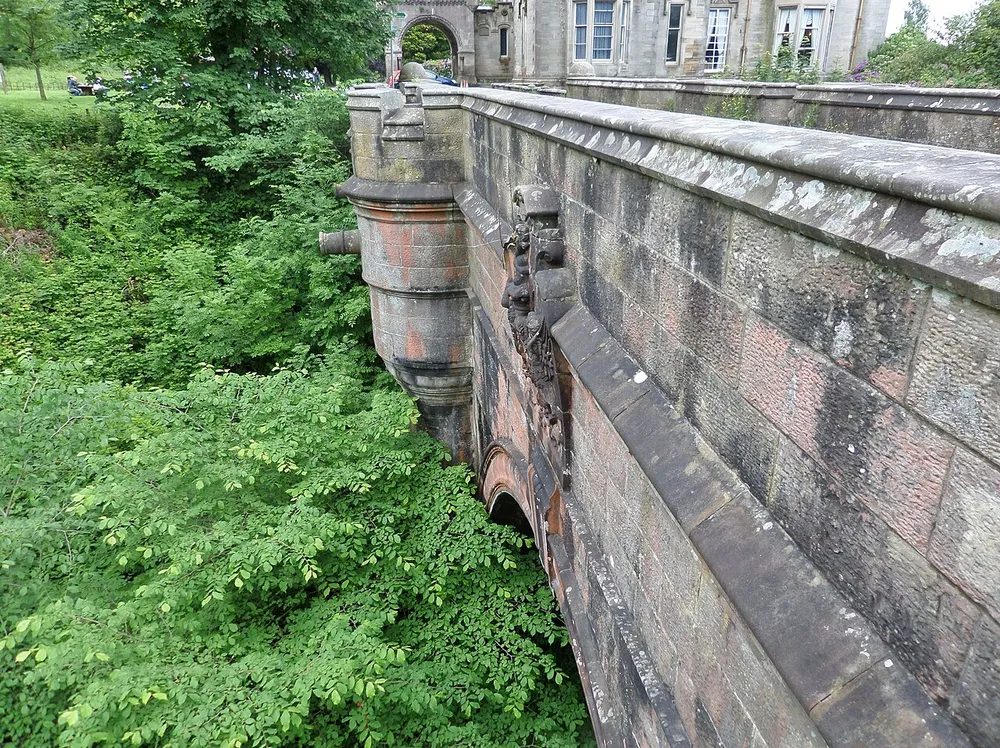
The upstream side of the bridge in June 2017. From the deck, foliage fills the gorge and hides the drop, a detail that matters to the scent-and-sight theory. Photo by Rosser1954 via Wikimedia Commons, CC BY-SA 4.0; resized and converted to WebP.
The builder was John Campbell White, first Baron Overtoun (1843 to 1908). His entry in the 1912 supplement to the Dictionary of National Biography describes him as a Scottish churchman and philanthropist, the only son of James White of Overtoun, a partner in the chemical firm of John and James White at Shawfield, near Rutherglen. His father bought the Overtoun estate in 1859. The son became principal partner, gave heavily to the Free Church of Scotland and to missions, and in 1893 was raised to the peerage on Gladstone’s recommendation, taking his title from the estate. He died at Overtoun.
There is a darker side to the family business, and it is documented history, not legend. According to the Wikipedia article on Lord Overtoun, which cites a 2005 historical study, the Labour politician Keir Hardie attacked conditions at the Shawfield chrome works in 1899 in a series of articles titled “White Slaves”. Workers there were exposed to toxic chromium dust. We have not read Hardie’s articles or that study, so this is a secondary account. It explains why the Overtoun name carried moral weight in Scotland long before any dog went over the parapet. It is not evidence of anything supernatural.
What was actually reported about the dogs
The earliest detailed press account we could retrieve appeared in The Independent in March 2005 and was republished by the New Zealand Herald. The reporter, Paul Kelbie, wrote that at least five dogs had thrown themselves from the bridge in the previous six months, and that locals had nicknamed it “rover’s leap”. In the most recent case, a woman had watched her dog jump about 40 feet to its death.
Doreen Graham of the Scottish Society for the Prevention of Cruelty to Animals told the paper that dogs do not commit suicide, because they have a strong fight-or-flight instinct. She suggested two possibilities: that the tree canopy created an optical illusion and confused the dogs’ sense of distance, or that a sound or smell people could not detect was drawing them over. Animal welfare experts quoted in the same report urged owners to keep dogs on a short lead near the bridge.
Later reporting added individual cases. The New York Times in 2019 interviewed a local woman whose Border collie had jumped about three years earlier and survived. The paper also spoke to Bob Hill, a pastor from Texas who had lived at Overtoun House for more than 17 years and runs a local centre for women in crisis. He said he and his wife had seen several dogs go over.
The numbers problem
Almost every article about Overtoun Bridge repeats a total. The totals do not agree, and none of them comes from a published count.
| Source | Figure | Where it comes from |
|---|---|---|
| The Independent, 2005 | At least five dogs in six months | Reported incidents at the time |
| Vice, 2018 | About 50 deaths since the 1950s, and about 600 dogs that jumped and survived | Not attributed to a named count |
| The New York Times, 2019 | More than 300 jumps according to local researchers, 600 according to tabloids, at least 50 deaths | Explicitly described as estimates |
Vice and the Times use the same headline figures in different ways. Vice reads 600 as the number of survivors. The Times reads it as the total number of jumps, and calls it the tabloid figure. Neither cites a log kept by a vet, a police force or an animal charity. The figure of five dogs in six months, reported while the incidents were fresh, is the most solid number available.
The repeated claim that the jumps began in the 1950s has the same weakness. It appears in Vice and the Times as something locals say. We found no record from the 1950s.
The explanations
Scent, sight and a solid wall
The explanation that comes up most often was developed by the animal behaviourist David Sands. Vice reports that Sands visited the bridge with a documentary crew in 2005; the Times dates his investigation to 2010. The two accounts agree on what he concluded. Sands ruled out the idea that dogs deliberately harm themselves. Vice says he dismissed sight as the trigger, because a dog on the deck cannot see over the parapet, and found no unusual sound.
What remained was smell. According to Vice, squirrels, mice and mink live in the gorge, and in a test with ten long-nosed dogs, seven went for mink scent over the others. The Times summarises Sands’s view as a combination: the scent of mammals below and a misleading view of the path, which appears to continue as solid ground when it actually becomes a bridge. A dog that leaps the parapet after a smell lands in a 50-foot gorge. Bob Hill gave the Times a similar explanation from what he had seen: scents of mink and pine martens excite the dogs, and the wall’s tapered top makes them topple over.
Vice adds two details that support the theory if they are accurate: the dogs that jump are long-nosed breeds, and they tend to jump from the same spot on clear days. We could not trace either claim to a recorded data set.
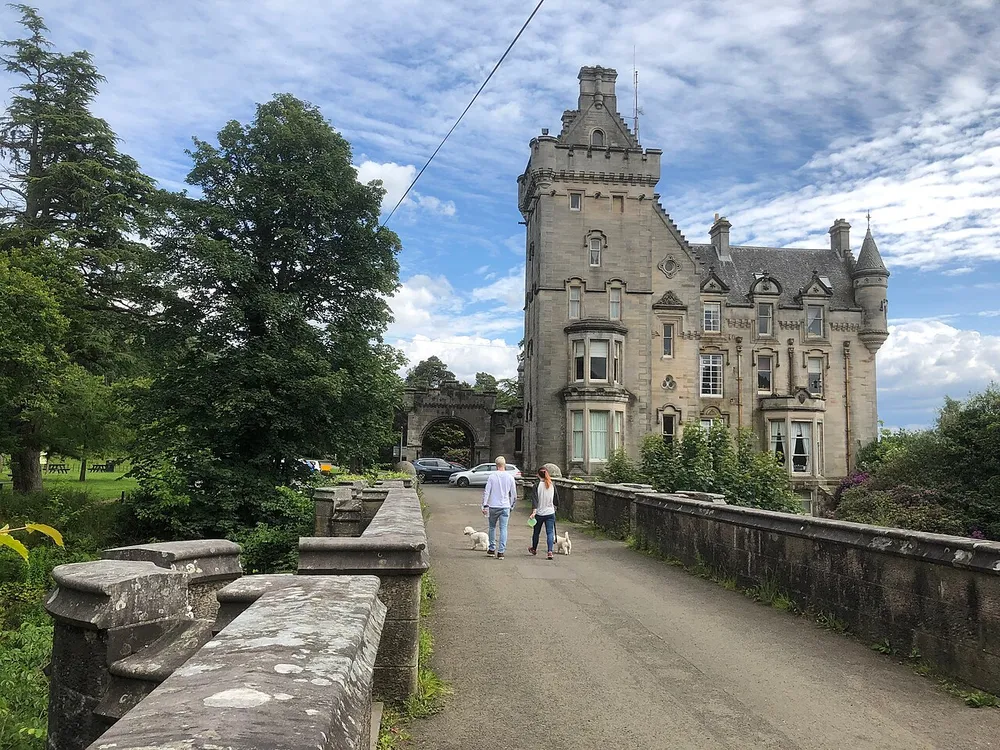
Walkers with dogs on the bridge in June 2019, looking toward Overtoun House. Photo by dave souza via Wikimedia Commons, CC BY-SA 4.0; resized and converted to WebP.
The theory has an obvious weak point, and residents raised it with the Times: mink and other wildlife live under many bridges in Britain, so why is this one different? A plausible answer is the structure itself. A high, solid parapet with no view of the drop, a deck that looks continuous with the surrounding ground, and a deep gorge filled with vegetation are a specific combination. That is a reasonable inference, not a tested finding.
Sound from the naval base
Vice describes an older idea that the Trident submarine base at Faslane, on the Gare Loch, emitted a frequency only animals could hear. Acoustic experts tested the bridge and found nothing unusual, and the theory was dropped. No source we read names the experts or gives a date.
Ghosts and “thin places”
The supernatural explanations are older in spirit than the dog stories. The Times reported that Paul Owens, a Glasgow religion and philosophy teacher who grew up nearby, spent 11 years researching the bridge, wrote a book about it, and believes a ghost is responsible. The same article mentions the local legend of a “White Lady”, identified with Lord Overtoun’s widow, who reportedly lived alone in grief for more than 30 years after his death, and describes the estate as fitting the Celtic idea of a “thin place” where the boundary with another world is weak. A local taxi driver told the paper that many residents believe in ghosts there.
These are beliefs and stories, reported as such. They do not explain the physical pattern of the incidents, and no evidence has been offered for them. Black dogs and death omens have a long history in British folklore, as with Black Shuck in East Anglia, and it is easy to see how a bridge where real dogs die attracts that kind of story.
A human tragedy that shaped the reputation
The bridge’s reputation is also tied to a real death. Vice reported that in 1994 a 32-year-old man threw his infant son from the bridge, believing the child was the Antichrist. The baby died in hospital the next day. The father was found not guilty of murder by reason of insanity and committed to Carstairs psychiatric hospital. Other accounts give slightly different details of the sequence of events, and we have not been able to read the original court reporting.
This was a crime driven by severe mental illness, and a child lost his life. It has nothing to do with the dogs, and it is not evidence of a curse. It does explain why some writers describe the bridge in such heavy terms, and why we have chosen not to name the people involved.
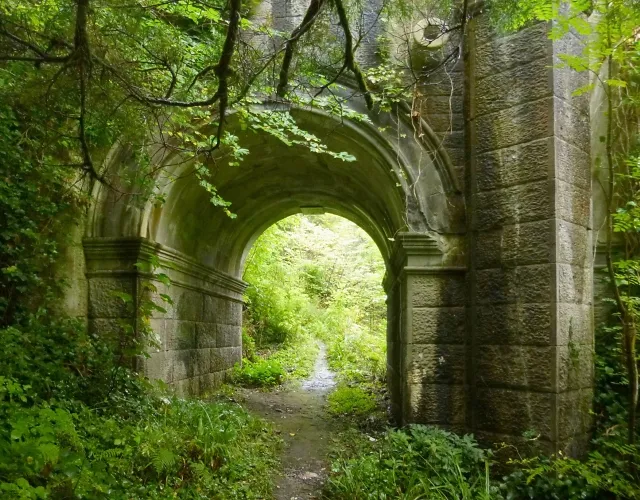
A footpath under one of the bridge’s smaller pedestrian arches, September 2013. Photo by Lairich Rig / Geograph via Wikimedia Commons, CC BY-SA 2.0; converted to WebP.
Claims we could not verify
Several details travel from article to article without a source we could check:
- An RSPB investigation. Some websites say the Royal Society for the Protection of Birds found mink and other nests on the side where dogs jump, sometimes naming a researcher. Wikipedia attributes this to the 2019 Times report, but the version we read does not mention it.
- A local hunter who said there were no mink. Also attributed to the Times by Wikipedia, and also absent from the version we read.
- A formal Scottish SPCA investigation with “inconclusive” findings. The SPCA did comment in 2005. We found no published report of an investigation.
- The breed and weather pattern. Long noses and clear days appear in Vice without a data source.
None of these is necessarily false. They are unconfirmed, and they should not be repeated as established fact. The same thing happens with other strange-light and animal stories: at Marfa, for example, a single family tradition became the accepted origin date through repetition.
What is documented, claimed and unresolved
| Claim | Status |
|---|---|
| The bridge was designed by H. E. Milner and completed in June 1895 | Documented in the listing record |
| It was built for Lord Overtoun, chemical manufacturer and philanthropist | Documented |
| Dogs have jumped or fallen from the bridge, some fatally | Documented in press reports from 2005 onward |
| At least five dogs jumped in about six months around 2004 and 2005 | Reported by The Independent |
| 50 dogs have died and 300 or 600 have jumped | Estimates; no published count |
| Jumps began in the 1950s | Local claim; no contemporary record |
| Mink and other animal scents lure dogs over the parapet | Best-supported hypothesis; not proven |
| Dogs cannot see the drop from the deck | Consistent with the structure and photographs; reported by Sands |
| Submarine sound causes the jumps | Tested and dropped, according to Vice |
| Dogs deliberately take their own lives | Rejected by the SPCA and by Sands |
| The bridge is haunted or a “thin place” | Folklore and personal belief; no supporting evidence |
| A father killed his infant son at the bridge in 1994 | Reported crime; court reporting not reviewed by us |
Like the Mothman sightings in Point Pleasant, the story is strongest where it is least specific. The structure, the dates and the family history are on record. The incidents are real but poorly counted. The paranormal layer has grown around them without adding evidence. For another Scottish case where an ordinary explanation competes with a much more famous legend, see the Flannan Isles lighthouse mystery.
Frequently asked questions
Why do dogs jump off Overtoun Bridge?
The most widely accepted explanation is that dogs smell mink, squirrels or other animals in the gorge and leap the parapet after the scent, without being able to see the 50-foot drop behind the wall and foliage. Animal behaviourist David Sands proposed this after visiting the bridge. It is a hypothesis, not a proven finding.
How many dogs have died at Overtoun Bridge?
Nobody knows. The commonly quoted figure of about 50 deaths, and totals of 300 or 600 jumps, are estimates from local researchers and tabloids. The best-documented figure is at least five dogs in about six months, reported in 2005.
Do dogs really commit suicide there?
No. The Scottish SPCA said in 2005 that dogs do not commit suicide, and Sands reached the same conclusion. “Dog suicide bridge” is a nickname, not a description of what happens.
Is Overtoun Bridge haunted?
Some locals and at least one author believe so, and the estate has a “White Lady” legend. These are beliefs and folklore. No evidence connects them to the dog incidents.
Can you visit Overtoun Bridge?
Yes. It carries the drive to Overtoun House near Milton, Dumbarton, and is a popular dog-walking route. Animal-welfare advice since 2005 has been to keep dogs on a lead on and near the bridge.
Sources & further reading
- Historic Environment Scotland, 'Overtoun House, Bridge at Garshake Drive over Overtoun Burn' (LB24908), listed building record, Category B, listed January 31, 1984 (accessed November 3, 2026)
- William Forbes Gray, 'White, John Campbell, first Baron Overtoun', Dictionary of National Biography, 1912 supplement, volume 3, via Wikisource (accessed November 3, 2026)
- Paul Kelbie, 'Spate of canine "suicides" from bridge baffles animal experts', The Independent, republished by the New Zealand Herald (March 4, 2005; accessed November 3, 2026)
- James McMahon, 'The Mystery of the Dog Suicide Bridge', Vice (April 24, 2018; accessed November 3, 2026)
- Ceylan Yeginsu, ''Dog suicide bridge': Why do so many pets keep leaping into a Scottish gorge?', The New York Times, republished by Boston.com (March 27, 2019; accessed November 3, 2026)
- Wikipedia, 'Overtoun Bridge', used only to trace where widely repeated claims originate (accessed November 3, 2026)
- Wikipedia, 'John White, 1st Baron Overtoun', used for its summary of the 1899 chrome-works controversy (accessed November 3, 2026)