The Index / Historical Mysteries
Are Rat Kings Real? What the Museum Specimens and the Science Show
Rat kings are real but rare. What the Altenburg and Tartu specimens, a 2007 study, a live 2021 find and two 1683 broadsheets show, and what is still unproven.
Topics: Rat king, Rats, Natural history, Germany, Estonia, Strasbourg, Omens, Museums
Yes, rat kings are real, but they are very rare, and most of what people say about them is either folklore or guesswork. A rat king is a group of rats whose tails have become so tangled or stuck together that the animals cannot pull apart. Preserved examples exist in museums, including a mummified cluster of 32 rats in Altenburg, Germany, and a group of 13 in alcohol at the University of Tartu in Estonia. Living rat kings were found and reported in Estonia in 2005 and 2021. What is not settled is how they form. The best-documented explanation, from a 2007 study of the Estonian finds, is that rats huddling in a cold nest get their tails glued or frozen together and then pull the knot tight while trying to separate. The old belief that a rat king was a monarch ruling other rats, or an omen of disaster, is folklore.
The short version
| Date | Find or event | Status |
|---|---|---|
| 1564 or 1610 | Earliest written mention of a rat king | Disputed: Wikipedia, citing a 1982 book, gives 1564; the Mauritianum museum gives 1610 |
| July 1683 | Six rats with knotted tails found in a cellar in Strasbourg | Documented in two printed sheets from the time |
| May 1828 | Miller in Buchheim, Thuringia, finds a mummified rat king while demolishing his hearth | Documented by the museum that has held it since May 26, 1828 |
| 1963 | Altenburg specimen removed from its case and counted: 32 rats | Documented by the museum |
| c. 1971 | 18 live rats found knotted inside a cowshed wall at Rõika, Estonia | Recollection of villagers, collected in 1986 |
| January 16, 2005 | 16 rats dug out of frozen sand in a shed at Saru, Estonia; about 9 alive | Documented in a peer-reviewed study |
| 2007 | Andrei Miljutin publishes “Rat kings in Estonia” | Documented |
| October 2021 | 13 live rats with knotted tails found at a poultry shed in Põlva county, Estonia | Reported by Estonian public broadcaster ERR |
What a rat king is, and what it is not
The German word is Rattenkönig, and the English and French terms (rat king, roi des rats) follow it. In the zoological sense the Mauritianum museum uses, a rat king is a group of rats whose tails are so entwined or knotted that the animals can no longer free themselves.
According to Miljutin’s 2007 paper, every rat king that had been studied was made up of black rats, Rattus rattus, apart from one find on Java that consisted of a related field rat. The number of animals ranged from three to 32. Most finds came from Germany, with others from France, Poland, the Netherlands, Belgium and Indonesia. Similar tangles have been reported in mice and squirrels, which Miljutin mentions in passing.
A rat king is not a single animal, not a new species and not something rats build on purpose. Nothing in the record suggests the knotted animals are “ruled” or fed by others as a court. Those ideas come from the name.
The Altenburg rat king: the largest specimen
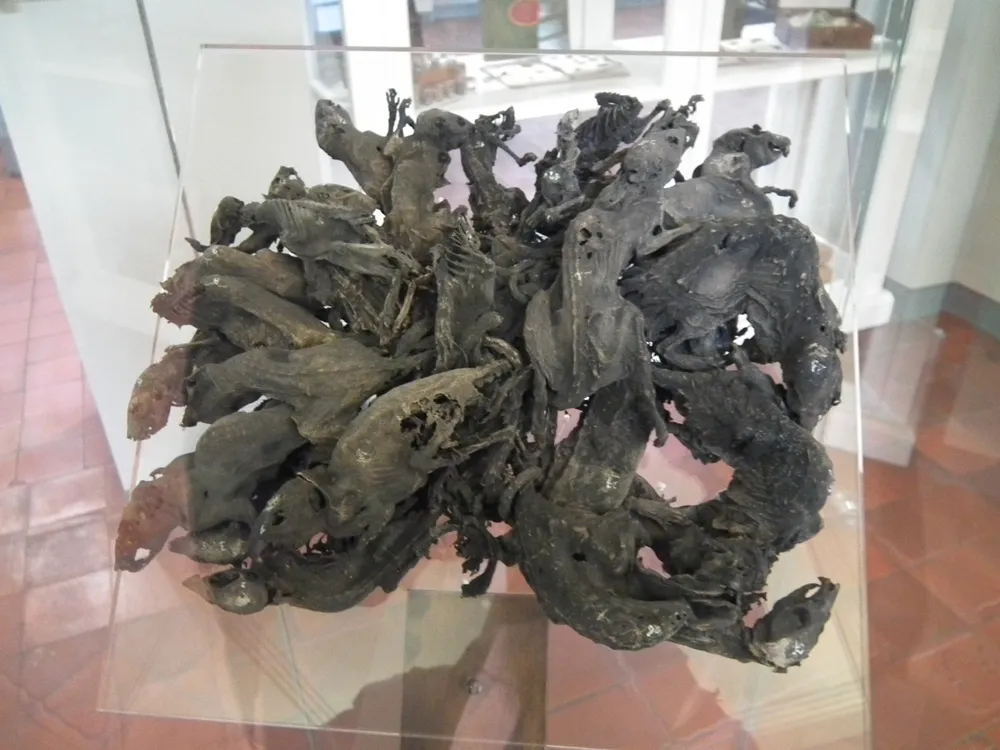
The best-known rat king is the one in this article’s main image. The Naturkundemuseum Mauritianum in Altenburg, Thuringia, gives its history in detail on its exhibition page.
In May 1828 a miller named Steinbrück, in Buchheim near Eisenberg, had the walls of his domestic hearth torn down and found a mummified rat king in the rubble. He gave it to the local natural history society, the Naturforschende Gesellschaft des Osterlandes, on May 26, 1828. The museum says the society received no further details about how it was found. It was shown in a sealed glass case and moved into the new museum building in Altenburg’s castle park when it opened in 1908.
The museum calls it the largest rat king in the world and the only one preserved as a mummy. Its animals are blackened with soot and have no fur. The museum identifies them from skull features as black rats.
A count that changed over time
The number of rats in the Altenburg specimen has not always been 32. The museum itself lists the drift:
- 1854: Melchior Schlenzig, in a book on mammals, described it as 27 fully grown rats.
- 1952: The science magazine Orion reported 30.
- 1963: The specimen was taken out of its case for the first time and the rats were counted and numbered. The total was 32. Of those, 27 can be clearly seen, and five are hidden or no longer complete.
That history matters beyond Altenburg. Older reports of rat kings were often made by people looking at a tangle from outside, so the numbers in early accounts should be read as estimates.
What the museum infers
The museum points out that the rats’ claws are very sharp and unworn. From that it concludes the animals must have been knotted together, unable to move about, for some time. It then raises the obvious question of what they ate, and answers with a guess, marked as such: probably scraps left in the nest by rats that could still move. Rat kings found between the floors of mills or granaries, it adds, could have eaten grain trickling through the boards. The claws are an observation. The feeding is a hypothesis.
The Estonian finds and the 2007 study
The most useful single source on rat kings is a five-page paper by Andrei Miljutin of the University of Tartu Natural History Museum, published in 2007 in the Proceedings of the Estonian Academy of Sciences. It describes a modern find in detail and uses it to test the competing explanations.
Saru, January 2005
According to the paper, on January 16, 2005, a farmer, Rein Kõiv, found a huddle of squeaking rats on the sandy floor of his shed in Saru village, in Võru county. The animals could not escape, and the farmer’s son killed them with a stick. A cluster of 16 rats was then dug out of the frozen sand. Their tails were tangled in a knot that had frozen sand in it. Miljutin says only about nine were alive when they were found, and that the rats had apparently been trying to dig their way out of a narrow tunnel.
The farmer had never heard of a rat king. He put the rats on a pile of planks for neighbours to look at. About two months later a relative who worked as a local reporter saw them and contacted zoologists, and the find was covered widely in Estonia. On March 10, 2005, the cluster went to the Tartu museum, where it was preserved in alcohol. Thirteen adult black rats remain, seven males and six females. One of the original 16 was thrown away by the finder and two were taken, probably by a polecat.
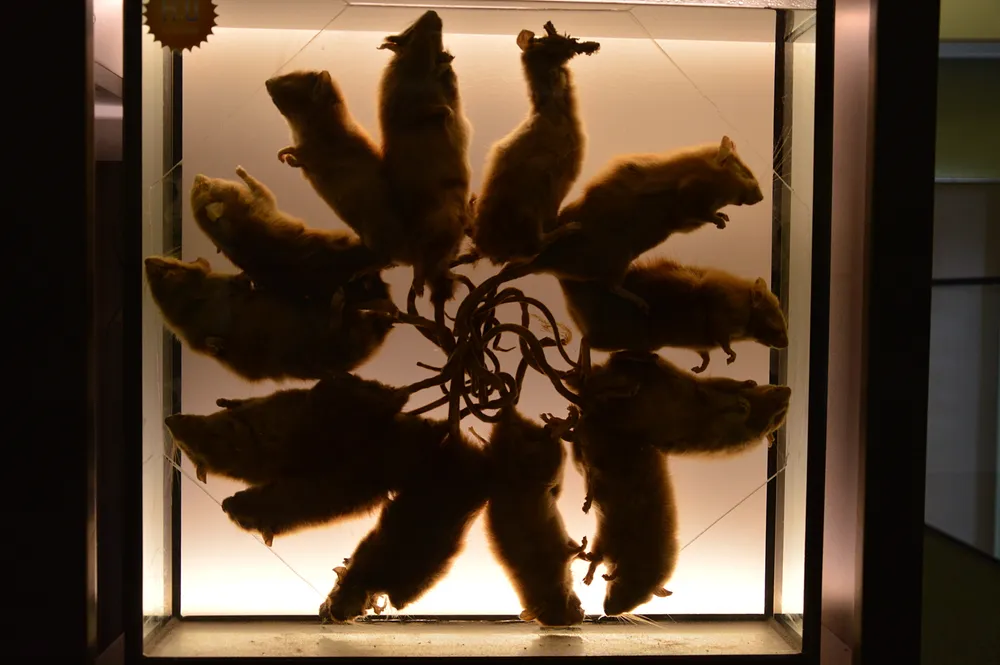
The Saru rat king of 2005 on display at the University of Tartu Natural History Museum. Photo by Ivo Kruusamägi via Wikimedia Commons, CC BY-SA 4.0; resized and converted to WebP.
Miljutin also recorded two older Estonian finds that survive only as memories. A small rat king of three was seen in Tartu around 1915 to 1920 by the father of a zoologist. At Rõika, in Viljandi county, villagers questioned in 1986 remembered 18 live rats found inside the wooden wall of a cowshed during an extremely cold winter “about 15 years ago”, which Miljutin tentatively dates to 1971. Those two finds are testimony, not specimens.
Three explanations, tested
Miljutin considered three explanations that he regarded as the most reasonable among those collected in earlier literature:
- Rat kings are made by people. He found no reason to suspect a hoax in the Estonian cases. The finders had never heard of rat kings, made no money from them, and he argues it is impossible to tie the tails of living rats without anaesthesia in farm conditions. The Saru finder also made no attempt to tighten the knot after the tails dried.
- Frightened rats grab each other with their tails. The Estonian rat kings formed inside shelters, a burrow and a wall, where rats should feel safe. Miljutin adds an observation of his own: he kept wild black rats in captivity for about eight years, disturbed hundreds of them daily, and never saw tails become entangled.
- The tails are glued or frozen together first. Rats huddle in the nest, especially in cold weather. If their tails stick together, through ice or a sticky substance such as blood, food or nest material, they pull in different directions on waking and tighten the knot. Even after the ice melts, they cannot get out.
Miljutin concluded that the Estonian finds support the third explanation. The Saru rat king was found after a sudden drop in temperature from above to below freezing, and both finds with known details formed in sheltered spots in frosty weather.
Why mostly Germany?
The paper’s second argument is geographic. Apart from the Java case, Miljutin says, rat kings turn up where two conditions meet: cold winters and black rats. Southern Europe has many black rats but mild winters. Northern Europe and Canada have hard winters but few or no black rats. Brown rats are common across northern Europe and North America but do not form rat kings, which Miljutin attributes to their shorter, thicker and less flexible tails.
This is an argument from distribution, not an experiment. It fits the freezing hypothesis well, but it also reflects where people were looking and writing. Miljutin makes that point himself: of the three Estonian finds, only one reached the media, and only because the farmer had a journalist in the family.
The live find of 2021
On October 20, 2021, ERR reported that a live rat king had arrived at the Tartu museum from a poultry outbuilding in Põlva county, in south-east Estonia. One of the finders, Johan Uibopuu, told ERR that his mother had opened the door in the morning to feed the birds and found the rats in front of it. In our translation, he said they had dug a tunnel right by the threshold and become stuck in it, and that it was hard to tell whether they were tied by their tails or glued to the bedding. Thirteen tails were knotted together.
Miljutin, quoted by ERR, described the same mechanism as in his paper: tails held together by a sticky substance can freeze together while rats sleep, and when the animals wake and move off in different directions, the knot tightens. He told ERR that nearly 60 rat kings had been found worldwide in almost 500 years, that the 2005 find had been the only one of the century as far as he and Wikipedia knew, and that this was at least the second. He estimated the knotted rats would have lived about a day.
In a 2025 National Geographic article, Miljutin described the 2021 tangle as looking like a large ball, because a mixture of clay soil, poultry manure, straw and feathers had worked its way into the knot. The magazine describes the 2021 rats as young animals of both sexes. In the same piece, the urban rodentologist Bobby Corrigan said of rat kings: “For sure, it is real, but it is rare.”
Strasbourg, 1683: a rat king as an omen
Before natural history explained them, rat kings were read as signs. Two printed sheets about the same find in Strasbourg in July 1683 show how.
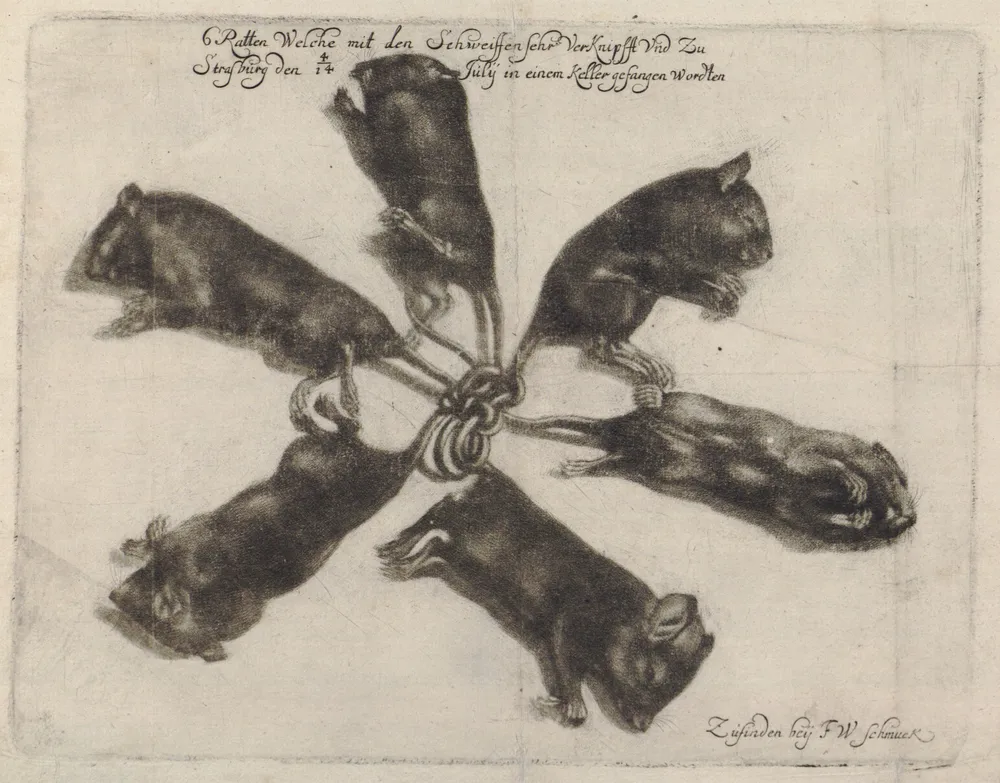
Engraving published by Friedrich Wilhelm Schmuck, about 1683: “6 rats whose tails were tightly knotted, caught in a cellar at Strasbourg on 4/14 July”. Universitätsbibliothek Erlangen-Nürnberg, public domain (PD-old-100) via Wikimedia Commons; resized and converted to WebP.
The first, sold by Friedrich Wilhelm Schmuck, is a simple picture with a caption. The second, a broadsheet held by the Bibliothèque nationale de France with the imprint of J. J. Felsecker, adds two columns of text. Its headline calls the find the “Scheusal eines entsetzlich- und ominösen Ratten-Ungeziefers”, roughly “the monstrosity of a horrible and ominous rat vermin”. The double date, 4 and 14 July, matches the ten-day gap between the old and new calendars then in use side by side in the region; that is our reading, not something the sheet explains.
From what we could read of the Fraktur text, the broadsheet says six notably large rats were found in the cellar of an Ammeister (a senior Strasbourg magistrate) named Würtz, with their tails so entangled and grown together that they could not be separated without injury, spread out “like a rose”. It says the sight drew many people and many wondering conjectures. The writer treats it as one of God’s “Schrecken-Boten”, heralds of terror, sent as a reminder of sin, and compares the rats to the poisonous schemes Christians hatch against one another. It also passes on a friend’s report that the rats were taken to be shown at the town hall, and that when people tried to kill them all, one escaped.
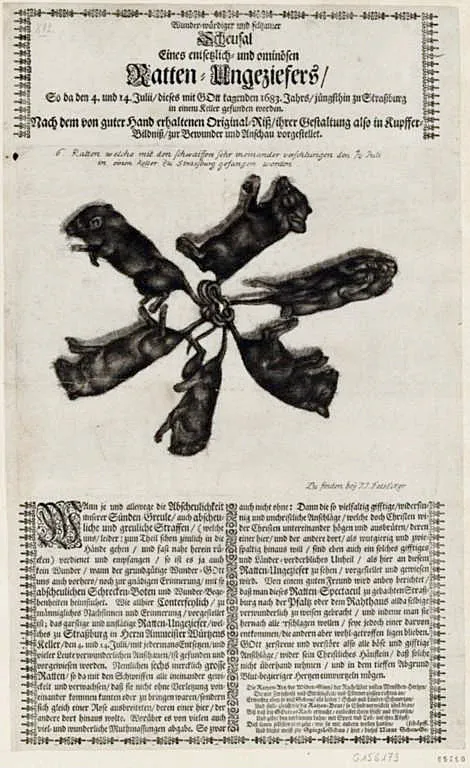
The Felsecker broadsheet of 1683, which presents the Strasbourg find as a warning from God. Bibliothèque nationale de France, public domain (PD-France) via Wikimedia Commons; converted to WebP at original size.
Read as evidence, the sheets show that a knotted group of six rats was found and displayed in Strasbourg in 1683, and that printers thought a picture of it was worth selling. The moral framing is the printer’s, not part of the observation. The 1656 plague-doctor prints are another example of a broadside picture that later readers took more literally than its makers did.
Where the folklore comes from
The Mauritianum’s page gives a short account of the legend. It says people once assumed any group of creatures acting together must have a ruler, so a pack of rats was given a king with a crown, sceptre and purple robe, and the tail knot became his throne. It adds that rat kings caused fear more often than admiration, and quotes Julius Wolff’s verse epic Der Rattenfänger von Hameln, in which Satan sits in the mayor’s cellar in the form of a giant ball of rats with a hundred heads and a thousand tails. That is a 19th-century literary image, not a record. It does show how easily the rat king attached itself to the story of the Pied Piper of Hamelin, whose earliest known version with rats dates from the 1560s.
Rats carry another heavy association. Their link to plague, which modern research has complicated rather than confirmed in its simple form, is covered in our guide to what caused the Black Death.
Were the old rat kings faked?
Some probably could have been. National Geographic reports that some experts have argued historical finds could have been hoaxes, without ruling out that the phenomenon happens naturally. Miljutin listed manufacture as a serious hypothesis. A specimen that dried out in a wall for years, like Altenburg’s, cannot prove on its own how its tails became tangled.
What changed the debate is the modern record. The Saru and Põlva rat kings were found alive by people with no knowledge of the phenomenon and no reason to fake it, and they were examined by a museum zoologist within weeks or days. That does not prove every historical rat king was genuine. It does show that the thing itself happens. As with the Mary Toft rabbit births, the useful question is not whether something sounds impossible, but who handled the evidence and when.
The numbers people repeat, and where they come from
Two figures circulate in nearly every article on rat kings: about 58 reliable finds before 2005, of which six were preserved. Both come from Miljutin’s paper, and Miljutin says he took them from Martin Hart’s 1982 book Rats and from Wikipedia. Wikipedia’s article now cites Miljutin. The figure is therefore partly circular, and it was never a census. Miljutin’s own conclusion is that the true number is higher, because many rat kings are never found, and finds reported only in local languages are missed by scientists elsewhere. He gives the example of a Lithuanian case published in Russian in 1961 that Hart did not know about.
The museums do not fully agree with each other either. The Mauritianum page says 31 German finds are clearly documented in the literature, that the smallest, of three rats, was found in Berlin in 1949, and that apart from Altenburg only Stuttgart, Göttingen and Hamburg hold rat kings, preserved in alcohol. That list leaves out the Tartu specimens and others reported elsewhere, so it is best read as a statement about German collections at the time the page was written.
The earliest mention is also disputed. Wikipedia, citing Hart, gives 1564. The Mauritianum gives 1610. Neither page names the original text, and we could not trace it, so we treat both dates as unconfirmed.
What is documented, claimed and unresolved
Documented
- Groups of black rats with knotted tails have been found and preserved, including the Altenburg mummy (32 rats, found 1828) and the Saru specimen (13 preserved of 16, found 2005).
- Live rat kings were found in Estonia in 2005 and 2021 and examined by the University of Tartu Natural History Museum.
- A knotted group of six rats was found in a Strasbourg cellar in July 1683 and depicted in at least two printed sheets.
Reported or remembered, not preserved
- The Tartu find of about 1915 to 1920 and the Rõika find of about 1971 rest on recollection.
- The overall count of about 58 to 60 historical finds rests on literature that has not been independently audited.
Theory
- That tails freeze or stick together in a cold nest and are then pulled into a knot. This is the best-supported explanation for the Estonian cases, not a proven mechanism for every rat king.
- That a reflex in black rats’ grasping tails helps start the tangle, which the Mauritianum proposes alongside sticky nest material.
- That the Altenburg rats survived for a time on scraps from free rats. The museum marks this as a supposition.
Folklore
- That a rat king rules other rats, is fed by them, or is an omen of plague or divine punishment.
Frequently asked questions
Are rat kings real?
Yes. Museum specimens exist, and live rat kings were found in Estonia in 2005 and 2021 by people who had never heard of the phenomenon. They are rare, and older reports should still be read with care.
How does a rat king form?
Nobody has watched one form. The best-supported explanation, from the 2007 study of the Estonian finds, is that rats huddled in a cold nest get their tails frozen or glued together with ice, dirt or other material, then pull the knot tight as they try to move apart. The Altenburg museum adds the black rat’s tendency to grip with its tail.
What is the largest rat king?
The mummified rat king in the Mauritianum in Altenburg, Germany, counted in 1963 at 32 rats. It was found in 1828 in Buchheim. Earlier accounts gave 27 and 30.
Can rats in a rat king survive?
Not for long without help, according to Miljutin. He told ERR in 2021 that the knotted rats he examined would have lived about a day. The Altenburg museum argues from unworn claws that its rats were stuck together for some time, which suggests survival is possible in a nest where food is within reach.
Why are rat kings usually black rats?
Black rats have longer, more flexible tails than brown rats. Miljutin argues that rat kings occur where black rats and cold winters overlap, which would explain why most finds come from Germany and neighbouring countries.
Is the rat king an evil omen?
That is folklore. A 1683 broadsheet from Strasbourg presented a rat king as a warning from God, and later stories gave the rat king a crown and a throne. Nothing in the natural history record supports either idea.
Sources & further reading
- Andrei Miljutin, 'Rat kings in Estonia', Proceedings of the Estonian Academy of Sciences, Biology, Ecology, 56 (1), 2007, pp. 77-81 (primary study; accessed November 4, 2026)
- Naturkundemuseum Mauritianum, Altenburg, 'Der Altenburger Rattenkönig', permanent exhibition page (archived April 29, 2023; accessed November 4, 2026)
- Lauraliis Süldre, 'Tartu Ülikooli loodusmuuseumi jõudis üliharuldane rotikuningas', ERR (October 20, 2021; Estonian, quotations translated by Morbid Index; accessed November 4, 2026)
- Jason Bittel, 'Rat kings might actually be real, but it's nothing to laugh about', National Geographic (August 5, 2025; accessed November 4, 2026)
- '6 Ratten welche mit den Schweiffen sehr verknüpft und zu Strasburg den 4./14. Julij in einem Keller gefangen worden', engraving published by Friedrich Wilhelm Schmuck, c. 1683, Universitätsbibliothek Erlangen-Nürnberg A IV 88x, via Wikimedia Commons (primary image; accessed November 4, 2026)
- 'Scheusal eines entsetzlich- und ominösen Ratten-Ungeziefers', broadsheet by J. J. Felsecker, 1683, Bibliothèque nationale de France (Gallica ark:/12148/btv1b8406359k), via Wikimedia Commons (primary text and image; accessed November 4, 2026)
- Wikipedia, 'Rat king', used only to trace where the 1564 date and the specimen list are cited from (accessed November 4, 2026)